Food as the new cultural touchstone

My wife came across an article that noted the primary cultural focus in 21st century America is fine food and wine. It’s what intelligent people discuss, even argue about, in casual conversation. And just look at all the writing focused on it today.

A related factor the article raised was that in modern history, in each century one nation has dominated in one art form rather than many. That’s had me thinking, even though I think America led on two fronts in the 2oth century.

Here are ten examples that spring to my mind.

  1. Painting and sculpture. 16th century Italian masters.
  2. Theater. 16th century England. Shakespeare is unrivaled.
  3. Painting. 17th century Dutch masters.
  4. Painting. 19th century France culminating in Impressionism.
  5. The symphony. 19th century Germany towering in Beethoven and Brahms. Do we think of Vienna as essentially German?
  6. The novel. 19th century England and America. Moby Dick and Huckleberry Finn may be flawed but they remain original masterworks.
  7. Opera. 19th century Italy. Verdi and Puccini remain the core of the repertoire.
  8. Ballet. 19th century Russia. Its great symphonists excelled here. And look where the great dancers and teachers still come from.
  9. Movies. 20th century America. (Shall we consider Hollywood as a nation unto itself?)
  10. Popular music. 20th century America as jazz and then rock evolve. (Note that this happens more in the eastern half of the country – New Orleans, Kansas City, Memphis, Cleveland, Nashville, but especially New York.)

I’ll leave it to others to look for the food trends over time. 

What else would you add to this list?

You can join in ‘Pit-a-Pat High Jinks’

Pit-a-pat is the sound of hands drumming as well as rain on the roof. Both fit my newest novel, which is being released today at Smashwords.com.

The book continues Cassia’s discoveries about her future father’s mysterious adventures before he meets her mother and settles down into marriage.

Here he heads for the hills after graduating from college, moving into a dilapidated farmhouse he shares with a dozen or so other young rebels and recluses. He goes back-to-the-earth with his housemates and their dogs and cats and chickens as well as their fields and abandoned orchard plus the surrounding ponds and forests. Nude swimming, anyone? Off they go.

He’s also coming to grips with his first full-time job, working as a photographer at the local small-town newspaper, where his bohemian ways don’t always fit well. Still, a job’s a job.

His life really perks up through eccentric new friendships around the campus in the valley, especially a young dreamer known as Drummer.

Sometimes it all resembles a three-ring circus.

In his heart, though, he’s looking for love – along with healing after being jettisoned by his college sweetheart. Running through Pit-a-Pat High Jinks is a series of lovers and passionate encounters that ultimately advance his erotic experience and understanding. Please note that the story can be rather graphic. (You will need to set the adults-only button to find it at Smashwords.) The tale is set, after all, in an era of free love and recreational substance exploration.

It’s a poignant and timeless mix of youthful escapades and mayhem.

Be among the first to read my newest novel.

What’s gonna be happenin’ here this year

Across town from this red barn, when I sit in the 250-year-old Quaker meetinghouse, the ancient Regulator clock ticks away. It irritates some worshipers and comforts others.

I know the timepiece wasn’t part of the original décor. Likely arrived a hundred or more years later. The classic Regulator, with its eight-day run on a single winding, came along with the railroads as one way of getting everyone on the same time to match the trains’ timetables. No more guessing, I guess. These days, our instrument gains about eight minutes a day. But it’s also on its last legs … or hands, ahem. The clock repairers have told us that much.

There’s something fitting about an old clock marking time now. Its heartbeat, so rooted in the past, has an air of eternity along with the flash of the passing present.

Hard as it is for me to believe, the Red Barn is entering its eighth year, and each one has been somewhat different. Last year, for instance, the focus shifted to my newly released novel, What’s Left, and some of that emphasis will continue through the year coming. That volume has become central to the series that originally proceeded it, and as a result of recent revisions, those books have now been thoroughly reworked to more fully embody the new perspectives.

As a result, we’ll also be reflecting the releases of two more of those novels this year, plus another thoroughly revised tale involving yoga.

With these publications, I’m feeling the satisfaction of having accomplished a standard I long believed was within my reach. I hope readers will feel similar pleasure in their pages.

~*~

Jnana’s Red Barn is the flagship of my related WordPress blogs, which are also gearing up for the new year.

Thistle/Flinch, my personal small-press operation, will keep the name in its address even as the imprint itself goes to the originally planned Thistle/Finch moniker, after the golden songbird – just for the L of it, as a punster might say. (It might be confusing, I know, but it beats changing the URL altogether.)

Its pace of releases will step up to one a week, including photo albums and printable broadsides.

The new direction will also reissue many of the earlier collections in much shortened, easier-to-handle formats. A full-length collection may be great when you’re buying a paper edition, but it’s just too clumsy, I think, in a PDF file.

Chicken Farmer I Still Love You, meanwhile, will be recasting its Talking Money series, this time keeping each post short, sweet, and more tightly focused for individual reflection. These useful exercises in addressing personal finances are timeless, ready for a new generation to apply their wisdom.

As Light Is Sown will also be in an encore mode as it repeats its Daybook of inspiration that originally ran in 2014.

Take a look at them all!

I hope they add pleasure and value to your new year.

THIS MATTER OF BRANDING AND SHAMELESS SELF-PROMOTION

The Mixmaster is back.

When my first novel was published, back in 1990, I was described as “a mixmaster of ideas, images, jokes, philosophy, and nonsense that defies categorization” – as well as “very eclectic and ebullient.”

I’m realizing how much that still fits, and so I’m returning to it as a core of what some might call branding.

As one longtime friend recently described me, I’m “an eclectic human being with a funky sense of humor and a large perspective.”

That’s what I like to do as a writer and thinker – toss a wide range of colorful things together and concoct fresh and exciting connections.

So if that’s what I do and, as I hope, do well, that leads to a new label: Mixmaster Supreme.

Now, where are the frozen strawberries?

Remember, the drink is shaken, not stirred. As for the emotions? Let’s go for both. 

LIVING IN MULBERRY ROW

As writers, most of us start with particulars we’ve known and try our best to abstract them – that is, make them more universal.

The dorm quad I now call Mulberry Row in my novel Daffodil Uprising is loosely based on one where I lived, though there was none of the clandestine financial intrigue I create to symbolize the old-boy network and its manipulative contortions. No, when I lived there, it was all simply a tad dowdy.

The dining hall, too, was far from the gloriously remodeled Annenberg Hall in Harvard’s great Memorial Hall – everyone who peeks in seems to utter something about Hogwarts – but it had its own low-key potential.

When I drafted the earlier novel, I had no idea what was about to happen in reality. The quad has since been renovated and refocused. From this distance, it all looks pretty exciting, actually.

I’ll assume the fictional benefactor Mildred Chouthonian would be proud.

My room was at the corner of the building at the right, in the center of this photo.


The dining hall looks much more modest all these years later, but it’s definitely been spiffed up.

ONE WAY TO NAME A CHARACTER

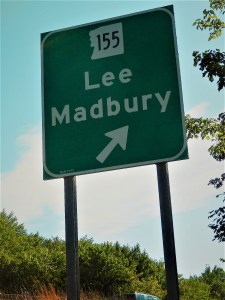
Those highway signs can often take on whimsical readings.

One poetry journal, for instance, took its name from an exit marker of the Interstate crossing from Pennsylvania into Maryland: Northwest Rising Sun. It was for two different towns. Everybody knows the sun rises in the east, not the west. Still, a great name. It pays to be alert.

Likewise, orchestral conductor David Zinman was recording with humorist P.D.Q. Bach (in real life, Peter Schickele) but found his contract with another label prohibited him from using his own name on this project. What could he use instead? Inspiration struck when he was driving on Route 128 outside Boston. That exit sign read Newton Wayland.

More recently, while updating and seriously revising my previously published novels, I set about renaming many of the characters for a better fit.

I’ve passed this sign hundreds of times and often thought it sounded great as a possible character, if only I had the right situation. And then, as I reworked the volume that now stands as Daffodil Uprising, I had the perfect guy to go by the name: LEE MADBURY.

The sign along U.S. Route 4.


TIME TO BLOW THE DUST OFF A FEW STACKS

As my wife and I started listing what’s keeping us busy these days, we were both surprised to find that one thing – one important thing – was missing.

What we both realized is that regular reading … as in books … had been pressed out of our schedules.

Instead, we’ve been doing bits and pieces of reading online. It’s just not the same as luxuriating in a deep volume.

How about you?

REWORKING A TEXT

When several of our lifeguards were complaining about their high-school term papers and having to meet the length requirements, I decided to show them a couple pages of my novel in progress, the book that’s emerged as What’s Left.

They were blown away.

It wasn’t any different from what I’ll assume all serious writers do. Just look at the examples in the Paris Review’s acclaimed author interviews. I remember my own shock at the first few I saw – what, we don’t write flawlessly the first time? Oh, the folly of youth!

Well, nowadays we don’t always work from typescript or even printouts – what I showed the teens-to-whom-I-fully-trusted-my-life had now become the exception. I should have photographed some for posterity but instead trashed them during a purging of my studio under the rafters.

Few readers imagine how thoroughly a serious writer or editor will rework a text – major sentences, even paragraphs, are struck out, new words and notes are scribbled everywhere, even fresh pages of inserts are taped to one side or the other of the page.

Tell them this is from the fifth or seventh revision of the manuscript, they’re even more incredulous. The discarded material is a flood compared to the drop or two they struggle to compose.

As the saying goes, inspiration goes in the first draft, genius comes in the revisions.

As we might add, if one’s lucky.

TEN WAYS THIS ‘DAFFODIL’ IS NEW

My newest novel, Daffodil Uprising, is a thorough revision of the earlier Daffodil Sunrise. Nearly half of the original book has been excised and replaced by twice that amount of new material, for good reason.

Here are ten of the big differences.

  1. The events and characters are now seen through the eyes and snarky voice of Kenzie’s daughter a generation later. They are Cassia’s discoveries about her father’s college years in the turbulent 1960s, pro and con.
  2. As the subtitle says, the focus is on the making of a hippie. The college and its good-old-boy network of abusive power and greed earn much of the blame.
  3. Kenzie’s growth as a budding photographer gets fuller attention, along with his artistic advances. It’s his basic reason for coming to Daffodil, after all.
  4. His girlfriend is a much more complex and troubled creature. She has good cause to be chafing in her relationship with him. And he, in contrast, is so truly naïve. Something’s got to give.
  5. Most of the characters have been renamed and are more uniquely defined. They and their actions have new grounding in everyday life.
  6. Kenzie’s buddies are no longer a pack of emerging radicals in action but rather a lineup of widely varied boyz stumbling along in a confounding environment. His dorm’s underground traditions are handed down through a band of quirky seniors and juniors who serve as wise elders and guides to neophyte freshmen like Kenzie. It’s a colorful crew – one that teaches him as much or more than his professors, in fact.
  7. The narrative’s giddy, upbeat, and sometimes sophomoric youthful optimism is now countered by darker forces of oppressive greed, violence, and despair. Bad drug trips and protest bombings accompany the scene.
  8. There’s now an element of Goth. This is a college campus, after all. Why should Hogwarts be all that different?
  9. There’s also a strand of the paranormal. You ever live in a creepy old apartment building or have the subject of a term paper start talking back to you?
  10. The work now stands in fuller correlation with What’s Left, a generation later, and the two other novels that follow him after college.
Daffodil Uprising

For details, go to Smashwords.com.