Summer almost gone, haven’t really been to the mountains this year — is it Kitty (together only on the weekends, and thus me reluctant to take off without her?) or the fact I’m working so long and hard I just want to collapse on my time off, making hiking/camping/travel too much (circuit overload) or that my days off now coincide with everyone else’s meaning the mountains are crowded? I wish I knew for sure. Or even so much rain in the mountains on weekends, each one at least cloudy?
But this has been a good summer of reading, novels, mostly.
~*~
Somehow, every time I suggested we head off into the mountains, her answer was, “What for?” meaning no interest on her part. It always put me in a bind.
As she said on Tuesday: “Hope today was better than yesterday.”
“Jesus, did it!”
“Well, cheer up. I just checked your horoscope and Wednesday, Thursday, and Friday will be as bad as Monday.”
And were they!
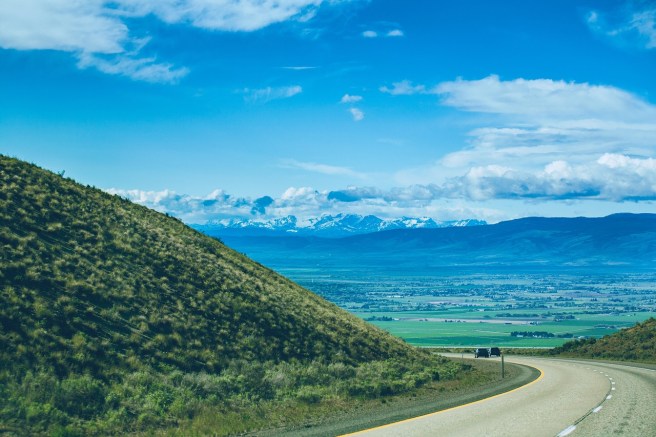
While the Canyon Highway was slightly shorter, the alternative route between Yakima and Ellensburg (and on to Seattle), Interstate 82, took a higher elevation course to the east but was faster though less dramatic as it ran through largely sagebrush barrens. Still, returning to the valley on either end felt like landing in the cockpit of an airplane, especially after dark when layer after layer of dazzling arrays of civilization lights unfolded. Sorry I haven’t found images of that, though I’m sure nothing could match what I remember.
~*~
Pixaby image. The ground along the interstate was seldom this green (the photo was likely taken at the prime of spring). The green in the Kittitas Valley below was irrigated hayfields and orchards, mostly. Forests on the ridge in the distance grew far enough up the slope to be sustained by lingering snow and wet clouds.
Kitty called me at work to tell me she had found a new apartment for the upcoming semester.
“Expensive,” said she.
“How expensive?”
“$110 a month, with utilities. But at least I won’t be embarrassed to have you over.” Adding, “Since you like my friends, you may want to spend some weekends up here.”
And, for once, we talked about Mark. [Or was it Michael?]
“Well, maybe the new place will help you keep out of trouble.”
“That’s over, anyway. Don’t worry.”
“You sure?”
“Yeah, I don’t want to get a situation that brings me down, and he only brought me down.”
“You realize this is the most we’ve ever talked about that?”
“I know, Jnana. I love you.”
“I love you, too. That’s about the first time in eight months I’ve told you that.”
“I know, but I mean it. I sure enjoyed your visit Sunday.”
“Me, too.”
7:IX
Jupiter entered Leo on Wednesday, “personal relationships will be much improved.” Also, “You will meet very interesting new people and find success working with a partner.” Also, tomorrow, “Venus enters Scorpio, where it will remain the rest of the year. This is your Business House and indicates that your relationship with business associates will go smoothly. You may receive favors from influential people.”
But Saturday? “You may spend the day with a group or organization, but do not get along with the group’s leader. You resent people’s telling you what to do.” Huh, the UPI meeting?
And Sunday, when our Friends circle resumes: “Mercury enters Virgo, your eighth house. Your mind is once again focused on hidden or spiritual matters. You are eager to explore occult ideas.”
~*~
Journaling 11 September, [Monday] Port Townsend again, first day out on vacation. Half-moon.
[Note that the UPI trip took a day out of my vacation] …
~*~
15 Sept / Friday (wait, a full Friday off?)
What a lazy, wasted day!
Tonight, watch the Ali-Spinks rematch. [Was it with anybody else?]
Apples picked and gone once again / circles, circles with a bullseye wide as the universe
~*~
1 Oct / First-day, after Mtg
in the morning like, Adams and Rainier as corral pink as the conch shell vulva
my only tranquil moment within a long day
mushroom growing in our shower stall
11:XI
Hit with my annual flu-symptoms
2:XII
Kitty wondering why people don’t like her.
Call at the office from a friend from high school Her husband has taken a pastorate in Grandview, moving up from California.
Unbelievable pain, certain Kitty was gonna leave me at last … [early the previous week]
Bodeen phoned, trying to find out over the telephone whether his paste-ups were straight — so I met him at last and am pleased by the poems for the first edition and the way they’re set
Allen McFee on CBC: “And may angels guard your rest” … signing off for the night
Kitty came home on Wednesday as a surprise, took me to Gasperetti’s for dinner with Whiz and Wisteria — his announcing he’s buying a ’77 Porsche ($8,500), trading in the Honda …
Fine Oregon wine: Tualatin, meaning “gentle” or easy, flowing, Vineyards, a white Riesling bottled at Forest Grove …
~*~
30:II
My wife in the process of leaving me: I feel so burdened and so seldom dwell in the realm of spontaneous delight …
In Seattle for the weekend (with Celeste), so was Kitty, in another place. My realization that Celeste doesn’t fulfill me, and there’s some other reason we cannot conjoin — “You’re body shows you’re still confused” …
Spider crab, rock crab, Dungeness crab — Vashon Island, near midnight — the crabs beside starfish (headlight into the water) … boil them, eat at 2 a.m. … Brian / Paul & Judy — Marj stayed home in her robes
A seal that follows Brian fishing …
~*~
26 feb — a long week
Bought LPs in Seattle: Bolet plays Liszt, Eileen Farrell and Max Rudolf, Janacek Sinfonietta (DGG) …
On my drive home, no Kitty in E’burg apartment or her studio nor in Wapato. Learned later we had crossed between E’burg sites, had I stopped at her apartment, would have found her note; instead, not seeing her car when I drove past, I assumed she wasn’t home …
Tuesday, after a hard day at work, an icy bummer phone call from her, her hatred brewing. (Long-distance.) TV mag and farm tab, too, on my end.
Wednesday, Kent told me I had the job but not to tell anyone else yet. Worked OT, elated but still down over Kitty. Went to bed early but couldn’t sleep, watched Georg Solti conduct R. Strauss on PBS …
Thursday, talked to Kitty, told her I’d be up and take her to dinner Friday but then Kent told me we’d be taking our new deskman interviewee to dinner [instead] … went to hear David Wagner read at YVC — older than I expected, white hair … enjoyable reading, though to my ear, flawed: still too prose-like, very little magic. Despite his denials, he remains Midwestern Scots-Presbyterian. He should have gotten lost in Yellowwood Forest, Indiana, rather than by Hoh logging roads (30 minutes, he supposes) … afterwords, with Bodeen and Grimes over three pitchers at Ole’s Tavern (nudes on bathroom walls) … home after midnight …
Half-drunk, drove to E’burg and sleep.
Saturday, breakfast at Adeline’s and then off to art building …
Tender talk, realizing her need to grow yet keeping the marriage alive … off to animal shelter, found a black cat (female, seven months?) … PennZoil — saw a bald eagle sitting in a tree near the Interstate in Selah … parked and watched it … week before I had watched a great blue heron land atop a Doug fir …
Sunday, a lazy morning … made love, showered twice …
The porch, wrapped in clear plastic … the crates of books, her plaster casts for a sculpture, stones collected here and there (turquoise, too), feathers, roped-up shelves, glass canning jars, Grandpa’s sleigh bells, her fabric above the door like a banner, the copper-fish scales she wove.
I dreamed of an art show she’d mount.
~*~
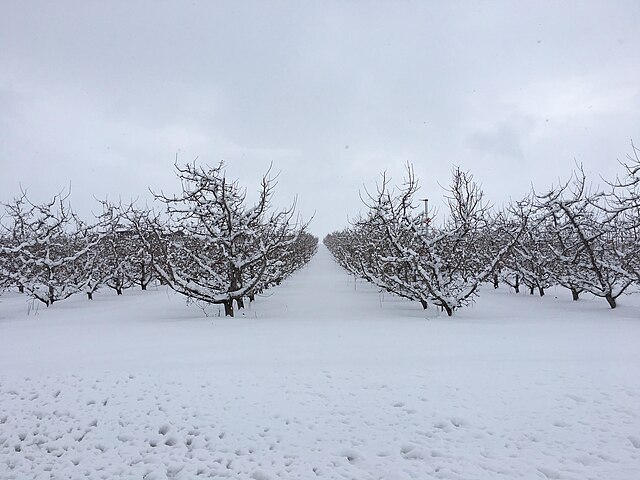
Apple trees in winter … Steve Groom photo via Wikimedia Commons.
~*~
9 march
Irrepressible sadness, knowledge of losing Kitty — all of her virtues and comforts I love so well, as if I’m suddenly quite old …
Mon-tue nights, I finished part 3 of the poem but can’t get the last section moving … perhaps I should split it …
The red buds on the elm are ready to burst … Belzer with his tractor applying dormant spray …
28 March .. apricots have exploded and petals litter the ground …
Last Thursday no water in the shack … Ivar broke the vein while installing new irrigation line …
Sunday, back from fragrant Seattle … Celeste perturbed by my not being more political — i.e., the Trident demonstrations and her upcoming trial … my necessity for professional neutrality versus moral responsibility … people let evil happen because of their failure to take a stand …
On way back find a note in E’burg, “I’m in Wapato,” and then Kitty in the orchard perturbed by her parents — she had phoned to wish them a happy Easter but let slip she’d gone to Canada, Victoria, with Mark but not by name … and they insisted she not return to school this term … Jeanice ready to fly out the next day. I had to call back, talk her out of it. Then Sam called last night, followed by Vince at 1 a.m. in my deepest of deep sleeps. “Guess who this is.” Moon? Gil? “Your best man.” So he could grill his sister just after he had lost GOP caucus for Wood County prosecutor.
Her dad insisted she not commute and she vacate her apartment. The past two days, a complete stranger to me. Yet if she returned to campus, she could not resist Mark’s invitation for her to move in with him next summer, wherever he establishes his studio nor another’s desire to take her to France this fall …
There are moments I’m ready to throw her out and yet others when I’m taken by how exquisite, soft, sensitive, psychic and nearly perfect she is and how foolish destruction would be …
Before her school vacation, she showed up at the Bushwhacker during our lunch, somehow icy brilliant “cool,” and Whiz observed her cruel side: “What right does she have to come just barging into your life like that?” … with my attempt to curb my emotions after I’d just about staunched the pain … so it would start anew when she’d gone again … she expected me to be angry with her, not kind … and she stayed until Monday, rather than living on the previous Friday morning …
My mother-in-law: You two are more important than college …
Kitty: What rights do I have!
Tomorrow, we go to the Buddhist church for the annual beef sukiyaki dinner.
~*~
6 apr
Letter from Mom noting that Rev. Joel and Sharon had split: she’s remarried, but he has the kids.
Rain in the Valley, snow in the hills …
~*~
Tuesday, 11 April 78
Full doctor’s exam today — Dr. P.H., about my age, younger than I’d thought — an English major at Wooster with Spanish, French, German studies. New practice, no one there but me, an hour and a half ($31 plus $31 lab fee, blood tests) … great relief to know all’s OK. Hearing, blood (cholesterol 190 on an acceptable scale of 150-290). Only blood element out of kilter relates to allergy reaction. No diabetes, eyes still good. Blood pressure 80 over 130. Feel like a stud again. (Only danger is all that coffee.)
~*~
15:IV
Ivar’s frost worries …
Kitty keeps asking what I’m thinking, my answers never satisfy. She wants to be “free” but with me as a friend or lover. Can’t understand why I don’t just up and quit my job, go off to Alaska or New York …
Already cutting asparagus ….
Phyllis phoned, “Wanna go to a concert,” Philadelphia String Quartet (of Seattle) … hold their bows funny — rich, velvety, but no brilliance: not hot in Haydn but great effect in Debussy …
~*~
24 apr
Kitty phoned me at the office Tuesday, she’s vacating her apartment, wanted me to drive up after work but I got mad, partly wondering where everything would go, she destroyed her tree sculpture … back in our place, crowded but cozy … boxes still to uncrate [top of the barn] …
~*~
6 May, Seattle
Kitty flying off to Ohio, Bloomington, and Chicago …
We never see Sea-Tac airport from I-5, which runs under the plateau
~*~
8:V
So mean when I called Sunday night … won’t let me say how much I miss her or love her, tells me to get a girlfriend …
Already the hills turn brown, yellow flowers in Union Gap are gone
The uncommon depth of the desert grass this year means danger: when it dries, flames will be waiting: lightning or careless matches.
Dad phoned to say Aunt Edna had passed away, heart failure. Kitty had visited, leaving a copy of Yakima review. He was going to show Edna the apple poem, but Grandpa did get to hear the piece and was “tickled by the plumbing yard” reference. So now he’s the only one, except maybe Jesse Haines, left of that end of the family. And what will happen to Kenny now?
~*~
21:VI
Ivar and Harold are bidding jointly on a piece of orchard. And Ivar has a bid on another behind Doornick’s, so to speak.
~*~
29:V, Memorial Day
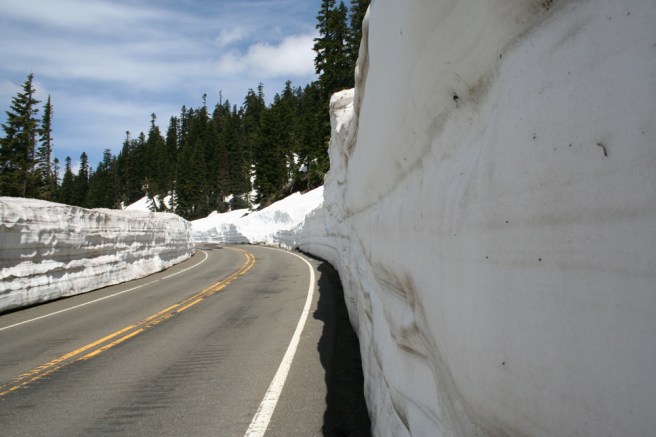
Chinook Pass opened Thursday; came through this morning on my way to Sea-Tac to get Kitty … some packs of snow 20’ high
Washington State Route 410 approaching Chinook Pass on a typical June day once the highway has reopened from its winter closure. Photo taken just south of Lake Tipsoo about 1/2 mile from summit.by Mrhyak at Pexels.
~*~
Missed having Kitty at social functions: Mortons’ party Saturday night, Mtg Sunday night … the emotional support …
~*~
13:VI half-moon
After everything came to a head Sunday, a storm of accusations and truths, we drifted into sex. Kitty was closer to explosion than I’d ever seen her, and the air cleared. Still, no resolution — “I don’t love you, but I respect you.” [If only I could say the same.]
Sez she: “We have no mutual friends. You make no attempt to have friends. … We never go dancing, I’ve never seen you drunk … you’ve done all that, I haven’t … if we went to a bar, you’d criticize the band and the people.”
She’s afraid if she goes back to Central, our marriage will break up …
~*~
Kitty called from E’burg, she’s coming home tonight. Had a fight with Michael, he wanted her to have found the questions so she could examine “her problem,” which she was supposed to do over her Ohio vacation. Told her she expected other people to pick her up and carry her load.
Somehow, she’s really happy for once, and in love with life (and us)
Full moon last night/tonight / summer solstice
~*~
Flash forward to now: Revisiting the previous volume was BRUTAL, especially my conflicts with what I have to admit was my unfaithful wife. Part of her problem, as I finally see, was her failure to commit herself to something beyond the present. Her reason for not having children was not, contrary to her proclaimed concern, about what it might do to her body but rather the reality that it would be a commitment for life, hers and the child’s.
As for me? I sense a Tendrils, beginning with the fact I put the women in my life up on pedestals and worship them, regardless of their flaws. Also, the question of what I would have done without her or some replacement; she was never an “editor’s wife.” As for her value of “having fun,” how futile and infantile that proves …
Looking at what I got out of our weird relationship: time to rise early, meditate, and write intensely … something having children would have greatly limited … also, without her, moving would have been difficult …
~*~
19 july
Just that feeling of treadmill: office, home, cook, clean dishes, to bed and up again too soon, to take off once more … what for?
THIS CAN’T BE IT!
~*~
30 July
Kitty seduced me, or whatever, in my sleep this morning. So long since we’ve done anything. Great way to start the week.
Her folks here Mon night or Tuesday through Friday. The Dolphs took off sailing, left Sam and Jeanice their house — a perfect arrangement. Now the in-laws are off at the Emory’s (Claira), possibly the cabin …
~*~
5 Aug, a Saturday
Kitty’s parents here again … nice, to a point. Right night, everything’s that point.
Good time to sit in the orchard.
~*~
8 Aug, Tuesday
Ivar saying he’d have no qualms about evicting us if Zenny were to become farm manager here. He’s making $3,000 a year running the Olympia blueberry patch.
& now I’m wondering if we should be looking to buy a place in town. I sure don’t want the responsibility but space of our own would be nice.
Came home zonked from work but a dip in the circular pool was refreshing and clarifying …
How difficult it is to be “clear” in “the world” — everything is wrong: use people, profit and efficiency above all else. Deplete materials, savor nothing, run but do not center. Unhappiness is the root of materialism, which it in turn sustains.
How quickly summer’s passed, how little I’ve been out.
The in-laws back here Friday p.m., off for Ohio 5 a.m. Sunday …
The Ala, deal off when the asshole started adding “nickel and dime” like 1/2 mineral rights after he had OK’d the deal …
~*~
And here I thought this was paradise? Parts of it weren’t even a good soap opera.
Let me confess
Keyboarding and then posting these is emotionally difficult, even painful, yet also liberating.
Also from the Yakima library, at the time a volume that became influential in my emerging thinking in poetry and fiction and even spirituality: Regional Perspectives: An Examination of America’s Literary Heritage, edited by John Gordon Burke.
From the chapter, “Crossing the Midwest” by John Knoepfle:
The mind wants to entertain the notion that the further west the frontier the more primitive the life. But that is not so, and that is why the Midwest is so puzzling … And great rafts of hardwood timber were floated down the Ohio River to Cincinnati and Louisville as late as the First World War. … There is room for a native literature in German that remains to be translated … cultures that are supposedly dormant or provincial have a way of flickering into life and proving themselves dramatically related to the contemporary mind. …
Another characteristic of the mid-continental mind is its very hazy sense of itself … But their [cities’] distances from one another help them to maintain life styles that are distinct. … Where is Dodge City? [little awareness of the religious sects and traditions] … (something about a Midwestern ragtime that cannot be explained except in terms of German right-hand piano technique and Black left-hand chord progression arrangements) …
This was all a revelation to me, as would the radical element of the Midwest that Kenneth Rexroth remembered from his youth in Indiana and Chicago.
Had I stayed in the Midwest, where would any of this have shown up in my writing? Or did it, in the exile after Yakima? I would certainly find some of it in my genealogy research that would begin a half-dozen years later and, beyond that, on my mother’s side in Missouri, which technically isn’t Midwest but in my case, definitely German, in part. In discussions of blogging, I would be surprised to see that a tag of Midwest or Midwestern had no impact.
Where does the book Anti-California show up in all of this?
I thought I was free of the Midwest, in a progression my novel Nearly Canaan explores, but cruel fate would prove otherwise.
Remember, my ashram training had taught me to be aware of vibes and the fact that different places had their own vibrations. My, did Yakima and the surrounding lands!
Or, “If it’s got sugar in it, it’s cake; if it doesn’t, it’s bread,” as someone local said of William O. Douglas’ new book at the time. [The blatantly liberal U.S. Supreme Court Justice had returned for his summer home in the Cascades, upriver near Mount Rainier.]
I was still trying to digest previous places I had dwelled in or otherwise experienced.
Remind me that not everyone has lofty ambitions.
~*~
As I noted:
Subway Hitchhikers?
Network of the Heart
Canary folded
= Teletype writer =
Canyon hopper
~*~
My, I was moving up in life! This journaling was getting Serious.
Trying to make sense of my work schedule at this point. “Time for a break = 4 days off, a schedule switch, my last week’s Monday off is today, then my normal Sunday-Monday off days followed by my Labor Day = a well-earned rest. I’m too tired to go to the mountains. Instead, I’m off to the laundromat.” [Good luck if you can follow that. Commiseration if it sounds familiar.]
By mid-October: Using the tape player to rework poems, a strangest joy, back to voice and recognizing what remains incomplete or experimental forms that contain more than I had thought. Also journal notes that need no revision to become poems.
~*~
18:X:77: Our photographer Whiz’s birthday (he was turning 24 to my 29): Snyder’s essays in Old Ways confirms I’ve been on the right track after all, seeking relationships of people to unique landscapes/environments/cultures … [a half century later, what happens when the land itself changes as a consequence of climate upheavals?] …
~*~
19:X, in checkout line at the library, taking a midmorning break from the office, met a pipe-smoking bearded fellow my age or so, Barry Grimes, checking out Allan Tate, Ed Koch, etc. Got his contact info. He and a buddy are editing a new journal along the lines of Paterson. I’m welcome to submit.
Wait, pipe-smoking in the public library???
[A later note in the journal proclaims the tabloid newsprint publication that resulted.]
Comparing [George] Szell’s early and late recordings of Beethoven’s Eroica against Max Rudolf’s; as always, I was amazed by the vitality and clarity / discipline Max obtained, as demonstrated in Cincinnati. The constant daring in each line, each phrasing having a stressed note. (Suppose the stress is largely spontaneous, varying from performance to performance: the players’ improvisation?) Yet the trills together (where Szell gets flutters). The amber warm clarity of tone. Structure revealed. The pivotal balance of conflicting possibilities: a disciplined wildness, savage elegance.
[And this was a period of my life with few live classical performances.]
Georgia O’Keeffe … demanded solitude as a painter … wouldn’t allow Stieglitz to enter the studio when she was painting …
As for Lake George? “Too much green.”
Not that I contested that later, in the vicinity. Green, it was.
~*~
12:XII: Conversation with Barry Grimes and Jim Bodeen: “I wouldn’t think you’d have any trouble getting published anywhere.”
My new longpoem more like Basho’s journeys — commentary linking poems rather than most English poetry.
Recitative and Aria
Potential for something there
Be clear or be clever?
Tribe: Neah Bay is our land because we spilled our blood for it,
a basket woven of snakes.
Symbols shaping the way we react to the land. [Wish I had more on that.]
~*~
25:X midnight
Acceptance of three poems from Roger and Dick (always surprising what editors choose, even when you know them) … with a note, “I like what you are doing. Your style is much harder and clearer. Keep to it.”
~*~
27:X
Among lingering impressions from Regional Perspectives ….
The belief that something remains intact in the backcountry, whether that be Vermont (and not Boston or Cambridge also as New England) or “upcountry” South (versus Atlanta or Nashville) …
How many respected but generally unknown writers are mentioned in passing?
There are great differences within each region …
Emotionally, the suffocation I’ve felt, even in Daffodil …
~*~
6:XII
… what my work lacks so much is the female (universal) element: softening, enveloping, making wet, warm …
Kitty’s new place: the smell, the copper drain ring in the kitchen sink, the freezer box suspended within the refrigerator all remind me of Gran’s second-floor apartment. All of those motionless Sunday afternoons hearing invisible traffic, bells, and wind.
Sign outside her window
FORD (blue
LINCOLN (white
MERCURY (red
just like our place in Prairie Depot, Ohio
~*~
A fine salad Kitty created tonight
Pieces of homegrown
watermelon
cantaloupe
peaches
~*~
One of every five commercial apples in the U.S. was grown in Yakima County. Peaches, pears, plums, apricots, and cherries were also valued fruit harvests. They play a major role in my Nearly Canaan novel.
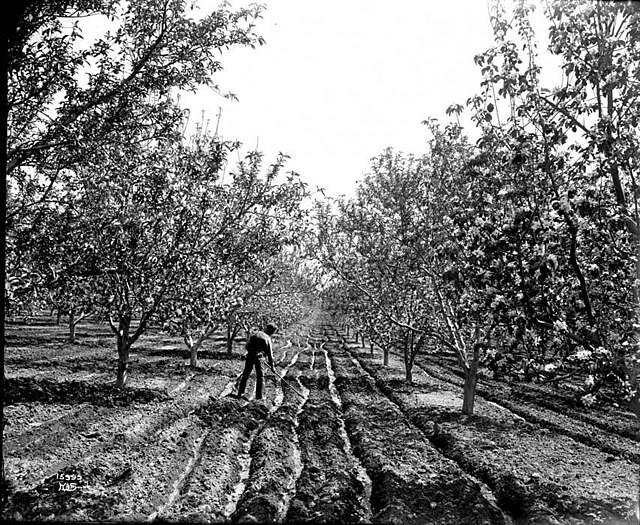
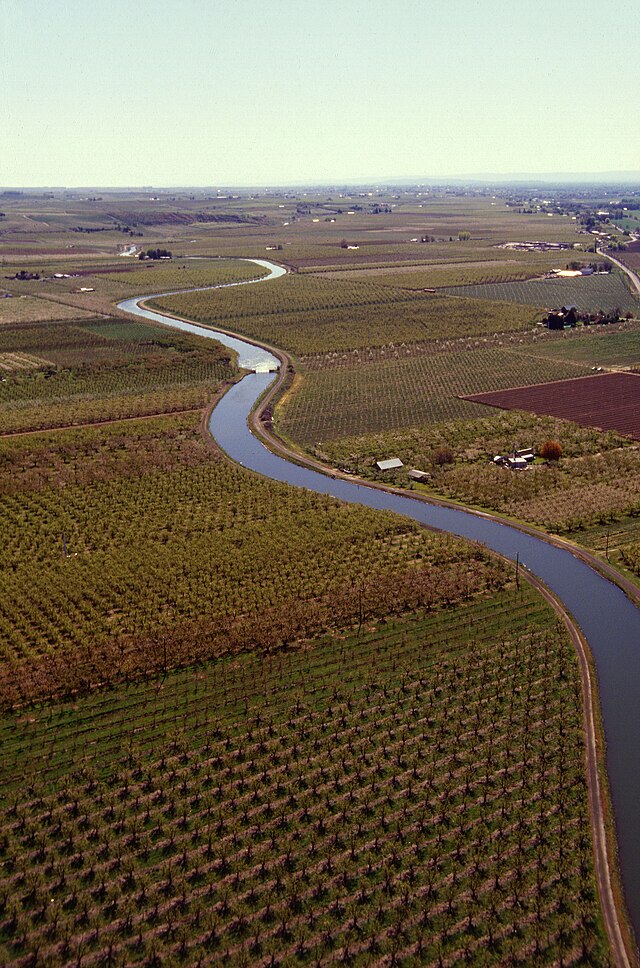
Irrigation had come a long way from the ditches used in orchards in this circa 1913 Webster & Stevens glass negative photograph via Wikimedia Commons.
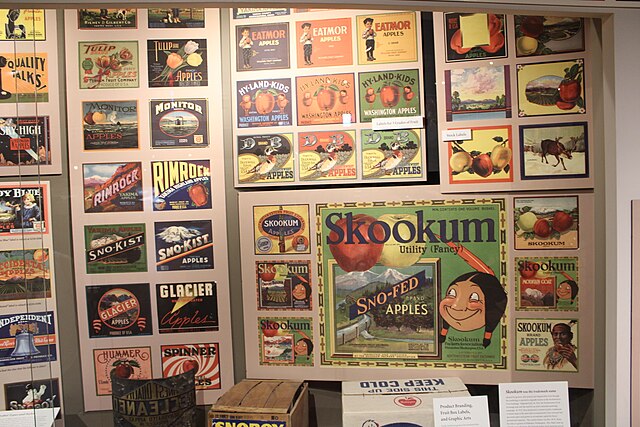
Orchard labels from Yakima in a Chris Light photo via Wikimedia Commons.
Lithograph label from California Historical Society collection …
~*~
13:IX:77
Pickers began on the apples this morning
seis y media
first the Goldens: the reds come off later
man with a limp
carries the ladder
~*~
14:IX
Ordered new car yesterday, Subaru
Legs for Kitty’s loom finally arrived after a long wait: it’s now “grown up”
Mention of Kitty taking the Greyhound to Ellensburg …
~*~
Where did I hope to be at 30? And how close am I?
Where have I been? What dreams and teachings have I forgotten?
A dusty novel manuscript, an unopened violin case, a holy title I seldom use — and all of these chains to Maya
~*~
28:IX
apples, gone from the orchard
at least around the house
prop sticks stacked between the rows
ladders, folded
sweet smell of bins
awaiting the straddle buggy
She’s in a bummer today. Not a single good word till I got mad and screamed and left the house and mowed the lawn.
Our orchard shack cleaned, inside and out, everything back in place and straight. TV moved from the meditation room [living room] to the bedroom. Good vibes back, our home is home.
~*~
3:X:77
[Desert reality}:
How strange that dew should be a sign of autumn!
This ink has an odor I now associate with Mr. Weiner’s junior high school art classes and later with my high school art class wash room.
Overheard: Yeah, Fort Lewis is a wild place. Kids go in, find live grenades. Fort Carson, too — stretches almost from Colorado Springs to Boulder. They wanted to expand it but faced a vote.
~*~
10:X:77
Called Subaru, told our car’s on the way, probably off the boat on Friday. Last boatload, they couldn’t get our five-speed, though it was promised, per the salesman.
The mail had a letter to Mrs. James Hodson from Mom Moran …
~*~
Later in month:
Sharon P from Kitty’s Ohio Northern days showed up in the Central State art building, wants to be an actress, just got a divorce. Seems Kitty really dumped on my in her journal the night before, can’t figure out why we’re married, “Most people need each other but we don’t,” ignoring the joys of shared freedoms. So Sharon’s husband had come in and asked why not, I’d say they were never married. And now she’s coming to visit us in the orchard?
An evening party in town, a political party fundraiser, after a rare rain had finally soaked the earth …
An old woman’s bathroom, ointments, creams, bottles of prescriptions, tweezers, scissors, lipsticks, perfumes, dirty towels, an unpleasant smell. Quotations taped to the wall.
Hamburgers on the grill. Why do none of their names stick for me? Why don’t I want to speak?
Two old women sit mysteriously behind their cigarettes, one in golfing attire, the other in a pink dress. Sometimes I don’t want a cocktail. I can’t find my friends. Who are these infants, crawling around my legs? Why did I find this place?
~*~
Don’t ever want to live again where I can’t see the Milky Way — Eternal Light — River of Light — our home in the universe.
[Not knowing there was a long dark period ahead.}
~*~
Kitty found an apartment in E’burg and is excited, a “place like Laura’s” or our “town house.” A bohemian dump. Maybe even my encampment on Mondays with a college library or movies and jaunts to the mountains … even courting her anew …
Dinner at New York Pagoda Café …
~*~
Picked up a hitchhiker on my way to work this afternoon. Seldom stop nowadays, did so today as an afterthought, his smile and the modesty of his destination: Union Gap. Fact was, he was walking, not standing; his big backpack barely fit in the Bug’s backseat. Turned out he’s a picker from Tempe, Arizona. Worked last five days on pears, $20 his best day’s pay. Got his check today. Getting cold, wished he hadn’t lent out his second sleeping bag to a friend with a job in town. He puts one inside the other. Once he’s home, he’ll play basketball, get a student ID, perhaps take an acting class.
“Oakland,” he says, “a lot of baseball players come from there.”
She’s sick of herself and everything she touches. So I noted.
In early March, while we were still living in town: Sometime today, water began filling the irrigation canal along the hill and the new massive house where the sun destroyed the grass now has all of its sprinklers spraying no matter their son playing professional football.
Apparently, we were visiting the Dolphs at their new orchard.
we are all nearly homeless
hoping for anchors
within our own time
[or: attached to our lines]
CHRONIUM DOWNPOUR
~*~
On 3:IV:77, started a new journal notebook, Vol. 48, Progress 100 sheets, 12 ½ by 8 inches college ruled … tan/kraft cover …
As I recorded, “It’s all here in the solitaire deck — the origin of statistics — all those crazy rules I never quite understood in statistics class — so obvious here before me — bell curve, for starters — the addiction of hands, feel of the shuffled cards, the electric knowledge that there are still undealt cards, in the random orders, with the anticipation of the one that will do it. The sense of yet unmoved faces that could make this hand go down, yes this one, will do the trick. And all those maybes — balance, in numbers and colors, highs and lows, latent moves — aces, kings, and deuces … it’s all there …”
[So I was getting hooked to the game long before I’ve thought]
Palm Sunday, partial lunar eclipse of the full moon. [Are lunar eclipses always full moon?]
Getting her back into the Sunday bed, long, languorous love-making, continuing past climax, slow and warm, in many positions through the morning …
That afternoon, at Gils’ once again sensing the futility of trying to find “the good life” in alcohol and horses, Whiz so loud, Wisteria’s conversation so much about things, my trying to extricate from books and type into my whole-self … back home going for a wind-fighting bicycle ride, my leg muscles taut …
Whiz trying so hard to make everything loving, caring, brimming with feeling — somehow reflecting a fear of his own empty hunger …
Hmm, like that phrase “empty hunger” … in contrast to the stone?
Gil had a cat named Mousetrap …
~*~
On her birthday, the first of her rejecting me because of her painful vaginal/uterus itching …
Do I blame pantyhose?
~*~
Saturday before Easter …
Earlier notations of impending drought now come to the fore …
White apple blossoms already open, earliest ever; prior record was 20th of the month. Now the fearful frost watch …
Everywhere, irrigation sprinklers squirting, using the water while they can …
~*~
Realized how much Whiz and Wisteria ape us … for instance, buying a chess board when neither of them plays. In two weeks they’ll act as though they know the Olympics once we’ve said we’re here …
~*~
Nothing much grew there without irrigation. Here’s one major canal diverting water to orchards from the small Yakima River, essentially snowmelt from the southern Cascades Range mountains. Water rights are a legal issue largely unknown in the eastern half of the U.S. My political science guru Vincent Ostrom was an authority on the matter. Finally, it was registering on me.
~*~
Early June:
Back from Tinowit powwow
dancers in angel wings
and Allan Ginsberg’s 50 already
The thinners — man and three women — floppy sun hats, loose dresses waving in the breeze — coming down from the ladders for dinner, chattering in Spanish, their movement like a dance
Also had just read Ecotopia the first time …
Late brunch today at Frasu’s at the airport (I didn’t get out of bed till one) — champagne part of the deal. Stopping to see Wisteria, Abell’s grown, rolls sideways, barks at dogs, cows, birds, and cats, and plays with balls. Laughs at subtle surprises, like when it’s caught or bounces on his head or disappears. A pleasant Sunday afternoon.
Learned how Hamilton lost his watch — gambling with a subject. Then tried to buy a new one at Penney’s, “Like to look at a Seiko under $35,” but the clerk just walked away. Next day he returned but the clerk wouldn’t accept his check. Called the manager, who demanded three pieces of identification before approving the check. At which point, Jeff took the watch off his wrist, said “Wait a minute, I’ve changed my mind. I’ve been treated rudely,” and then took his check back and ripped it up. The clerk looked wounded, as if “not me.”
Our first winter Out West was accompanied by domestic tensions. As I noted:
Sucking, swirling blaze
fire in here, snow on the roof
faintly false smell of burning tea
candy on the table
bulbs in the box
tears on my wife’s cheeks
Also:
inner silence in contrast to the newsmen made of gossip,
bitching, down the drain to sorrow
Kitty’s down: “I don’t belong anywhere!”
Also unhappy with my Chinook “paraphrases” (her term): “write your own stuff.”
When I go back over the Chinook pieces, add my own smart-aleck comments: the evil thing at the door “must be the cops” or Indian agents … BIA … or go free-wheelin’ into myths and texts … go back over the economy thing I’ve been trying to develop, “we’ll all be tent makers.”
Beer as cheap as Pepsi.
RITUALS, especially on a day free of the office:
Rising early, when silence is strong. Or, more lazily, sleeping in, hopefully late.
Making coffee, to sip all day using a special mug
Reading sacred texts. Followed with the morning paper
Cooking. Breakfast. A dinner wine. Candles.
Shower.
Planting, Weeding. Harvesting. Canning in old glass jars.
Vol. 47, starting 29 November 76, was the third tall, tan Citadel … had many poetry drafts and other bits that were eventually published. Now, for a few things that weren’t …
First, an erotic dream a few nights earlier, resigned myself to a wedding feast, mine to a wealthy, rural, landed girl — Quaker family — and, oh, how happy the whole circle was, as if trying to wake me from a heavy sorrow … she had long hair. This dream would haunt me later.
I woke myself, insisting, “But I’m already happily married!”
The farmhouse, set in a grove of solid trees, was a three-story federal style I would encounter six to eight years later in Maryland or Delaware and then, later, in New England.
Also, an erotic dream of Celeste followed the next day, in fact, with a tender letter from her in the mail …
“Got Yule cards out Thurs, only marginals remain.” Guess that means the ones that needed more personal notations.
~*~
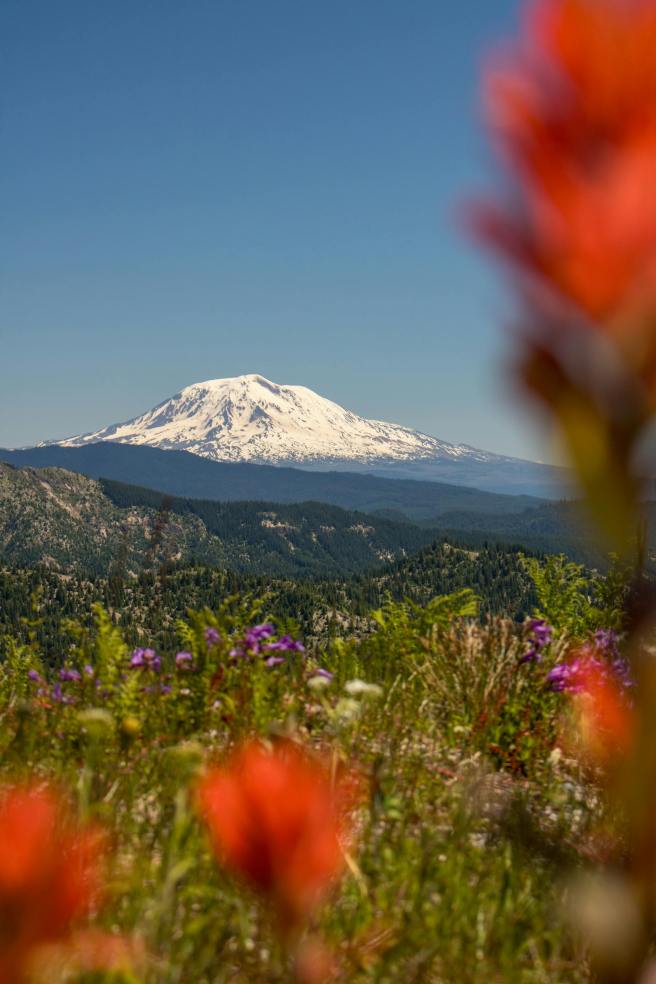
Mount Adams, the distant presence to our west, continued to fascinate, perhaps as an emotional anchor for me.
Mount Adams by David Lepore at Pexels.
~*~
In revisiting my journals from this stretch of my life, I’m struck by ways my memories diverged from the timeline recorded in the pages.
I would have insisted, for instance, that the wedding dream took place about two years after leaving Yakima.
On the other hand, the Quaker circle gathered earlier than I sensed.
The office situation was more tangled than I remembered, too.
I’m also more conscious of not having close local connections or friendships in Fostoria, apart from Kitty and her family, and wonder how a local church might have altered that, had I not been such a yogi. Jump ahead, and it becomes apparent that my Yakima contacts, apart from the office, were mostly among transplants, especially our new Quaker circle.
I do wonder, too, if it weren’t Friends, how might I have connected. Unitarian?
Picked Kitty up after her job Friday and hit Keoki’s for cocktails and appetizers. How I wish she would like it here! Indian crafts show in Toppenish this morning, stopped at Wappenish Bead Shop/Trading Post, very nice vibes — mild ashramic throughout, a place to return. Both Rainier and Adams in the sky.
Ray’s Meat Store, hardback bacon and shoulder of lamb — free pound of ground sausage, free pound of ground beef — friendly old shaky fat fellow. Kitty, afterward, “Do you cook the shoulder the same as the leg?” and then phoned her mother, who said, “The shoulder’s better!”
We were getting to know salmon and crab and rainbow trout, too.
~*~
As my then-wife accused me, where the hell was I taking her? Much of the land was settled within the memory of some of the oldest living residents. The route we entered by, with heavy cloud cover, was highly honky-tonk cowboy. Here’s a historic photo reflecting the early settlement, 1880 to 1920, via Wikimedia Commons.
~*~
Touchy around Kitty, who’s speaking baby talk more and more, drawing me into pointless conversation or interruptions, “How do you spell …” for the umpteenth time, and desires to spend (I just noticed the clutch needs tightening). Now she wants a $139 necklace for Christmas.
Where am I going? What am I doing here?
To again be passive and receptive wouldn’t be bad.
She’s impossible to live with these days. She wants something, wants to buy everything, but that’s not it. Unhappy, clinging to me yet feeling trapped, not knowing which way to go.
A man can live on next to nothing but not a woman. Even in the war, when they were starving, they had cosmetics, they had perfume. (So says my father-in-law, with a sly grin.)
Another flannel shirt — 36 or size 12/large women’s or medium men’s
Candles
Place mats
Ceramic cups etc.
Paul [a new sports writer?] was talking about the spirits in his parents’ house (behind you, the cold), thermostats clicking on within warm rooms. Well, it was a funeral parlor.
Where everyone has a fireplace
or wood stove
that works,
everyone burns.
Or could.
Watch the flames
while pondering life
facing death.
With or without smoke.
Or a snake.
Kitty got her four-harness loom on our dash to Seattle … and we stayed with [former Workshop colleague] Franny’s parents, Cortes Island … quite lovely on the waterfront with light snow.
Putting presents away: Avon bottle, English Leather aftershave, an electric can opener — things you get used to, the trappings of middle class.
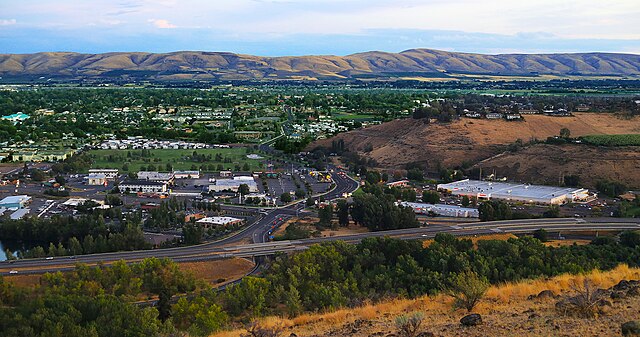
We settled into a new three-bedroom duplex with an attached garage, situated at the base of the ridge.
Living in town: the newest and most modern dwelling of my life, even now 50 years later … (of my first decade after college, I’m seeing on aerial photos that the majority have been demolished) … It was about a 30-block walk to the office, something that could be done if needed but still long.
We even had a fireplace, come fall and winter.
We were down there somewhere. Photo by Michael S. Shannon via Wikimedia Commons.
Summertime, though, had us learning the intensity of the desert sun, including the need to close both the blinds and the curtains in windows being struck by direct sunlight. The radiant heat was brutal. That was especially true of our living room in the late afternoon. Many houses had extra blinds on the outside, too.
As I set up my meditation room slash studio, I noted: European/American Eastern poetry reflects a resignation, where Asian/American Western has an acceptance of life / one is essentially sad, the other full of discovery and delight / the curious juxtaposition of East and West here!
While I was reading the Hindu classic Patanjali, the doorbell rang. Thought it might be the mailman, answered it to find an old man carrying Bible tracts denouncing crime, asking if I had watched the presidential debates, handing me his Bible to read two verses — an answer, he said — talking all the while of meekness — but this was no dialogue, no conversation — it didn’t matter if I were here or not, only that there be an audience.
In his demeanor, no meekness, yet my feelings were mixed. Admiration in his determination going door-to-door, but sadness in his lack of holy radiance. His book for a quarter? “Can you speak to the dead?” and “Is Hell really hot?” And then his magazine, the Watchtower.
He kept speaking of the Kingdom. “Kingdom, isn’t that what it’s all about?” Guess he’s never heard of love.
Well, you can speak to the dead but don’t expect an answer.
Rosh Hassahna began that night — a new year of thanksgiving.
We were certainly on the verge of a new year, personally.