Tag: Inspiration
Kinisi 263
Anyone else missing
pickled summer?
Mobility issues, mostly
Halloween (1977): 22 inches of new snow in Cayuse Pass, 4 in Snoqualmie Pass, two of our routes to Seattle … winter was already closing in.
The kid wrecked the Capri while trying to use the CB he had received for his birthday the night before. Had he been in the Triumph, he’d be dead.
From loose letters, carbon copy, Nov. 28, a now obsolete form of address: “Sirs:” Even “Sir” becomes questionable.
windy night
gusts to 55 mph
highway speed
not feeling well
as Kitty smelled on my breath
~*~
6 Nov, Wednesday, new car arrived today. Feels solid, runs beautifully.
Looking back, I’m surprised that we went with Subaru, at the time a new entry into the U.S. market. I draw a blank at trying to remember the process of signing all the papers or how I even picked up the car, considering that we (make that Kitty) decided we’d keep our VW Bug which had no trade-in value.
That night, I surprised Kitty by driving up to E’Burg.. She loves the new car, its size and color. Took her to dinner.
Back at her apartment, a knock at the door. Two officers checking a strange odor in the hallway, fearing it might be more than rotting garbage. Inquiring about the neighbors. Any elderly? How long the smell? (A week.) Have you seen them recently? (Later she said her neighbor had been crying the day before. She almost offered her a ride to cheer her.) (Wait? In what?) On my drive home, I wondered: Did her neighbor kill the boyfriend she was kicking out? Is Kitty safe? She wouldn’t have answered the door if I weren’t there. Did the officer parked behind my car take down my license plate number? What was he radioing so long? They said a sheriff’s deputy reported the smell, but what was he doing in the building in the first place? Intrigue and foreboding, I presume …
Small-town cops, I’d say now, or perhaps federal ICE agents.
~*~
Mid-November
Snow flurries,
large flakes
briefly at noon
Nancy and Len’s visit all the way to our shack near Wapato, south of Yakima … [surprised to see they did that, though she had parents in the Seattle area … wish I had more!] Sleeping bags on our floor? She was a fine bubbly presence in our Indiana University endeavor.
Kitty’s been asked to place two of her sculptures in a Central [State University] show this spring — it’s by invitation only. Any reassurance she finds will quickly fade …
~*~
From Spiralbound Cascadia with commentary.
Kinisi 262
INDIA
INDIANA
Kinisi 261
carping breeds more
diss relief
Kinisi 260
death as a cave in the woods
sinkhole filled with trash
Bodies of water attract us, naturally
Walking along rivers, lakes, and ocean shores seems to have healing powers for the soul. Just consider.
- “If there is magic on this planet, it is contained in water.” — Loren Eiseley
- “Rivers run through our history and folklore, and link us as a people. They nourish and refresh us and provide a home for dazzling varieties of fish and wildlife and trees and plants of every sort. We are a nation rich in rivers.” — Charles Kuralt
- “To put your hands in a river is to feel the chords that bind the earth together.” — Barry Lopez
- “The wise man knows that it is better to sit on the banks of a remote mountain stream than to be emperor of the whole world.” — Zhuangzi
- “Have you also learned that secret from the river; that there is no such thing as time?” That the river is everywhere at the same time, at the source and at the mouth, at the waterfall, at the ferry, at the current, in the ocean and in the mountains, everywhere and that the present only exists for it, not the shadow of the past nor the shadow of the future.” — Herman Hesse
- “I’m an old-fashioned guy… I want to be an old man with a beer belly sitting on a porch, looking at a lake or something.” — Johnny Depp
- “When anxious, uneasy and bad thoughts come, I go to the sea, and the sea drowns them out with its great wide sounds, cleanses me with its noise, and imposes a rhythm upon everything in me that is bewildered and confused.” — Rainer Maria Rilke
- “There’s nothing more beautiful than the way the ocean refuses to stop kissing the shoreline, no matter how many times it’s sent away.” — Sarah Kay
- “Some people could look at a mud puddle and see an ocean with ships.” — Zora Neale Hurston
- “Despite the ferocity of the current, a river is always moving but it’s always in the same place. And much like a river, while we should surge forward with great ferocity, our principles should never move.” — Craig D. Lounsbrough
Kinisi 259
A cricket
grows up
into a toad
in late summer night
Seeking to capture the local land and culture in my own writing
As for poetry? “Wonder if my work adds up to summa, if it has a point” …
The night before (so where were we?): “the aging aesthete dismissing Pfingston’s piece, ‘This isn’t a poem,’ as though he knew, this uptight, pretentious high-school teacher whose 30 friends kept clinging to him, whispering comments about ‘classical forms’ and the ‘need for discipline’ and keeping a guard against ‘imitators’ and how Joan Stone can’t STAND Duane Niatum, ‘He borrows everything.’”
“That’s what happens when you get a PhD,” I almost said.
How many tall tumblers did that guy down — a dozen? How can any drunk evaluate a poem, appreciated its silence?
I’m tired of veneer, tired of poetry tasters — everything but the purely original, primitive, religious incantation …
[I had not yet delved into Jackson Cope’s “incantatory language” perspective on early Friends …]
When a batch of submissions go out, the first back are quick rejection slips — usually overstocked — then the mixed bag of acceptances and misses — and finally the slow anguish of almost-takens and those returned unread …
It’s almost a pattern
~*~
Wollah Wollah = whistling water = Walla Walla
~*~
When Coyote desired Beaver’s beautiful daughter, Rain sent his own beautiful daughter to plead with Coyote, who instead tried to rape her and make her his other wife. And thus, enraged, Rain punished the east — Coyote’s land — by raising the Cascades mountains so that Coyote and Wind could not steal all the clouds.
I’m left wondering about Beaver and his child.
~*~
Meanwhile, these local poets and artists who don’t study, don’t know what’s been done before, wouldn’t recognize ancient excellence, don’t know what’s being done now, don’t experience the nature out there or the scary, untapped energy fields within themselves … who don’t try to make each piece unique but merely a repetition of their static non-discovery closed-in closed-off non-lives …
[How’s that for non-judgmental?]
~*~
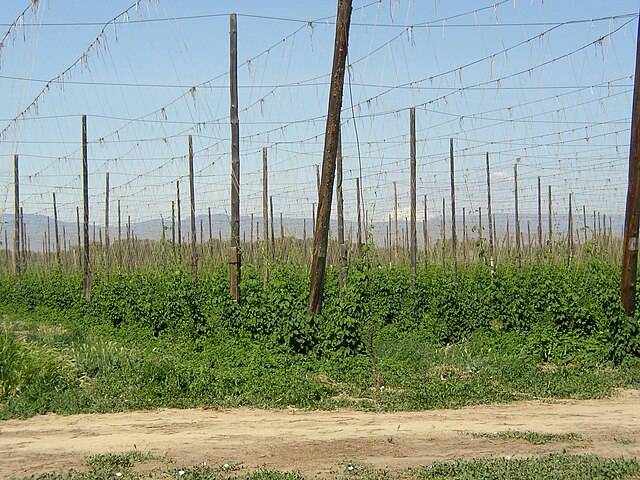
Hops, which are used to favor and stabilize beer in its brewing, were another famed agricultural product from Yakima. The vines would climb the ropes to the top, with the whole vines being cut down at harvest. Note Mount Adams in the background. (Photo by William Borg via Wikimedia Commons.)
~*~
I used to write poems about the weather. But what can you say about a place where the weather’s always good? Only that the wind’s blowing?
[Think of a comment I recently heard, about a poetry editor who scorned Weather Report pieces. Gave them an instantaneous rejection.]
~*~
Watching clouds 50 miles away.
~*~
From Spiralbound Cascadia with commentary.

