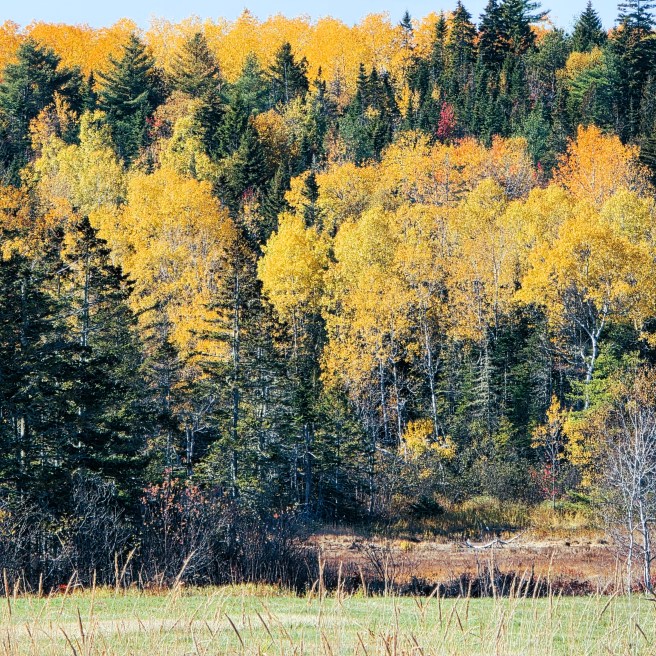
Sunny bursts of foliage like this, in easternmost Maine, remind me of the aspen of the Far West. Oh, the memories.
You never know what we'll churn up in cleaning a stall
Sunny bursts of foliage like this, in easternmost Maine, remind me of the aspen of the Far West. Oh, the memories.
There were no mountains where I grew up, but even then, they rose in my imagination.
Here are ten related perspectives.
Picking up on my old journals:
A month of rain: 2½ inches in December: snow, then melt. Our view of Rattlesnake Hills (rising behind our shack) washed out in fog. Ground soggy, making up for drought.
Vol. 50, 11:II:78
(first trip to Portland, a city that would become our alternative to Seattle, though we never got to know it as well)
longhorn steer on Satus Pass Highway
a longhorn?
Yakama Reservation
Quaker meetinghouse in an old storefront
Service Committee on one side
First-day school upstairs
or a Friends’ apartment? (caretakers
overwhelmed by the Native display at the art museum but not the rest of the collection
Portland-town, calm as Philadelphia
Asian and Native
with an Anglo overlay
afternoon, clouds cleared
revealing Hood, proud and pink over all
– Rainier and St. Helens in the soup
but where, oh where was Adams?
Still so ignorant regarding this land
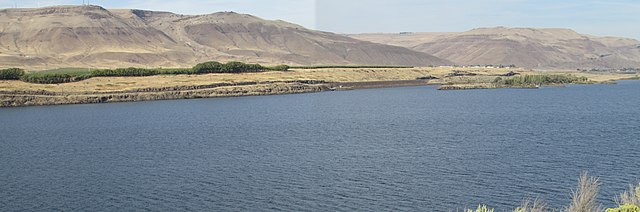
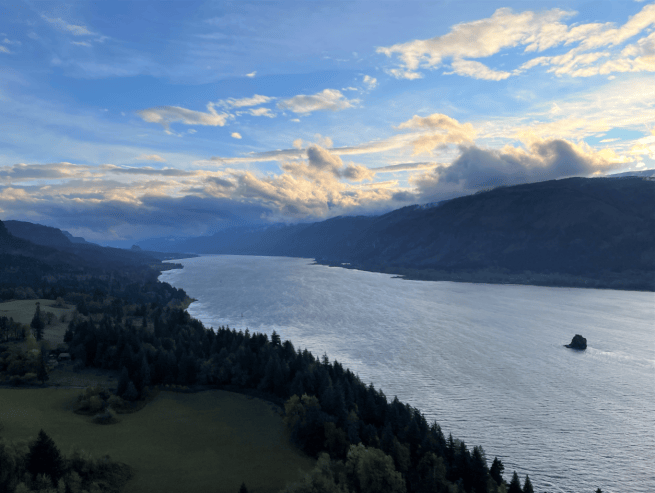
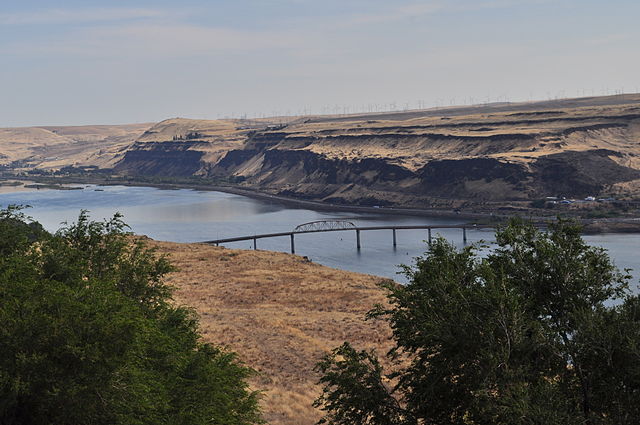
Much of the Columbia River runs through desert before getting to the lush greenery in the Cascades and on westward to the Pacific. Much of the route forms the border between Oregon and Washington state, Here’s a taste of the eastern Columbia River Gorge downstream from the Dalles, Oregon, looking into the “Evergreen State,” photo by Chris Light via Wikimdedia Commons.
As for the more common impression, consider this photo by Lena Chang/USFWS, also via Wikimedia Commons.
~*~
14:V
Climbing Clemens in fog and rain, encountered my first rattlesnake, dead in the logging road; five rattles. They gain a new one every time the shed their skin, usually three times a year.
Old-timers saying this is greenest, mostly intensely flowered spring they can recall.
17 june
Slept till 9, met Whiz and drove from the Nile to Tieton ranger station, then out, in six-foot snow pack to the Timberwolf Lookout — the forest fire watch building is gone but great panorama of Adams, Goat Rocks, Rainier, the Stuarts — Mount Glacier clear, a ghost of Baker, and crown of St. Helens. Plus Aix, Bismarck, Nelson, Butte, Shellrock, Ironstone, and others.
Kitty, off to Seattle with Michael. Platonic, she insists.
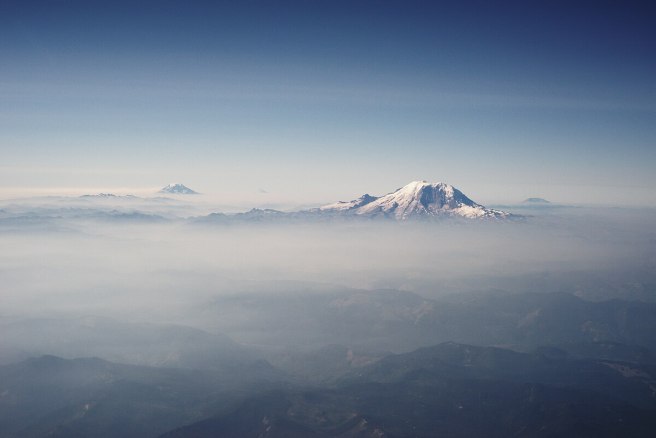
Stratocone volcanic mountains poking through clouds are Mount Rainer, center, Mount Adams, left, with a very tiny Mount Hood appearing halfway between if you zoom in; St. Helens rises to the right.. Photo by Dllu at Wikimedia Commons. A distinctive feature of the Cascade Range is stratocones about 50 miles apart from Lassen Peak in California to Mount Baker near the Canadian border.
~*~
20 Aug, Sunday
Entries lately: weekend to weekend
Sweet smell of conifers in the passes — rain at White Pass
everything clouded in
U.S. 12 still showing washout debris
wrecked guard railing
and other signs of last winter’s thawing and rains
4 Sept, Labor Day
Ginko Petrified Forest (at Vantage, where Interstate 90 crosses the Columbia)
Once, 10 or 15 million years ago, 200 species of trees grew here … the Cascade Range, not yet up, left ocean rains to come far inland (mahogany, maple, magnolia, Douglas fir, spruce, elm, ginko, box elder, beech, butternut among the common examples)
When the lava flows rolled over all, only the waterlogged trees didn’t burn … thus forming this site, one of seven major ones in US, and the one with the most species.
Wanapum tribe, peaceful, never declared war on USA and thus no treaty: and thus, alas, no reservation, no land = seems to sum up too much of Amerikan political and economic system, including judicial-legal mysterium frateritas …
~*~
Sometimes — no, too often — I feel or am wrongfully identified in a situation, perhaps because I do not submerge myself solely in a field — so that within a convention of journalists I may seem to be too ethereal, artsy, not politically-addicted enough, a health-food addict, whatever — yet among poets not hip enough, too square, too wealthy (!) or whatever: even too success oriented.
[Success? Guess that rules out poetry.]
A drive today, up into the Horse Heaven Hills … no irrigation system in sight, a few trees by the gully …
~*~
From Spiralbound Cascadia with commentary.
Although they live underwater and are commonly called “starfish,” they are not true fish. Unlike fish, they do not have gills, scales, or fins.
Also, they move quite differently from fish, which have tails to propel themselves. Instead, sea stars use tiny tube feet for moving along.
Thus, since they are not classified as fish, scientists prefer to call them “sea stars.”
Now, for ten more points.
So many of my posts from the Pacific Northwest mention big, glacier-clad stratovolcanoes, or stratocones, that are found roughly every 50 miles from northern California to the Canadian border. Yakima is to the right (or east, under the word “Helens”) of Mount Adams, but Rainier was easier to access and explore.
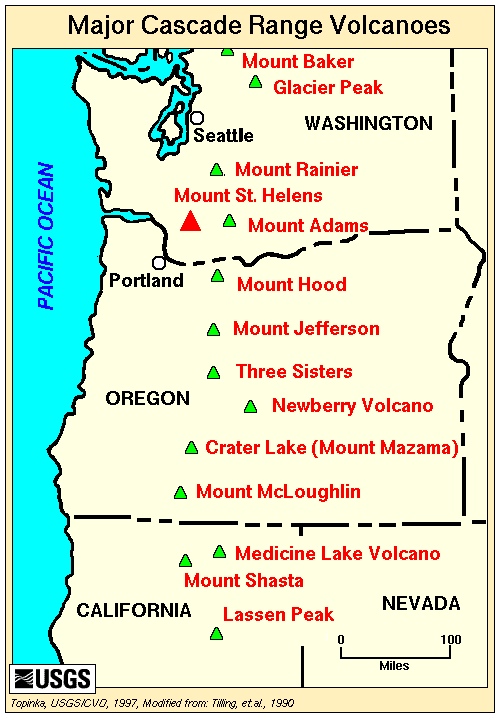
Baker came into play during my trips to the North Cascades, and Hood on our trips to Portland, Oregon. The others in Oregon and California framed our one dash down to San Francisco.
The year 1977 presented us with several memorable treks that included camping.
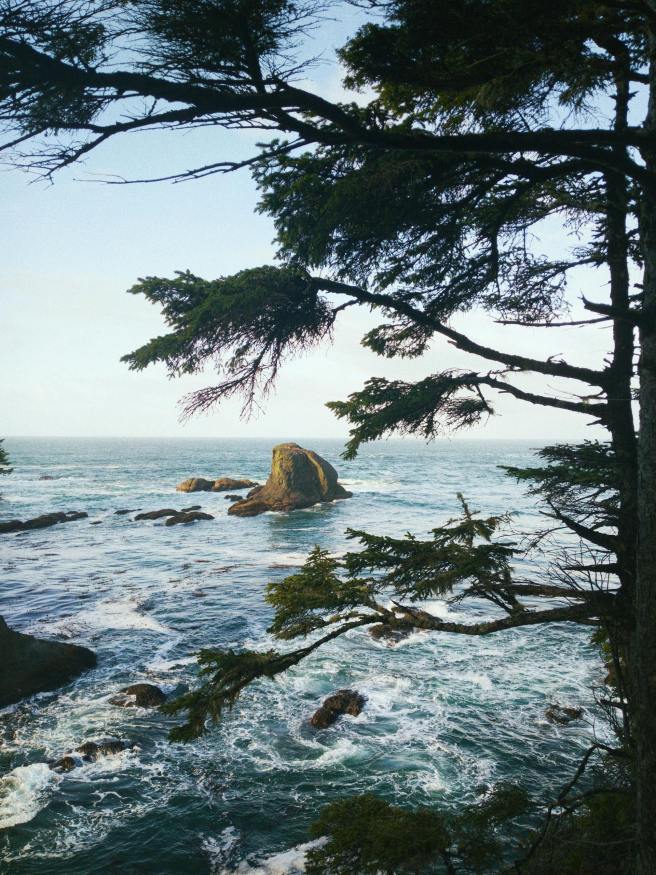
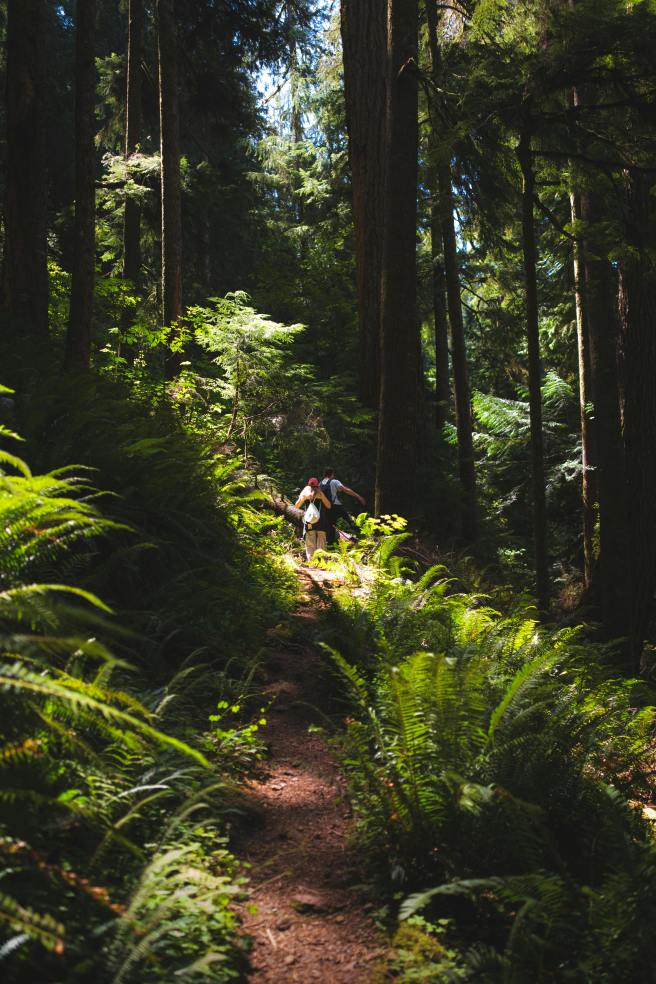
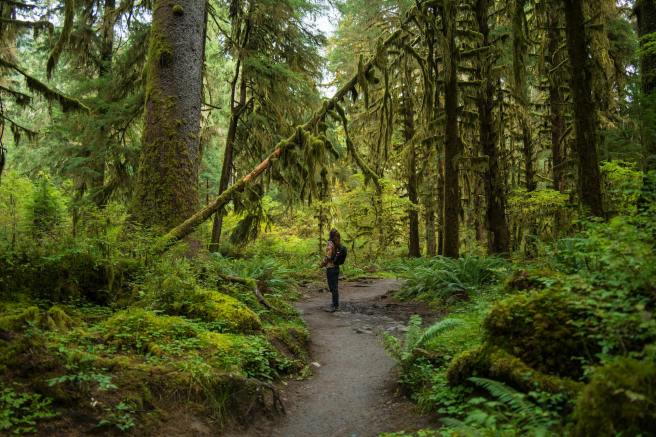
In early May came this entry: 2nd day of my first real vacation in two or four years … about to set forth on the Olympic Peninsula camping trip … in that cumbersome umbrella tent, smelly but with odors that stirred much within me …
The experience evolved into my longpoem, American Olympus.
The place is a cosmos of its own, one we explored before the summer crowds flocked in.
~*~
Meeting campout the weekend of June 5, Meeks Table, elevation 4,200 feet …
Nathan Trueblood, 7, in his dad’s Cub Scout shirt … Indianola, Iowa …
Recorder music resounding at twilight …
Great worship atop the butte …
Prickly pear cactus on the way home
My sit focused on a feeling that people should strive for excellence, constantly making an effort to expand, grow, produce their best, but then feeling it contrary to faith, in which God gives all, that the way may unfold — like bees, birds, grasses, with ease and faith (the child). But then realized that every tree in nature survives by effort, by striving to stand (in light), that many seeds fail (may eaten or trampled), that even the biggest fall, are cut, get blight and die (silver snags, silver forests, or become nurse logs) …
~*~
And then, 26 jun 77, First-day:
Workt long hours (1 p.m. to 1 a.m. yesterday to get the Sunday paper out: breaking a new guy in for the rim)
Today, woke at noon at packed for camping, off to Adams. Kitty resistant, her tension fighting me (don’t go, don’t leave me) …
Stopped at Maryhill, place to honor a minor queen (as if a movie queen), mostly mediocre art, save Rodin studies, some glass, Russian icons, and Native collections …
Tonight, Morrison Creek camp, wondering if we have enough gasoline to get out tomorrow (on empty) … learned later this was rattlesnake infested …
Mountains white as moonlight … even in the day.
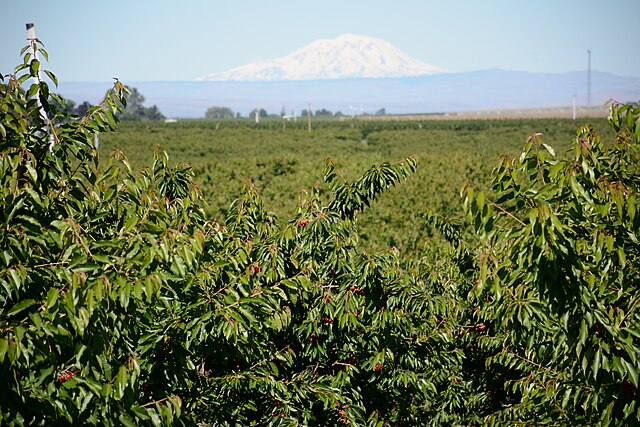
Glacier-clad Mount Adams dominated the western horizon of the valley, peering over 6,000-foot-ridges of the Cascades, though it was more than 50 miles away. The summit was, however, much harder to approach than Mount Rainier, some 2,000 or so feet taller.
After spending the night camping in a high-country grove in what we later learned was rattlesnake-infested, we explored the alpine edge of the mountain, where I collected two elk vertebrae.
Then we packed up the Bug and coasted down, out of the mountain, tank on empty. Silently, wildly rolling. Found a Chevron station at Trout Lake but lady afraid to fill it, tank under the front hood.
Back home, via the Horse Heavens heights and their barley expanses:
So many stars familiar constellations vanish. The awesome addition of the unexpected.
Perseid showers: fat, brilliant streaks sometimes long, others dim, thin; fast flashes or slow particular dissolves. Such variation.
Pure cold fireworks.
~*~
From Spiralbound Cascadia with commentary.
When it came to the great outdoors for us, the year 1977 early on presented us with a trip that settled in E’burg rather than a few more hours on to Seattle. We found refuge in the Outrageous Taco, a freak center in an old beer hall turned pizza/taco/deli quiet with live music and free poetry journals to circulate … a sense of pleasant decay (a $2 movie nearby) … incense in the air, too. We would return frequently … a good selection of new and used books, too.
Homeward by the Canyon Road, walked over the swinging bridge at Umtanum Creek, Kitty screaming, scared, delighted, a future point for a hike …
~*~
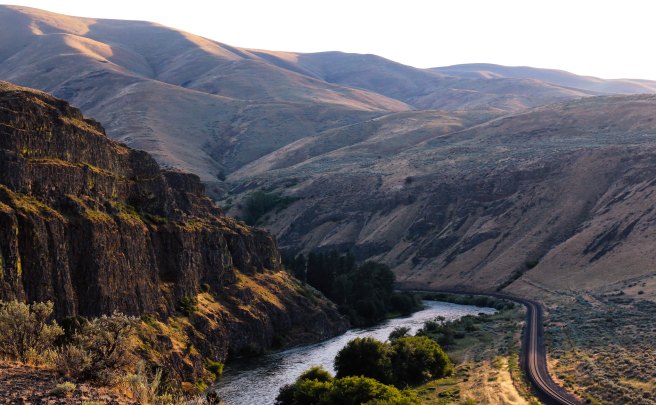
The Yakima River Canyon stretches 27 miles through three major ridges between Yakima and Ellensburg, with summits that rise more than 2,000 feet in places. A railroad and two-lane highway cling to the base beside the river.
In late February, we made our Umtanum ascent, including the bald eagle observation, the first in the valley in 25 years. It was the middle ridge, as I recall, and forms a pivotal chapter in my novel Nearly Canaan.
Thinking of my nature poems … man, the legions of demigods, takes something away, reduces the richness of the land … Nancy Trueblood’s “in the mountains I feel closer to God” … limits the diversity of the species, the expansive quiet, the wonderful circling weaves … in Indiana, my nature poems were often at the edge of the woods — the interface of man, land, and seasons … historical depth where farms sometimes expressed a harmony … a deep cold springhouse, a summer porch … the mountains here, ever green or, like our desert ridge, light brown, are something else … and man adds nothing …
~*~
10 July, Sunday
Drove along Sauk Creek to Stevens Pass … [north of Ellensburg]
Gold-mining remains … introduction to Leavenworth and then the North Cascades …
Leavenworth, with its Swiss Alps festive mood … shame that something similar cannot be created/sustained in “American” or Native authentic theme … maybe something to do with America’s lack of holy rivers and mountains or maybe our flat “Christian” approach to life … (Swiss Calvin not withstanding)
~*~
18 July … apricots gone
~*~
31 July/First-day evening
No entries in a week —
Last Sunday, left early for Seattle (after a midnight Saturday shift) to meet Bill and Mig Dietz and Curtis and Jacquie. The whole port city bit: winos, sailors, loggers, porno shops (me, buying newspapers!), Blacks and students, crowded Sunday parks, jazz. Got to know Curtis better, though their planned North Cascades backpacking got jettisoned by Jacquie’s emergency retinal surgery. His gentleness and humor, plus his Seattle friend Bob Green. Our disappointment with the Seattle art museum, then learning it was cut in half, with anything modern at City Center. The aging freaks and the strangest cats.
Met the Dietzes for dinner at Ivar’s, pier 54. How beautiful these people are. Bill’s ability to melt Kitty’s sharp questioning from Jacquie …
Had salmon, scallops. [Not crab?] The Yakima, a sleek new ferry, in the next pier. Seagulls and seafoam.
Heard of one Friend’s decision to go to Australia, though she didn’t have enough cash to get a visa. Hitched to SF, her first ride was with a trucker who CB’d ahead, starting a chain that got her safely, quickly down the pike — always the next ride waiting. Got to the SF consulate office, sat outside till she got a “hardship” visa. Got her case heard. And went on her way, after staying at Friends House.
The uncommonly filling spirit at our parting. So high, elated from this visit, happy to be together, laughing aloud on our long drive home with a new moon.
~*~
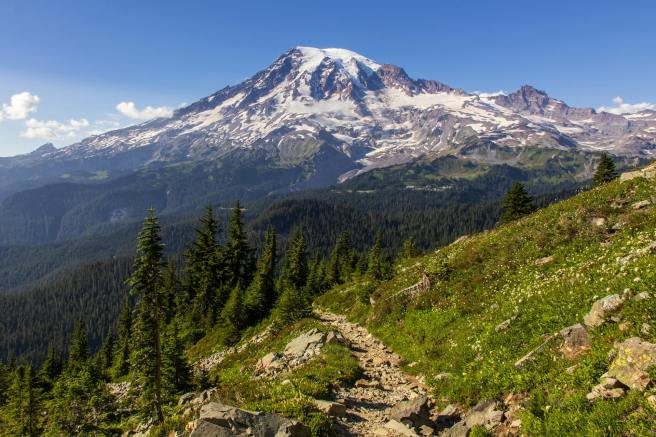
Fremont lookout
Rainier National Park
7,200 feet sea level
Kitty joined me in the ascent from Sunrise; thought she’d stop at Frozen Lake but seeing children’s tracks felt shamed into continuing. Amazing Alpine natural gardens …
Clearest day one could hope for: Adams, Goat Rocks sharp view from the trailhead, yet a violet haze layer over Puget Sound from Olympia to Mount Vernon.
Next page a sketched panorama map showing Mount Baker, Glacier peak, and the Stuarts … plus notation, “Olympics a blue ragged line riding above the haze.”
Sitting up here’s just like riding a cloud.
And thus we are cloud-riders being ambushed by ’monks,
the fearless chipmunks attempting to ride our lunch …
~*~
From Spiralbound Cascadia with commentary.
My encounters with the unfamiliar terrain of the Western mountains and desert had me reading everything I could find. The public library was a good start.
As I noted:
Rainier, honeycomb mountain, radiating heat under all that ice and snow — so fragile a good explosion could level it all … a new appreciation for “the temple tops” …
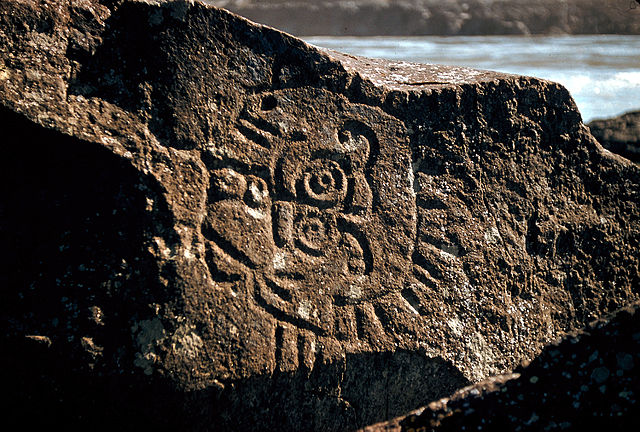
Regarding petroglyphs at the Dalles, to the south of us on the Columbia River:
“It seems impossible to decipher these inscriptions satisfactorily as it is not likely anyone except the makers and those living at the time the work was done could tell what was meant by them” — Newcombe, 1907
Also in Beth and Ray Hill’s Indian Petroglyphs of the Pacific Northwest, 1974, University of Washington Press:
“To make my name good” as a Northwest Native’s goal in life …
~*~

~*~
My explorations fill a number of poems and much of my novel Nearly Canaan and of Kokopelli in the Secret Side of Jaya. In fact, I’ve considered the place to be a central character in itself.
~*~
One book I found most useful in understanding the social differences in the Far West was Anti-California. Many of the points its author raised regarding the Golden State fit what I was seeing in the Pacific Northwest. For instance, few children grew up within a day’s drive of their grandparents or aunts and uncles. He saw that as extending into social life in general, which tended to be more polarized, using the Roman Catholic church as an example in having both one of the most conservative cardinals in the world as well as an entire order of nuns that broke away. (I could add that Quakers there came in two opposite camps, liberal “unprogrammed” meetings and pastor-led evangelical churches.) You get the idea. The author had been a correspondent for Newsweek magazine and other respectable periodicals. I didn’t recall the 1971 book’s subtitle, “Report from our first parafascist state,” or know anything about the author, Kenneth Lamott, father of novelist Anne Lamott. As I’m now hearing, he was quite a flamboyant character, to put it mildly. I do wonder how I’d see that book now.
~*~
From Spiralbound Cascadia with commentary.
Walking unrushed, meaning outdoors, in fresh air, releases something within me: I feel freer. When I begin, I’m like a slightly out-of-tune violin. I enter the woods full of thoughts, problems. The office is still with me, along with many worries. The wind may scurry up leaves, and I jump and then freeze, startled that I may have scared up a large animal of some sort. Or perhaps it’s be a twisting item that resembles a snake. Sometimes the sun stings my eyes. I adjust, from one system of time and timing to another.
As I fall into a rhythm, my mind clears. Poems begin.
In the hills or mountains or along the water, the world is always fresh: sunlight on branches or water.
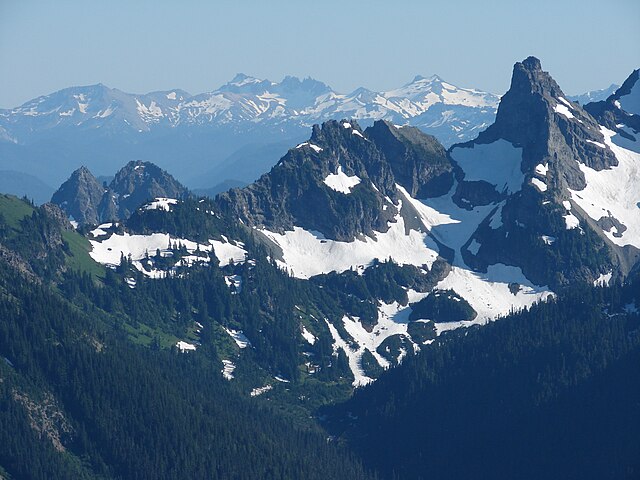
The primary attraction had been the mountains. We were in the foothills on the eastern flank of the Cascade Range. I was getting out into the wild probably every week from summer to the start of winter. Here are a few excerpts.
One of my first exploration, maybe the first, was on a Tuesday I had off work, when I drove up the Middle Fork from Tampico and then logging roads to Darling Mountain crest. Sheep scats and tracks around the snow and awesome meadows. Old site of forest fire lookout, since torn down. Climbed a dead tree to enhance the view. Mount Hood, above clouds. Adams, thrusting into them, closer. Goat Rocks across the way, and St. Helens’ perfect cone beyond. Straight ahead, following the road, Rainier thicker into the clouds somehow superior to the others. Then, a golden eagle sailing straight toward me, turning off perhaps 30 yards away, soaring off, circling briefly, and disappearing. With my guest status, I gave gratitude.
Deep forests were extraordinary.
I had no idea that this was on the second-highest logging road in the state.
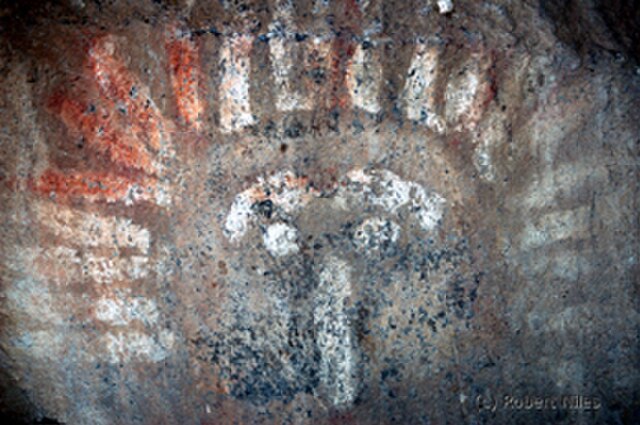
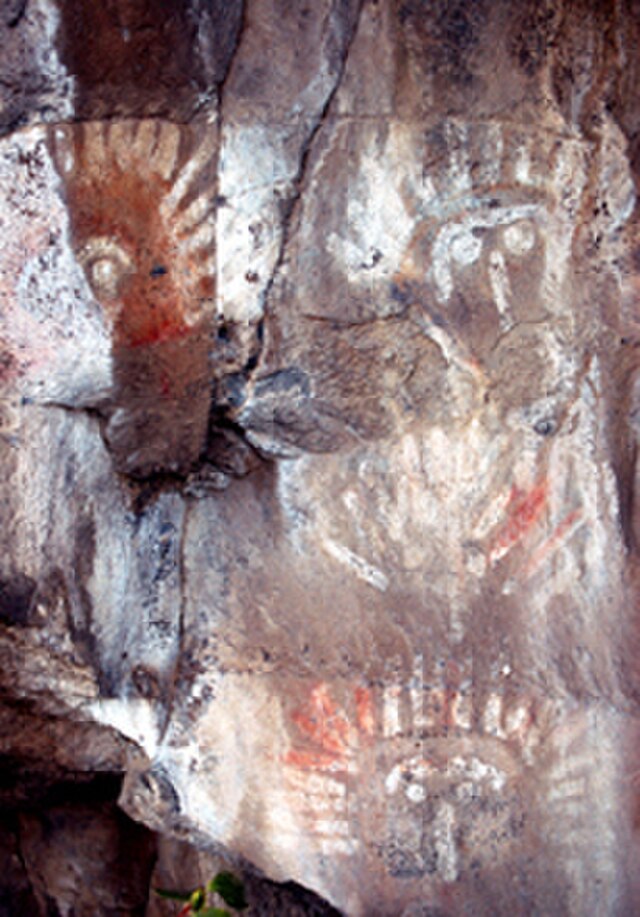
On another trip, on my way to Mount Rainier, saw my first petroglyphs (rock inscriptions) and petrographs (rock paintings) outside of Naches. The paintings looked a little faked — red and white, perhaps with a little blue or red.
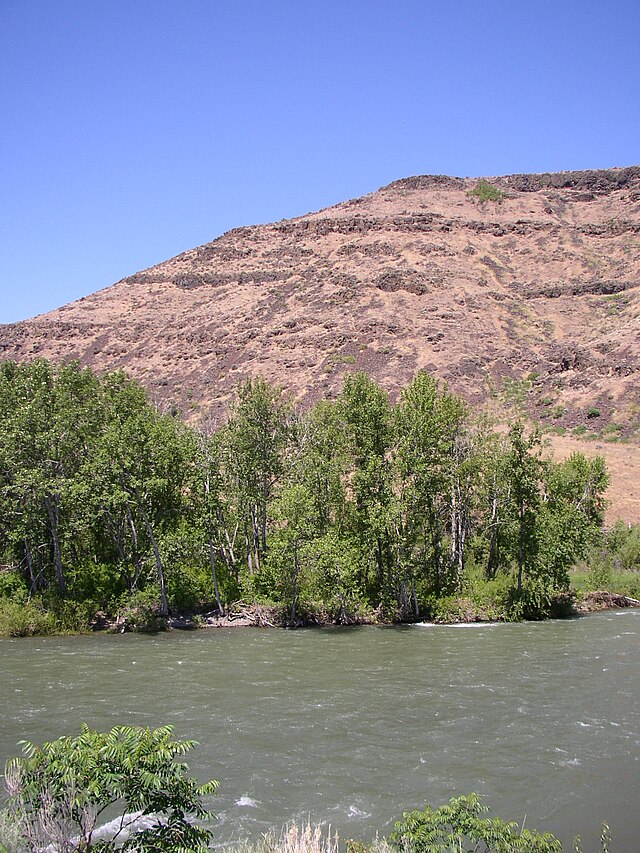
Our routes to Rainier were progressions through ecosystems that became familiar over repeated exposure as we drove from sagebrush desert into ponderosa pines and reservoirs of future irrigation waters on our way to the high country of the Cascade Crest and the rainforests beyond.
Rainier hikes inspired many poems as well as scenes in my novel Nearly Canaan.
Each day trip was intoxicating.
John Day Dam in Columbia River: fish ladder and 80-foot drop of locks: air in stomach, at man’s mass of cement: aluminum company by the RR tracks.
Steam locomotive at Maryhill State Park, reflecting Sam Hill’s source of wealth: Maryhill Museum of Fine Arts, his castle above the palisades, green lawn dropping off into clouds. The sculpture studies by Rodin the claim to fame. During the trip, pondering Mount Adams vs Rainier …
~*~
Sweet vinegar smell of hay [up to 5 mowings a year in the interior Far West; the hay was grown in the sunny lands east of the Cascades, and much of it was trucked to dairy farms and other livestock operations on the rainy western side of the mountains].
~*~
From Spiralbound Cascadia with commentary.

