PLAYING WITH CROWNS, LIKE IN CHECKERS

Last week, I wrote about relearning Spanish and the tree of Crowns the online Duolingo course uses.

As I’ve been earning Lingots for rebuilding those, I’ve had a series of sessions where I’m presented with a sentence or phrase to translate and a set of mosaics or buttons to choose from, one word on each. It’s kind of like a Magnetic Poetry Kit, except that you have to click on the word you want.

In the first hour of my day, my mind wants to run off in whimsical directions.

Here are a few examples.

Approved answer: The girl wants sugar on her apple.

Rejected answer: The girl wants sugar on her husbands.

(Or just a sugar daddy?)

Approved: Are you going to school today?

Rejected: Are you going downstairs today?

(There are days we don’t want to get out of bed, right?)

Approved: I want to go to the movies with my friends.

Rejected: I want to go to the movies with my girlfriend.

(Except that she doesn’t like the action-adventure stuff we do?)

Approved: I always go to work by bus.

Rejected: I always go to work by duck.

(There’s an opera about a guy who goes to work on a big swan. I’d settle on a big yellow duck, wouldn’t you?)

Approved: Do you have to work today?

Rejected: Do you have to speak today?

(Some days simply speaking is a lot of work … especially if it’s in Spanish. That’s the polite explanation. The other one is “Firme la boca,” I think.)

Approved: We don’t open the messages.

Rejected: We don’t open the refrigerator.

(You never know what’s inside.)

Approved: We are buying a car.

Rejected: We are buying a brother.

(Hope he’s worth it.)

Approved: My husband never gets up with me.

Rejected: My husband never gets up on me.

(That would lead to a lot of words we haven’t learned yet.)

Approved: I want a modern kitchen.

Rejected: I want a modern husband.

Also rejected: I want a modern dog.

(Oh, don’t even try to make the connection. Puleeze!)
I START MY MORNING WITH SPANISH

For the past two years, a daily online language class has opened my day. The practice began shortly after the annual sessions of New England Yearly Meeting of Friends, where repeated happenstances with our guests from Cuba had me realizing how much of my high school Spanish I’d forgotten.

Well, a lot of my recall also got tangled up in my college French, but that’s another story.

A conversation with my elder daughter, the linguist, convinced me to try a free online refresher course via Duolingo, which some of you probably know of. The high school text I’d carried since 1964 soon went into the trash – it was terribly dated.

So I rise, usually before dawn, brew some full-bodied, fair-trade Cuban-style coffee beans we get at Costco (they’re like espresso but better), and head off to my laptop in the attic for a half-hour of language learning. Let’s say that at that hour, I make a number of stupid mistakes. I’m still groggy.

A few months ago, the powers-that-be behind the free course decided to alter a few things. It’s inevitable when it comes to anything computer, isn’t it? So instead of seeing something like “You are 67% proficient in Spanish” on the home page, they were taking a different tack. Most startling was that my Crown Level had decreased significantly. Look, that was something that would occur if I missed a few days of practice, but I had been faithful. I felt robbed.

That’s when I started thinking about some of the motivating factors the Duolingo brain trust applies.

The first is something they call Lingots – kind of like Monopoly game cash you can hoard, like me, or spend on things like commentary or idioms. If you do 10 uninterrupted days of study, you’re awarded Lingots – one point when you hit the first 10 days, two more at 20, three at 30, and so on. You can also wager some of yours for other accomplishments. Look, it’s stupid but highly addictive, especially when you reach 150 straight days. That’s 15 Lingots, hombre.

The Crowns, meanwhile, are part of a “learning tree” Duolingo has for advancing. When you start a language, you begin by clicking on a little button labeled “basics,” do the required number of lessons within it, and it soon turns color. You earn a Lingot or two and move on to the next, maybe “articles” or “vocabulary.” Eventually, all of them – 30 to 50, maybe? – change color and you go back to raise each of them to the next level.

Or from that point you can simply do a random set of practice questions. Oh, but that option doesn’t win you a lot of Lingots.

What I really want at the moment is to hit a thousand in my account. Hoard them, in fact. Es muy loco, verdad, but it keeps me going.

And then I move on to the latest manuscript in progress or check up here at WordPress. Both in American English.

ONE WAY TO NAME A CHARACTER

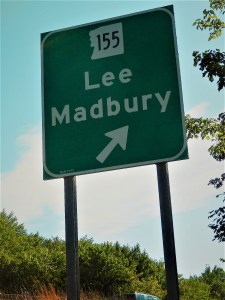
Those highway signs can often take on whimsical readings.

One poetry journal, for instance, took its name from an exit marker of the Interstate crossing from Pennsylvania into Maryland: Northwest Rising Sun. It was for two different towns. Everybody knows the sun rises in the east, not the west. Still, a great name. It pays to be alert.

Likewise, orchestral conductor David Zinman was recording with humorist P.D.Q. Bach (in real life, Peter Schickele) but found his contract with another label prohibited him from using his own name on this project. What could he use instead? Inspiration struck when he was driving on Route 128 outside Boston. That exit sign read Newton Wayland.

More recently, while updating and seriously revising my previously published novels, I set about renaming many of the characters for a better fit.

I’ve passed this sign hundreds of times and often thought it sounded great as a possible character, if only I had the right situation. And then, as I reworked the volume that now stands as Daffodil Uprising, I had the perfect guy to go by the name: LEE MADBURY.

The sign along U.S. Route 4.


REWORKING A TEXT

When several of our lifeguards were complaining about their high-school term papers and having to meet the length requirements, I decided to show them a couple pages of my novel in progress, the book that’s emerged as What’s Left.

They were blown away.

It wasn’t any different from what I’ll assume all serious writers do. Just look at the examples in the Paris Review’s acclaimed author interviews. I remember my own shock at the first few I saw – what, we don’t write flawlessly the first time? Oh, the folly of youth!

Well, nowadays we don’t always work from typescript or even printouts – what I showed the teens-to-whom-I-fully-trusted-my-life had now become the exception. I should have photographed some for posterity but instead trashed them during a purging of my studio under the rafters.

Few readers imagine how thoroughly a serious writer or editor will rework a text – major sentences, even paragraphs, are struck out, new words and notes are scribbled everywhere, even fresh pages of inserts are taped to one side or the other of the page.

Tell them this is from the fifth or seventh revision of the manuscript, they’re even more incredulous. The discarded material is a flood compared to the drop or two they struggle to compose.

As the saying goes, inspiration goes in the first draft, genius comes in the revisions.

As we might add, if one’s lucky.

COMING OUT OF SEMI-SECLUSION AFTER BEING IMMERSED IN REVISIONS

Writers work in many different ways.

Some sit down and write two hours a day. When I read that in interviews, I used to think, “What slackers!” Only later, when I realized how much other work needs to be done to sustain that, did I revise my opinion. Research, reading, and correspondence are also crucial parts of the job. For many professional writers, you can add teaching to the list – it can be what really pays the bills.

Others charge up and then lock themselves away for an orgy of keyboarding. Say, two weeks to two months of doing nothing else. There are tales of some writers in the old days who would rent a hotel room for a week or so to do that – they must have had a very nice advance and known exactly what they were setting out to do, it seems too short a time for me these days.

When I was working full-time, my method was rather piecemeal. I’d plunge into writing heavily one day a week – it helped when my four-day workweek allowed me three days off in a row, though I paid for it with that double-shift each Saturday. The rest of the week I put in a couple of hours each day for keyboarding and the supporting labor.

That schedule, in fact, led me to concentrate on poetry much more than fiction, though the budding novels typically got their attention on my vacations and holidays. Looking back, it was a rather schizoid existence.

Since retiring, a major shift has happened, and I’m just now seeing its impact. I’ve been able to immerse myself in drafting and deeply revising a work, to live with it more thoroughly.

I’m going to blame Cassia, the voice of What’s Left. Working with her was unlike anything I’d attempted before. The focus shifted from her curiosity about her father’s past to a close examination of his photos and the family he discovered to, finally, Cassia herself and her siblings and close cousins – the Squad. The spotlight went from being on what happened to the individuals themselves. It was no longer action-driven but character-driven.

That, in turn, led to a similar reworking of my other novels, often with Cassia in effect sitting beside me. Again, unlike anything else I’d done before.

Doing this, though, has involved a lot of semi-seclusion. I’m definitely ready for a change.

I’VE COME TO ENVY HER OUTSPOKENNESS

As Cassia took on her own voice in the later revisions of What’s Left, she seemed to be dictating her lines, leaving me with the task of taking dictation. There were many times I could barely keep up.

It was a weird sensation. Wasn’t I supposed to be in charge here? It was like I was channeling her from somewhere in the spirit world.

Weirder yet was my envy for her ability to speak as openly and directly as she does. As caustically, too.

Well, she does bear a resemblance to an older woman I know of in the next town, one fondly called simply as Auntie with an outrageous fearlessness in speaking that way.

In contrast, here I am usually censoring myself or at least editing my utterances.

Of course, I also envy Cassia her close-knit family with its well-defined purpose and supportive network. Her Squad, especially, and the way it, too, evolved in the revisions.

And I am grateful for the ways she’s helped me recast the earlier novels leading up to her appearance. That, too, has felt weird, having her sit beside me, in effect, while we thoroughly reworked them. She trashed a lot of material, I’ll admit, and then added a lot more new stuff of her own.

This time, I was all ears.

Authors are advised to know their readers – their target audience – but this takes it one step further.

Any of you have a similar experience?

KEEPING THE COMPANY IN CHECK

Across New England, the spire on city hall typically had prominent clock. Its purpose, I’m told, wasn’t just civic pride.

No, it was to keep the mill owners in check, just in case they were tinkering with their own clocks to squeeze unpaid time out of their workers.

It’s comforting to know the town fathers could stand up to corporate powers. Most of the owners, by the way, lived far from these sources of their wealth. Many of them were Boston Brahmins clustered around Harvard.

In honor of the workers and those who stand up for them, Happy Labor Day.

A FLICK OF THE LEO MANE

Just a taste of what’s popping up. In case you were looking for a prompt.

~*~

  1. This shift in my wilderness destinations, from mountains to ocean. When did that happen?
  2. The ripening of peaches spurs trips to our favorite pick-your-own orchard a half-hour to our north. More trips will follow for apples.
  3. Maybe I really am an “advocate of living-up-the-world-in-your-own-village,” as one comment chimed.
  4. I do like the concept of transitioning, rather than progressing, with all of its assumptions.
  5. Overheard at Walden Pond: “No, they won’t even get in a car anymore. They ride their bikes everywhere.”
  6. The Wiggly Bridge for hikers beside the York River. One way to get over high tide.
  7. Home Depot workers call their pesticide section the Wall of Death.
  8. So many field notes from spiritual aspiration and practice springing from a muse of fire. The one that’s sometimes scorched me.
  9. My life as a failure. There’s no autobiographical novel to be written on my last 30 years.
  10. A bumper sticker I’d like to create: I’D RATHER BE READING.

~*~

Downtown venting, here In Dover.


TEN REASONS TO GO TO YEARLY MEETING

In Quaker organizational structure, the ultimate decision-making body is the Yearly Meeting – so named because of its annual sessions. While the central event is the convocation, the organization itself (also called the Yearly Meeting) has ongoing activities and committee meetings throughout the year. One of the purposes of the gathering is simply to coordinate and nurture these missions.

Unlike some denominations, we have no central headquarters. Our Yearly Meetings are rather distributed across the country and the globe, and these bodies work together through cooperative affiliations, shared projects, communication, and inter-visitation.

My local Friends Meeting is part of New England Yearly Meeting of Friends, the oldest such body in the world. In fact, when more than 800 people – representatives, their spouses, and children – assemble next month on the Castleton University campus in Vermont, it will be our 358th gathering. (Until 1905, we met in Newport, Rhode Island. Since then, we’ve moved around New England.)

Here are some reasons I attend, whenever possible.

  1. It’s inspiring. I’m reenergized and refreshed by the daily devotion of some very dedicated Friends I’ve come to treasure over the years. Some of them are deeply involved in peace and social justice work. For others, it’s environmental or economic. And still others, it’s radical theology. For all, it’s rooted in a shared faith.
  2. It’s challenging. My assumptions are tested from alternative perspectives and actions are questioned in rounds of profound introspection and spiritual direction – something that’s ultimately cleansing and refreshing.
  3. The Bible Half-Hour. Each year a respected Friend is invited to discuss selected Biblical texts and stories in the half-hour right after breakfast each morning. Last year we spent 2½ lively hours on a single sentence from Romans. It’s rarely anything you’d expect to hear from a pulpit but rather a personal journey that’s an eyeopener in more ways than one.
  4. We’re always eating. Or so it seems. Dorm food was never like this back when I was in college – it’s gotten so much better. The reality is that we’re usually lingering over animated conversations, sometimes at a table set aside for a specific topic or group focus.
  5. The clerking. Crucial to the success of Quaker business is the skill of our clerks. At Yearly Meeting, this means the presiding clerk, two recording clerks who are minuting our deliberations, and two reading clerks. Since we arrive at decisions without ever taking a vote and still face crowded agendas, clerking is a unique art. Time after time, what I observe is the best. Admittedly, though, sometimes it can be trying – very trying.
  6. Few of our Meetings include music as part of our worship, but Yearly Meeting has times that reveal the amazing voices and talents in our midst. These can be emotionally moving.
  7. Workshops and “opportunities.” Tucked into each day are short presentations, discussions, or even documentaries based on particular interests Friends carry. These can be anything from parenting and child care to Mideast peace to nomadic reindeer herders to new publications to theology or history. I hate it when three or four at the same time compete for my attention.
  8. Just good to get away. It’s a unique kind of vacation. Who could possibly complain about driving across New Hampshire and Vermont, for instance? Period.
  9. The contacts. This means reconnecting with incredible people and being introduced to more – individuals I’m likely to be working with somewhere in the future, and perhaps even in the past. I’m often surprised when someone I don’t recognize says, “I remember when you …” So far, it’s always been in a positive light.
  10. We’re building on a revolutionary foundation. The Quaker movement emerged in the upheavals of mid-1600s Britain, one of the most incredible periods in history when it comes to social, economic, political, and religious breakthroughs. Being part of a group central to that legacy and its continuing advances is both humbling and exciting, especially in the face of the difficulties of our own time.

 ~*~

Is there a similar assembly – maybe a camp? – that you like to attend for similar reasons? What is it? And why?

~*~


Continuing the poetry parade, see what’s new at THISTLE/FLINCH.

WELCOME TO AMERICA

In my new novel, What’s Left, her mother’s grandparents sail from Patras, Greece, to America in the years just before the First World War. In contrast, her father’s side appears to have farmed the Midwest in the oblivion of forever.

In observance of Independence Day, here are images from the Library of Congress in homage to those immigrants who arrived in that period by way of Ellis Island in New York Harbor.

Greeks board rowboats to a steamer in Patras to begin their voyage to the New World.
The faces on these women still say everything.
Imagine the anxiety of approaching the registration desk, to learn if it’s yes or no or maybe.
The view of the harbor filled with hope and the unknown.
Think of all that’s left behind, too.