A generic side to Dover’s downtown transformation

As I’ve looked with delight at the renaissance of my small city’s downtown, one modeled in part on Jane Jacobs’ then revolutionary attack on urban renewal back in the ’50s, I am a bit bothered by how much of it is now based on a commercial cookie-cutter concept known as mid-rises – five-story stick-frame construction above a steel-frame pedestal that’s then given a brick or similar exterior facing.

It’s happening all over the country, actually, and not just in the heart of a city, either. Even here in Dover, we’re seeing something similar happening about a mile south of downtown as an over 50s-something neighborhood called Pointe Place with rents that astound me. Who can afford it? Some retirees, apparently. It’s a downtown within a doughnut, in effect. You can’t really walk there from anywhere else.

Of course, the Covid-19 pall casts a big shadow over these developments, but some observers say it might encourage more people to move from big cities to smaller communities like ours. We’ll have to be patient and see what actually unfolds.

As I’ve argued here in various forms, I’d rather have a real city center abutting organic neighborhoods, one with a funky fringe of mixed-use buildings, unlike apartment complexes surrounded by parking lots along the major highways or shopping strips.

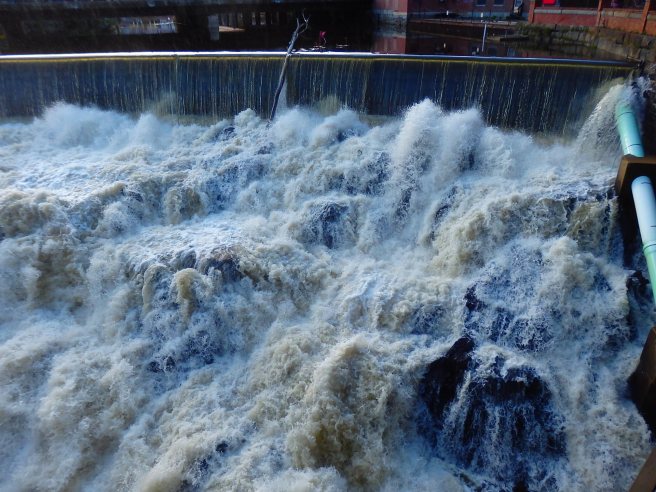
What we definitely have here in Dover is the attraction of a river that rises and falls with the tide, as well as the historic mills once renowned for their calico and now serving as entrepreneurial incubators and housing.

Call it atmosphere and scale.

~*~

As Dover’s emerged as New Hampshire’s fastest growing city, the bulk of the new downtown residents are presumably singles and child-free couples, either young professionals or older folks who want the amenities of living close to restaurants, parks, and public events.

The retail and professional rentals are a larger concern, though, especially as many small merchants find themselves at a disadvantage against Amazon. Take the local hobby shop as an example. And that’s even before the bigger threat of coronavirus hit the entire economy.

Even so, these projects haven’t been on hold.

OLYMPUS DIGITAL CAMERA
The new Orpheum takes shape downtown, matching the height of the old Masonic building to its east and the old Strafford Bank across from that. The spire at top left is city hall, a block away from the back of the new building in what was previously a parking lot.
The Robbins Block storefronts are now gone and a five-story Orpheum is rising in their place. The hardware store, lower right, is still there. From the top left are the library, community center, and district court.

The old block may look charming in the photo, but the buildings were rundown and unwelcoming to pedestrians, as was the sprawling parking lot behind them. There was also a traffic bottleneck that’s being eliminated.
An aside on poetry readings

Catching up on my stack of Harper’s magazine, I came across a remembrance of the poet Etheridge Knight, and it stirred a long buried memory.

Etheridge? I paused, before remembering he was a black inmate of the Indiana State Penientiary when he began writing seriously. Damn good stuff, as I discovered.

My introduction came in the mid ’70s when Roger Pfiingston asked if I wanted to go with him up to Indianapolis, aka Naptown, to a reading and open mic. I was free that night. The trip from Bloomington was a little over an hour, and he was driving.

The event was at a bar in the inner city, not a familiar terrain, and Etheridge was hosting. I should go back to my journals for details, but I recall it as a warm and comforting evening. I think Jared Carter was the featured reader. Another damned good Indiana poet.

I was a bit nervous about one of the pieces I’d brought with me, one that quoted a friend’s father about a lover in the ’30s, but I read it anyway.

The line in question triggered delighted, loud laughter from Etheridge, especially. I was sooooh relieved!

Looking back, I see it as one more confirmation – and welcome – as my identity as a poet.

What a wonderful community!

Zoom? Ten takes on group meetings online

By now, you’ve probably had your fill of Zoom or GoToMeeting or Skype. (Any others I haven’t heard of?) They’ve become inescapable, it seems, and essential.

Here are ten takes from my end.

  1. We don’t look good, folks. Everybody looks older. More wrinkled. Distorted, too. (There are reasons actors use so much makeup!)
  2. We spend too much time on trying to figure out what we’re doing. It’s not just the agenda, but mostly about getting settled, figuring out who’s “here,” and tweaking our settings. It’s a real problem when we have only 40 minutes total.
  3. Tech confusion. Are you muted or not, why isn’t this or that working, that sort of thing.
  4. Remembering to cover or uncover the camera
  5. We sound wobbly. That, and all the awkward pauses and unintentional interruptions. Oh, yes, and all the ambient noise if a group is mostly unmuted.
  6. The moderator is very important. Though trying to chair a meeting and simultaneously man the controls is a bit much. We really need a “producer” for that.
  7. Selecting who’s to speak next. Do we raise a hand to the camera or press the little hand button instead? How about the Chat function? Are we unmuted? This gets difficult once the group gets bigger than a handful and the moderator has to keep scanning the panels that were offscreen.
  8. We get to “visit” in others’ homes. Often, the scene is an individual’s dining area or study, but we’ve also been outdoors on a porch and down in the cellar (which looked and sounded more like an Apollo space mission). It’s been fun seeing other sides of our friends this way, though often the lighting’s not so hot. (See Point 1.)
  9. Remembering to “attend.” Or to send the invitation out to all in time. Somehow, we’re losing track of time, even the day of the week, in this self-isolation.
  10. Doesn’t work as well on smart phones or tablets. No, you really do need a laptop, PC, or large screen for optimal control.

What stands out from your encounters?

Greetings from the bunker

Unlike many journalists, who lust after the scoop – to be hailed as the first to the punch in revealing the newest surprise in a hot ongoing drama, especially – I preferred to wait for the dust to settle a bit so we could discern the bigger picture. Yes, I was still competitive, but too often all the latest clamor struck me as confusion. What’s REALLY going on here, rather than who’s speaking the loudest or all that, is what I wanted to hear.

(Actually, with the presence of ’round-the-clock cable news and Internet connections, it’s gotten much worse. Just look at how the current resident of the White House stirs up something fresh before the outrage of his last errant lunacy can even sink in.)

The Covid-19 situation is turning into something similar. Who can keep up with the story? There are so many elements, not just the latest numbers or locations.

We’re definitely facing some ominous long-term impacts here, and we’re not getting much clarity yet.

A big exception has been voices like the Atlantic, as well as the New York Times and Washington Post.

~*~

For me, many of the biggest issues emerge around the question:

Who’s going to pay for this?

Wall Street still hasn’t factored in the debt load, unless maybe as inflation. Make that HUGE debt load and HUGE inflation, unless the wealthiest five percent of the population come to the rescue, whether they want to or not. We can look at their gains via tax cuts as longterm loans to be repaid royally now.

As a few of the clairvoyants have noted, many of the problems now emerging have been long simmering and coronavirus is merely bringing them to the fore.

Student debt loan would be one, especially if bankruptcies become widespread.

The future of retailing would be another. And the entire medical system.

The lack of antitrust action in the face of cable operators, Amazon, Walmart, and the like would be yet another.

We get glimmers here and there, but little in the way of big pictures, which are ominous.

As one voice emphasized, we do have socialization in America, but not for the people. We’ve privatized profits while socializing risks for big corporations. That’s not real capitalism. Just watch as they line up for a bailout at the public trough. Keep an eye especially on the ones laying off people and closing plants while taking the aid for themselves and their overpaid top executives. How about tying any aid to an exchange of stock placed in public trust funds, for starters?

By the way, is anyone else aghast at the Donald’s insistence on putting his signature on those relief checks, as if he’s paying out of his own pocket? Such bombast!

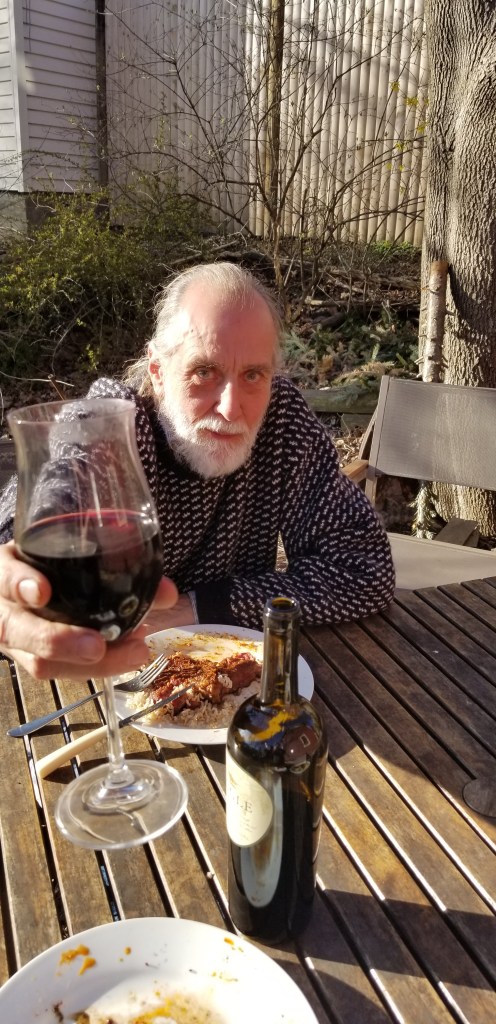
Well, we can’t go out to dine, but we can get an early start on grilling in the Smoking Garden beside the barn. Cheers!

~*~

One canary-in-the-mine-shaft question of mine asks:

How will performing arts organizations survive this shutdown?

For me, they’re essential components to society. The artists have trained all their lives for what are often marginal wages, and the supportive structures are not easily created. Rebuilding audiences will not be easy, especially in the face of damaged incomes in general. Yet they’re crucial to the fabric of civilized community.

Unlike sports, the arts don’t have huge advertising revenues. They reflect a number of similar services that make our communities better places to live, no matter how modest their seeming place in the overall scene. We need to make note of them, too, and redress the suffering.

~*~

Is anyone else watching the impact as Covid-19 spreads from the big cities into the suburbs and rural areas – that is, from urban (which also translates as black and immigrant and blue) into red-district Trump country? The virus is no longer a safe distance from “them,” or what was originally dismissed as a liberal hoax to tarnish their cult leader, and instead clearly appearing as a cruel reality. We’re back to the already fragile state of health care in rural America, for starters.

~*~

The fact is, at the rate Covid-19 cases were initially multiplying, we could have had 40 million infected people by Easter, had we not gone into quarantine. As I almost quipped back then:

How would the nation’s funeral industry cope with an extra 450,000 corpses?

As one friend said

It’s like we’re living with no destination. We can go out for a walk but can’t stop casually at the store or the library or café. Maybe wave to neighbors through a window.

To call what we’re doing “monastic” misses the mark. After all, monks live in communities, working and praying together. And being single, as he is, still doesn’t mean monkish.

We can’t hug or even touch anybody outside of our household, not if we’re maintaining quarantine.

Humans are social animals, after all.

At the moment, the one thing that makes sense doing is prayer.

Ten things to look forward to in ‘normal’

To put the U.S. coronavirus crisis in perspective, consider that its toll has surpassed the 58,220 deaths of American servicemen in the Vietnam war. And to think, it would have been much worse if we hadn’t hunkered down, even as the virus continues to multiply.

Yes, I know it’s premature to expect our social lives to be returning to “normal” anytime soon, but let’s keep the hope alive.

Here are ten things I’ll say we’re missing.

  1. Worship. Gathering together, not just solo meditation. Followed by hugs and handshakes. Even weddings and funerals are on hold. Don’t overlook regional board meetings, annual sessions, community suppers, or big festivals, either.
  2. Live public events. Let’s start with concerts, theater, dancing and dance, sports of all sorts, both as players and fans. Add festivals, graduations, political rallies, public lectures, governmental meetings. The things that bring us together as a community.
  3. Swimming and the gym. For me, this includes the daily banter with fellow swimmers I’ve come to know and the lifeguards, too. It’s like workout partners and trainers at the gym, so I’ve heard. Long walks just aren’t the same.
  4. Eating out and meeting for a drink. Let’s throw in catching up with a friend over a cup of cappuccino or stopping off somewhere while off on that stroll. A phone call is a poor substitute.
  5. Shopping. Yes, we can still go to the grocery (kind of), but many other places are closed. As for yard sales, where we find some of our best stuff without them? I’ll put banking in person here, as in being able to walk into the lobby.
  6. Beaches, parks, playgrounds. I couldn’t even harvest seaweed for garden mulch this year. Seriously.
  7. Health care and grooming. How much can we put on hold? OK, I don’t need a barber these days, but my cardiologist would like some blood work at the lab and our rabbits need their nails trimmed, which has been happening at the high school’s animal sciences center, or was.
  8. Travel and transport. As I posted about not going to Boston recently or noting friends stuck without cars (and we can’t really offer them rides, either). Add to that airlines, not that I was planning on flying. But we really would like to get away from the house for a weekend breather.
  9. Libraries and museums. Special sanctuaries.
  10. Community care. Things like the soup kitchen and fundraisers. And places with public restrooms when I’m out on those long walks.

Schools I’ll set aside as a whole special category.

What are you especially missing these days?


Does Covid-19 spell the death of local newspapers, too?

Jack Shafer of Politico magazine recently aired his argument against including newspapers in stimulus aid for companies hurt by what he calls the coronavirus apocalypse. As his title says, “Don’t waste stimulus money on newspapers. You wouldn’t put a dead man on a ventilator, would you?”

It’s a harsh assessment, coming not from a right-wing fanatic but someone who values the experience of reading the news on paper. He knows all too well the precarious state of the news industry even before the Covid-19 devastation, and I hate to admit I have to agree with him.

If you want to see my take on some of the deep systemic financial problems, just turn to my novel Hometown News, available as an ebook.

For a little perspective, you have to realize you can’t even purchase blank newsprint for the cost of your local paper, and that’s without anything on it or delivery to your doorstep or favorite store or the box on the corner.

Shafer is not talking about the handful of national papers that are thriving, thanks to a surge of online subscribers during the Trump nightmare. He’s talking about the local papers across the country, many of them now owned by hedge funds and similar short-view gaming investors. The kind of enterprise that has gone from family ownership with roots in the community to a global conglomerate that sees money in liquidation, as in who-are-you-all-anyway and why-do-you-matter when it comes to the locals.

Well, with oil companies lining up for relief aid, newspapers definitely should be higher on the list. But I digress.

In some ways, the papers are a canary in the mine shaft, or a dinosaur looking into the eyes of an approaching train, if you care to mix metaphors. Remember what happened to the railroads, after all, when the Interstates were built … with public money. Again, I digress.

The biggest question for me is what happens to local communities if and/or when the local papers expire.

First, of course, is that the public loses an essential watchdog on grassroots level politics. Believe me, local officials act differently when they know they’re under scrutiny. It will cost you dearly when they’re not.

Covering their meetings and the impact takes time, knowledge, ability, and courage. If you’re simply blogging in your spare time, you can be bullied or miss the follow-up phone calls. ‘Nuff said there. We’re facing a threat to ground-level democracy, OK? How many of us can really afford a lawyer?

Second, though, is the loss of local identity. I think most newspapers have fallen down here, failing to raise distinct columnists you just have to read first thing in the morning, but that’s not the only problem. How important is your neighborhood and the general area to you, anyway? Do you even know your neighbors?

A third problem involves the local economy. For one thing, there’s been a huge shift in local retailing, from mom-and-pop stores to the big-box intruders at the mall or Miracle Mile and then online, as in Amazon. The mom-and-pops are the lifeblood of newspaper revenue. Those glossy inserts pay next to diddly. And when’s the last time you saw anything from that monster Amazon or even Craig’s list, which is killing the classifieds?

The obvious shift would be from on-paper publication altogether to online presence only, but no newspapers have figured out how to manage this. It requires subscriber-paid content. Web users are way too used to getting everything for free.

By the way, I hope television and radio are not included in the assistance packages. Yes, they, too, are suffering loss of ad revenue and audience. Rotsaluck. Their news coverage, meanwhile,  often rips off a lot of newspaper stories and then act as if they actually had reporters there. Who will take up the slack? Again, rotsaluck.

Which leads me to one more thought. Sports radio. That once hot-in-the-ratings screaming format that pushed broadcasting from music to talk and then to professional, mostly, athletics – with regional loyalties and identity. What’s happening there, now that nobody’s playing?

Where are you getting your community news?

As the supply chain breaks down

First, it’s chicken, as we discovered trying to reserve thighs for the local soup kitchen. Our usual supermarket can’t guarantee us it can have them for Thursday.

(Let’s not start a run on the stores, though. They should be smart enough to be limiting purchases to one per customer or so by now.)

Next will be pork, apparently, followed by beef.

Blame the Covid-19 outbreaks out in the big-producer lands. Workers too sick too work.

I’m wondering about eggs, though many of those are grown locally. I hope.

What do you suppose those protesters out in Michigan are going to do about this?

Two more years of THIS?

We were wrapping up yet another committee session on Zoom and trying to look ahead to our next one when one member made an unsettling comment.

Said he, “I don’t expect to be out of this (self-isolation) for another two years, not until they have the vaccine in place.”

He’s a retired medical professional, and the other (now unretired) one in our group didn’t correct him.

It’s a gloomy prognostication, not just personally, I’ll admit as senior with a pre-existing condition, but as one considering its dire social consequences as well.

I was going to say the quip hit like a ton of bricks, but considering that the emotional impact had more of a slow motion effect, I’ll say like a ton of hay (hey, a ton is a ton, right?).

So much for dashing our hopes.

I think I’ll go listen to “Casey at the Bat” again, the poem with the phrase “but there is no joy in Mudville.” As if we’ll ever again have baseball, either.

Your turn to whine! I’m all ears.