I START MY MORNING WITH SPANISH

For the past two years, a daily online language class has opened my day. The practice began shortly after the annual sessions of New England Yearly Meeting of Friends, where repeated happenstances with our guests from Cuba had me realizing how much of my high school Spanish I’d forgotten.

Well, a lot of my recall also got tangled up in my college French, but that’s another story.

A conversation with my elder daughter, the linguist, convinced me to try a free online refresher course via Duolingo, which some of you probably know of. The high school text I’d carried since 1964 soon went into the trash – it was terribly dated.

So I rise, usually before dawn, brew some full-bodied, fair-trade Cuban-style coffee beans we get at Costco (they’re like espresso but better), and head off to my laptop in the attic for a half-hour of language learning. Let’s say that at that hour, I make a number of stupid mistakes. I’m still groggy.

A few months ago, the powers-that-be behind the free course decided to alter a few things. It’s inevitable when it comes to anything computer, isn’t it? So instead of seeing something like “You are 67% proficient in Spanish” on the home page, they were taking a different tack. Most startling was that my Crown Level had decreased significantly. Look, that was something that would occur if I missed a few days of practice, but I had been faithful. I felt robbed.

That’s when I started thinking about some of the motivating factors the Duolingo brain trust applies.

The first is something they call Lingots – kind of like Monopoly game cash you can hoard, like me, or spend on things like commentary or idioms. If you do 10 uninterrupted days of study, you’re awarded Lingots – one point when you hit the first 10 days, two more at 20, three at 30, and so on. You can also wager some of yours for other accomplishments. Look, it’s stupid but highly addictive, especially when you reach 150 straight days. That’s 15 Lingots, hombre.

The Crowns, meanwhile, are part of a “learning tree” Duolingo has for advancing. When you start a language, you begin by clicking on a little button labeled “basics,” do the required number of lessons within it, and it soon turns color. You earn a Lingot or two and move on to the next, maybe “articles” or “vocabulary.” Eventually, all of them – 30 to 50, maybe? – change color and you go back to raise each of them to the next level.

Or from that point you can simply do a random set of practice questions. Oh, but that option doesn’t win you a lot of Lingots.

What I really want at the moment is to hit a thousand in my account. Hoard them, in fact. Es muy loco, verdad, but it keeps me going.

And then I move on to the latest manuscript in progress or check up here at WordPress. Both in American English.

TEN SIGNS IT MIGHT BE LOVE

You’re dressing better than usual, paying attention to the personal hygiene, even cleaning the car or apartment. My guess is this could be serious, especially if you’re coming down with any of these symptoms.

  1. It’s ALL magic when you’re together. Everything else becomes secondary.
  2. You glow in your darling’s presence. Yes, lightness.
  3. Make that giddiness. And fumbling.
  4. You’re convinced this is fresh history. The past is just that. Life’s beginning anew or maybe for the first time, ever. You’re even talking funny. To match your emotions and wit.
  5. You like their car or dog even though you’ve always been an ardent cat-hater or dog-kicker.
  6. You agree to go places or do things you’ve never ever imagined yourself venturing.
  7. You feel joined at the hips and shoulders … and not just the lips.
  8. You’re Superman and Wonder Woman at last.
  9. When you’re apart, you’re falling through space … without a parachute.
  10. You get knowing looks … from strangers.

~*~

The obvious signs must be endless. Which ones can you add?

~*~

Continuing the poetry parade, see what’s new at THISTLE/FLINCH.

ONE WAY TO NAME A CHARACTER

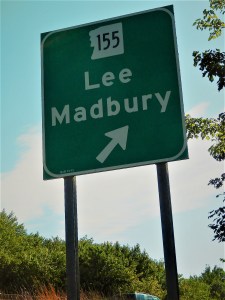
Those highway signs can often take on whimsical readings.

One poetry journal, for instance, took its name from an exit marker of the Interstate crossing from Pennsylvania into Maryland: Northwest Rising Sun. It was for two different towns. Everybody knows the sun rises in the east, not the west. Still, a great name. It pays to be alert.

Likewise, orchestral conductor David Zinman was recording with humorist P.D.Q. Bach (in real life, Peter Schickele) but found his contract with another label prohibited him from using his own name on this project. What could he use instead? Inspiration struck when he was driving on Route 128 outside Boston. That exit sign read Newton Wayland.

More recently, while updating and seriously revising my previously published novels, I set about renaming many of the characters for a better fit.

I’ve passed this sign hundreds of times and often thought it sounded great as a possible character, if only I had the right situation. And then, as I reworked the volume that now stands as Daffodil Uprising, I had the perfect guy to go by the name: LEE MADBURY.

The sign along U.S. Route 4.


TAKE A SELFIE WITH WILLIAM PENN

If the weather is fair, Dover’s annual Apple Harvest Day today will attract a crowd twice the size of the city’s population to the downtown.

Since there are no commercial orchards within the city limits, I’ve always been baffled by the festival’s name, but it does come a week ahead of the Columbus Day holiday, when most of the other communities in the state host end-of-the-season blowouts. It’s nice to beat the competition.

For several years now, Dover Friends Meeting has been among the nonprofit organizations that have participated. Our canopied booth offers a meet-and-greet opportunity to let people know that Quakers do indeed still exist and to invite folks to join us in reflective worship on Sunday mornings.

We’ve heard that as a nonprofit, we need to make 17 positive impressions, on average, before anyone responds, so we’re not discouraged if people don’t show up in our meetinghouse later.

It’s a two-way street, frankly. Answering questions can be a big way of getting a clearer view of the way others see us.

I was startled, for example, when one woman asked if you have to be a protester to be a Quaker. (Answer: No!)

And when some confuse us with the celibate Shakers, we now respond, “Shakers made beautiful furniture. Quakers make trouble.”

And last year, many folks told us how much they appreciate our “Love Thy Neighbor, No Exceptions” banner across the front of our building.

This year we’re setting out to have fun. Period.

You know, take a selfie of yourself standing with William Penn. Well, someone dressed as a not-too-accurate impersonator. Or you can make your own real Quaker rolled oats using one grain, a hammer, and an anvil. (Watch your thumb, please!)

Or here, have an oatmeal cookie or take a recipe for granola.

That sort of thing.

We’ll still have a bowl of water out for passing dogs and, as a new touch, a small changing station for parents or grandparents with infants.

It’s still a work in progress. Will probably always be, I hope.

TIME TO BLOW THE DUST OFF A FEW STACKS

As my wife and I started listing what’s keeping us busy these days, we were both surprised to find that one thing – one important thing – was missing.

What we both realized is that regular reading … as in books … had been pressed out of our schedules.

Instead, we’ve been doing bits and pieces of reading online. It’s just not the same as luxuriating in a deep volume.

How about you?

TEN THINGS I LIKE ABOUT OCTOBER

  1. Foliage. This is New England, after all.
  2. Cool evenings. You snuggle under the blankets, sleeping with the windows cracked slightly open.
  3. Apple Harvest Day outreach. Meet a Quaker’s our pitch.
  4. Mums in pots everywhere.
  5. Butternut squash soup.
  6. My annual survey of Charles Ives symphonies and then George Whitefield Chadwick’s.
  7. Pumpkins as décor … and as crisps and pies. Although we’re rather appalled by its spread into coffee and beer.
  8. Fresh unpasteurized apple cider.
  9. Sitting in the loft of the barn again, reading.
  10. Intense full moonlight.

~*~

What do you like about October?

~*~

Historic company housing for mill workers in Manchester, New Hampshire. I used to enjoy walking through the millyard this time of year.


GOTTA LOVE THOSE APRONS

In my new novel, What’s Left, there’s one thing you can say about aunt Yin: she adds another fashion touch to the family. I love the aprons she introduces to Cassia’s aunt Pia, Yin’s brother-in-law’s wife.

Oh, those two form quite a contrast!

And yet? They play off each other perfectly.

~*~

I’ve never been a suit-and-tie kind of guy, although I do have a wild tie collection for use, when needed. I’ve been more known for my Converse sneakers (before they were “in”), my Hawaiian shirts, or even my scarves back when. (Scarves were a writer’s thing in some circles.) These days it’s more likely to be turtlenecks, by the way, with my ponytail.

What’s your most distinctive fashion flair or statement? Something simple? Or do you like to go quite elaborate?

~*~

Traditional Greek Easter lamb and kokoretsi. I do wish the cook was wearing an apron. Photo via Wikimedia Commons.

In the family, Cassia may have had food like this.

REWORKING A TEXT

When several of our lifeguards were complaining about their high-school term papers and having to meet the length requirements, I decided to show them a couple pages of my novel in progress, the book that’s emerged as What’s Left.

They were blown away.

It wasn’t any different from what I’ll assume all serious writers do. Just look at the examples in the Paris Review’s acclaimed author interviews. I remember my own shock at the first few I saw – what, we don’t write flawlessly the first time? Oh, the folly of youth!

Well, nowadays we don’t always work from typescript or even printouts – what I showed the teens-to-whom-I-fully-trusted-my-life had now become the exception. I should have photographed some for posterity but instead trashed them during a purging of my studio under the rafters.

Few readers imagine how thoroughly a serious writer or editor will rework a text – major sentences, even paragraphs, are struck out, new words and notes are scribbled everywhere, even fresh pages of inserts are taped to one side or the other of the page.

Tell them this is from the fifth or seventh revision of the manuscript, they’re even more incredulous. The discarded material is a flood compared to the drop or two they struggle to compose.

As the saying goes, inspiration goes in the first draft, genius comes in the revisions.

As we might add, if one’s lucky.

TEN WAYS THIS ‘DAFFODIL’ IS NEW

My newest novel, Daffodil Uprising, is a thorough revision of the earlier Daffodil Sunrise. Nearly half of the original book has been excised and replaced by twice that amount of new material, for good reason.

Here are ten of the big differences.

  1. The events and characters are now seen through the eyes and snarky voice of Kenzie’s daughter a generation later. They are Cassia’s discoveries about her father’s college years in the turbulent 1960s, pro and con.
  2. As the subtitle says, the focus is on the making of a hippie. The college and its good-old-boy network of abusive power and greed earn much of the blame.
  3. Kenzie’s growth as a budding photographer gets fuller attention, along with his artistic advances. It’s his basic reason for coming to Daffodil, after all.
  4. His girlfriend is a much more complex and troubled creature. She has good cause to be chafing in her relationship with him. And he, in contrast, is so truly naïve. Something’s got to give.
  5. Most of the characters have been renamed and are more uniquely defined. They and their actions have new grounding in everyday life.
  6. Kenzie’s buddies are no longer a pack of emerging radicals in action but rather a lineup of widely varied boyz stumbling along in a confounding environment. His dorm’s underground traditions are handed down through a band of quirky seniors and juniors who serve as wise elders and guides to neophyte freshmen like Kenzie. It’s a colorful crew – one that teaches him as much or more than his professors, in fact.
  7. The narrative’s giddy, upbeat, and sometimes sophomoric youthful optimism is now countered by darker forces of oppressive greed, violence, and despair. Bad drug trips and protest bombings accompany the scene.
  8. There’s now an element of Goth. This is a college campus, after all. Why should Hogwarts be all that different?
  9. There’s also a strand of the paranormal. You ever live in a creepy old apartment building or have the subject of a term paper start talking back to you?
  10. The work now stands in fuller correlation with What’s Left, a generation later, and the two other novels that follow him after college.
Daffodil Uprising

For details, go to Smashwords.com.

THE IMPORTANCE OF SMALL TOUCHES OVER TIME

From our perch today, it’s hard to believe that a Broadway musical like “South Pacific” could have been a bold statement on behalf of racial tolerance a half century ago.

I’m encouraged, of course, to see a Quaker connection.

First, even though the novelist James A. Michener, whose book was the basis of the show, had served in the U.S. Navy during World War II, he was raised by a Quaker adoptive mother and attended Quaker-affiliated Swarthmore College. In other words, he had been exposed to both pacifist and racial equality values.

Second, as Vanity Fair writer Todd S. Purdom notes in “The Road to Bali-hai,” is that librettist Oscar Hammerstein’s wife’s niece Jennifer attended the George School, another Quaker institution, one where Michener also taught briefly. The Hammersteins’ own son Jimmy also went there, as did a young family friend named and future Broadway great Stephen Sondheim. (And to think how vigorously earlier Quakers denounced theater as vain entertainment!)

Purdom’s article contains another telling point. The hit song “I’m Gonna Wash that Man Right Out of My Hair” was originally a flop. In the preview performances before the Broadway opening, director and co-author Josh Logan was perplexed to see it wasn’t connecting until he realized that star Mary Martin had the women in the audience so abuzz about whether she was actually washing her hair onstage that nobody ever heard the lyrics themselves. He fixed that by having her belt out the first stanza before working her hair.

I wonder about how many other small changes in any art form spell the difference between boffo hit and mundane shelving.

A similar tweak in “Wonderful Guy” changed the song to a soliloquy with the word “you” substituted for “they.” As Logan recalled, “That night they tore the house apart.”

As I was saying about small changes or a simple touch? Never underestimate the importance of revisions in art. Or maybe life itself.

~*~

Michener, by the way, wrote of his experience on the Electoral College elections with the telling title on his political science volume, Presidential Lottery: The Reckless Gamble on Our Electoral System.

He was so prescient there.