TEN TASTY FISH

Living a few miles inland from the Atlantic, I’ve learned a few things when it comes to fresh fish. Just be sure to stock up on lemons and melted butter and maybe a few spices and fresh parsley.

  1. Cod. Once available in unbelievable quantities, it’s become scarcer and costlier. Still, it’s classic – especially as scrod.
  2. Haddock. Makes a great sandwich or flaky fish ’n’ chips.
  3. Monkfish. Like lobster tail.
  4. Dayboat dogfish shark. It’s a favorite in England for fish and chips. A different texture than haddock. Nothing like a little variety, right?
  5. Trout. You don’t have to be near an ocean.
  6. Salmon. Now we’re talking.
  7. Striper, so I’ve heard. This one’s purely for sport fishermen and their friends and family. Or the cormorants and osprey and bald eagles that follow them upriver.
  8. Flounder. We have some good species at hand.
  9. Dabs or American Plaice. Now we’re into a cooperative program to protect the local marine resources through more responsible practices. These less popular but more populous alternatives make for fine fresh eating.
  10. Hake, flounder, pollock, or king whiting. Ditto, ditto, ditto, and, yes, ditto. Depending on the week they come in.

For details on some of these, check out the New Hampshire Community Seafood site. The cooperative’s introduced us to some delicious but largely unknown species that are abundant in our own waters, and it’s devoted to sustainable community.

~*~

When it comes to fish and shellfish, what are your favorites? Any special way of preparing them, too?

~*~

Continuing the poetry parade, see what’s new at THISTLE/FLINCH.

EVEN WITHOUT A FAIRY GODMOTHER

In my new novel, What’s Left, her aunt Pia arrives as a kind of Cinderella, but, my, how she arises from the ashes!

Gone from the final version is this tactile stroke:

When she starts exhibiting her love of fabrics – and textiles – as delights to both the eye and the touch, we could add weaving to her bucket list.

Along with this photographic suggestion:

And Thea Pia, perhaps Baba’s second favorite subject, after us kids, produces some of Manoula’s most insightful remarks. He did have some great models at hand!

~*~

Well, as it turns out, Cassia’s father had a number of favorite subjects in the family. Pia would have to come down a few spots, but it’s still quite a trove Cassia uncovers. Each of the women in the family can be seen embodying a unique style.

What is your idea of uber-feminine?

~*~

Roasted chicken and Cretan wine served for Christmas lunch in Greece. Photo via Wikimedia Commons.

In the family, Cassia may have had food like this.

INTRODUCING THE ELEMENT OF ORTHODOXY

For most Americans, Christianity is contrasted between Protestant and Catholic. In the past, or so it seemed, you were born into one or the other, and in my neighborhood, it took a long time to mix. Even now I find many people are surprised to discover how much variety exists on the other side of the line. (Lutherans, Methodists, Baptists, Congregationalists, Presbyterians, Pentecostals, etc., or Italian, Irish, Polish, German, Hispanic, French, French-Canadian, etc.)

It takes some doing to realize just how different Eastern Orthodoxy is from the strands of Western Christianity we’ve known. And then you get into the variations there, starting with Greeks and Russians.

In my new novel, What’s Left, the family lives at a distance from the nearest Greek Orthodox church, so its connection to the faith is stretched thin at the beginning. Still, it’s part of their identity.

While I do relate some of the customs they rediscover, I don’t do much with the dietary limitations for Advent and Lent – essentially, vegan with no oil or alcohol. How’s a professional cook supposed to do his job if he can’t sample the food? (Any of you facing this conundrum are invited to tell us how you address it.)

So what about other traditions of dietary limitations? Kosher, for instance?

~*~

Do you observe any dietary restrictions? What’s your experience? Have you ever fasted? How long?

~*~

A large Queen Anne-style house with a distinctive witch’s hat tower something like this is the headquarters for Cassia’s extended family in my new novel, What’s Left. If only this one were pink, like hers. (Manchester, New Hampshire.)

TEN THINGS I LIKE ABOUT AUGUST

  1. High Summer arrives … gloriously, breaking the oppression of July. Days and nights are nearly perfect.
  2. Annual week of sessions at New England Yearly Meeting.
  3. Homegrown tomatoes. Who needs bacon? Good bread and mayonnaise set them off perfectly. I add a dash of Old Bay in memory of Baltimore.
  4. Lobster prices come down.
  5. Same-day corn on the cob. Boil it in the same water before or after the lobster. Eat both in the Smoking Garden, where a mess is quite easy to clean up.
  6. Apples and peaches at Butternut Farm.
  7. Ice cream.
  8. Body surfing at Long Sands.
  9. Two weeks of swimming laps in the city’s 50-meter outdoor pool while the indoor pool undergoes annual maintenance. On my backstroke, especially, I watching for bald eagles in the distance or count the contrails of jetliners heading for Logan – one a minute.
  10. Instead of a profusion of birdsong in the morning, it’s now crickets fiddling in the night, starting a crescendo that will end only with the first killing frost.

~*~

What do you like about August?

~*~

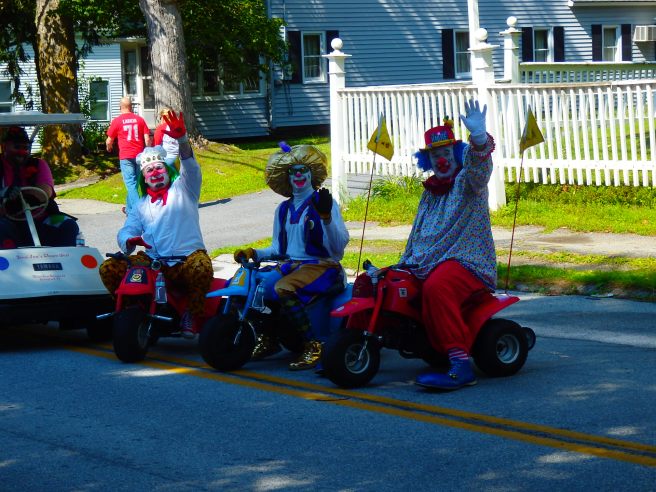
Shriners in an annual parade, Castleton, Vermont.

WHO HAS THE WARMTH FOR THIS ROLE?

If we were casting a movie version of my new novel, What’s Left, who would you have play her uncle Graham? Who has the warmth and the gentle classiness for this role?

~*~

People performing a traditional line dance at the Greek festival in Belmont, California. (Photo by Dvortygirl via Wikimedia Commons.)

Cassia’s roots included inspiration like this.

WHEN YOU MEET THE BUDDHA ON THE ROAD TO THE RESTAURANT

A central suggestion arising at the end of my first novel, which then shapes my new one, What’s Left, is that her father will be crucial in guiding the family in its embrace of Buddhist practice. Even if I cast that as spirituality rather than religion, it’s a big challenge.

In the course of multiple revisions, this was greatly toned down and redirected.

While Cassia’s concerned with more fully defining who her father was, the novel’s primary focus is on her. Here’s some background that’s much fainter in the final version:

Where had he come from, what prompted his interests, what were his pet peeves, what made him truly angry or truly delighted?

To make this little more concrete:

Some people contend my Baba was a lama. Not the camel-like pack animal from the Andes but a Tibetan Buddhist born in a humble city along the Mississippi, of all places. After college in Indiana and a broken heart, he looped into Dharma by way of, well, a hippie farm where Thea Nita also lived. And then he found refuge in something like a monastery. And then he magically returned here. You thought a monk couldn’t get married? Technically, no, though we’re dealing with an American twist in the mechanics of reincarnation. Or so they’ve told me.

In the end, much less of the responsibility falls on him. Rather, he helps establish an institute having a resident teacher, Rinpoche, who becomes his colleague.

~*~

For Cassia’s father, religion is a way of engaging life more fully. He might even say it is liberation from the tangles of daily life.

Let’s open our range of focus a bit wider.

Where do you go or what do you do to be free? Can you describe the feeling?

~*~

A large Queen Anne-style house with a distinctive witch’s hat tower something like this is the headquarters for Cassia’s extended family in my new novel, What’s Left. If only this one were pink, like hers.

AS A FOOTNOTE AT THE TABLE

I wonder if the longstanding tradition of morning cleansing of marble steps at the front door in many inner city neighborhoods of Baltimore has survived the stresses of two-income families or single-parent households? Who knows when it started or in how many other locales it’s also practiced. This has been a custom of row houses, connected to each other – blue-collar communities, in fact – and not of detached suburban housing. And that makes the foremost difference.

These poems consider what women do and preserve – though not always exclusively. Yes, I’ve known women who bale hay or decipher monastic manuscripts, and I’ll also admit men can know nothing of bearing children or nursing. Yet, somehow, many women seem most at home around the kitchen, even if it’s nothing more than a teacup or a picnic. Even her garden, should she be so inclined, seems to extend from that table or the alchemy of her oven. And that goes for flowers, as well as vegetables and berries. (Remember, though: not all mothers and daughters can stand to be in the same kitchen at the same time, though they both be masterful cooks.)

Looking back on Baltimore, I remember my next-door neighbor, each morning in season watering the black locusts between our houses and the street. Maybe she did her stoop, as well. But the trees, which seemed to have always been there, were beautiful and timeless, as if spreading their own table.

Returning 1

~*~

For the poems, click here.

A FLICK OF THE LEO MANE

Just a taste of what’s popping up. In case you were looking for a prompt.

~*~

  1. This shift in my wilderness destinations, from mountains to ocean. When did that happen?
  2. The ripening of peaches spurs trips to our favorite pick-your-own orchard a half-hour to our north. More trips will follow for apples.
  3. Maybe I really am an “advocate of living-up-the-world-in-your-own-village,” as one comment chimed.
  4. I do like the concept of transitioning, rather than progressing, with all of its assumptions.
  5. Overheard at Walden Pond: “No, they won’t even get in a car anymore. They ride their bikes everywhere.”
  6. The Wiggly Bridge for hikers beside the York River. One way to get over high tide.
  7. Home Depot workers call their pesticide section the Wall of Death.
  8. So many field notes from spiritual aspiration and practice springing from a muse of fire. The one that’s sometimes scorched me.
  9. My life as a failure. There’s no autobiographical novel to be written on my last 30 years.
  10. A bumper sticker I’d like to create: I’D RATHER BE READING.

~*~

Downtown venting, here In Dover.


A MODEL COUPLE, IN THEIR OWN WAY

I suppose I need to issue a spoiler alert. I cut this from later revisions of my new novel, What’s Left, since it felt redundant:

To be honest, most of my memories of Dimitri and Graham are fuzzy. Remember, I was little at the time.

Curiously, I have more early memories of Graham than of Dimitri. He was very gentle and knew how to play along. He would have made a great preschool teacher, I think.

~*~

Some of you will have vivid early-childhood memories, while for others, these will be a fog, at best.

I’ll be candid, I have few early memories of relatives when I was little. Who stands out most for you in your own family?

~*~


Koulourakia, melomakarona, kourambiethes, and kourambedes by Andrea Wright via Wikimedia Commons.

In the family, Cassia may have had sweets like these.

THERE’S PASSION AND SCANDAL IN THE MIX

When it comes to sex, love, and relationships, my new novel, What’s Left, offers a full range of examples over its four-plus generations of her family.

Her mother’s line in the New World begins with a round of scandal. Her great-grandfather and his brother break tradition by marrying sisters against the wishes of their parents and their village, and then flee Greece altogether for Indiana. Her other great-grandfather marries a non-Greek, a Cuban he loves intensely amid another scandal, and relocates to Chicago.

Her grandparents’ marriage includes sibling rivalry and another scandal, as well as a packet of letters from the war years that Cassia discovers wrapped in lace ribbon.

Her parents’ generation includes sparkles of free love before her father-to-be is introduced to the family in what might be considered both love at first sight and an arranged marriage, thanks to her aunt Nita’s role as a matchmaker. Then there’s the whirlwind when her uncle Barney falls hard for her aunt-to-be Pia. In contrast, her uncle Tito and aunt-to-be Yin present a much more restrained story off in San Francisco. As for her uncle Dimitri, we’re back to scandal, as far as many in town would be concerned.

Cassia’s father leaves a rich photographic history of these events, along with three years of daily love letters to his wife-to-be. Maybe there are things a daughter would rather not see? Or is temptation too much to resist?

Well, however much their story can resemble a fairy tale, not everything turns out happily ever after.

As for her own generation? Times and traditions have changed, right?

~*~

Cassia’s is a much livelier family than many I see around me. I imagine it could be pretty demanding, as well as rewarding in its own way.

Would you like to marry into this family? Why – or why not?

~*~

Cassia’s family restaurant has me looking more closely at the ones around me. (Rutland, Vermont.)