Our landlords’ younger son and I hiked to Camp Muir, a 5,000-foot or so ascent in 4½ miles, then back again. Nearly all on snowfield with rock-pile islands within it. Amazed by so much alpine flowering within it. On one island, clear streams gurgling through moss and blossoms.
As I noted, 23:VII:78, Sunday [I’m assuming the climb was on a Saturday, now that I had those off]:
A stiff, hard climb. We both stopped many times to rest / catch our breath, then discovered that by moving slowly, in “rest step,” we made better time, even with still needing rests … we were passed by skiers who climb to the camp and then ski down, and by climbers with full packs. [how humbling!]
But we made it! Left the ranch at 3 a.m., stopped for breakfast and gasoline, catching the first pink rays on Rainier as we came through White Pass and then the first rays on Adams in Stevens Pass …
At the higher altitude, the sky becomes the clearest, deepest blue, almost the color of this pen but clear, like a dense copper-sulfate solution. (Ward would also mention this about his Rainier climb.)
Muir, “cloud camp,” is nearly Tibetan — two rock shelters in a barren, snowy saddle, plus a few other shelters for shitting, mountaineering supplies, and a ranger. Five ravens fly in, like hawks or vultures on battered wings …
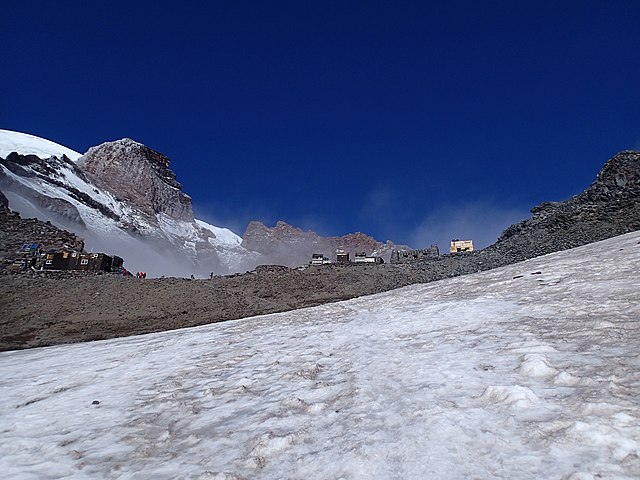
How lucky we were to have a clear day. Only the highest clouds, nothing on the mountain itself. Adams, Goat Rocks, St. Helens all clear, even distant Hood. Above Seattle, though, the purple-exhaust soup rising perhaps to 8,000 feet. Fantastic views, too, of Nisqually Glacier, with its pale blue electrical ice …
I was surprised by the number of people we saw above timberline — 300, perhaps. Party after party, black dots working toward the crest or returning.
By late afternoon, the atmosphere thickened; we lost sight of Hood in the haze.
~*~
I loved using the ice axe I borrowed for this outing, felt it gave me so much control as we carved our steps upward in the slick cold. I even felt armed and protected. The ax proved especially helpful on our descent. We wrapped our ponchos around our butts and slid down the slopes, using our ax as a rudder and brake. Glissade, as it’s called, bouncing and spraying up snow as we go. Still, we got wet.
Despite sunburn precautions — zinc oxide over our face, gloves to protect our hands, wide-brim hats (“Say, Cowboy,” I address Anders), we were both burned on our faces by the strong reflection off the ice and snow, as well as the thinner air not breaking the rays …
And then, as we approached the Paradise lodge, the mobs of tourists plus rangers directing traffic, like a Central Park in Manhattan.
The tourists looked at us as if we were Bigfoot or space aliens. Zinc oxide? “I’ve been drinking the clouds.”
Later, I was surprised by how many skilled climbers go in shorts only, achieving the deepest of tans.
[I had forgotten we did that twice.]
~*~
From Spiralbound Cascadia with commentary.


