NOT YOUR TYPICAL FATHER

The driving force for my new novel, What’s Left, is her struggle to recover her father after he vanishes in an avalanche halfway around the globe when she’s 11. It’s a tall order, even when it’s self-imposed.

She would say he’s not a typical father. He comes from mainstream roots in Iowa, becomes a professional photographer and starts practicing Tibetan Buddhism before marrying into her mother’s close-knit extended household, one based on running a family-owned restaurant where Cassia and her cousins all wind up working from an early age.

The crucial twist comes through her aunt Nita, who guides Cassia into a long, patient investigation of the photos her father left in disarray in his studio. Bit by bit, the focus shifts to Cassia’s discovery of her own nature, dreams, and destiny – one where her extended family plays a big role.

Continue reading “NOT YOUR TYPICAL FATHER” →

AN UNCOMMON FAMILY

The close-knit extended family of Cassia’s childhood is quite different from her father’s. Hers is the one he leaped into when he married her mother. What was he escaping? And what was he embracing in the act?

As my newest novel, What’s Left, unfolds, hers is a family with a mission and a place in the world. Everything her father accomplishes in the ensuing years is enabled by their enterprise and unity.

For Cassia, her brothers, and her beloved cousins, the big question becomes: Will this be too confining for their personal ambitions and dreams? Or will it assure them a secure future if they settle in and stay put?

Do they ever think of themselves more as a tribe than as individuals? We follow our elders in decisions and wisdom?

A family business is full of peril. How will they choose?

~*~

In a passage I cut from the final edition, the family’s spiritual practices are considered. On one hand there’s the Orthodox Christianity; on the other, Tibetan Buddhism.

Well, you could also see it as a refuge for my family. As a calming influence guiding us through some turbulent times. Through it, our eyes returned to the greater good in our shared mission. We were given a vocabulary and fresh ways of thinking about the eternal elements of life. We accepted its reliable foundation in teaching these to our children – including me.

~*~

Well, that could be one uniting factor. I see another family that’s held together by its emphasis on sports and sports medicine. As for others?

What holds your family together? How far does it extend?

~*~

A large Queen Anne-style house with a distinctive witch’s hat tower something like this is the headquarters for Cassia’s extended family in my new novel, What’s Left. If only this one were pinker, like hers. (Rochester, New Hampshire)

NAME THAT VOLUME … THE SOUP’S ON

In my new novel, What’s Left, her father teams up as the photographer when her uncle Barney, the top cook at the family restaurant, tries his hand at writing a cookbook. Well, a whole series, I suppose.

Their first volume is all soups, inspired by the grandmothers’ daily special bowls and wild chili concoctions – the ones he’s advanced.

I never get around to titling the book when I mention the project.

Now it’s your turn to get creative. What would you call a cookbook about soups?

~*~

The famous donkeys of Santorini carry visitors from the small port up the steep path to the town of Fira. (Photo by Rennett Stowe via Wikimedia Commons.)

Cassia’s roots included inspiration like this.

DRUMSTICKS AREN’T ALWAYS ON CHICKENS … OR TURKEYS

In my new novel, What’s Left, her aunt Yin has her helping book rock bands rather than working in the restaurant. For Cassia, it’s a welcome break. She can be cool and hang with her cousin Sakis’ scene.

While her mother’s a skilled violinist, Cassia herself is not a musician. In one explanation that didn’t make it to the final revision, she explains:

When it came to music, I wanted to play drums but was shunted to piano, which I hated. It just wasn’t me.

~*~

Are you part of a band? Do you sing in a choir? Play an instrument? Was there one you wanted to study but told otherwise? Do you sympathize with Cassia here?

~*~

A large house with a distinctive witch’s hat tower something like this is the headquarters for Cassia’s extended family in my new novel, What’s Left. Gee, and this one’s almost pink, like hers. (Tamworth, New Hampshire.)


FACING AN OBSESSIVE LOSS, A VOID TO FILL

Central to my new novel, What’s Left, is a painful awareness that something crucial is missing from her life. In her case, it’s the physical loss of her father when she’s 11. For others, that sense could be prompted by a divorce – which also figures in my novel – or the rejection by a lover, as happens much earlier to her father. Or even drive one to suicide or self-destructive behavior. (No suicides in the story, in case you’re wondering.)

A comment by one woman whose father had died when she was about Cassia’s age prompted a key change in the voice of my novel in its ninth revision. “I still talk to him,” she said, nearly 40 years after his passing. That perspective opened a whole new dimension for me in developing Cassia and her relationships. It’s changed the voice and tone of the book, resulting in far more intimate dialogue, I’d say. Just take a look at the finished novel.

~*~

This didn’t quite fit on the platter:

What Baba and Manoula shared is an awareness of some loss or suffering the illusory surface we view might be masking. For Baba, the ultimate rejection by Diz opened a pit for him to fall into – nothing he’d assumed quite held, either, as far as he could see. (Never mind Nita’s role – he wanted a lover.) For Manoula, the fatal crash of her parents did something similar. From a Greek perspective, suicide makes perfect sense – as does, I might guess, sin. The convolutions only thicken the engagement with life itself.

~*~

Well, this was an early stab at the issue. In the finished novel, we never get around to asking if Manoula winds up frequently talking to her deceased parents, the way Cassia does throughout the story. Or whether her husband, Cassia’s Baba, somehow fills the void.

For me, the conversation’s often invoked certain long-gone lovers.

Do you find yourself talking to someone who’s not present? Have you ever felt a loss like Cassia’s? Has one of your close friends? What insight would you have?

~*~

Cassia’s family restaurant has me looking more closely at the ones around me. (North Berwick, Maine)

OH, THE LIFE LOOKED SO BEAUTIFUL

“Sister Act,” a profile of the German twins Gisela Getty and Jutta Winkelmann in the May 2018 issue of Vanity Fair, reminds me of another disturbing side of the hippie era. The two celebrity “cosmic flower children” are portrayed as the antithesis of the poor underage runaways-turned-beggars who populated Haight-Ashbury a few years earlier, desperate for a better life than they’d had growing up.

No, these two had access to anything – and anyone – they wanted. They were already the Jet Set, slumming for fun during the day and partying with the rich-and-famous at night. Or the other way around, depending.

The photos made their stylish life look so beautiful. Much more so than the rundown places where most of us were living or the clothing we wore.

Their biggest leap into the spotlight came when Gisela, then 24, became engaged to marry oil-fortune heir J. Paul Getty III, age 17, shortly before he was kidnapped and held for ransom – and had his right ear severed and mailed away as proof during a five-month ordeal. His abduction itself may have been prompted by his own wayward wanderings and musings. They did marry after his release, though it had its problems leading to divorce.

So just what upsets me so in the article by Mark Rozzo?

I think of social activist Saul Alinsky’s revulsion at the yippies and the like, perceiving that their actions actually harmed efforts for political and economic justice.

Over the years since, too few dreamers have stepped up to do the nitty-gritty daily labor toward these ends – a protest march is superficial in contrast to serving on a board or writing to officials or work on campaigns for office.

The article also has me recalling an op-ed piece in the New York Times in the early ’70s that noted six types of hippies – and a huge gap in the middle of the range. In the upper categories were altruistic social reformers, artists and poets, spiritual practitioners – the ones I celebrate. In the lower categories, though, were misfits who had little ambition and few abilities. Ultimately, the two extremes had little in common.

Rozzo’s depicted counterculture is self-indulgent, narcissistic, rife with drugs and promiscuity, and celebrity connections like actor Dennis Hopper and his machine guns. This is the Revolution of Peace & Love? Or its spoiled countercurrent?

What a waste, I mutter. What a waste.

What did they contribute to the common good? What was their vision for a better world? They had so much to begin with, they could have supported so much.

The very tempting beauty they embodied winds up feeling hollow, even venomous.

Pipe dreams, then. There’s so much we lost that still haunts me.

I STILL LIKE THE GREENHOUSE

How far can a restaurant extend its business base? Its “brand,” as they say. This passage is prompted by meals at restaurants that expanded into new revenues, even though I cut this from the final version of my new novel, What’s Left:

Still, the playful concept feeds into what emerges around the corner as an elegant multi-purpose restaurant, plus a bookstore, art gallery, gift shop, and even a small greenhouse.

And that’s before the bakery or brewery comes into sight. For whatever reason, though, I shied away from launching Carmichael’s own brand of bottled products.

This has me thinking of a couple of specialty food markets on the tourist trail that include a cafe featuring their products. Turns the concept I’m discussing around, in effect.

The identity, of course, is built on something that makes us go gaga. Something that makes us want to return again and  again.

What’s someplace that features your favorite comfort food or special treat? Would you wear a T-shirt proclaiming it? What do you think of restaurants that have a gift shop attached? Does it add or detract from the mission?

~*~

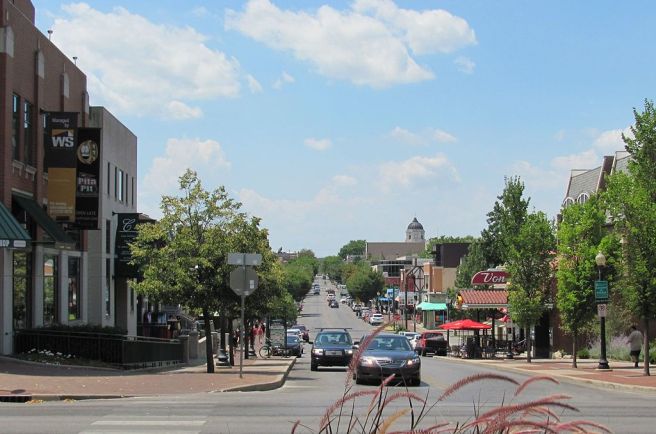
Bloomington, Indiana, by Marelbu via Wikimedia Commons.

Her hometown may have been something like this.

NORMAL? YOU MEAN LIKE FITTING IN?

Though she’s grown up in an extended bohemian family, Cassia’s able to cope with being different from many of her classmates – up to the point her father vanishes in an avalanche halfway around the globe. The other kids have fathers – that’s normal, or so she thinks. And then, in a flash, she and her home aren’t normal.

To see just how atypical they are, check out my new novel, What’s Left.

~*~

I just couldn’t pour this down the drain. It needed to simmer much more:

Her father was also a dreamer – or at least an idealist – a dimension that often inhibited him from asking hard questions or anticipating a full range of obstacles in a course of action. And he had an innate aversion to conflict.

What Thea Nita has confirmed is that Baba carried a sense of not quite belonging in the consumer culture of America. He had rightly concluded the ultimate flatness of his birthplace had nothing to do with its landscape and everything to do with a wider loss of stimulation, imagination, and inventive discovery – all further inhibited by social conformity rather than any acceptance of eccentricity. He recognized the potential for more, much more – something he encountered first in science and the fine arts and later in direct spiritual experience.

~*~

And then there’s her mother’s side, where they live – where he, too, has chosen to place his life.

Reflecting on the emotional cost of an upbringing like that in my own life has me realizing just how debilitating it has been. Like him, I found ways to escape and still somehow “fit in.”

Let’s get back to the basics. Would you say you’re “normal”? What would you like to change about yourself or your situation?

~*~

A large Queen Anne-style house with a distinctive witch’s hat tower something like this is the headquarters for Cassia’s extended family in my new novel, What’s Left. If only this one were pink, like hers. (Manchester, New Hampshire.)

SUGGESTING A CREATIVE TENSION BETWEEN INSPIRATION AND TECHNIQUE

In another of the grandiose outbursts I surgically excised from the final version of my new novel, What’s Left, her uncle Dimitri and her father-to-be are engaged in a heated late-night debate.

While their dialogue springs out of a consideration of photography as a fine art, it could extended much broader – perhaps even onto the plates served in the family restaurant.

Here’s how it stood:
Any fine art of the future cannot be an end in itself. It must reflect a much more comprehensive spiritual current. It must instill an awareness of a community. You, of all people must have noticed the only thing the university can teach is technique. The profs can’t instill the leap of psychic thunder. They may encourage a few people to take up vital self-discipline and daily practice.

~*~

Surgically excised? Looks like I actually used one of Barney’s super-sharp chef knives!

The dynamic of formal teaching and learning ultimately fell outside the parameters of my new novel anyway. The important thing is that Cassia’s Baba finds a true home.

I’d say her uncle Barney, the chef, practices a fine art, in his own way, and he’s never attended college. He just has an active curiosity and a place to engage it. Maybe that’s why he and her Baba get along so easily.

Do you practice an art or a craft? Have you ever tried to define your “mission”? How do you explain your motivation or activity? Who gives you the most positive feedback?

~*~

This Victorian house, with its witch-hat tower and roof, was erected in Allentown, Pa., around 1891. It is shown here in 1926 during construction of the New Pergola Theater next door. The house was torn down in 1960, replaced by Van’s Diner, a glass and aluminum structure. (Photo via Wikimedia Commons.)

In my novel, the family home could have looked like this.