Hunkering down for winter

We’re quickly approaching the longest nights of the year, which are truly long here in Eastport. Accompanied by the most truncated days of the year, when the sun barely clears the horizon. We’re just a hair shy of the 45th Parallel, the halfway point between the equator and the North Pole. These days, it can feel even further north than the map shows.

The experience can be especially harsh here, now that the Summer People are long gone and most of the stores and galleries are shut for the season while those that remain open do so largely on limited hours. You might see a stranger or two in town around sunset, looking for a place to eat, and the best you can do is tell them to go to the IGA and get there before the 7 o’clock closing. Pizza slices or deli cuts plus a six-pack lead the list.

Even more, we know big snow, escalating ice, and profound cold are still ahead, as well as a blustery nor’easter or three.

We don’t even have a retail scene to crank up the holiday hoopla. Nor do we have anything resembling a nightlife, apart from a few cultural performances. Bless ‘em, especially after the Covid shutdowns.

Needless to say, social connections are especially important. For me, that includes singing in Quoddy Voices and worshiping with Cobscook Friends Meeting.

Also anticipated is a big stack of reading, both books and magazines, and concerts streamed from the Pine Tree State and beyond.

I’m already looking forward to the invasion of family for the holidays.

How do you adjust to such seasonal change?
 

Maine Public service reaches far

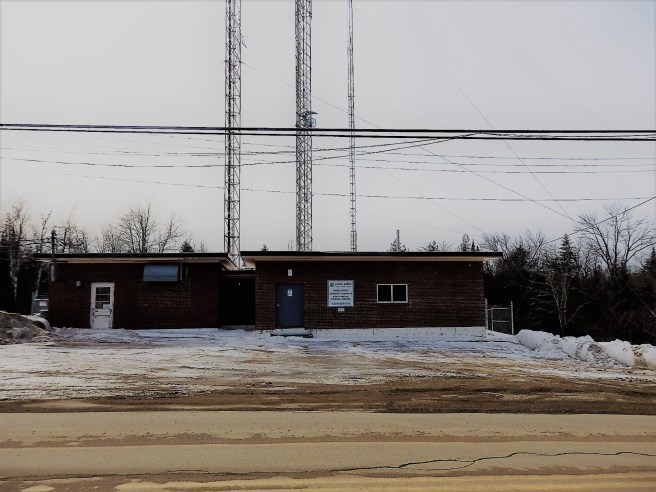
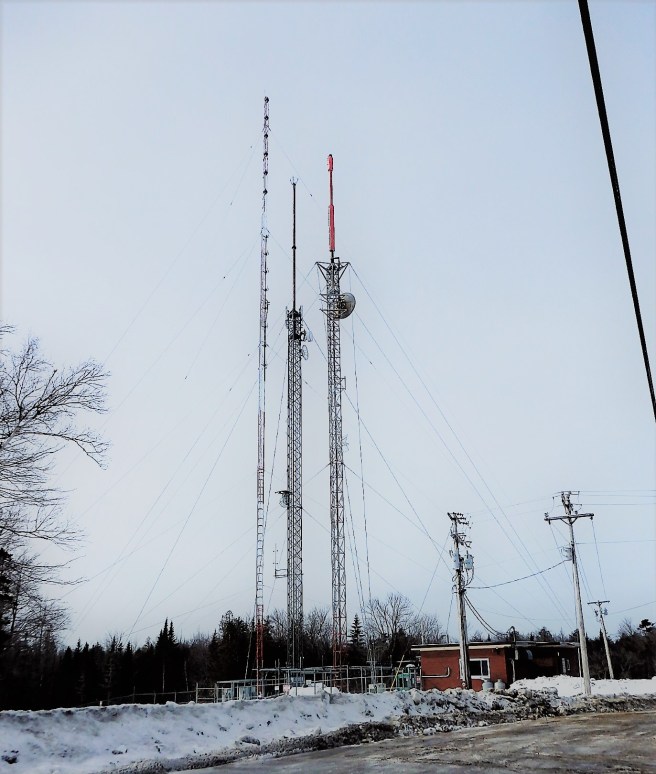
Usually, you need a tall tower for FM and TV transmission. The taller, the better. Not so in the mountainous terrain of Washington County. One stick sends Maine Public Television’s signal across the easternmost reaches of the state. Another, Maine Public Radio’s. I’m not sure about the third. Maine Public Classical comes to us locally from Millbridge, rather than this transmission complex on the Charlotte-Meddybumps town line..
It really is pretty modest.

Bays within bays, all adding into one

For someone raised like me far from the ocean, trying to pin down places along the coastline can be confounding.

Eastport, for instance, lies within famed Fundy Bay yet also has Cobscook Bay lapping its west banks and Passamaquoddy Bay on its east.

What gives?

Well, let’s say the bays are like Matreshka Dolls, one fitting inside another one that fits within yet another one and so on.

Cobscook Bay, for instance, includes the smaller East, South, Sipp, Dennys, and Whiting bays.

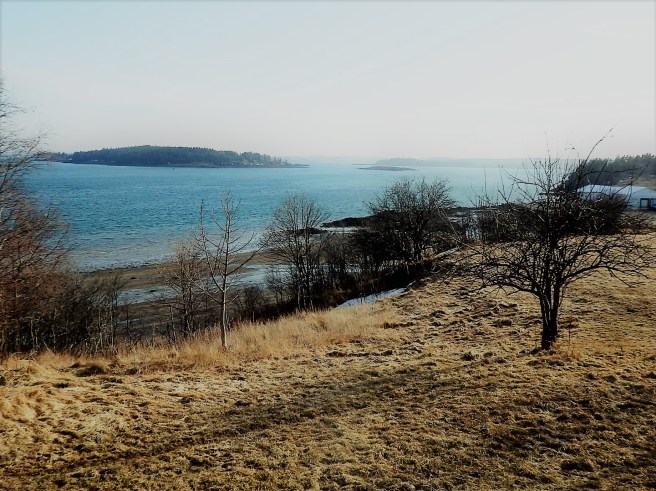
Looking into Cobscook Bay to the west of Eastport.
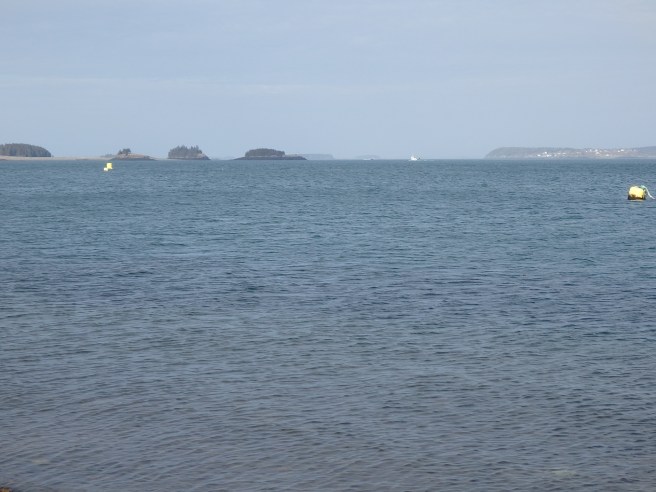
Or to the east, toward the Bay of Fundy.

I guess it’s like a New Yorker saying she’s from Flatbush, meaning a part of Brooklyn within New York City, which does – contrary to the knowledge of many Manhattanites – sprawl far beyond their little island.

So Eastport can justly claim to be the City in the Bay. Or several.


How you locate where the international border runs between two islands

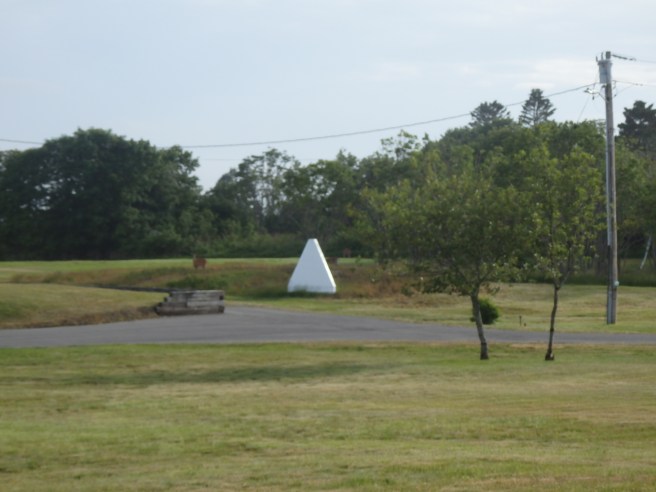
What’s with these pyramids? They’re even found in folks’ yards.

Pyramids like this sit in prominent spots along the shore. They can seem mystifying enough, even before you see a second one nearby.

At last, I learned the two can be lined up to create an imaginary line running out across the water. The border between the United States and Canada falls where the line crosses a similar line running from islands on the other side. That spot can then be connected to others, at least by some kind of maritime surveyors. It’s another example of connect-the-dots.

The four-sided pyramids are called range markers. They’re a special kind of daymark or day beacon, too.


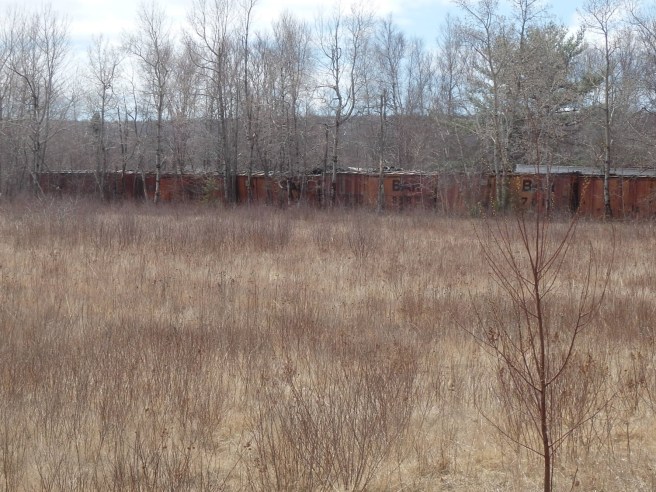
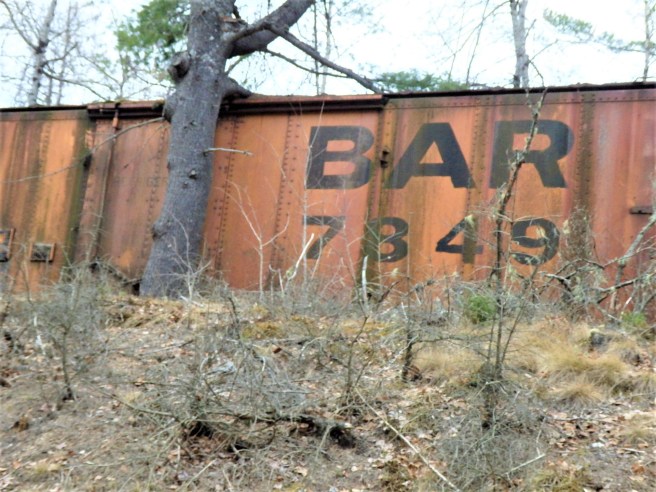
BAR cars stuck in the woods

Seeing railroad boxcars away from the tracks around here no longer surprises me. Many of them stand beside farmhouses and sheds or even businesses, where they serve as extra storage space, presumably cheap or for the taking.

But this sight along State Route 191 always grabs me.

Like they simply stopped in time.
It’s like the trees are trying to pull the cars back into the earth itself.

The Bangor and Aroostook Railroad served Washington County as well as the Penobscot Bay region and the spud country up north.

When sardines were big

Eastport’s economic glory days were when the city was the Sardine Capital of the World.

They’re small herring and abounded in the waters around Eastport, where they were easily caught and delivered straight to the cannery atop the wharf.

Here are some related facts.

  1. Napoleon Bonaparte helped initiate the canning of sardines, the first fish to be so preserved.
  2. Packing in Maine took off from Eastport in the 1870s and peaked around 1900, with 75 plants, mostly along the Downeast coast. The first sardine cannery in Eastport started in 1865 but failed to reduce the moisture in the cans, leading to a sharp, unpleasant odor. Its owner returned to Portland and found success with baked beans. Others in Eastport improved the process.
  3. The workforce was largely women, with blurring hands and sharp knives or scissors expertly packing the small fish into cans – as crowded as sardines, as the popular expression went. Their hands were in cold seawater, year-‘round.
  4. Eastport also cranked out the cans and lithographed labels.
  5. The fish were packed in cottonseed oil, soy oil, or upper-end mustard sauce.
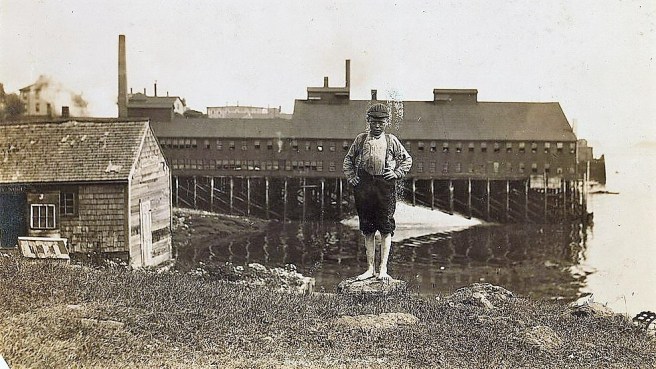
  6. The world’s biggest sardine cannery jutted 250 feet out from the shore at the entrance to Shackford Cove.
  7. Home refrigeration doomed the industry, making fresh cod, haddock, and other fish readily accessible.
  8. Sardine tins were part of soldiers’ rations during the world wars.
  9. The discarded fish parts were used to make fertilizer, while the scales were transformed into pearl essence, a shiny coloring used in many consumer products.
  10. Vintage sardine cans and labels are collectors’ items.
Eastport’s sardine canneries were also centers of child labor, as photographer Lewis Wickes Hine documented in August of 1911. Above, Fulsom McCutcheon, 11, was a worker at the covering machines. The world’s biggest sardine cannery extends behind him. It was about two blocks from my house. 
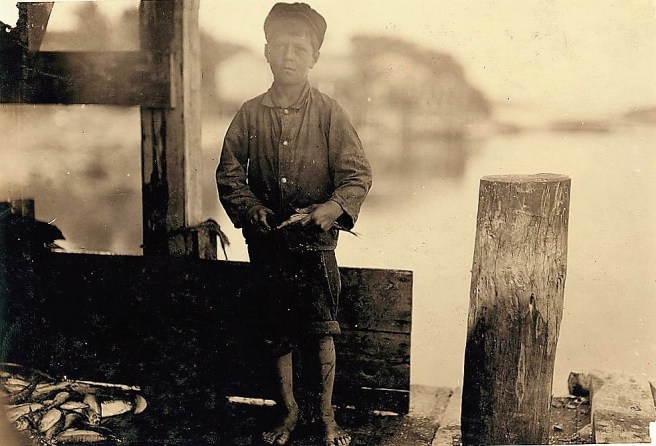
Hiram Pulk, 9, cuts sardines at the Seacoast Canning Company’s Factory No. 1 in Eastport. “I ain’t very fast – only about five boxes a day. They pay five cents a box,” he was quoted. Both photos from the Library of Congress collection.


The Bingham connection

After discussing Maine’s unincorporated townships, I need to add that there are a lot of variants – 17, if I’m counting right. Among them are the BKP, BPP, NBKP, NBPP, and WBKP designations – translated as Bingham’s Kennebec Purchase, Bingham’s Penobscot Purchase, North of Bingham’s Kennebec Purchase, North of Bingham’s Penobscot Purchase, and West of Bingham’s Kennebec Purchase.

So just who was this Bingham guy?

In short, he was William Bingham, already a wealthy Philadelphian when he became filthy rich via privateering during the Revolutionary War. He was also a statesman and U.S. senator who parlayed his riches into vast land purchases, as noted above but also including upstate New York, where Binghamton, where I’ve also lived, was named in his honor.

Got it?

Quite simply, Bingham owned two million acres in Maine, making him land rich but cash poor.

His agent in Maine, Revolutionary War Gen. David Cobb, was responsible for laying out most of the roads associated with the Airline Highway (now eastern State Route 9). And when Cobb retired in 1820, John Black, agent for Baring Brothers Bank in London, felt that lumber was the wealth that would provide his boss the needed profit. There were further complications as well as marriages, but you get an idea how Baring township in the Moosehorn wildlife preservation got its name.

Cobb did, however, build a great house at Gouldsborough and soon faced some harsh realities that he notated between 1795 and 1800.

First, the land and climate of eastern Maine were not and are not suitable for farming. He noted that “those who come to view the country … have as frequently returned almost blind by the bites of flies and mosquitoes. You have no conception of the hosts of these devils that infest the thick forest at this season.”

More critically, he found “the great body of the people of this country possess no regard to the rights of private property,” calling them ” vicious inhabitants who disfigured its landscape. Every inhabitant here is now a trespasser, a plunderer. They live by it, and therefore they will not cultivate the finest soil in the world. They’re not doing this is the chief cause why the reputation on the country has been damn’d. If the people who live by lumbering are indulged in cutting the forests wherever they please, they will have but little … appreciation of the soil.”

For the record, the soil itself wasn’t nearly that rich.

But continuing, in his estimation, “The greater part … follow lumbering and fishing … and they are very intemperate, very lazy and very poor. It may be said in truth … the majority of the inhabitants are drunkards.”

There are those, of course, who would question whether much has changed since.

Or, as is sometimes said of Eastport, it’s a drinking village with a fishing problem.