Bunchberry or, if you prefer, creeping dogwood, I still love seeing it

We’ve become fond of this groundcover along many of our trails, with its white blossoms in the spring and red berries well into summer. Here the foliage is fringed with red, set here against moss and a touch of snow in a stretch of what may be a peat bog.

Quoddy Head State Park, Maine

For the record, Cornus canadensis is also known as Canadian dwarf cornel, quatre-temps, even crackerberry,

Wonder how it would work in our home garden.

Yes, I live just a mile or so from New Brunswick

Have to admit “New Brunswick” sounds more exotic than simply “Canada.” Most Americans know where Canada is, after all, but have to think twice when the province is mentioned.

The deep channel between Eastport and Campobello Island, New Brunswick, is called Friars Road, named for a rock formation dubbed the Old Friar. It stands at the foot of the bluff that’s part of the international park honoring Franklin Roosevelt’s former summer estate.

Equally exotic for this Ohio boy is living on one of the Fundy Bay islands, even if we don’t have to take a ferry to get to or from the mainland.

If I’m counting right in the satellite images, mine is one of the one hundred most easternmost houses in the continental U.S. It’s likely I’m even the most easternmost Quaker in the country.

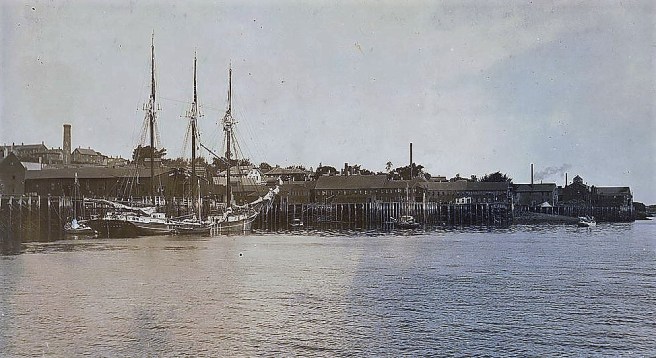
Was this once part of a sardine cannery? Or the steamship terminal? Yes, that’s more of Campobello Island, New Brunswick, on the other shore.

Been here two years now, too, and it’s still amazing me. 

Not a bad way to spend a dark Saturday afternoon

This has the makings of a fine Saturday afternoon tradition through gloomy winter around here. Not that it won’t work on a sparkling day, either.

Moose Island Contradance Band. Photo by Rachel A. Williams.

The local contradance band has another monthly performance at the Old Sow grill coming up, and the previous one, as you can see, was a hoot.

It attracted a handful of sit-in musicians in addition to an appreciative audience that packed the house.

Plus, monthly dances at the arts center are set to resume at the end of January after a long Covid hiatus.

A special kind of humor

Vermont may be renowned for maple syrup and skiing, but Maine lays claim to a very dry humor as well as lobsters. Maybe they’re somehow connected.

When I first moved in New Hampshire, I learned much about the region through the Humble Farmer, Robert Skogland’s weekly hour on Maine Public Radio. But his comedy act wasn’t the only one in the Pine Tree State.

Tim Sample remains the epitome, even though his time was cut unfortunately short.

Another now classic run was “Men from Maine,” a one- to two-minute comedy segment that opened with soap opera organ music and something varying along the lines of, “And now for another thrilling episode of the exciting adventures of Men from Maine. As today’s action-packed drama begins,” which aired on a morning radio show in Boston.

The episodes typically revolved around Lem and Ephus and others in backwoods Maine. While the humor was essentially redneck, it was opposed to that of the American South. Episodes ran all the way from industrial accidents handled in incompetent ways (many residents, including Lem and Ephus, worked in the local sawmill, though the canneries could be equally hazardous), to bestiality, but, as observers noted, the humor always came from the stupidity of the characters and their obliviousness.

After I’d been introduced to the men via Clackity Jane’s show on Eastport’s little FM station, I discovered how much they’re stilled treasured in these parts, maybe because they struck something true.

Laugh on, dude … and dudette.


Reflections from the stage of the Quoddy Voices concert

Singing in front of an audience is a relatively new experience for me, one arising in my retirement years, mostly through Boston Revels’ top-caliber community chorus and related events.

What I can say is that from the stage, each performance has been thrilling and transcendental, even when not necessarily perfect. Most remarkable is the oneness we sense as a company making melody and harmony.

Before the Covid restrictions and my relocating to Downeast Maine, I was commuting from New Hampshire to Boston as a baritone in the Revels Singers, first under George Emlen and then Megan Henderson. The ensemble ranged from 40 or so to maybe 80 members, depending on the season. Its classical and world folk repertoire was drawn largely from the shows the organization had produced in its more than a half century, with music in nearly 30 languages and spanning a good millennium of history. Many of the arrangements, editions, and original compositions were by our conductors or others affiliated with Revels.

~*~

These days I’m with a much smaller group, Quoddy Voices, which is also led by a fine conductor, pianist, and composer, John Newell, and I’ll proclaim that its standards and abilities are just as high.

We just concluded the second pair of programs with me as a member, and once again I must admit moments of listening to the others in amazement and then wondering how on earth I ever managed to be included. Yes, it’s humbling and challenging.

Technically, we’re a chamber choir – for the concert, 20 singers. Among other things, it means any slipups are more exposed.

(Photo by Jessica J. Williams)

Our program, a Harvest of Song, put us ahead of Thanksgiving and the crowded holiday schedule at the arts center. That meant a shortened rehearsal schedule, but online practice scores of our parts definitely made a difference.

Compared to Revels Singers, our repertoire engages more in works other choirs are also exploring, which led us to three pieces by Florence Price, the first Black American woman to have a symphony performed by a major orchestra. She’s finally being widely discovered, nearly 70 years after her death. From our point of view, her writing is deft, with touches of jazz and flashes of difficulty. The bass line in one score movingly upheld the axiom of less is more.

From living composers we had two widely performed works by Englishman John Rutter, who is admired for pieces that fit the voice like a latex body suit; Californian Frank Ticheli’s masterpiece, “Earth Song”; a lively Calypso in 5-4 time by the now 95-year-old Harry Belafonte; and a haunting 35-year-old Dan Forrest’s setting of a Ralph Waldo Emerson poem.

From old masters we had a deeply reverential motet from Romantic-era Anton Bruckner and sections of Baroque brilliance from Henry Purcell’s 1692 “Ode to Saint Cecilia’s Day,” which foreshadows Handel and his Messiah but with sides of pagan homage, as English poets of the time were wont to do.

We concluded with Randall Thompson’s classic 1940 “Alleluia,” drenched in sadness, as the composer admitted, but becoming quite polyphonic and agitated before introducing a single second word at the end, a seven-part, two-note amen.

While all of these works are widely known in choral circles, all but the Thompson were new to me. I had heard the Thompson only in a broadcast just a year ago and earlier from an old buddy who raved about singing it with his chorus.

Our audiences, as usual, were attentive and enthusiastic.

~*~

So now some of us are scheduled to do some informal caroling before Christmas.

And then, come February, we get to see what our director has in store for us next.