As a matter of career advice?

Growing up in a financially secure family like the one in my novel What’s Left could open your educational and career options, I suppose. For Cassia’s mother, I saw events unfolding along these lines — which I then cut from later revisions of the story:

Manoula, on the other hand, possessed some of her sister’s ability to ask those questions, however gently. And she had some of her brother Dimitri’s practical streak. But she also had an underlying spiritual awareness and a sharp intelligence to match. It’s a potent combination — even intimidating to many potential suitors.

Crucially, both Manoula and Baba knew the vitality of artistic practice and expression. Remember, he was more than a photographer — he may have worked on a daily newspaper, but he profoundly appreciated all the fine arts. On top of that, he had a natural ability in writing that had yet to be encouraged and released.

On her part, Manoula loved literature, in particular, and practiced hours a day on her violin. Realizing early on how difficult it is to earn a living in either endeavor, she followed Dimitri’s advice to pursue a double major — English and music — with a minor in business to fall back on. As she told people, she was open to a career in arts management, and in a way, with the publishing, she’s held to it. She spent five years on her bachelor’s degree — including summer courses — but she was in no race to get out into the world, not once my Baba crossed her path. They were both taking a long-range view ahead. 

In a way, you could say she was a Yiayia Dida while Nita was a Yiayia Athina in new guise. Oh, I don’t know — maybe it was the other way around. They were all strong, emancipated women with a bohemian streak. Not all bohemians, I should add, are strong — not by a long shot.

~*~

In early versions of the novel, when Cassia was piecing together her family history from the perch of a teen or 20-something, she might have seen events something along these lines. But in the later revisions, told as she’s seeing them as a teen, this passage was just too much. Way too much. Besides, through much of high school time, she was a lackadaisical student more interested in managing a live music scene.

Looking at her ancestors, though, I doubt that her great-grandmothers had more than a rudimentary education. Her grandmother, Bella, came to town for a college degree but was thwarted in her plans. Cassia’s mother, her Manoula, raised the educational bar.

Fortunately, Cassia’s aunt Nita provides crucial encouragement that leads to college in time.

So what is essential in releasing talent or dreams you have? What kind of advice have you received regarding continuing education and career? How have your plans taken shape? What’s been especially helpful?

~*~

They know how to work together. In my novel, a family like this takes their skills far beyond the kitchen. The most important thing that’s happening has nothing to do with the dishes.

Why I keep returning to counterculture particulars

I wish there were a better label than “hippie” to apply to the counterculture explosion that swept the world in the late ’60s and early ’70s. Contrary to popular assumptions, there was no standard-issue hippie, male or female. Not everyone did pot or ventured into acid and beyond, nor did everyone participate in a protest march or have long hair or have sex every night or at least on the weekend. We all came in various degrees of separation from general society yet, somehow, we also recognized a kinship with each other.

The paperback cover …

“Are you sure you were a hippie,” my wife sometimes asks. So what if I didn’t like rock? Many of my friends had been at Woodstock just down the highway from the milieu I describe in Pit-a-Pat High Jinks. No, we didn’t recite a credo, you dig what I mean?

The only other flash in history I can see similar to this was the mid-1600s in England, with its World Turned Upside Down before the restoration of the monarchy – stresses that would fester until the American Revolution a century later. What we shared was a vision of a more just, equal, and caring society. We didn’t have standard-issue, card-carrying members. Alas, we didn’t have elders or cohesive discipline, either. And the breakdown that followed can’t be blamed entirely on a youth movement crossing over into the dreaded age 30. (Oh, how I’d love to be back there, if only I wouldn’t have to figure out how to survive in the current economy.)

Tom Wolfe, author of “The Electric Kool-Aid Acid Test,” pointedly asked why there wasn’t the big hippie novel, overlooking a few notable entries like Gurney Norman’s “Divine Right’s Trip.” The problem, as I see it, is that the scope of the events was too big and too fuzzy to be encapsulated in a single volume. You had the activist side, from civil rights and draft resistance to pacifism, feminism, and the environment, for starters. Add to that sexual revolution. And then drug use, abuse, and visions, as well as new spiritual teachings and practices. All before we even get to the music and its scene. How could you possibly wrap all of that, plus more, into a single volume?

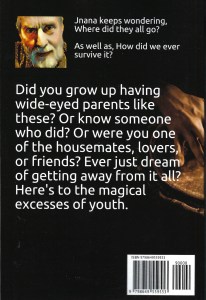
… and the back cover.

Believe me, I’ve tried with my own Daffodil Uprising and its companion “Pit-a-Pat High Jinks.” Hate to admit there’s so much more that could be added to the, uh, pot. Make that “pan.”

By the way, I think there are worthy nominations in each of the subcategories I’ve just mentioned. I’d love to hear more.

Frankly, I think we, as a nation, have been in a state of denial about the era, with its tension between the war in ‘Nam and the Establishment supporting it, on one side, and the opposition on multiple grounds, on the other. Those rifts in the soul of the nation have never been adequately examined and addressed from either side, much less healed. We could start with the MIA-POW myth, for one, or the ways we might have failed to answer our kids’ questions about pot use, for another. They are definitely exploding in our face now.

Meanwhile, Cassia, in What’s Left, has come along to try to make her own way out of the debris.

And so I humbly or brashly offer my own novels for discussion.

So much for their model of a commune

When Cassia’s future father moves in with Nita’s four siblings, their big old Victorian house and its household are practically a hippie commune.

But then, when her parents’ generation begins marrying and having children, things change.

Still, she’d grown up as part of a tightly knit extended family, one that was just about everything his hadn’t been.

Where was your family when you were starting out as an adult? Nearby or far away?

Have you ever lived in a group household?


In your mother’s dreams

brutal deep-freeze, heavy snowfall blanket, ice dams on roofs, melting drips through ceilings the hill resembled a resort ski condo development appropriate considering the city-operated slope on the other side of the expressway runs a single chair-lift I tour the surrounding woods on cross-country blades and observe bald eagles wintering along the Merrimack and recall the rainforest of the Olympic Peninsula, desert along the Yakima, views down over the Mississippi or Potomac or elsewhere in New England . spread your wings, then, in the thawing


Ways Quakers differ from other Christians

Admittedly, it’s hard to generalize. And not everyone agrees we’re even Christian, though our historic roots certainly are. In addition, for some of these, it’s more a matter of degree in comparison to some other faith traditions.

With that, let me suggest that those of us in the Society of Friends (Quakers) are distinguished by our:

  1. Open worship conducive to reflection or even meditation, at least for some part of the service. This is best seen in the traditional hour of silent Meeting.
  2. Personal direct experience of the Divine, rather than what I’ll call speculative theology.
  3. Queries to guide personal daily practice and awareness rather than recitation of dogma or creed.
  4. Emphasis on what we do in all facets of our lives rather than on what we believe or are supposed to believe.
  5. Metaphor rather than law as the language of our faith.
  6. Corporate decision-making. No vote. (This could lead to a whole other Tendrils entry!)
  7. No outward sacraments. Baptism is of the Holy Spirit, not water.
  8. Shared discipleship. We learn to listen to each other openly, sometimes even as “listening in tongues.”
  9. Pacifism and non-violence as essential tenants of faithfulness. Here, we unite with Mennonites, Amish, and Brethren as historic peace denominations, though Quakers are more likely to take public action.
  10. We find our name appropriated by whole lines of products we don’t make, starting with Quaker Oats. What other denomination is so, uh, honored, apart from some later applications of Amish in recent years? Seriously!


How close do we hew to an ethnic tradition?

One of the dilemmas in shaping my novel What’s Left, involves the naming of children. I felt a repetition of first names in successive generations, such a common Greek custom, would have simply become too confusing for readers to follow. Am I right?

~*~

In a passage I cut from the final edition, the unifying influence of tradition or spiritual practice is considered:

Let’s face it, our worst disagreements are insignificant compared to the conflicts that could be erupting within our circle.

~*~

Not all families get along, after all. Even Cassia’s will face some difficult trials.

For the moment, let’s look at names. Cassia, in the novel, is short for Acacia, a tough wood mentioned in the Bible. (In the King James version, though, it’s called shittam. Ugh.)

Do you know what your name means? Were you named in honor of anyone? Do you like them? Would you prefer something else?

~*~

If it were only pink, like the one in my novel!


In my dreams for 2021

Here’s to restoring civil discourse to public places. Here are a few ways to begin.

  1. Real analyses rather than tweets and insults. A respect for facts rather than fabrications or superstitions. Yes, empirical science balanced by intuition and empathy. And historical perspective as well.
  2. Ethics and spirituality voiced from personal practice as essential points within a wider community rather than kept to the margins of polite discussion. Faith really matters and touches on our highest aspirations. Let’s not bury it.
  3. An embrace of high culture as enriching human awareness and feeling.
  4. Financial and artistic recovery for musicians and actors and others whose livelihoods depend on public performance. Covid-19 has been especially devastating.
  5. A renaissance in reading and literature as well as lively conversation thereupon. Even at the reopened coffee house on the corner or local bookstore.
  6. Lengthening attention spans and a recognition that “fun” is not a destination in itself but at best a way of living and working playfully.
  7. A Second Amendment firearms stance requiring membership in and supervision by a well-regulated militia. Anything less is on the road to anarchy and slaughter.
  8. A celebration of work ethic rather than gambling. And an admission that CEO compensation is way out of line, any way you dice it.
  9. Reframing corporate existence, starting with its legal basis (not as a fictional “person”) and extending to size, global spans, and taxation. We’ve been socializing capitalist risk too long, while privatizing the public.
  10. A day of Sabbath for all. Not necessarily Sunday, but one that could float through the week. Does any company really have to be open 24/7? Much less, any one worker be on constant call?

~*~

Gee, this almost starts pointing me in the direction of a set of Ten Commandments.

What would you add to the list?

A little idealism helps

Somehow, in starting from the finale of an earlier novel, my novel What’s Left would have to resolve a gap between the five siblings’ Greek ancestry and their interest in Tibetan Buddhism, along with the challenges of running a restaurant shortly after the loss of their parents. Their view of business is more radical and community-focused, for one thing.

Yes, they were young and idealistic, but would that be enough to get them through?

What would you hope to see change in your surrounding society? Or even your own life?

Looking at movies set in the subway

I’ve expressed my surprised there aren’t more stories set along the underground rails, and now I learn of one based on the eight fortified trains that were painted yellow like other MTA service trains as a disguise. The so-called money trains regularly picked up millions of dollars of toll fares in the wee hours every night in New York City.

Their existence was a well-kept secret that finally surfaced in a 1995 flick starring Wesley Snipes, Woody Harrelson, and a young Jennifer Lopez. If only the movie had lived up to its promise. The film, though, was a bomb, snarled in Hollywood clichés and comical misteps. Maybe they should have played it as comedy rather than criminal action.

Meanwhile, the trains themselves have become history, in part due to the MTA’s switch to from cash and tokens to MetroCards issued at vending machines, typically using credit cards.

Well, it’s one more element that could have gone into my novel Subway Visions, maybe as a somewhat friendlier bank-on-wheels, back before we had ATM machines everywhere.

Can we really keep up with all this change, everywhere we turn?