A vital extension opens on the community trail

Dover’s four-mile-long community trail is a gem and has provided more than a few photo ops I’ve shared here at the Barn. Its southern leg starts at the Amtrak station downtown and, until recently, ended unceremoniously at residential Fisher Street with some delightful scenes in-between. Considered the urban leg, it’s paved for bicycle use as well as pedestrians and runners.

The northern leg kicks off at Fourth Street and follows the Cocheco River up to Watson Road, with its waterfalls and dam. One kink in that route – approaching at the Spaulding Turnpike bridge – was cleared up a few years ago, as was improved access to the trail itself at Fourth Street more recently. Some memorable cross-country skiing from the Watson Falls down to the Spaulding and back had me feeling I was up in the White Mountains rather than still inside the city limits.

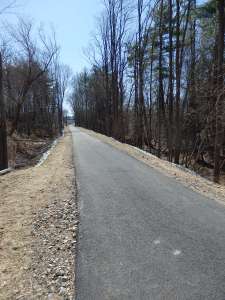
Now, after being on the drawing board for more than six years, a 2,000-foot-long portion of the rail-to-trail pathway has extended the southern end almost all the way to the Sawyer Mills apartments and made ready access for middle- and high-school students.
No motorized vehicles allowed. What a delightful luxury! I think of the trail as Dover’s own Central Park.

There were complications getting permission to skirt some commercial properties along the way, as well as drainage issues and some serious poison ivy. Remaining railroad ties made walking difficult – forget the bicycle or the baby stroller.

Now that winter’s over, the stretch has been graded and paved and, where necessary, fenced off – in a stylish way, I’d say – and while some final touches remain, it’s already attracting happy pedestrian traffic.

You can bet I’ll be checking it out on my return visits.

It’s somebody’s back yard. Really. An industrial parking lot is just ahead on the trail.


What I don’t like about gardening

If you’re still on the fence about breaking some sod and scattering seeds or selecting six-packs of young plants, think about this.

  1. Gardening is time-consuming. There’s a lot to do before planting and harvesting. Even before and after. Wouldn’t you rather be doing something else?
  2. Heartbreaking. There’s always a sacrificial crop each year. You never know which one it will be.
  3. Demands weeding. And more weeding. Especially if you’re largely organic. They’re back in a flourish overnight.
  4. Messy. You have to have someplace out of sight to hide all the pots and bags you’ve pulled out of the shed or garage. As for those weeds you uprooted? They get thrown somewhere.
  5. Debris-producing. You can’t compost it all, especially the woody stuff. And, yes, you can put that in those big brown-paper bags and haul them to the dump, or you can find somewhere to establish a brush pile. And then, at some point, you’ve got to do something with that brush pile before it requires a building permit.
  6. Anxiety-producing. Just listen to my wife watching the weather report or me anticipating the water bill when we’re having to water intensely through a dry spell. And that’s before hailstorms or frost warnings or …
  7. Unforgiving. For example, when a crop arrives, it’s often a flood that must be picked pronto or spoil. And just picking it isn’t enough. You can’t eat it all, so somebody has to can or freeze it. Now! Before it starts rotting or wilts.
  8. A magnet for invaders. Birds, picking out sees and later berries. Slimy garden slugs, taking bites out of anything fleshy, like strawberries and tomatoes, or greens. Squirrels digging mindlessly, often planting walnuts as they go, which then sprout into stinky treelets with tenacious roots. Woodchucks, which can devour a row of their choice overnight. (See item 2.)
  9. Costly. Those bags of potting soil and additives and pesticides (even organic) add up, as do the flats of seedlings, even once you’re past the round of catalogue orders at the beginning of the year. As I was saying about the water bill?
  10. Let’s not overlook replacing broken tools. Or lost ones.

~*~

Well, all those benefits do come at a price. Best you know now!

Fellow planters, be frank. What other downsides would you acknowledge?


When siblings and their spouses work together

My novel What’s Left includes reflections on a first generation of a family business dynamic, somewhat like one I also describe in passing in Nearly Canaan.

In reality, the model of a restaurant run by two brothers and their wives was one I observed in a small Midwestern city where I edited the local newspaper. In this case, their roots were Italian, not Greek, and the economy was essentially farming and two large factories, without a university or county seat to boost business.

Do you have any insights on ways siblings interact when they run a business together?


Comment allez-vous, Yvonne

in outward affairs, a broken toe and off I went, steering in late snow to the emergency room blizzard, too, in sandals now, finally wearing eyeglasses for reading, blame the computer screen and more balding Maine coast from time to time, plus some light rowing and canoeing, and chamber music in mountain villages . still, the annual boat dance with live country folk band and callers cruises Boston Harbor Smell the breeze in its permutations of loving

Some facts related to Prairie Depot

My novel Nearly Canaan starts off in a railroad crossing called Prairie Depot. It’s imaginary, of course, a blend of several small cities I’ve encountered. But, for the record, let’s say this.

  1. It was a dozen or so miles from the nearest Interstate Highway.
  2. It sat in what had been the Great Black Swamp that covered roughly 1,500 square miles before being drained to open up some of the best farmland in the world … and some of the flattest, stretching for miles.
  3. There really were some surviving patches of original prairie nearby, as well as new reservations harboring restoration. The ecosystem had reached westward to the Rocky Mountains, especially in a broad swath through much of the Midwest.
  4. Five different railroads once interconnected in the town. It could lead to frequent delays for drivers and pedestrians alike, as well as interrupted sleep.
  5. It was also a good place for grain elevator dealers to ship from.
  6. The real center of town was a small restaurant owned and operated by two brothers and their wives.Back to the novel!
  7. The town library had a translucent marble exterior wall and a fine collection, thanks to a resourceful director who managed to deflect criticism. He could be a fictional character all in his own.
  8. The region was the scene of a big oil boom, back in the early 1900s. Petroleum was still being pumped at the time of the novel, on a smaller scale, though the grade was lower grade than the market desired.
  9. The place was best known for its collectible glass, before the company relocated to West Virginia, where the name lives on, if not the quality, at least in the estimation of some.
  10. The most celebrated resident dwelt quietly on a shaded side street, her secrecy preserved by the locals, even though she was rumored to have been gangster Al Capone’s mistress. Yes, the one.
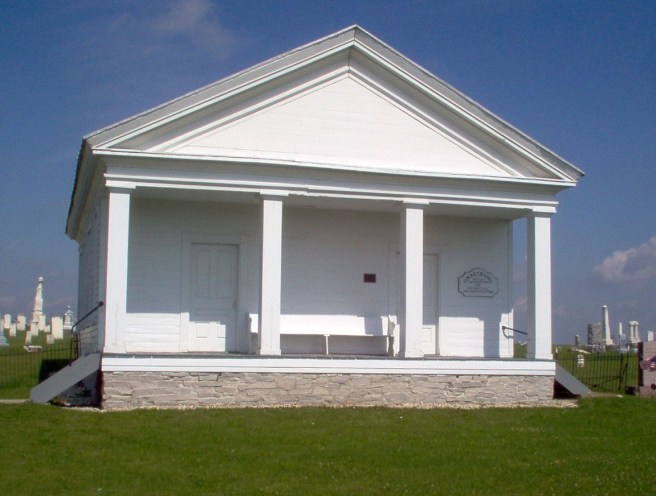
The astringent Greek Temple Revival appearance of Omar Chapel, in Seneca County, Ohio, not far from the prompt for Prairie Depot in my novel Nearly Canaan, continues to haunt me. It says so much about the dreams of its benefactor, out on what was then still frontier.


Packing it in to move on

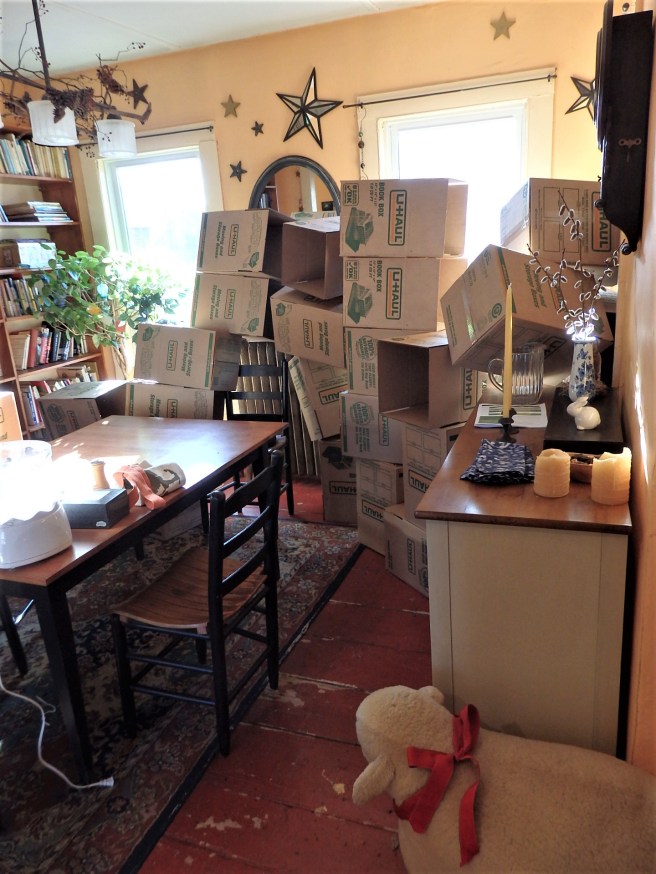
We were reluctant to start packing up our final goods from the house until the new couple passed through their final checkpoint in the home-purchase process. You know, just in case we had to show the place again to a fresh round of bidders.

What it’s meant was less than a week to box or wrap all that remains and haul it off somewhere.

We had already done a ton of packing and purging to make the rooms look presentable, but we wanted to leave enough to make it look cozy and livable. So that part’s done.

I’m a big believer in having uniformly sized boxes in a big move. They stack much more easily, for one thing.

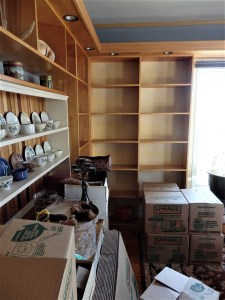
Seeing those shelves empty of books does look strange. I’d forgotten how heavy they are in a box, too.

There’s no way it will all fit in our new Downeast address, especially before our anticipated renovations are completed, so we’re putting some in two storage units, in effect buying some time for some serious culling. More is going off to our daughter’s already stuffed barn in York, to come up later.

It gets emotional, of course. I’m surprised how much responsibility I feel toward the books I’ve read, and their authors. And then there’s my vinyl collection.

Of course, that’s only my tip of the proverbial iceberg. Take the kitchen and garden goods, especially.

Sometimes I used to joke that I couldn’t understand how people lived without a barn to hold all the overflow. Only now it’s not the least bit funny. Seriously, folks.

What I like about gardening

Candidly, I’m not the gardener in our household, but I still have to pitch in with the work. Let me look on the bright side. Plus, when it comes to dining, I definitely enjoy the benefits.

  1. There’s less grass to mow, thanks to the beds that take up at least half of what would have otherwise been lawn.
  2. The sequence of blossoms and produce give me a heightened seasonal awareness. Every week is different, from mid-March as far as mid-November, in the progression of blossoms .
  3. The selections and placement of plants reveals my wife’s mind with its shifting palate of color. She designs English-style clumps, unlike my straight rows. Yes, it really can be a feast for the eyes, even as we look out from our windows.
  4. Asparagus, in a permanent bed, is a delight to cut and eat almost immediately each day through the month of May. It’s the first of our you-can’t-buy-it-this-fresh revelations and reminds me of my years of living in the Yakima Valley of Washington state, where it sprouted like a weed. There, our goal was to sate our taste buds for the coming year. Besides, the delicate ferns are stunning foliage all summer.
  5. Fresh greens. Salads, especially.
  6. Berries, starting with strawberries and extending into blueberries and raspberries. We also have a bank of currants.
  7. Real tomatoes, not the poor substitute you find at the supermarket. We always raise a variety of sizes and shapes, and you’d be surprised how much their flavor varies. One year, I think we had 14 different kinds. Nothing surpasses a tomato and mayo sandwich every day through August and much of September. The king of France should have been envious. You can forget the bacon or even lettuce, as far as I’m concerned, they detract from the star attraction. Again, it’s enjoy it while it’s so gloriously available. (We also freeze a lot for deep winter – the soup, especially, can be heavenly while you watch the snow fall.)
  8. Weeding, which I’d normally avoid, has become a quick means to collect food for the rabbits, which they so greedily and efficiently compost.
  9. Which brings up composting, a lesson in patience and the importance of worms, as I feel virtuous in turning what would have otherwise gone to the landfill into a miracle mixture that’s revived much of our property from what my wife termed “dead dirt” into something soft, pliant, and fertile.
  10. Hummingbirds. They make their rounds through everything flowering, but you have to be alert to see them. Sometimes they’re even right behind your back.

~*~

Well, gardening does also serve as an item of conversation.

What would you add?

Room to welcome everyone

They definitely weren’t suburban. A big pink Victorian house suits Cassia’s colorful extended family in my novel What’s Left. And guests, even guests of guests, are typically welcome.

Have you ever been welcomed in a home like Cassia’s? How does it differ from yours?

~*~

Theirs also had a witch hat, something like the one here.