SHOWING UP AS THE HEAD OF THE EXTENDED FAMILY

Though he’s the youngest of three brothers in my new novel, What’s Left, her uncle Tito winds up as the family patriarch.

As much as Cassia would love for him to fill the emotional void created by the disappearance of her father in an avalanche halfway around the globe, he’s not naturally inclined to be the warm supportive figure she desires. Even her best friend forever Sandra, Tito’s daughter, would agree.

Still, he’s physically present, usually in suit and tie, when required.

And he’s married to Yin, for added friction.

~*~

A passage I trimmed from an earlier version gives you a taste of his sensibilities:

Tito, in turn, confirmed Baba’s astonishment at the amount of waste in the food chain, from the way a big pile of an ingredient might cook down into a condensed quantity – that, in addition to all the leftovers that came back on the plates to be washed.

~*~

There we have it, quantity over quality! Or appearances over essence. How crass it seems now!

Is there a significant event in your life when you really hoped someone in particular would be there for you – but wasn’t? What happened, and how did you react?

~*~

Louis and Michael Pappas preparing Greek salad at Riverside Cafe in Tarpon Springs, Florida, April 12, 1947. (State Library and Archives of Florida via Wikimedia Commons.)

In her family’s past, there may have been scenes food like this.
ANOTHER BIG WAY THIS BECAME A DIFFERENT STORY

I’ve waffled at times on my decision to add her other maternal great-grandparents to my new novel, What’s Left. It was already a big book with a big story when their role expanded, even as I was repeatedly pondering what else could be eliminated without detracting from the whole.

One bold quick cut would take Ilias and Maria out altogether. The story line would be tighter if Bella’s parents had simply rejected her when she tells them she’s marrying into Cassia’s family. But Ilias the Cypriot Greek and his wife, the Cuban-born Maria, insist on inserting their own spicy ingredients to the stew.

For one thing, they strengthen Bella’s emerging role as the family matriarch. For another, they loosen the symmetry of the brothers/brothers-in-law and sisters/sisters-in-law at the helm of the family restaurant that had hired Bella at the outset of the war years. And, my, how they dote on her baby Dimitri and then his brothers and sisters as they come along.

Their embellishments add humanity and warmth. And so they move in – and stay.

~*~

I’ve become a big believer in adopting people into the family – one’s who aren’t blood relations but belong all the same. Is that something you, too, do?

Who is your favorite family member? What makes that person special? How do you think that individual sees you in return?

~*~

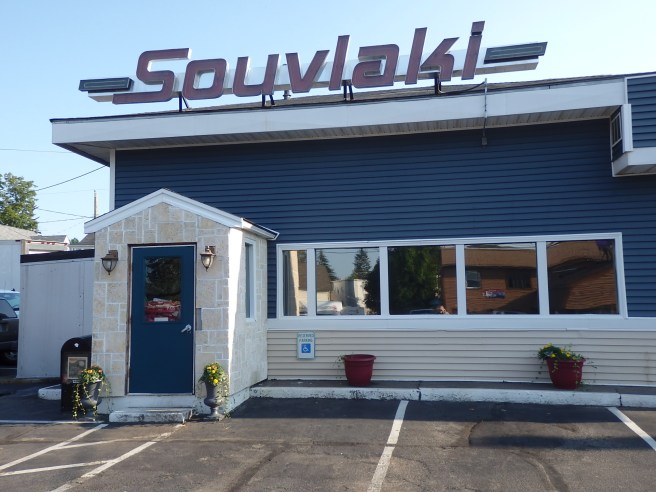
This was one of my favorite places when it came to “ordering out” food at the office. I usually got the souvlaki, even though the menu had other tempting options. (Manchester, New Hampshire.)

AS OUR ADONIS

Oh, if my new novel, What’s Left, were being made into a movie, who would you cast as her uncle Dimitri?

Remember, he has to possess Adonis good looks — and wit to match.

~*~

In the novel, Cassia invokes a blessing for toads — well, maybe its more of threat to anyone who harms one. (Photo by Judy Webb.)


HOW ACCURATE ARE THOSE QUOTATIONS?

In my new novel, What’s Left, she’s retelling much she’s heard from others.

As Cassia might say, while describing the story she’s telling:

Look, if I’m telling you something, it’s happening now. I don’t care if the event took place a hundred years ago, when I evoke it, it’s all happening now, right in front of us. Anyone mind if it’s for the umpteenth time? Or if I’m quoting someone else in my own voice? It’s all coming through my mouth, so it’s me, too. Pay attention. OK? Now listen! Especially you, Baba.

~*~

As an author, I had to ask myself the question. Now it’s your turn for input.

Is it fair to put secondhand dialogue – even hearsay – in separate quotation marks? Or is it some other blending of voices?

~*~

Mock orange has a lovely scent, too.

A VITAL FAMILY IS MORE THAN FLESH AND BLOOD

As Cassia investigates the workings of her extended family, she finds that much of its vitality has resulted from the colorful members in her father’s generation who freely chose to join in. She could say their role was as important as the siblings who were born into the family.

Her father, her uncle Graham, and aunts Pia and Yin all advance the family fortune. It’s a powerful ring, one where they all get along together. Is it too much to expect? Or more good luck?

And then the cracks appear.

Continue reading “A VITAL FAMILY IS MORE THAN FLESH AND BLOOD”

DREAMING OF THE BIG SCREEN

Nearly every novelist of the last half-century, at least, must have had moments of dreaming of a screen adaptation. (And, yes, nearly every one that was adapted was never as good as the book. Oh, well.)

As a critical aside, we’ve seen too many novels that were thinly disguised screenplays. Yet while my new novel was created as a purely literary effort, I’m impressed by great cinema.

If we had a movie version of What’s Left, who would you have play Cassia’s aunt Pia?

She’d have to project so many dimensions!

~*~

Greek Orthodox icon of the Virgin Mary of Mount Athos (and details) created by Father Vasileios Pavlatos in Kefalonia, Greece using the technique of Pyrography. (Via Wikimedia Commons.)

Cassia’s roots included inspiration like this.

THE ULTIMATE FLOWER CHILD

In my new novel, What’s Left, her aunt Pia is the epitome of bohemian possibility, even after being scorched by its downside. She’s the one who’s lived on communes; in contrast, Cassia’s father and aunt Nita had merely paid their share on an abandoned farm filled with other hip renters. Pia’s the one who witnessed drug busts and overdoses or worse, she simply went hungry.

As she recovers in the midst of Cassia’s extended family, her bohemian tastes find welcome expression in food and fabric and childlike wonder, especially. She’s hardworking and responsible, especially amid the circus she creates.

For Cassia’s generation, of course, hippie is old hat. But her aunt Pia is someone they see as special. Wouldn’t you?

~*~

Watching Pia was like watching a flower emerge from the soil and then bloom. The girl arrives destitute and broken and is given space to heal or regroup.

Whatever haven we offer is gratefully embraced.

She mends clothes. Tends the garden. Sits with us as we ride our White Cloud thrones.

~*~

I can’t evade the question any longer. What comes to your mind when you hear the word “hippie”? Do you prefer “boho”? Or does some other term work better these days? Is it positive … or negative?

~*~

Pikilia, an assortment of Greek appetizers. Photo via Wikimedia Commons.

In the family, Cassia may have had food like this.

CHARTING THEIR COURSE

As Cassia reconstructs the household when her father-to-be first shows up, she sees multiple currents in motion.

As she observed in an earlier version of my new novel, What’s Left:

Dimitri’s primarily about family duty. Too many have worked too hard to get us here. For Barney, that’s steam and splatter and sudsy sinks. Tito and Manoula are essentially on hold, preparing for their own futures – college for her, law school for him.

~*~

In another version of the story, Tito and Manoula’s futures could have been thwarted at this point. Dimitri may have required their help in the restaurant and real estate ventures.

Something similar happened with my grandfather, whose classroom education ended at elementary school because he was needed on the farm. Later, though, he did learn the plumbing trade from his two older brothers.

With Cassia’s family, though, they were agreed on a plan. They all worked together to assure it.

What’s your No. 1 goal these days? What support do you need? How are you arranging it?

~*~

Ring dancing at Greek Fest, New Orleans. (Photo by Infrogmation via Wikimedia Commons.)

Cassia’s roots included inspiration like this.

COUSINS WHO COUNT

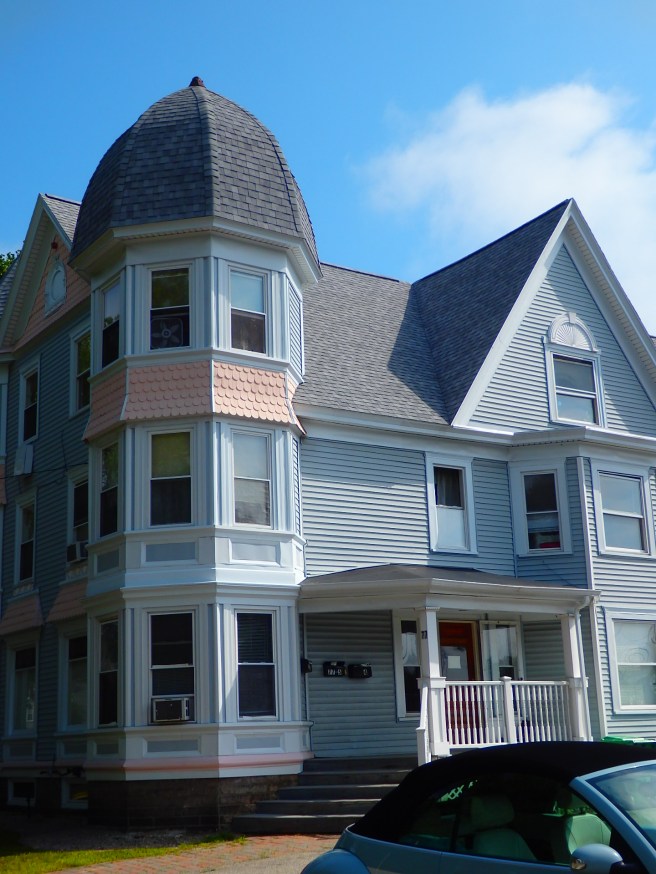
A large Queen Anne-style house with a distinctive witch’s hat tower something like this is the headquarters for Cassia’s extended family in my new novel, What’s Left. If only this one were pink, like hers.

Could I have directed my new novel, What’s Left, to move straight from her loss at age 11 into her subsequent growth within her close-knit circle of cousins?

Since so much of their group identity depends on the family restaurant where they all work at some point in their youth and the big Victorian house where they gather and many of them still live, this would nevertheless require some hints of the history of their being where they are – and who they are – pretty close to the top of the story anyway, plus far more detail about the cousins and their parents than I now need to engage in the opening chapters.

As a writer, I’m left wondering how I’d ever introduce all of this at once and still have you readers following the narrative. A related challenge would be any attempt to work our way back through the family history, like an archaeologist, layer by layer, rather than jumping down to the trunk of her family in the New World and moving upward from there. There are many sound reasons for presenting a history chronologically, after all. Especially when past events help us more clearly understand where we are and who we are now.

~*~

Well, you can check out the book as it stands.

The story, of course, turns toward the crucial decisions they’ll face. Will Cassia and her cousins ever live up to their family’s resourceful and romantic roots? Will they be able to take their legacy to greater heights?

What would you do in their place, given their resources? Stay and work in the restaurant and real estate? Start something of your own while living close at hand? Or head off for careers and family elsewhere?

WHEN THREE’S NOT A CROWD

For me, her uncle Tito originates as a problematic character. I have no idea what prompted me to create him nearly five decades ago in the closing chapter of my first published novel, but he does change the dynamic of the family that Cassia’s father-to-be joins.

Having five siblings rather than four avoids the symmetry of two brothers and two sisters, for one thing, and as an odd number, five pushes us away from possible gridlock. But advancing the story another generation, as I do in my new novel, What’s Left, means we’ll have more characters to follow, once we add spouses and children.

Without him, my new novel would be tighter, since all of Cassia’s close cousins would come from Barney and Pia. Well, maybe Dimitri and/or Nita would have to be recast, too, losing some of the story’s diversity and depth. The plot itself would likely pivot on the sibling rivalry of Dimitri and Barney, and I’m not sure we’d have the impetus for expanding the family enterprise that I, for one, find exciting. The status quo could continue, with the story’s focus on day to day interactions more than transformation of the larger community. The mantle of patriarch, too, would fall differently.

Continue reading “WHEN THREE’S NOT A CROWD”