In my new novel, What’s Left, her aunt Yin has her helping book rock bands rather than working in the restaurant. For Cassia, it’s a welcome break. She can be cool and hang with her cousin Sakis’ scene.
While her mother’s a skilled violinist, Cassia herself is not a musician. In one explanation that didn’t make it to the final revision, she explains:
When it came to music, I wanted to play drums but was shunted to piano, which I hated. It just wasn’t me.
~*~
Are you part of a band? Do you sing in a choir? Play an instrument? Was there one you wanted to study but told otherwise? Do you sympathize with Cassia here?
~*~
A large house with a distinctive witch’s hat tower something like this is the headquarters for Cassia’s extended family in my new novel, What’s Left. Gee, and this one’s almost pink, like hers. (Tamworth, New Hampshire.)
Central to my new novel, What’s Left, is a painful awareness that something crucial is missing from her life. In her case, it’s the physical loss of her father when she’s 11. For others, that sense could be prompted by a divorce – which also figures in my novel – or the rejection by a lover, as happens much earlier to her father. Or even drive one to suicide or self-destructive behavior. (No suicides in the story, in case you’re wondering.)
A comment by one woman whose father had died when she was about Cassia’s age prompted a key change in the voice of my novel in its ninth revision. “I still talk to him,” she said, nearly 40 years after his passing. That perspective opened a whole new dimension for me in developing Cassia and her relationships. It’s changed the voice and tone of the book, resulting in far more intimate dialogue, I’d say. Just take a look at the finished novel.
~*~
This didn’t quite fit on the platter:
What Baba and Manoula shared is an awareness of some loss or suffering the illusory surface we view might be masking. For Baba, the ultimate rejection by Diz opened a pit for him to fall into – nothing he’d assumed quite held, either, as far as he could see. (Never mind Nita’s role – he wanted a lover.) For Manoula, the fatal crash of her parents did something similar. From a Greek perspective, suicide makes perfect sense – as does, I might guess, sin. The convolutions only thicken the engagement with life itself.
~*~
Well, this was an early stab at the issue. In the finished novel, we never get around to asking if Manoula winds up frequently talking to her deceased parents, the way Cassia does throughout the story. Or whether her husband, Cassia’s Baba, somehow fills the void.
For me, the conversation’s often invoked certain long-gone lovers.
Do you find yourself talking to someone who’s not present? Have you ever felt a loss like Cassia’s? Has one of your close friends? What insight would you have?
~*~
Cassia’s family restaurant has me looking more closely at the ones around me. (North Berwick, Maine)
The once grand dame of an apartment house turned shabby that I describe in my novel Daffodil Uprising was real, though situated in Upstate New York rather than southern Indiana. A little bit more poetic license, if you will, in my relocating the blocky building.
I use the past tense, because satellite searches inform me the structure has been demolished, no doubt because of some of the health and safety issues the story relates. Bringing everything up to code would have cost a fortune.
Well, maybe a fire did it in. That, too, feels quite plausible.
When Kenzie and his two buddies flee their dorm, they have such high expectations. So did I, in what was supposed to be a haven after college. Look, this was what a professional journalist could afford – slum housing.
Still, the moldy manse was memorable and possibly haunted. I certainly heard rumors to that effect.
How far can a restaurant extend its business base? Its “brand,” as they say. This passage is prompted by meals at restaurants that expanded into new revenues, even though I cut this from the final version of my new novel, What’s Left:
Still, the playful concept feeds into what emerges around the corner as an elegant multi-purpose restaurant, plus a bookstore, art gallery, gift shop, and even a small greenhouse.
And that’s before the bakery or brewery comes into sight. For whatever reason, though, I shied away from launching Carmichael’s own brand of bottled products.
This has me thinking of a couple of specialty food markets on the tourist trail that include a cafe featuring their products. Turns the concept I’m discussing around, in effect.
The identity, of course, is built on something that makes us go gaga. Something that makes us want to return again and again.
What’s someplace that features your favorite comfort food or special treat? Would you wear a T-shirt proclaiming it? What do you think of restaurants that have a gift shop attached? Does it add or detract from the mission?
~*~
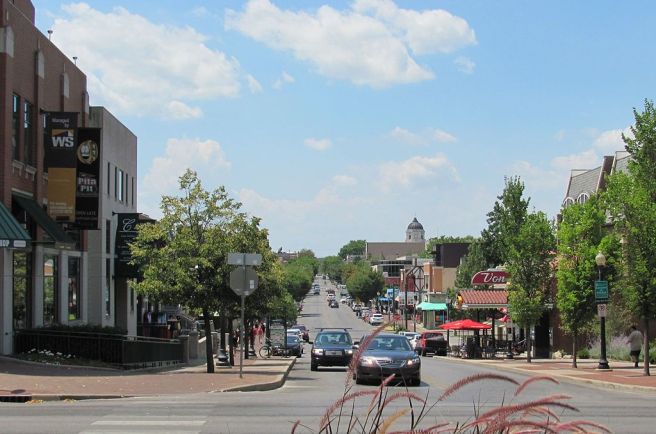
Bloomington, Indiana, by Marelbu via Wikimedia Commons.
I had long been perplexed why my modern American poetry class in the late ’60s had spent so much time on Edwin Arlington Robinson, especially since we never got up to more pressing figures like Kenneth Rexroth, Lawrence Ferlinghetti, Allen Ginsberg, or Gary Snyder.
I made a jab at this plaint in my Daffodil Sunrise novel, where our budding photographer was panicking while typing away on his take on Robinson.
More recently, when reworking that manuscript into Daffodil Uprising, I found myself running with the poet more fully.
For one thing, I had to admit he was more contemporary than I’d allowed back in college. His lines and insights are clean, prescient of new approaches, even snippy.
For another, he could be bitter, sarcastic, depressed – as were many beats and budding hippies.
Edwin Arlington Robinson. I still think he looks like a proto-hippie.
His parents themselves weren’t that far from bohemian, either. His mother couldn’t even come up with a name for him, after all, and that fell to a circle of “summer people” visiting Maine. They put names in a hat or whatever and the slip of paper that came up was Edwin. The woman was from Arlington, Massachusetts. Bingo. We have a middle name.
His eldest brother went from being a successful businessman to bankrupt and alcoholic to die in poverty with tuberculosis.
His other brother, a physician, became addicted to morphine and died of what might have been an intentional overdose.
Living the past 31 years in northern New England, I’m now familiar with the culture Robinson grew up within. Gardiner, Maine, is a few hours up the road from us. I have friends whose roots are there.
Without giving a spoiler, let me say Robinson is now an active figure in the new novel. He infuses some wonderful, if sardonic, perspectives to the younger generation, and becomes a foil for similar spirits from the Edwardian past that sway the photographer’s girlfriend, too.
Would he talk this way, though? Who knows.
By now we’re dealing with fantasy, anyway, and that’s so unlike the concrete details of his verse. Again, we’ll excuse ourselves with poetic license.
Though she’s grown up in an extended bohemian family, Cassia’s able to cope with being different from many of her classmates – up to the point her father vanishes in an avalanche halfway around the globe. The other kids have fathers – that’s normal, or so she thinks. And then, in a flash, she and her home aren’t normal.
To see just how atypical they are, check out my new novel, What’s Left.
~*~
I just couldn’t pour this down the drain. It needed to simmer much more:
Her father was also a dreamer – or at least an idealist – a dimension that often inhibited him from asking hard questions or anticipating a full range of obstacles in a course of action. And he had an innate aversion to conflict.
What Thea Nita has confirmed is that Baba carried a sense of not quite belonging in the consumer culture of America. He had rightly concluded the ultimate flatness of his birthplace had nothing to do with its landscape and everything to do with a wider loss of stimulation, imagination, and inventive discovery – all further inhibited by social conformity rather than any acceptance of eccentricity. He recognized the potential for more, much more – something he encountered first in science and the fine arts and later in direct spiritual experience.
~*~
And then there’s her mother’s side, where they live – where he, too, has chosen to place his life.
Reflecting on the emotional cost of an upbringing like that in my own life has me realizing just how debilitating it has been. Like him, I found ways to escape and still somehow “fit in.”
Let’s get back to the basics. Would you say you’re “normal”? What would you like to change about yourself or your situation?
~*~
A large Queen Anne-style house with a distinctive witch’s hat tower something like this is the headquarters for Cassia’s extended family in my new novel, What’s Left. If only this one were pink, like hers. (Manchester, New Hampshire.)
In another of the grandiose outbursts I surgically excised from the final version of my new novel, What’s Left, her uncle Dimitri and her father-to-be are engaged in a heated late-night debate.
While their dialogue springs out of a consideration of photography as a fine art, it could extended much broader – perhaps even onto the plates served in the family restaurant.
Here’s how it stood: Any fine art of the future cannot be an end in itself. It must reflect a much more comprehensive spiritual current. It must instill an awareness of a community. You, of all people must have noticed the only thing the university can teach is technique. The profs can’t instill the leap of psychic thunder. They may encourage a few people to take up vital self-discipline and daily practice.
~*~
Surgically excised? Looks like I actually used one of Barney’s super-sharp chef knives!
The dynamic of formal teaching and learning ultimately fell outside the parameters of my new novel anyway. The important thing is that Cassia’s Baba finds a true home.
I’d say her uncle Barney, the chef, practices a fine art, in his own way, and he’s never attended college. He just has an active curiosity and a place to engage it. Maybe that’s why he and her Baba get along so easily.
Do you practice an art or a craft? Have you ever tried to define your “mission”? How do you explain your motivation or activity? Who gives you the most positive feedback?
~*~
This Victorian house, with its witch-hat tower and roof, was erected in Allentown, Pa., around 1891. It is shown here in 1926 during construction of the New Pergola Theater next door. The house was torn down in 1960, replaced by Van’s Diner, a glass and aluminum structure. (Photo via Wikimedia Commons.)
In my novel, the family home could have looked like this.
At one point in earlier versions of my new novel, What’s Left, I envisioned her family using their financial resources to drive an alternative local economy. The concept survives in the final version of the book, although this passage was boiled way down and many of the details changed:
Dimitri admits our enterprises will operate at the fringes of the economy.
He anticipates other extensions. We’ll encourage other friends to open a bakery. A guitar maker will join in a folk music shop. Rural skills like chair-caning and quilting will find a market here. Not everything we encourage will be quaint, as we’ll discover. Technology might include not just Baba’s darkroom and cameras but recording studios, computer designers, and solar entrepreneurs as well.
~*~
Or, as I noted in another now-deleted passage:
With patience, we’ll assure our dilapidated neighborhood just off campus undergoes rebirth.
~*~
Money issues – especially of an emotional, theological, and personal nature – are a topic I believe worthy of deep discussion. Just look to my Talking Money series archived at my Chicken Farmer I Still Love You blog for inspiration. Admittedly, they’re too big for this novel, though now I’m beginning to wonder about another, maybe as a series of telephone conversations? Please, somebody talk some sense into me!
(Oh, my, now I’m recalling that “financially secure” line in the old personals ads and still wondering exactly what the women meant by that – a guy who has a regular job with benefits or a seven-figure portfolio instead?)
Thinking of operating at the fringes of the larger economy, though, good things can happen. Where do you imagine an infusion of “greenback energy” might empower you or your friends to better the world as we know it?
~*~
The town of Fira on Santorini photographed from the roof of the Archipelagos Restaurant. (Photo by Rennett Stowe via Wikimedia Commons.)
The evolution of my character Nita Zapitapoulos through my four Hippie Trails novels was a fascinating creative process. At first she was a faint reflection of a friend’s hot infatuation, and then she grew into something else.
In the storyline, she and a photography student meet through a mutual acquaintance. Nita soon takes him under her wing and, over time, becomes his guardian angel. By the time we get to my Hippie Love novel, she’s speaking almost exclusively in questions, a characteristic that continues in my newest novel, What’s Left.
~*~
Well, by the time I got to the final revision of my new novel, the cousins were too busy for this, too:
When it came to work, as kids, we weren’t always at the restaurant. Sometimes Thea Nita hired us to vacuum and dust her place and help her reorganize her shelves and drawers. Sometimes, when we were older, she’d even have us sanding and repainting her apartment. And that’s before she picked a few of us to help her with her newspaper column.
~*~
In the end, it wasn’t about money – it was about a deeper connection. She wasn’t shy about asking for help, either, but I don’t think she’d take advantage of anyone.
Have you ever had a friend or relative like Nita? How so?
~*~
Dan Kuzoff, a Macedonian immigrant, opened the Majestic Restaurant in Hamilton, Ontario, in 1933. It was a 150- to 200-seat operation serving good food at good prices. It was a middle of the road restaurant with no liquor license. Frequent diners there including politicians such as Lloyd Jackson and Vic Copps. As with all the other businesses in the area, the restaurant was expropriated for the construction of Jackson Square in 1969. Hamilton Public Library via Wikimedia Commons.
In my novel, the family restaurant could have been like this.
When she begins her investigation in my new novel, What’s Left, she may think her generation’s quite different from her father’s.
But her family does run a family restaurant, and that gives her a different insight:
We can always count on someone looking for a handout at the back door. We’re happy to oblige them. And they’re happy, too – the word spreads.
~*~
Restaurants are often staffed by an underworld of their own, or so I’m told. And some of the characters aren’t that far removed from the folks looking for a handout.
I’m surprised to see how many people in my own community remain invisible, especially when your eyes look instead to “normal” society.
Have you ever gone to a “soup kitchen” or charity food pantry? Have you ever worked in one? What was your experience?
~*~
If Cassia’s great-grandparents had only bought this house instead! And it’s almost pink … (Manchester, New Hampshire.)




 Jnana's Red Barn