In case you’re not conversant in Tibetan

Having Cassia cast a Buddhist chant as a spell in my novel What’s Left, is a bit of an inside joke. She may be trying to intimidate her middle school classmates, but what she utters, Su To Ka Yo Me Bha Wa, translates as “Grant me complete satisfaction” or “Grant me complete satisfaction within me.” Not that they have a clue.

Besides, I feel a shade of Harry Potter here, without an ominous wand. These words can simply feel magical.

By the way, Cassia’s chant is one letter off from Su Po Ka Yo Me Wa, “Grow within me” or “Increase the positive within me,” which also fits.

Just in case you’re wondering.

~*~

Think of some word or phrases you repeat often.

Do you have your own “mantra,” a word or phrase to raise your spirits?

(My favorite 9-year-old introduced me to “Yay!” So yours doesn’t have to be the least bit exotic.)

~*~

Cassia’s aunt Pia came from a family that owned places like this. Not far from Lowell, Massachusetts, where she grew up, for that matter.

Family honor means something

In my novel What’s Left the family-owned restaurant is a local institution, one set at the edge of campus even before her grandparents and their siblings took over and made it distinctly their own. Everybody in town seems to know them.

Have you ever been recognized because of something your parents or grandparents did?

~*~

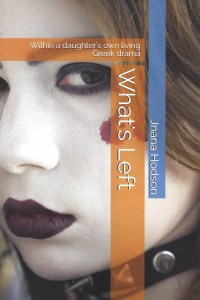
My novel’s available at the Apple Store, Barnes & Noble’s Nook, Scribd, Smashwords, Sony’s Kobo, and other fine ebook distributors and at Amazon in both Kindle and paperback.

The paperback cover …

Working all hours, for starters

Here’s something I’ve pondered in revising my big novel What’s Left:

Does the restaurant business essentially operate at the fringe of normal society? Or do weird characters naturally gravitate toward jobs there?

If you’ve ever worked in a commercial food operation, what’s you most telling impression?

~*~

What a tradition!

An insider’s tricks of the trade

Her aunt Nita in my novel What’s Left, has an interesting insight on showing up for work before all the others. It doesn’t fit every job, but it did hers. And then I cut this from the final version of the book:

If you’re the first one in and the last one out, you can disappear in the middle of the day and your coworkers and bosses are none the wiser. They just assume you’re out on assignment.

~*~

Not all jobs require you to punch-in or punch-out on some kind of clock. I’ve never had to work one of those, fortunately, although I’ve often had to fill out weekly time cards before being paid.

What I did find, though, was that even when I was putting in a lot of unpaid overtime (the joys of being low-tier management!), I could still feel the judgmental eyes behind my back.

Are you ever considered a slacker on your job? How does it feel? How do you respond?

~*~

In the family, Cassia would have had food like this. Greek olives! Best of all, packed in olive oil!

With a focus on the family

Cassia’s future father marries into a family that owns a popular restaurant. So that’s one additional connection for the members.

Considering his wife’s sister and three brothers, all with potential partners of their own, he’s not the only spouse thrown into the mix. And that’s before getting to those who want careers elsewhere.

What holds your extended family together? Or are you widely scattered?

~*~

The family also buys an old church, something like this, and turns it into a community center that features wild rock concerts.

How well do you know your cousins?

Would you agree that a close-knit extended family like the one in my novel What’s Left, is uncommon in today’s American society? Of my own five surviving first-cousins, only one remains in communication — a brief note every Christmas. None grew up in our city; two lived in the other corner of our state; the other four, at the time, in California.

~*~

In a passage I cut from the final version:

It wasn’t quite like that when Baba shows up, but only because we kids aren’t yet on the scene. First, we need some marriages, like when Barney and Pia get a new generation rolling, followed by Tito and Yin and then my parents.

~*~

And if Cassia’s uncle Dimitri or her aunt Nita had been adding to the gene pool, we’d have an even bigger slate of first-cousins to draw on. When it came to the novel, I had to limit things somewhere.

Have you ever been introduced to family members and found yourself asking yourself: Just who are these strangers? Have you enjoyed some of your kin at one point in your life but not at others? Do you ever feel some have been treated better than the rest?

~*~

Do you ever get lost when older members of your family start mentioning so-and-so? Just how do they all fit together?

Well, they couldn’t wear nametags

One approach I employed may help readers keep track of the spreading number of family members.

In drafting my novel What’s Left, I envisioned each chapter as a module that could stand alone from the rest of the book. Think of it as a short story. That way, the number of characters in each chapter is more focused.

And while first names are usually repeated frequently in a Greek-American family, I limited this to just one great-grandmother and one descendant, and used a nickname for the elder one. Neat, eh?

Yes, the family members do show up in other modules and there is continuity over the whole, but at least you don’t have everyone in your face at once.

When you go to a social event and are introduced to many new people, are you able to remember their names and faces? Or do you go into a blur? How do you cope with this challenge?


When flights intersect or move on 

Just what was I thinking? Was this supposed to be a philosophy class moment? A reflection on time versus space? Or fate versus free will? No wonder the paragraph failed to take root in my novel What’s Left.

History is filled with unique moments when something flashes up and takes hold. Or a singular intersection of trajectories appears in the universe of motion.

~*~

The novel, by the way, has many of these situations, just as life itself does. We just didn’t need to get preachy.

I suppose this just might fit a story about baseball. Or think of football. The great play no fan will ever forget.

There are also those accidents, seemingly chance encounters, like the late-night crash that kills Cassia’s grandparents or the avalanche that claims her father. A few moments one way or the other, and her story would be much, much different.

I was more likely reflecting on those seconds where you have to make a decision one way or another. Say something. Do something. Yes or no. The beginning of a romance, for instance, once you’ve introduced yourself. Uttered the joke that could have as easily fallen flat.

Can you recall a significant moment in your life when something had to happen right then — or never at all? One with no second chances? Please share it! Be bold!

~*~

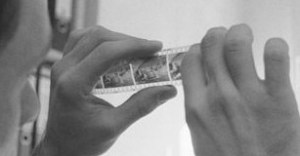
Cassia learns to “read” strips of photographic negatives like this as she looks for clues to her father’s life journey.

Maybe it’s not really news but it counts

Heyduck

In my novel What’s Left, Cassia’s aunt Nita writes a daily newspaper column focusing on local people and their real interests. It’s not all that different from CeCe Cobb’s in my earlier novel Hometown News, but Nita’s is far less corny and far newsier.

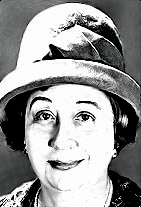
In Dayton, where I grew up, it was Marj Heyduck of the Journal Herald. Her mug shot on her daily column featured a new hat each week as a signature touch. And in Cincinnati, it was TV host Sally Flowers.

But I can think of others who just seem to know everybody.

Does your community have a local voice? A minor celebrity or just a naturally curious friend of all?