Somehow it looked different

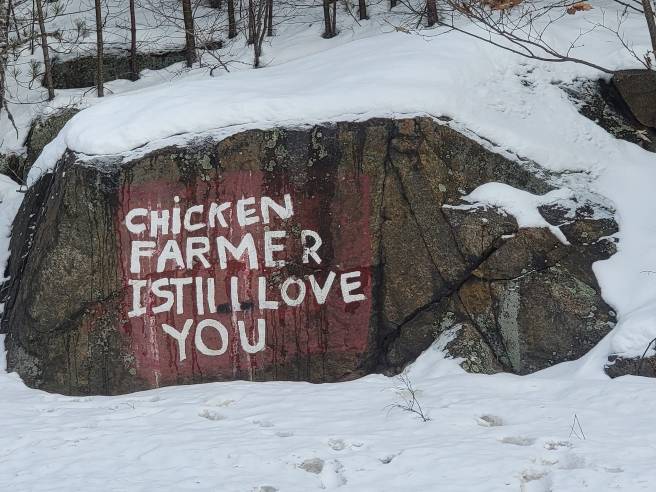
Seeing this photo of the painted rock along the state highway in Newbury, New Hampshire, had me doing a doubletake. Twice.

First, I realized I have never seen it in winter. Even in summer, it’s easy to miss, and I can’t recall any reason I would have been up that way other than August.

Second, though, I slowly noticed the lettering is different. It’s obviously been repainted, which is supposed to always be done on the sly, and this time the lettering is thicker, bolder.

The slogan and its history did inspire a blog related to the Red Barn, and if you haven’t visited there, please take a tour. It can be an enriching experience.


I’m still in the dark about how they actually conducted business

There were no banks and you couldn’t write checks.

Were dried fish and lumber so valuable in Britain and the Continent that you could still make a fat profit shipping them across the ocean? Furs, I can understand, as well as the hunger for gold and silver, which may have fueled speculators who were inevitably disappointed. Plus fish, likely dried.

As for paying your workers? A daily portion of rum or the like was apparently often part of the deal.

By the way, Quakers were in the forefront of developing banks and insurance and even packet shipping in time.

The early colonies had layers of ownership, starting with those demanding annual quitrents for the land you would clear and build on or have “purchased” with any improvements. Then there were the chartered investors, like Lord Saye and Sele and Lord Brooke in New Hampshire’s case, who somehow expected to make a profit overseeing the place. They still had obligations to other investors, like the Council for New England. I’m really unclear how all of that worked in practice or what they got from “selling” their charter to Massachusetts.

The best I can come up with is that it was a kind of private enterprise tax, though I’m not sure what was offered in return. Like Mafia “protection” or layers of graft?

And that’s even before getting to England’s heavy mercantile system that hampered American entrepreneurial opportunities. The colonists were expected to provide raw materials for manufacture in England before being sold at hefty markups in the New World, too.

How did the colonists ever thrive, all their hard work aside?

I’m thinking it’s almost as vaporous as bitcoins.

Not to be left in the dark

Is it just me but are power outages becoming more common, more widespread, more severe?

That would fit the forecast of climatic instability, otherwise known as global warming, which is no longer undeniable.

Remember the scoffers who first decried the prophets as ridiculous, denied the causes, spent millions to ensure their profits, and ultimately said there’s nothing we can do about it, contrary to what those insightful prophets had warned?

I’m looking for a better option than paying for a propane-powered generator that further lines the pockets of a source of the problem. Got it?

Those guys should be paying us.

End of this jeremiad, for now.

Cold reality

In an effort to keep the fuel oil bill down, the family decided to set the furnace thermostat no higher than 57 degrees.

But I’m freezing.

I’m threatening to turn the air conditioner on, hoping for 65.

~*~

Am I turning into a gnome these days? You don’t even see the finger-free gloves I’m also wearing when I’m inside the house.

Delving into a microcosm for a bigger comprehension

In looking at the categories I’ve used since launching this blog a decade ago, I feel I should explain why I’ve resisted adding to them.

I simply wanted to retain some kind of focus on what I’d envisioned as a merry-go-round. Yes, the categories were the selected horses to ride.

Think of “American Affairs,” largely inspired by an academic department that Indiana University and Yale and a few others launched in the mid-‘60s to encapsulate a multicultural investigation of current affairs. I nearly embraced it as my own major, the way some Blacks turned to Swahili.

Hey, I had a girlfriend who saw that regarding her own eldest brother. Back off, please, and let’s get back to subject.

What I’ve found in practice here at the Red Barn is that my Am Affairs specific pigeonhole has increasingly probed local public states, especially in Dover, New Hampshire, and more recently, Eastport in Way Downeast Maine.

Or, as the adage goes, all politics are local. (Should that be “is”?)

The writer Tom Wolfe was someone I had thought followed this American Affairs college degree path, but I find myself mistaken, at least as far as academia goes. Still, I would list him as an inspiration here, just shorn of the heap of superlative adjectives, expletives, and adverbs.

But our localities do get lost in the national mass-media mindset, to the impoverishment of us all.

Or, as the French said, “Vive la difference!”

Actually, as I’m realizing, that also applies to my latest book, Quaking Dover.

How the Cocheco Mills reshaped Dover

My history of Dover, focused on its Quaker Meeting, begins trailing off about the time the textiles mills prosper at the Lower Falls in the Cochecho River. There’s no escaping the fact that the mills completely reshaped the direction of the emerging city, then and now.

  1. The complex began with the Dover Cotton Factory in 1812, but the surviving buildings were constructed between the 1880s and early 20th century. The downtown is built around them. The mills even span the river below the falls.
  2. A clerical error in the company’s 1827 reorganization, as the Cocheco Manufacturing Company, dropped the second h from Cochecho, leading to ongoing confusing about the proper spelling of the river’s name.
  3. In 1828, the mill was the site of one of the earliest labor strikes in the nation, the first to be conducted entirely by women. They were protesting a pay cut.
  4. The mills brought waves of immigrants to the city, especially from Ireland, Quebec, and Greece. The complex eventually employed 1,200 workers, most of them women.
  5. At its height in the 1880s, the mills shipped 65 million yards of printed calico worldwide annually, with esteemed designs from the associated printing operation on the site of today’s Henry Law Park.
  6. The buildings were subject to disastrous fires and floods. They were also noisy and cold in winter, hot in summer.
  7. The company owned lakes upstream to ensure water power through the year.
  8. The mills operated as the Cocheco Manufacturing Company and then the Cocheco Mill Company until 1908, when the operation was bought by the Pacific Mill Works of Lawrence, Massachusetts, which shuttered everything in 1937. The buildings were then bought at auction by the city.
  9. In the early 1980s, entrepreneur Joseph Sawtelle purchased the largest vacant building in the county and began a visionary restoration that uncovered the boarded windows and led to offices, entrepreneurial incubators, and retail stores in the heart of the city. After his death in 2000, Eric Chinburg acquired the properties and added trendy apartments to the mix.
  10. The mills were placed on the National Register of Historic Places in 2014.

Check out my new book, Quaking Dover, available in an iBook edition at the Apple Store.

Even in a housing shortage

Yup, home prices went through the roof in most of the country – but not here.

A common sight throughout Downeast Maine is abandoned housing in varying stages of decay. Seeing an old dwelling like that, your initial impulse is that somebody, somewhere, ought to save it. You know, live out in the woods, free from hassles, and all that. It’s gotta have a charming history, right?  (Rusting trailers and mobile homes somehow get less sympathy, if any.)

Abandoned housing comes in varying stages of collapse.

Then reality kicks in. Most of these would cost a ton to renovate – and many are tiny. Insulation, plumbing, and wiring are only the beginning. It’s cheaper to start fresh, if you can. Jobs are scarce, often towns away, if you can find work, so unless you’re retired, that’s another strike. And if you are retired, you might check out far to the nearest doc or clinic. I have to wonder, too, why anyone would want to live that close to the highway and its noisy traffic, other than maybe getting priority plowing after a snowfall. As for the mosquitos and black flies?

Others might tell you it gets boring. No malls or big-box stores, much less neighbors or a real supermarket.

Even as a summer home, then, there are drawbacks. Wouldn’t you rather be on a lake or the ocean?

It’s not all out in the wilds, either. Eastport has three in a row here.
Each with this notice attached, declaring a building dangerous, unsafe, and not habitable.

How can anyone ever read all of what’s pouring in?

There’s just so much out there, in print and especially online, and it keeps proliferating daily, even hourly, and I don’t know about you, but I’m in the camp that finds it truly overwhelming.

Everywhere, each minute, make that second, we’re expanding outward, away, from any notion of a renaissance man, and woman, who could possibly be well informed on every facet of a civilized society.

Even in science – or maybe, especially in science – it’s become impossible to keep abreast of the flood.

Interdisciplinary collaboration has become more essential than ever, but also more elusive.

Is this leading toward disintegration?

Is this, in fact, the root of the reactionary backlash around the globe, not just the Trumpian cultists?

Yeah, the folks who rely on Fox TV biased “news” in the USA.

I look at the crises facing our children and grandchildren, and these are critical, but there are so many it’s mindboggling trying to decide where to pitch in taking a stand. Climate change, population explosion, racism, corrupt politics, the one percent and injustice, environmental protection, medical systems, education … Hey, I’m back to hippie era causes on steroids.

How are we supposed to preserve our sanity and still press toward a better future?

We still have to be informed, right? And thinking clearly?