
Aw, gee, Doc
You never know what we'll churn up in cleaning a stall

The range of the bard’s vocabulary and situations long appeared to be beyond the possibilities of the man’s background and training.
Long ago I came to a sense that he might have simply been the recorder and editor of a more free-form ensemble, an improv troupe, if you will.
Now I’ve come across arguments that the real playwright was Amelia Bassano, and it’s far more convincing.
A digital search will point you to the arguments, pro and con.
Anyone else like the idea that the most important writer in the English canon was a woman? One of Italian and Jewish descent, at that?
In What’s Left, Cassia spends hour after hour organizing the chaotic mess of her father’s photo studio after he vanishes in an avalanche halfway around the globe.
He was something of a hippie, too, as she sees in some of his excesses from the period. Here’s something that popped up for her in a conversation with her aunt Nita. You won’t find it in the final version of the novel, though — some things just got toned down.
And? You ever see the movie he made about the courthouse?
The one with the dome turning into his girlfriend’s breast? Diz’s?
You remember he made that while he was still an undergraduate? Before all the really freaky stuff that followed?
Yes, and that reminds me. We need to have to get that reel converted to digital from Super 16. Before it starts disintegrating or fading.
You know what a hit that was in some circles? How he was on the verge of notoriety or celebrity?
So why didn’t he continue in that vein?
How would he have paid the bills? The big bills? Where were his introductions? Producers, distributors, even actors? Or his confidence,
~*~
I’ve been trying to think if there’s anything in my past quite that outrageous, but it all seems to be included in my Freakin’ Free Spirits series. My kids would likely be disappointed, but I’m glad my parents never knew the details. I hate to think, though, of some of the things my two girls are hiding from me. My, the times have changed!
What’s something you or your friends are hiding from your parents? What’s most shocked or surprised you about them? What other directions might their lives have taken? What might you hope your own kids never ask you about?
~*~

~*~
You’ve no doubt heard cliché quips about the stress-relieving blessings of having your own garden. I want to know, compared to what? A day at the beach or in the mountains? Kicking back with a brew on a deck overlooking the river? Listening to music or dancing? Sunbathing on your own deck? Reading a book?
Maybe you’re one of the newbies who decided the year of Covid, with its upsets to the food chain, would be a good time to lay in your first home produce. Welcome, and good luck. Now, for the learning curve.
Veteran gardeners to some degree enjoy what they do, the way any obsessive does, and the activity does provide a common topic for conversation with an in-crowd, or one that’s “in” at the moment. Otherwise, it’s usually old folks looking for some diversion.
Either way, don’t consider relaxation to be among the benefits.
Here are ten reasons gardening is going to raise your blood pressure instead.
All that said, before adding guilt or shame to our list, let’s return to the amazing taste of asparagus or strawberries or real tomatoes sped straight from the garden to the plate. There’s no other way to get this. We’ve really earned it.
One of the joys of publishing ebooks is that they can be updated easily and quickly.
So I had a flash, maybe while I was in the shower, and wondered what would happen in What’s Left if Cassia’s father died of a coronavirus complication instead of an avalanche.
It was tempting until I started realizing that it would have to be an entirely different story. She couldn’t grow up, for one thing, not unless I wanted to project that into the future, up to 30 years from now. Right now, everything just a year from now’s looking fuzzy.
And it couldn’t work with the premise of her having to go back through photo negatives – we’ve been digital too long now. As for the hippie, Buddhist, or AIDS epidemic dimensions?
The very thought, though, has me looking at some of the daily news reports through fiction-oriented lenses. Who are the villains and who are the heroes? Where do you want to set this – the White House, an intensive-care unit, a multi-generational household? What focus would you take? Would it be romance, young adult, sci-fi, fantasy, children’s?
I don’t see myself getting to this anytime soon, but good luck to any of you who feel free to tackle a Covid-19 big tale. There are certainly plenty of angles to consider.

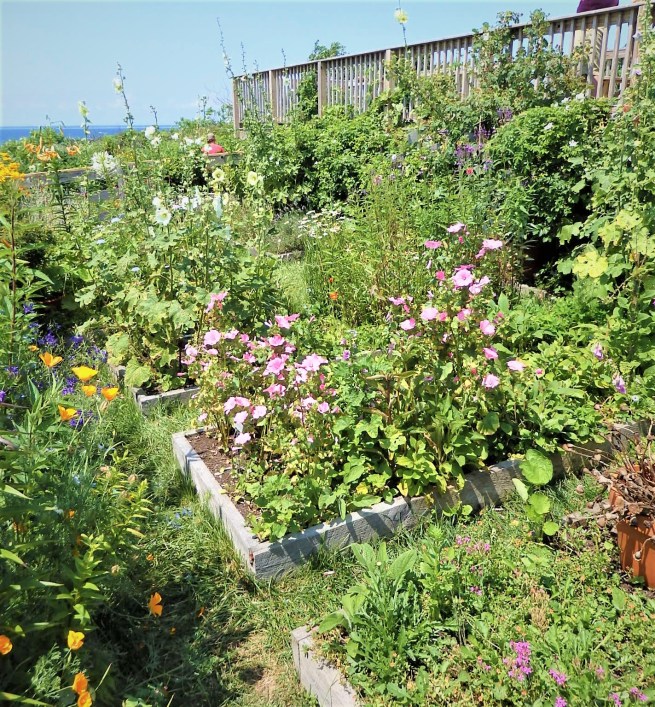
Celia Thaxter (1835-1894) is an intriguing character in New England history. An important figure in New England poetry, she was also a pioneering hotelier, flower gardener, and catalyst in the fine arts.
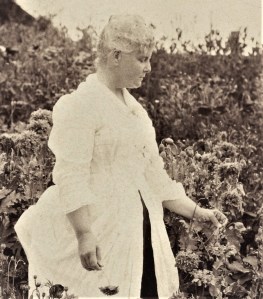
While turning her family’s hotel on Appledore Island in the Atlantic into what was probably the leading summer resort in the Northeast, she also created a famed artists’ colony with salon events featuring a who’s who of America’s leading artists, poets, novelists, and painters. There were likely more, including actors and dancers.
With its 95 acres, Appledore is the largest of the nine islands that comprise the Isles of Shoals about nine miles off the coast of Maine and New Hampshire. It was known as Hog Island until Celia’s family decided to build the hotel and turned to an earlier name for the shoals, one drawn from the Old English word for apple tree. How romantic.
The shoals also include tidal ledges.
Celia’s flower garden in front of her cottage became legendary, celebrated in her lovely book An Island Garden, with glorious illustrations by Impressionist master Childe Hassam. I treasure my reproduction copy. She’s the one who convinced Hassam to use his middle name rather than Frederick as an artist.
The hotel itself burned in 1914, and today the island is privately owned, much of it by the Shoals Marine Laboratory run by the University of New Hampshire and Cornell University. Visits are strictly controlled.
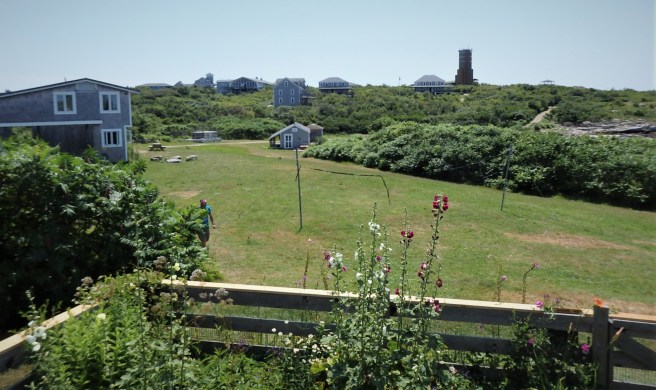
Last summer, my wife and elder daughter and I indulged in a tour of the island. Among its highlights was walking through the grounds of the long-gone hotel and a replication of Celia’s garden, which is much smaller than we’d expected and less carefully tended. The fact that it needed such constant care is a lesson in humility for those of us who expect similar results on much larger tracts.
And, for those of you who have read the garden book, I’m told that garden slugs are no longer a problem.
Nearby is her grave.

I relied on writing poetry and fiction in my spare time as a discipline to counteract the conventions of newspaper editing, my professional career.
The job could feel quite dulling of any aesthetic awareness, and quite confining.
Still, some of the qualities between my vocation and avocation overlap, including an insistence on factual observation.
And now I’m free to focus more fully on my literary aspirations. Surprisingly, my focus has been on the fiction, rather than poetry. Could it be that without that dual tension of before, I can now steer a route between them?
How do you stay mentally sharp?

