the repeated but unreal seasons of pork chops with browned potatoes, peas, and Jell-O salad, the next night’s meatloaf with Spanish rice and green beans followed by fish sticks with scalloped potatoes and corn et cetera, always the same combinations back then, even Chinese would intimidate in dim rooms some at the edge of town on a Sunday night away from campus in the galleys of perdition, as if soy sauce would fix anything ketchup wouldn’t
Keeping a clean desktop?
Here’s one filing system I used, back when dealing with piles of paper:
File
Toss
Act
Delegate
Haven’t quite figured out an alternative for online “piles” yet. Guess they’re “files” on the screen that’s erroneously called a “desktop.”
Last time I looked, my laptop was sitting on the real desktop.
And I’ve still been getting by without a printer.
Any ideas on how to keep those incoming emails and texts from getting lost in the clutter?
As I wrote to a friend
Birthdays happen, Covid precautions or not. Please remember to remove the mask before lifting the bubbly to your lips or trying to blow out the candles …
The settlement isn’t named for a town with white cliffs
The name of the settlement kept bouncing around.
Cochecho or Piscataqua plantation, for a while Bristol or Bristow, and even Northam, but the one that stuck was Dover.
Just as the names Hilton Point and Dover Point keep bouncing around, for the same place, though the latter has also largely replaced Dover Neck.
Neighboring Strawbery Banke did get renamed Portsmouth, after the harbor town in Devonshire, but Dover was never named for the village with the famed white cliffs in Kent.
No, the inspiration’s better than that.
The name comes through Dover’s second minister, George Burdet, who was more Anglican than Puritan, though apparently not outwardly. The proprietors of the colony at the time, Lord Saye and Lord Brooke, are both staunch Puritans, and the cleric works for them. In fact, he even manages to become the colony’s governor, or agent – a dual role forbidden to ministers in Massachusetts. Some even see him as trying to become a little pope in his power.
In calling the settlement Dover, Burdet pays honor to the anti-Puritan wit and attorney Robert Dover, who created the Cotswold Olympick Games near Cambridge in the heart of the Puritans’ East Anglia.

As my upcoming book details, there’s a long list of reasons the neighboring Puritan landlords forbid their servants from attending the pagan festivities. Besides, Dover was likely a secret Roman Catholic while openly ridiculing the Puritans. We can imagine what he would have said of Quakers.
Burdet, however, winds up fleeing Dover amid sexual scandal, only to generate more where he lands in Maine. Yes, the plot keeps thickening.
As for, “Roll over, Dover,” if we put it up for a vote, which inspiration would you chose? The picturesque cliffs or the scoundrel in the pulpit?
Welcome to Dover’s upcoming 400th anniversary.
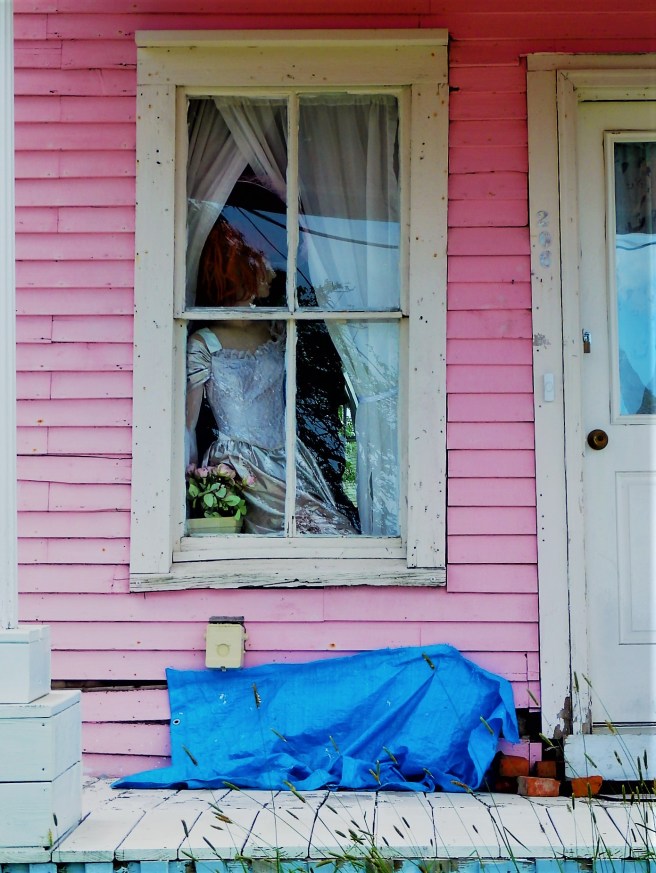
Bride at the window
A big comfy place for reading?
As we anticipate the renovations to our new old house, one of the big touches I realize I’m missing is a really comfy place to sit while reading. I’m admitting I never really had that in our old place, not until we got the lights above the pillows in bed, but even those were too hot for comfort and the lack of back support took a toll.
So here are the specifications:
- The seating has to be comfy, for starters. A puffy chair with good backing heads the list, likely with an ottoman.
- It has to have a small table or other service to hold a cup of coffee or glass of refreshment, plus pencils and maybe a notebook.
- Lighting is crucial – my wife hates table lamps, at least the ones with lampshades, as well as floor lamps. I hate overhead lighting, in general. So I want something that brightens the page while making the space intimate. We’ll see what we come up with.
I’m assuming it will be in the parlor where the wood-fired stove will sit. The big question now is just, where, exactly they’ll fit.
~*~
I do wonder, by the way, why nobody sells dental chairs as home furniture. These days, they’re quite cozy and seem to contort themselves to everyone’s fit. Any ideas? I’m not sure they’re exactly what I envision for reading, but in front of that giant home screen? Or just for a snooze?
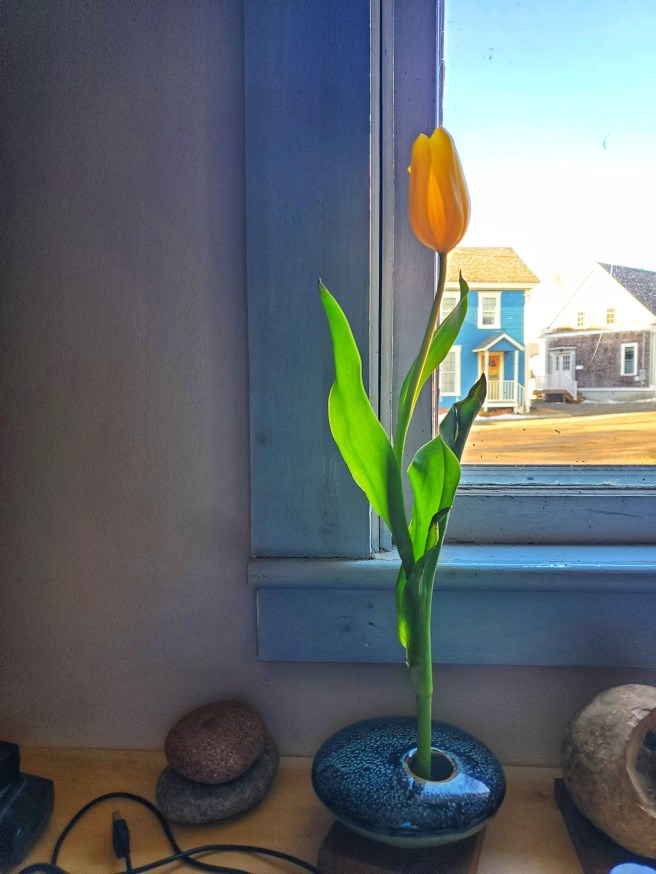
Jessica’s tulip
In case you’re considering a pet rabbit
You’ve been seeing our duo, Salty and Pepper. Before that were Boo, especially, and Widgeon.
Now, for some details on the species.
- Officially, they’re lagomorphs, though we find their chewing habits resemble rodents – you know, beavers, when it comes to wood. You’ve been warned.
- Existing as an animal of prey, meaning a food source, makes them skittish. Boo, though, came to be a lap rabbit, sitting for hours in her someone special’s lap.
- In short spurts, they can zip along at up to 45 miles an hour. As ours do when they’re first out of their cage in the morning.
- In general, they’re silent. They don’t bark or meow or anything like that, though Salty has a whiffling snore while dozing. You’d think she’s in pain, but she’s not.
- They’re meticulously clean and can be potty trained, like a cat.
- Their ability to jump straight up, from all four legs, and twist and spin about in the air is called binky.
- Born covered in fur, they can run from the start.
- Their teeth and nails never stop growing.
- They cannot vomit, which requires us to be careful in what we feed them. Even when they seem to eat almost everything we offer them. That, by the way, has been an incentive for more attentive weeding on my part. Those weeds suddenly become bunny treats, and watching those greens be so assiduously devoured is quite amusing.
- They’re cute and soft, mostly.
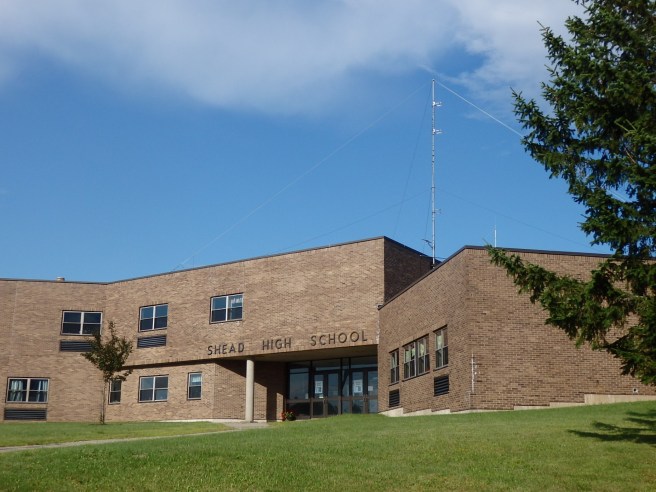
Tiger Radio, named for the school mascot
Our local radio station is licensed to the high school. Seriously. And it’s as quirky as KHBR-AM 570 in the legendary TV series “Northern Exposure,” even without Chris Stevens as the DJ. Or I’d contend, even more.
The television show never got into young people, for one thing, but there aren’t many in Sunrise County, where the seven public high schools together have about 200 graduates a year, half of them from just two schools. A private academy adds another 100. It’s a long stretch, by the way.
Pointedly, Eastport’s Shead Memorial High has only about a hundred students, down from 300 a few decades earlier, and a faculty of 11, some of whom also teach at the junior high or elementary. The principal serves all three. The school proudly proclaims its emphasis on personalized education, which I applaud. What’s obvious is the incredible student-faculty ratio.
One big challenge is in trying to find ways to lure more of the younger generation into staying put here. Maybe the economic tide is changing in that direction.
In the meantime, the radio station gives them an opportunity to learn production skills. In fact, the station started out as a school club in 1983 and took off from there. Throughout the day, the station’s IDs feature the different kids, however bashfully, and it’s charming.
Much of the programming is a stream of music, a mix of blues, jazz, rock, country, bluegrass, and more, I’m assuming streamed from somewhere. Yes, and there are public service announcements as well as the honor rolls and other local touches. Truly. And then the DJs kick in, including some of the kids, with surprisingly sophisticated tastes.
They’re not the only ones.
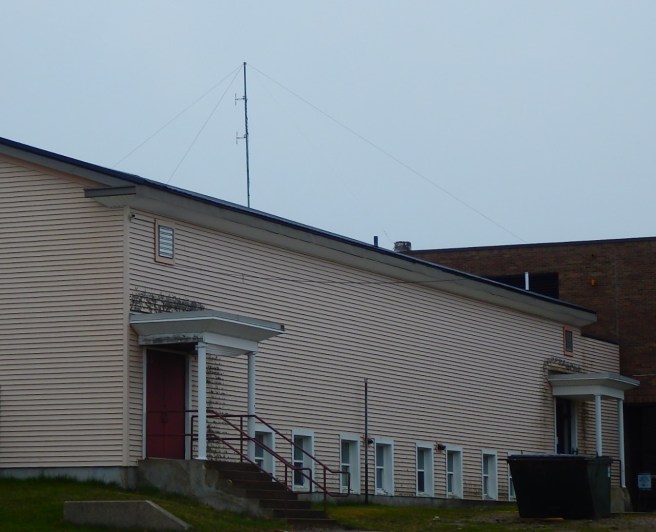
The local demographics skewer sharply upward, and volunteers at the station are welcome. In fact, they create much of its most distinctive programming. As I was saying about do-it-yourself participation?
There’s Cracklin’ Jane, with only 78 rpms, a weekly theme, and radio dramas from a golden age, including commercials for brands that no longer exist. And others like Sam’s Caffeine Café, yes, it’s redundant, but mostly acoustic Americana two mornings a week; the Bass Lady’s informed insights into anything with a bass line, Chloe’s folksy Friday afternoon transition; Firedog’s Electric Doghouse, Boldcoasting; and the like.
Well, this is a town filled with eccentrics and geezers. Its low-power radio station reflects that. And to think, it all started as a school club in the ’80s!
I think of it as Radio Free Eastport, broadcasting to the free spirits on and around our islands.
Looking at the closet
First off, I should explain that few old houses in New England actually have much by way of closets. So I’m actually talking today more about personal wardrobe and style.
One of my long-term planning notes was this, for my shift into retirement:
Focused look: new jeans (black/green/gray); sandals (fewer socks; also, they travel better); blazers for the pockets.
What actually emerged was quite different.
I shifted from denim jeans to tan cargo pants, for their pockets, especially.
Instead of my customary oxford shirts, I wore turtlenecks in winter, and Aloha shirts in summer. (I still largely avoid T-shirts.)
Instead of that blazer, I rely on a messenger bag to hold my reading glasses, cell phone, emergency cardiac prescription, choral music scores, and so on.
My style, such as it is, has emerged from yard sales, mostly. These days my focus is on wearing them till they give out while also downsizing. You’d be surprised how many compliments I get.

