In the photos, I’m always off to the side.
Or somewhere in the back row.
Or even just a tad out of the frame.
You never know what we'll churn up in cleaning a stall
In the photos, I’m always off to the side.
Or somewhere in the back row.
Or even just a tad out of the frame.
Massachusetts Bay authorities are in an anti-Quaker frenzy even before two small groups of Friends set forth for Boston in 1656. Fifteen in all, they meet a harsh reception from the Puritan leadership, even banishment on pain of death, but return anyway, some after having an ear cut off. Their one haven is in Rhode Island, a colony founded by Roger Williams and augmented by Anne Hutchinson’s followers, who had almost ousted the Puritans from their governance of Massachusetts only two decades earlier.
Some of the most intense persecution comes down in Salem, north of Boston, already the second largest city in the English colonies, where a small circle of newly converted Quakers boldly holds firm. By 1658, their influence seeps into New Hampshire at Hampton and Dover and across the Piscataqua River into today’s Eliot, Maine. In 1659, a Dover court fines 15 residents for non-attendance at the Puritan services, and one of them is specifically convicted of having attended a Quaker meeting. Six of the surnames are among those active in the earliest surviving Dover Friends records four decades later. Most prominent among them is Thomas Roberts, one of the town’s first two settlers and later the colony’s governor.
This occurs before Quaker missionaries William Robinson and Marmaduke Stephenson are arrested three weeks after visiting Piscataqua. It’s possible that William Leddra and William Brend were here the previous year, before their apprehension in Salem on their way back to Boston, or perhaps Christopher Holder and John Copeland, before that, in 1657 – that would be a plausible reason for some Dover residents to be worshiping “after the manner of Friends” by early 1659.

Early Friends activity along the Piscataqua is confirmed in early 1660 when Anthony Emory, an innkeeper and ferryman at Sturgeon Creek in Eliot/Kittery, was fined and disenfranchised on charges of “entertaining” Quakers. His ferry route connected to Bloody Point (Newington) and Hilton Point across the Piscataqua River. Whether Emory had merely transported the Quakers as passengers or allowed them to stay at the inn or been more active in welcoming them is unclear, but his independent streak was well established. He was a signer of the Dover Combination before moving to Eliot/Kittery in 1649, where he was fined five pounds in 1656 for “mutinous courage” in challenging the authority of the town’s court. The disenfranchisement was too much. He sold the property on May 12, 1660, to his son and relocated with his wife to the Quaker stronghold of Portsmouth, Rhode Island.
The earlier controversies over the ministry of the town’s church had no doubt left dissenting locals, joined by eccentrics, whom the itinerant Quakers then galvanize into an assembly. Quite simply, Dover is out on the frontier of English settlement and relatively far from the Puritan mainstream.
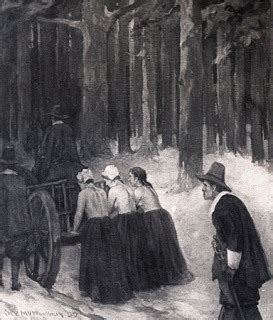
Significantly, Robinson, Stephenson, and Leddra are among the four Quakers hanged in Boston in the years before three women arrive in Dover in 1662 and are whipped out of town, an event that has long been considered the start of Dover Friends Meeting. Traditional histories even say there was no Quaker presence in town before that. Instead, I’m certain the women and two male companions arrived to nurture a previously gathered circle.
~*~
How dangerous are they? Here’s a brief life story Stevenson wrote a week before his execution – that is, just days after being in Dover.
In the beginning of the year 1655, I was at the plough in the east parts of Yorkshire in Old England, near the place where my outward being was; and, as I walked after the plough, I was filled with the love and presence of the living God, which did ravish my heart when I felt it, for it did increase and abound in me like a living stream, so did the life and love of God run through me like precious ointment giving a pleasant smell, which mad me to stand still. And, as I stood a little still, with my heart and mind stayed upon the Lord, the word of the Lord came to me in a still, small voice, which I did hear perfectly, saying to me in the secret of my heart and conscience, “I have have ordained thee a prophet unto the nations,” and, at the hearing of the word of the Lord, I was put to a stand, seeing that I was but a child for such a weighty matter. So, at the time appointed, Barbados was set before me, unto which I was required of the Lord to go and leave my dear and loving wife and tender children; for the Lord said unto me, immediately by HIs Spirit, that He would be as an husband to my wife and as a father to my children, and they should not want in my absence, for He would provide for them when I was gone. And I believed the Lord would perform what He had spoken, because I was made willing to give up myself to His work and service, to leave all and follow Him, whose presence and life is with me, where I rest in peace and quietness of spirit, with my dear brother [William Robinson] under the shadow of His wings, who hath made us willing to lay down our lives for His name’s sake, if unmerciful men be suffered to take them from us. And, if they do, we know we shall have rest and peace with the Lord for ever in His holy habitation, when they shall have torment night and day.
So, in obedience to the living God, I made preparation to pass to Barbados in the Fourth month [June] 1658. So, after some time that I had been on the said island in the service of God, I heard that New England had made a law to put the servants of the living God to death if they returned after they were sentenced away, which did come near me at that time; and, as I considered the thing and pondered it in my heart, immediately came to word of the Lord unto me, saying, “Thou knowest not but that thou mayst go thither.”
But I kept this word in my heart and did not declare it to any until the time appointed, so, after that, a vessel was made ready for Rhode Island, which I passed in. So, after a little time that I had been there, visiting the seed which the Lord had blessed, the word of the Lord came to me saying, “Go to Boston with thy brother William Robinson,” and at His command I was obedient and gave up to His will, that so His work and service may be accomplished. for He had said unto me that He had a great work for me to do, which is now come to pass. And, for yielding obedience to and for obeying the voice and command of the everlasting God, which created heaven and earth and the foundations of waters, do I, with my dear brother, suffer outward bonds near unto death.
And this is given forth to be upon record, that all people may know who hear it, that we came not in our own will but in the will of God.
Given forth by me, whom am know to men by the name of MARMADUKE STEVENSON, but have a new name given me, which the world knows not of, written in the book of life.
~*~
His tone and content are quite different than that of the leading Puritans of the time.
Welcome to Dover’s upcoming 400th anniversary.
One of the things that got dropped in my relocation from Dover was my morning half-hour or so of relearning Spanish via Duolingo.
Problem is I’m not sure I want to pick it up again. It feels more like an obligation. Besides, my aging brain just doesn’t seem to retain much of it. That leakiness is scary. Am I turning into a sieve?
Part of the earlier motivation was a desire to visit Quakers in Cuba, but I’m no longer sure that’s a really viable option, not when I look at the budget.
Worse yet, going from on-the-page to conversational seems like an insurmountable barrier.

Oh, the joys of online streaming! In my case, music, classical and jazz. Or when everyone else is up visiting, what we’re watching on the big screen. The one I call the wall of death, when it’s black with nothing on, or even when it’s blazing action blood, aliens, car crashes, and meaningless gore.
Yeah, I love having my beloved circle spending time in this place that’s ultimately theirs. For now, it’s like our extraordinary tides. Hopefully, I can roll with it.
Call me a fuddy-duddy, one living in a remote fishing village with a lively arts scene on an island in Maine, but that doesn’t mean I’m isolated from what I might be dialing in on the radio in Boston or New York, much less attending live. I have an ear on weekly orchestral concerts or Metropolitan Opera, for starters. And we do have some incredible live performances here, musical and theatrical, just less frequently. Oh, my, do we! Many of them are only eight blocks from home, an easy stroll.
Well, the opportunities for ethic food deliveries are another matter – even pizza. Things you might take for granted. But that’s offset by things like fresh scallops, which you’ll never eat anyplace else.
I’m not so sure how I’d feel about all this if I were exiled to some small place in North Dakota or the Upper Peninsula of Michigan, by the way. But this really feels like home.
One thing for sure. I had no idea this was my destination, back when I was in college back in Indiana. But I really have no complaints, other than trying to keep warm through deep winter.
The first college I attended had an excellent writing program, and somehow most of the kids in it began wearing scarves as a kind of identity badge. I posted on that back in 2013, but am now reflecting on a later incarnation, once I had relocated to New England.
In the intervening years, I had discovered the glories of silk, a fabric I had been taught was expensive and somehow beyond our means. What I found instead was how marvelous it felt to the touch and how warm its lightness could be in winter here or how well it breathed in warmer weather. And then I picked up a few brightly patterned ones that were scarves. They were a stylish touch to my otherwise nearly Plain wardrobe and made a definite impression, often eliciting favorable comments.
But then, when I remarried, they vanished into my stepdaughters’ collections. Fine enough.
The other day, though, I flashed on the thought I could really use those again – they do hold the heat in cold weather – or cold rooms, especially.
So I’m on the lookout. This should be fun, picking up a couple or more.
Now, as for my necktie collection? When’s the last time I’ve even worn one? Will I ever wear one again?
As for the rabbit, Alice?
Keep your eyes on the cocky boy in the oversized coat and top hat
The lucky devil, I think now, as the inevitable third party
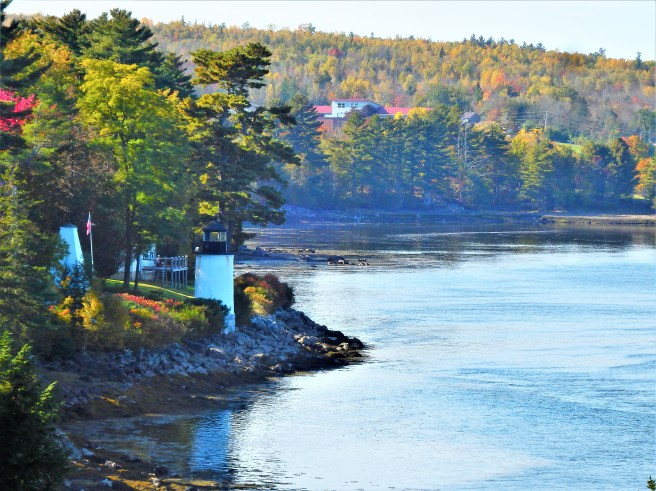
Maine’s coastline, with islands included, comes close to the combined coastline of California, Oregon, and Washington state!
No wonder we have so many lighthouses.
That’s how the Native name Machias translates.

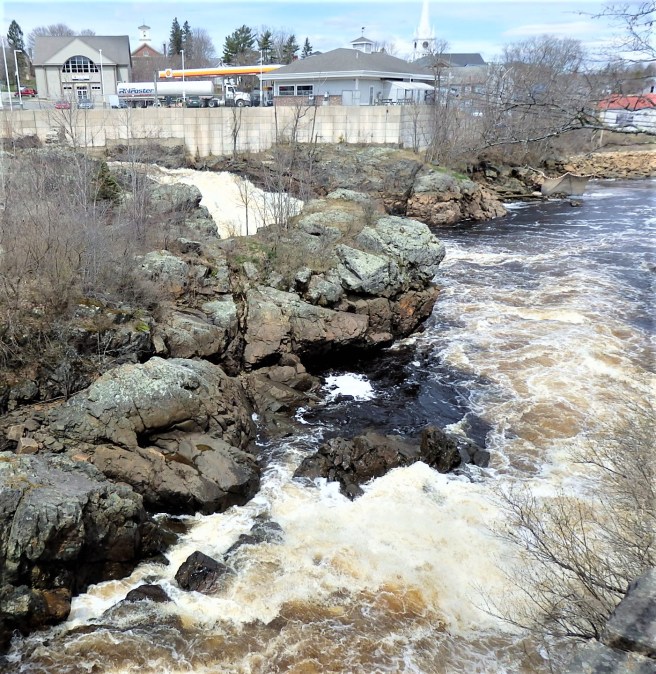

The tranquil city of Machias at the falls is the Washington County seat.

