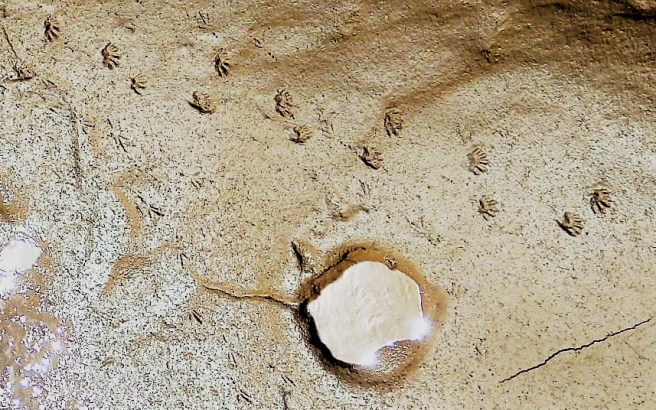
Fisher tracks, or maybe badger
You never know what we'll churn up in cleaning a stall
As I’ve admitted, many of the historical persons in my new book, Quaking Dover, really deserve full-length biographical treatment or maybe individual operas or Hollywood blockbuster movies, if only we had time to linger. Four hundred years requires a lot of compression and that meant keep moving ahead. Anyone looking for a writing prompt can dig in with a host of possibilities on the list.
Retired librarian Olga R. Morrill, bless her, rises to the challenge with her historical fiction, Vagabond Quakers: Northern Colonies, published in 2017, focusing on the three women missionaries who came to Dover in 1662 and were whipped out of town in what was essentially a death sentence.
 In doing so, she also portrays Richard Waldron and Nicholas Shapleigh as fully fleshed characters, even though they both have much more ahead in their lives after the three troublesome Quakers venture off-stage, the part she follows as the women venture south. (Yes, we need a full bio for each of the guys, please.)
As fiction, Vagabond Quakers resorts to some creative history and plausibility to fill in huge gaps. I see this in Waldron’s chronology, especially – with details where my findings and her tale conflict – but she does induce a compelling drama even in the minor players. She weaves fact and fiction seamlessly and manages a credible dialogue. (What they actually said would sound unintelligible gibberish to our ears.) If only I were sure which parts arise in her invention and which parts rest on solid evidence.
I’m happy to see that she examines Waldron’s life as a major figure in Boston, not just his existence as the most powerful man in New Hampshire, where he’s usually confined in the telling. Dover may have been his private fiefdom, out on the fringe of New England, but he wasn’t exactly provincial. She even manages to stir some sympathy for the man I dub the perfect villain.
She also gives full due to the deep conflicts in the town church before the Quakers arrive. Those are something I’ve long suspected contributed to the willingness of so many residents to join Friends early on. My one quibble is that I think Elder Starbuck would have been in the other party than the one where she places him.
For me, Morrill’s biggest contributions come in her envisioning the proceedings from the women’s perspective – not just the Quakers, but even those in the Waldron household. In the actual dates-and-names history, they’re mostly invisible. Many of Dover’s earliest wives remain ciphers, and even too many of their first and maiden names are missing. As for their language, demeanor, and dress? Morrill has me willingly suspending disbelief in her storytelling. Was one of the Quakers of short stature? Not that I’ve found anywhere. As for singing? Unlikely, but the quirk does pop the individual into three dimensions.
The events she describes in what would seem an out-of-the-way frontier settlement remain an important breakthrough in establishing religious freedom, anywhere.
Morrill and I both find these events to be endlessly fascinating, and hope you will, too.
Let me know of examples of courage you find that match the Quaker women’s.
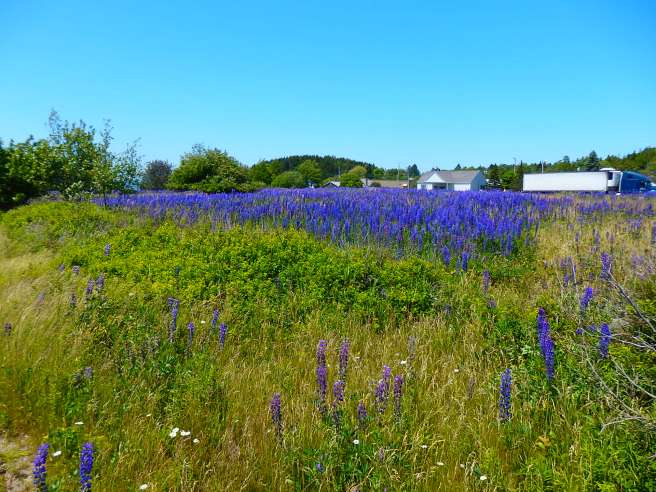
Officially, Eastport sits on Moose Island, though I have yet to see one here.
This time of year, though, it’s covered with flowering lupine, gloriously so. You’d never imagine the kind of winter we’d had.


There are reasons it’s also known as Charm City. Or, as they say of neighboring D.C., it has Northern charm combined with Southern inefficiency. By the way, don’t blame me for that perspective.

Though Eastport was settled relatively late – that is, toward the end of the Revolutionary War – it was instilled with a Colonial flavor by prominent early residents who were resolute veterans.
A continuing spirit of Tea Party and Minutemen makes Independence Day in New England feel different than those elsewhere. It’s not just the place of the Shot Heard ‘Round the World. It’s the region where thickheaded Yankees have always doodled.
Quite simply, history is palpably alive everywhere across New England.
Boston, of course, is the epicenter, but across the six most northeasterly states, local observations uphold distinctive traditions. Think of musketeers firing a round ever so often along the town parade route, along with fifes and drums.
As an independently enterprising oceanside village, Eastport soon had a reputation as a hive of privateering – that is, legalized piracy – and not-so-legal smuggling. That independent streak gets its own attention in the city’s annual Pirate Festival a week after Labor Day.

Unlike much of America, the city had frontline experience of the War of 1812. Fort Sullivan atop the bluffs surrendered to the British Navy in 1814, and Eastport then remained under the royal thumb until 1818.
Two years after its reunification with the United States, Maine became liberated from Massachusetts for the first time since 1653 and began to breathe into its own unique character.
For its part, Eastport rocketed as a center of shipping, shipbuilding, fishing, and sardine canning before the big decline of the 1900s set in.
Today, the tiny city’s locals remember a vibrant past and close-knit community, one that spanned the shorelines on both the American and Canadian sides of the watery border.
Is a renaissance on the horizon? There are signs for hope.
All of these strands infuse the holiday here.


The national holiday also marks the opening of New England’s short summer season. After a cold, dark, long winter, Eastport’s small year-’round populace can actually come out into the open air for long times together. The ocean and lakes are finally warming, to the extent that they do, and that attracts vacationers to join in.
After months when only a stray New Hampshire or Massachusetts auto plate is seen around here, I’ve now seen those of every state but Alabama, Hawaii, and North Dakota (not all at the same time), some seeming rather exotic.
And the Fourth includes the city’s Old Home Week, with high school reunions and the return of many summer residents.
A lot happens over a four-day span. There’s a doll carriage and wagon parade. A torchlight parade. Car shows, bike races, water games, pet show, rubber ducky race, festive all-you-can-eat blueberry pancake breakfast, free outdoor movie, contests, live music, and a street dance, all with a small-town flavor.
A traditional visit by a large U.S. Navy vessel failed to materialize, a consequence of being on Ukraine-related alert. Three different ships had expressed interest in landing at the Breakwater before the turn in world events.
While fireworks were displayed off over the harbor on the Fourth, America’s Independence Day (the beautifully designed and executed big show fired from the town’s Fish Pier was followed by a joyously rowdy encore from a diner’s smaller private pier), the companion July 1 presentation for Canada Day, in honor of our neighbors in New Brunswick, was still a victim of Covid cutbacks. Some residents, though, could view shows happening on Deer Island across the water.
Seems ever so fitting to shoot the works twice, considering Eastport’s dual connections.
it really does feel like a party’s come to town.
How do you celebrate the Fourth?
Great ideas remain the heart of a revolution. The kind that strike the core of one’s being and inspire action.
They must have a foundation in irrevocable reality if they’re to succeed in the long run.
Not lies, which are shifting sands. Or dreams, which float far from their anchors. Instead, some touchstone that resonates and holds fast, even on the great prairie.
And that’s it, for now.
Carry on.
Respectfully, I hope. Or else.
not exactly anywhere dutiful in all my difficulty gearing up for minor chores regular folks seem to enjoy defining their lives thereby at least scrubbing their ass break back to poverty, Dharma! would be scouring the bathtub one morning or a manuscript or adding oil to the leaky BMW such a thrill put aside long enough it evaporates two months overdue or just punctuates existence, the vacuum of rooms of the mind or the plate and so if one makes other things wait, yes, the grass grows or leaves fall in all that running as in down some sewer of household drain, so how would you handle a valet or fulltime maid

