This time, it’s a Not in My Backyard reaction triggered by opposition to a wind-energy farm 20 miles offshore because it “would spoil the view.”
From what, the yacht?
Get real!
I’m sure they wouldn’t be as vocal if it were a coal-fired plant going up near neighborhoods next to industrial wastelands – the places poor people live.
The people and the places they’re trying to escape, along with the shared responsibilities and real community. And poor people are largely envisioned as Black, no matter that many are white.
Well, the NIMBY crowd might pipe up if they can see the development from the expressway into town. Heavens!
The fact is that if we want electrical power or sewers and water or trash removal, it all has to happen somewhere. Shipping it off to the less fortunate rings sour in more ways than one.
Less fortunate, indeed.
Just don’t try to put them in you-know-whose backyard.
As long as I’m reflecting on our Christmas gift-giving (why not, it’s time to start planning for the next round), I should mention our new Ooni Kanu 16 outdoor pizza oven from England. What, not Italy? Or Greece?
The second time she spoke up from her laptop and uttered the words, “I’d sure love to have one but (sigh) it’s beyond our budget,” adding, “I can dream, can’t I?” I knew it was time for the rest of us to put our conspiratorial resources together.
After several miscommunications on our end, we got the order off, knowing it wouldn’t arrive in time to be wrapped up and put under the tree, so we came up with an amusing announcement envelope to cover us in that part. My crude cartoon slowly kicked in and generated a grin.
The said item arrived in February, big relief, and we can see why it was such a hot item last fall, even before the international shipping delays kicked in.
The oven can sit on a table, for one thing, and be fueled by charcoal, wood, or propane, which can fire it as high as 900 degrees Fahrenheit, cooking a pizza at a lower setting in minutes.
We can finally find a pizza in Sunrise County that matches our high standards. Deep-dish and thin are options. And it’s not limited to pizza, either. I’m thinking of a Vietnamese dish that would glory to such instantaneous blazing.
Well, this has required me to take one more step into 20th century technology, specifically 20-pound propane tank use. As for grilling, I’m sticking to charcoal.
In 1676, during King Philip’s War, a number of Natives fleeing from the Massachusetts Bay colony militia received shelter among the Pennacook tribe living around Dover. The refugees were part of what’s called a rebellion that began the previous year, the first in a series of armed campaigns between the colonists and the Indigenous peoples in and around Dover and beyond.
The existing accounts, of course, are one-sided, but the devastation afflicted innocent non-combatants on both sides.
~*~
Up to this point, most of the fighting was to the south, though there were fatal attacks in Oyster River, still part of Dover, among others.
Not all of the tribes aligned with the rebellion. The Narragansetts, for one, were neutral, yet more than 600 were killed by the colonists in revenge.
Dover’s Richard Waldron and Maine’s Charles Frost led colonial forces in an incursion on the Mi’kmaq in French-held Acadia – today’s Downeast Maine.
In the midst of this, two events in Dover added fuel to the conflagration. Until now, Dover had largely mutually positive relations with the Natives, Waldron aside.
Waldron was ordered to attack the Natives who had found refuge nearby and turn any combatants over to the Massachusetts militia. He instead invited about 400 Natives to participate in a mock battle against the New Hampshire militia. After the guests had fired their guns, Waldron took them prisoner and sent them to Boston, where the leaders were executed. Others were sold into slavery in “foreign parts,” mostly Barbados.
The usual take on the “mock battle” comes from Waldron’s account and often has most of the captives being returned peacefully. In contrast, the Indigenous version handed down orally has the event being an invitation to a feast. Only twenty of the Natives were armed, and at least 350, mostly women and children, were taken, sold, and never returned. Among the consequences was the fall of the peaceful, Christian Wonalancet as sachem and the rise of the warlike Kankamagus.
Major Richard Waldron masterminded the sham war game that led to the captivity of local Natives who came in peace.
Quakers were no doubt appalled by Waldron’s dishonesty and physical violence as well as the enslavement – New England Friends, including children, had faced being sold into slavery by Puritan authorities at the height of the persecutions. Moreover, Friends cherished good relationships with the Natives.
They were not alone.
“The local Indians were released but never forgave Waldron for the deception, which violated all the rules of honor and hospitality valued by both sides,” as one version, drawing on the colonial record, relates.
Despite its brevity, King Philip’s War is considered the greatest calamity in 17th-century New England and the deadliest war in Colonial American history. Within a year, many of the towns had been destroyed or damaged, and the economy of Plymouth and Rhode Island colonies was all but ruined. Hundreds of Wampanoags and their allies were publicly executed or enslaved, and the Wampanoags were left effectively landless.
For northern New England, it was only the beginning of a series of wars connected to European conflicts that would devastate the frontier until 1763, when New France was surrendered to Britain.
One of the fortified garrison houses built in Dover. Each one was surrounded by a palisade. When the neighbors arrived for the night, things must have been pretty crowded.
Along the Piscataqua, the Natives were patient, waiting 13 years for revenge. As historian Jeremy Belknap related: “Friday the 28th June, 1689, was the fatal day in the morning of which Major Richard Waldron was murdered and the destruction of Cochecho perpatrated by the Indians of Pennycook and Saco. This caused the absence of Mr. Pike for some years.”
Was the town’s minister permanently injured in the attack? Or suffer mental illness as a consequence?
~*~
The Reverend John Pike noted “the eastern Ind joyning with those of Pennicook (thro the Instigation of Hawkins & a Sagamore) suddenly seized on Cochecho, about break of day, wn all things were silent & secure. Killed 23 persons … and carried captive 29.”
This was the beginning of King William’s War, a series of massacres orchestrated by Jean-Vincent d’Abbadie de Saint-Castin and Father Louis-Pierre Thury.
In New England, the conflict originated in the failure of the settlers to adhere to the treaties and agreements made at the end of King Philip’s War, but the renewed outbreak of hostilities was also the North American theater of hostilities originating when King James II, the last of England’s suspected secretly Roman Catholic kings, was deposed and replaced by Protestants William and Mary. Hence, the “William” in what was also known as Father Baudin’s War and Castin’s War. Baudin was a French Sulpician priest who had trained to become a musketeer and later ministered in Acadia. This segment would continue for nine years, ending in 1697.
Waldron had dismissed concerns about renewed hostilities, telling residents to go and plant their pumpkins, and he would take care of the Natives.
Instead, in the attack, the sword-wielding elderly Waldron was cut across his belly with knives, with each warrior saying “I cross out my account.” Five or six dwelling houses were burned, along with the mills. Fifty-two colonists, a full quarter of the entire population, were captured and carried off to Quebec or slain.
One view of the attacks.
The Indigenous account of 80-year-old Waldron’s demise is more detailed. His nose and ears were cut off and stuffed in his mouth, as were his thumbs. To the Natives, he had turned his nose to injustice, refused to hear all sides, and cheated on weights in trade – placing his thumb on the scale. He also avoided trading them useful goods they desired and instead paid them in rum or trinkets.
The garrisons were houses that had been fortified from 1675 and on, set within palisades and designated as places of shelter in the event of attack. At the time of the 1689 attack, there were an estimated fifty such sites within and around the sprawling town.
The most extensive toll came at Richard Otis’s garrison, where the 64-year-old blacksmith, his son Stephen, and daughter Hannah were killed. His third wife, Grizel, three-month-old daughter Margaret, three daughters from his first marriage, Judith, Rose, and Experience, and at least two grandchildren were taken captive. One adult son, Richard Jr., escaped. The garrison was burned.
Just putting those two items in the same line sends me spinning, as if it’s natural they should ever be synonymous.
Let me proclaim I’m a true conservative, unlike those pretenders using that label. Not that I’m ever confined to tradition.
Take gift-giving in our household, for example, it doesn’t always happen on the intended date, whether Christmas or birthday. And I should point out (again), that it’s often a conspiratorial effort.
One example I’ll give is my new cell phone, which they’d been threatening to impose on me for several years now. They’d given me the previous one maybe a dozen years earlier, replacing the flip phone I had accepted only in case of a midnight emergency somewhere in the wilds of New Hampshire on my commute home from the newsroom.
So much for the history. Perhaps you remember I happen to be somewhat of a neo-Luddite, in no rush to learn yet one more new technology. I’m more interested in spending those hours doing something at hand other than retraining on a new device, like an endless loop of abuse.
Our move to the island was heightening the rationale that I really needed to upgrade. T-Mobile’s coverage here is spotty, and often nil off in the neighboring wilds, and whenever my text messages were arriving through Canada, which was often, they’d get turned into zip files that took forever to download. Photos were even worse.
Blogging, by the way, had prompted my photo shooting hobby years ago leading to the purchase of cheap Kodak point-and-shoot, which they eventually pressed me beyond by having me unwrap the Olympus that has provided many of the visuals here at the Barn. Over the past few years, my wife and elder daughter have been insisting I could do better with a good cell phone, and their many fine photos had me reluctantly agreeing. It’s just that I have a workable system going, ya know, and already have thousands of shots that need further sorting. Can’t I finish that first? Besides, shouldn’t photos be taken by cameras?
Well, no.
Last Christmas, everybody piled on the upgrade-Jnana bandwagon.
I didn’t know I needed the little LED ring to illuminate my face during Zoom meetings. OK, I finally “got” the idea that the lamp was supposed to clamp onto my laptop and glow on me, but I found that bright light in my was face annoying and visually taxing. But that lamp is rather nifty attached to the little bookshelf over my desk, and other Zoom participants have expressed their preference for the warm light setting rather than the clinically cold one. So maybe I’ve needed it.
Nor did I know I needed a short camera tripod, but there was the “lobster” in one of the next boxes I unwrapped. OK, cool, it would work for my Olympus, but what about the next two – the remote selfie button and the macro-micro lenses, both definitely cell-phone attachments?
That’s when they broke the news to me that time was up, the new phone was definitely included, or would be, as soon as they could haul me up to Calais to sign up, something that finally happened in late April.
As you might imagine, I was in no rush, but my Olympus was starting to act wonky. The zoom lens (yeah, zoom as in getting a closer look rather than pressing mute or chat) was getting stuck and failing to deploy, meaning my real, albeit digital, camera wasn’t working. Change would be inevitable, even if I am no longer pressing for a return to film, which I could never afford, anyway.
Off to the UScellular store we went, and I was instructed not to look at any of the prices. I’m still shocked by what we were paying for the family plan we were on, now that it’s been revealed to me.
OK, the new phone, a Galaxy S22 Ultra (does that impress you?), is a vast improvement over the S4 or earlier model it was replacing. The latter had no trade-in value, except maybe to a collector of obsolete technologies. The sales associate was rather kind in calling it a classic and keeping her laughter lighter than a sneering snicker.
Only after we were in the car and on the way home did my wife tell me my new phone retails for a thousand bucks. That’s enough to frighten me from touching it. Oops, a figure oil smear! And kids wear these in the pocket behind their butts? I’m never going there, I’m toting mine securely in the pocket of my messenger bag, next to my nitro pills. Keep your hands off.
Flash ahead, Slim and I are getting acquainted, gingerly, and I’m starting to play with the camera half, too. Hate to admit it, but I’m impressed.
Now, what am I supposed to do with my old phone and my old camera? I can’t just junk them, can I?
My wife is quite fond of wild Ox-Eye Daisies – not the bigger and, to her view, coarser Shastas. But she’s usually saddened each year when the Black-Eyed Susans arrive about this time, announcing the end of the Ox-Eyes’ blooming. Not so in Eastport, where, to her delight, some continue through August.
Yeah, yeah, I know the concerns about holding animals in captivity. But where else are kids going to learn about exotic fellow creatures? TV? They can’t smell them there. The circus? Few of us even live on farms anymore, and those dogs I see walked up and down the street are hardly exemplary of the animal kingdom. Frankly, they’re more spoiled than most children.
But I digress. Out of view, the best zoos are also places of serious research and attempts to keep gene pools alive.
Here are some of the best in North America:
San Diego. It pioneered the open-air, cageless exhibits, for one thing, and is in a beautiful park, for another. So I’ve heard.
St. Louis. More than 600 species on 90 acres, and you can get around via a mini-railroad.
Omaha. Some of us remember it from a television series.
Cincinnati. Includes a botanical garden, and for years it was also home to the summer opera, the nation’s second-oldest. Now that was an interesting mix.
Bronx. It was the first with a zoo animal hospital and full-time veterinarian staff.
Toronto. Features seven distinct zoogeographic regions – animals and relevant plants and climate displayed together.
Smithsonian, Washington, D.C. One of the most diverse, and admission is free.
Los Angeles. Founded in 1966, it’s one of the newer zoos in America and has zoomed in status.
Columbus. Includes a notable aquarium, a manatee rescue and rehabilitation program, and Polar Frontier.
Philadelphia. Also noted for its success with hard-to-breed-in-captivity species.
Honorable mentions to Miami, Fort Worth, Seattle, Brookfield and Lincoln Park in Chicago, Disney’s Animal Kingdom in Florida, Houston, and Denver.
Let’s just say it grows in my estimation every time I hear or see the Metropolitan Opera’s production.
There’s so much packed into its 3¼ hours that the full story can seem unwieldy and overwhelming, but I’m thinking maybe it actually needs to be longer, have more air to allow digestion, with a dinner intermission and perhaps jazz dance/combo interludes inserted at key points in the narrative.
Porgy is not simply the best American opera to date, contrary to the Vienna dismissal of it as a “folk” opera, but, yes, I’d now place it among the top ten ever, in a global view. The grander the reach, the more likelihood of imperfections. Guess where I am on that spectrum?
Quite simply, has any other produced so many hit tunes, especially as jazz standards? Composer George Gershwin held Georges Bizet as an idol, yet has anyone else spawned so many classic offerings from a single stage work? Not even Bizet, nor anyone else I can think of. Just a single hot tune would be considered success. And his have proved incredibly flexible and addictive.
Gershwin had already had a string of Broadway stage successes, but he wasn’t resting on his laurels. No, he agonized over this work and his previously stifled artistic visions. Make that ambitions.
Has anyone else so successfully addressed the realities of drug addiction or prostitution?
Courtesan, as in La Traviata, seems downright respectable in comparison. Bess is raw.
Does anybody else agree Eric Owens and Angel Blue deserve Tonys and Oscars for their performances?
Eastport may be a city, but much of it is still forest.
Shackford Head, between Broad Cove and Deep Cove, has one of those. And it’s a state park. Mercifully, it even escaped becoming an oil refinery in the 1970s and ’80s, thanks to some dedicated citizen action.
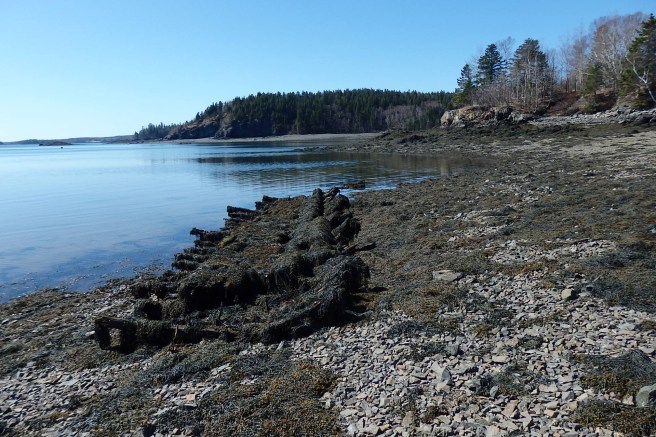
This is all that remains of five Civil War ships that were burned between 1901 and 1920 at Cony Beach at today’s Shackford Head State Park. The vessels were brought close to shore and set aflame to release metal for scavengers to collect at low tide. This is Cony Beach with Shackford Head beyond.
I should note that the Shackford family, so prominent in the settling of Eastport, had roots in Dover, New Hampshire, before spreading into Newburyport, Massachusetts, and then shooting up here. It seems that our house was built in the 1830s by one of them.
Apart from that, the 90-acre state park allows for some delightful hiking and vistas without having to drive miles from home. You know, needed a quick fix of more nature.
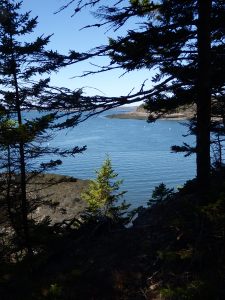
The shoreline can be quite rugged but have a pocket beach below.Deep Cove flanks one side of the park.Sometimes a trail takes to a plank walk over muddy stretches.