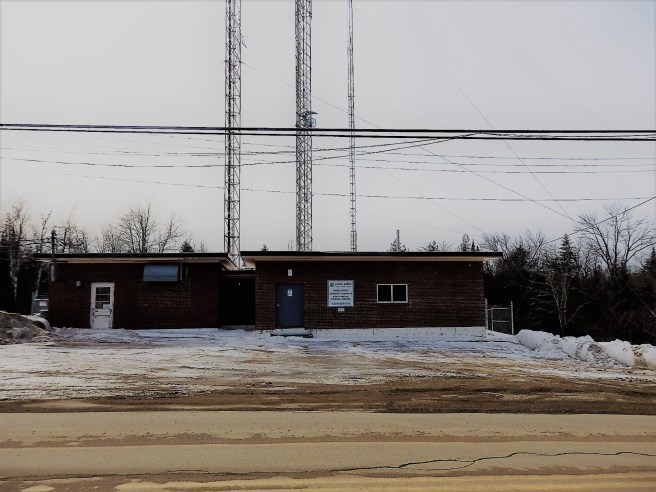
Usually, you need a tall tower for FM and TV transmission. The taller, the better. Not so in the mountainous terrain of Washington County. One stick sends Maine Public Television’s signal across the easternmost reaches of the state. Another, Maine Public Radio’s. I’m not sure about the third. Maine Public Classical comes to us locally from Millbridge, rather than this transmission complex on the Charlotte-Meddybumps town line..It really is pretty modest.
in the Quaker circles, how many in their sixties and seventies are still quite bustling well on into their eighties and nineties, I would add compared to so many on respirators and walkers the problem is we need a lot more half that age moving forward yes toward New Jerusalem where are all welcome and made anew whole
Saw a small, weathered sign at the side of the road.
A restaurant, it turns out: Pickled Wrinkle.
While that particular location is long gone, not so over at Birch Harbor, near Acadia National Park.
“Wrinkle,” as I’ve learned, is a diminutive of “periwinkle,” which are commercially harvested around here. In the old days, pickling them was perfect for packing and shipping. And they are an invasive species, FYI.
As for today, you can look up the recipes yourself.
It turns out that Edward Hilton’s older brother, William, did indeed have a taste of what to expect in New England before settling in along the Piscataqua River.
William had emigrated to the Plymouth Bay colony aboard the Fortune, the first vessel after the Mayflower to bring settlers to the Pilgrim plantation. The small ship, carrying only 35 passengers, left England in July 1621 but didn’t arrive at Plymouth until November 10 or 11 of that year – late in the sailing season and most likely after the big feast or even too late for any leftovers.
As genealogist Mark Everett Miner notes, “On arrival they found that half the Mayflower passengers had not made it through their first winter in Plymouth and had died. The Fortune sailed back to England carrying a ‘cargo of good clapboard as full as she could stow, and two hogsheads of beaver and other skins,’ which showed the great potential for settling in America, and the hopes of selling this cargo and ensuring future settlement at Plymouth. Unfortunately, before reaching port in England, the ship was stopped by the French, who seized the cargo, and that intended profit for the small colony back in Plymouth was lost.”
So much for further thanksgiving. Sounds more like continued lamentation was in order.
The Fortune was under the command of Captain William Trevore, who had previously joined the crew of the Mayflower in its oft-told voyage to the New World after the Speedwell was deemed unfit. His exploration of Boston Harbor with Myles Standish gave name to the island New Hampshire pioneer David Thomson later inhabited. In the 1630s, as master of the William, Trevore made repeated trips bringing Puritan settlers into Massachusetts.
In a letter sent to their cousin Anthony Hilton in South Shields, England, William Hilton described the conditions of the Pilgrim settlement, where William was now living and laboring while his wife and children remained in England. They would come in 1623 aboard the ships Anne and the smaller, supply-loaded Little James.
As he wrote in a cheery mode:
“Loving Cousin,
“At our arrival at New Plymouth, in New England, we found all our friends and planters in good health, though they were left sick and weak, with very small means; the Indians round about us peaceable and friendly; the country very pleasant and temperate, yielding naturally, of itself, great store of fruits, as vines of divers sorts, in great abundance. There is likewise walnuts, chestnuts, small nuts and plums, with much variety of flowers, roots and herbs, no less pleasant than wholesome and profitable. No place hath more gooseberries and strawberries nor better. Timber of all sorts you have in England doth cover the land, that affords beasts of divers sorts, and great flocks of turkeys, quails, pigeons and partridges; many great lakes abounding with fish, fowl, beavers, and otters. The sea affords us great plenty of all excellent sorts of sea-fish, as the rivers and isles doth variety of wild fowl of most useful sorts. Mines we find, to our thinking; but neither the goodness nor quality we know. Better grain cannot be than the Indian corn, if we will plant it upon as good ground as a man need desire. We are all freeholders; the rent-day doth not trouble us; and all those good blessings we have, of which and what we list in their seasons for taking. Our company are, for the most part, very religious, honest people; the word of God sincerely taught us ever Sabbath; so that I know not an thing a contented mind can here want. I desire your friendly care to send my wife and children to me, where I wish all the friends I have in England; and so I rest
“Your loving kinsman,
“William Hilton”
The “cousin,” incidentally, may have been an alias for Captain Smith, who soon after published the letter in his own book promoting New England settlement.
~*~
William Hilton next appears in 1623, when Governor William Bradford dissolved the communal operation of the Plymouth colony’s holdings and parceled out land to the settlers to build on and farm themselves. Hilton received one acre as a passenger on the Fortune and his wife and two children received three acres as passengers on the Anne.
Given a farm of four acres, Hilton was unlikely to pull up roots so soon to try the unknown Piscataqua venture or, for that matter, to be part of Thomson’s Pannaway Plantation. Confirmation of his remaining at new Plymouth rather than Piscataqua comes the next year, when the infant John Hilton was baptized by the Reverend John Lyford, who was not a member of the Pilgrims’ congregation. That action stirred up a controversy between Lyford and the Plymouth authorities that quickly escalated to the point that Lyford and John Oldham were expelled.
According to Miner, Hilton and his family left new Plymouth soon thereafter, possibly to join his brother Edward on the banks of the Piscataqua. William’s land in Plymouth, I assume, reverted to the colony. Real estate ownership, as we’ve noted, had different meanings back then.
Regarding the Lyford controversy, Miner explains the child “could not be baptized at Plymouth unless the parents joined the Pilgrim church, which they were not disposed to do, being staunch Anglicans. They appealed to Rev. John Lyford and arranged a private baptism according to the rites of the Church of England. … This issue … was behind the family’s migration first to the Piscataqua River and later to join his brother Edward to help found Dover, New Hampshire.”
Miner does acknowledge an alternative destination: “On the other hand, Noyes, Libby and Davis state that Hilton ‘left Plymouth and joined Thomson at Little Harbor with the purpose of starting salt works,’ and apparently did this in partnership with Gilbert Winslow,” a brother of two fellow Fortune passengers. “This would provide William Hilton and his family with a home prior to the arrival of Edward Hilton, assuming the latter did not come so early as 1625.”
There’s also the possibility that William may have had previous wives before the one, maybe named Mary, who followed him to new Plymouth. Miner quotes a source “suggesting that if one of his wives should prove to have been a Winslow, it would explain his letter writing with Edward Winslow, his association with John Winslow, his removal to Piscataqua [Fort Pannaway] with Gilbert Winslow and the marriage of two of John Winslow’s sons to his relations.”
Either way, William Hilton and his family would not have been living on the Piscataqua as early as 1623. And curiously, there’s no indication of his trade directly involving fish but rather salt manufacture.
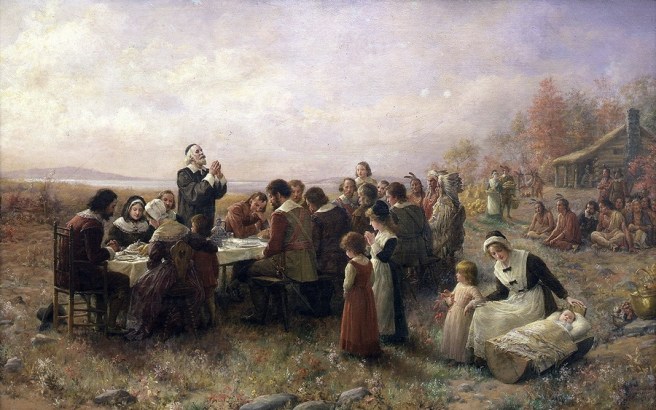
William Hilton arrived at Plymouth but probably was a tad too late for the big dinner. Don’t bother looking for him in the group shot. Also note that the settlement looked nothing like this. It was fortified, for one thing, and had a completely different style of house.
The Lyford incident illuminates another side of the New England migrations. Not everyone came for a noble cause, religious or entrepreneurial. Some were running away from reprehensible acts.
After the Hilton child’s baptism, leaders of the colony discovered that Lyford had been writing letters to England disparaging the Separatists at new Plymouth. As the Lyford entry on Wikipedia explains, some of the letters were seized before they were sent and opened. When Governor Bradford confronted Lyford about their contents. Lyford apologized but later wrote another similar letter that was also intercepted. After the second incident, Lyford was sentenced to banishment.
Before his expulsion, Lyford’s wife, Sarah, came forward with further charges. Lyford had fathered a child out of wedlock with another woman before his marriage, and after his marriage, he was constantly engaging in sexual relationships with his housemaids.
Bradford recorded Sarah Lyford’s explanation of how her husband “had wronged her, as first he had a bastard by another before they were married, and she having some inkling of some ill cariage that way, when he was a suitor to her, she tould him what she heard, and deneyd him; but she not certainly knowing the thing, other wise then by some darke and secrete muterings, he not only stifly denied it, but to satisfie her tooke a solemne oath ther was no shuch matter. Upon which she gave consente, and married with him; but afterwards it was found true, and the bastard brought home to them. She then charged him with his oath, but he prayed pardon, and said he should els not have had her. And yet afterwards she could keep no maids but he would be medling with them, and some time she hath taken him in the maner, as they lay at their beds feete, with shuch other circumstances as I am ashamed to relate.”
Once more, he was on the run, eventually landing in Virginia. Sarah apparently remained behind, where as a widow, she married Edmund Hobart, a constable, court official, and minister, in 1634.
~*~
So much for some juicy scandal surrounding all the piety.
Happy Thanksgiving, anyway.
It’s all part of my new book, Quaking Dover, available in a Nook edition at Barnes & Noble.
Not everybody shares my delight in pickles, at least the kind you put on sandwiches, but I pile them on, when I can. I’m not much for lettuce there, by the way – I prefer that as a separate salad.
I like the crunch and acidity the pickles add, or even the sweetness, depending on the variety.
My wife grew up in Mount Olive, North Carolina, where many of these originate today.
My eyes were opened to this reality the year we went largely vegan when we practiced the Eastern Orthodox feasting for Advent. The hardest part for me was finding snack food. (Well, that plus a satisfactory creamer substitute for my coffee and something in place of cheese and … the list goes on.) Fortunately, my wife makes a great humus, and the wraps can be filling, though bland over repetition. And that’s when the pickles took center stage. A row of the green orbs in the torpedo was truly heavenly.
Not that I stop there. When we’re out to eat, the rest of the family puts their kosher pickles on my plate. Not that I’ll argue.
And then there are the summer pickles, meant to be consumed shortly after the cucumbers taken from the garden and put into canning jars. Sometimes it’s a challenge to keep up with the harvest. As if I’m complaining.
Only in the past few years have I begun to appreciate other kinds of pickles – beets, green beans, and eggs, for instance – dishes that used to appear on family dinners at Grandma and Grandpa’s. Especially on big events like Thanksgiving and Easter. Just how far back in our heritage does that go through generations of farmers?
Anybody else love that pickled ginger they serve with sushi?
It may be a small city, but even so, it was home. And much larger than where I’m now living.
So some of what I miss?
The over-the-fence or across-the-street conversations. Especially the guy stuff. Tim, Mark, Jack, Mayor Bob, that circle, especially.
Recycling. I feel guilty putting it all in one bag. Unless the volunteers regroup after this Covid thing.
The indoor pool. Not just the physical exercise of swimming, but the banter with other swimmers and the lifeguards.
The Quaker Meeting and Greek circle, too. Not just older folks, but meeting the babies who have come along in the interim.
Our garden, even though it was a lot of work. It was even visually pleasing.
That leads to glutting out on fresh asparagus for nearly a month in late spring.
And heirloom tomatoes, with tomato and mayo sandwiches for the better part of two months come high summer. (Downeast Maine is too cold at night for them to mature.)
A range of dining options, not all of them in Dover. We weren’t far from neighboring communities. Not just ethnic, either. LaFesta Pizza would be a prime example of taking a specialty a step extra.
The Amtrak as an escape to Boston or Portland. Not that I had used it that often, back before Covid, but I had plans.
Dishwasher, clothes washer and dryer. Without the renovations on our new old house, it was a return to a primitive era for me. The two nearest laundromats were an hour away, in opposite directions.