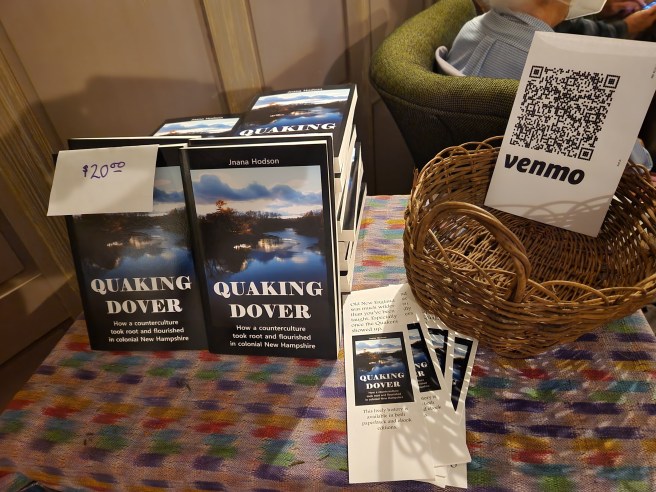
Listen to this from a five-star review Beth Collea posted at Smashwords.com’s Quaking Dover page:
Jnana Hodson combines solid historical research with his engaging writing style. Light touches along the way keep the text moving. His own historical wonderings give us the feeling of personal involvement in the quest for insights and answers.
Drawing on the work of David Hackett Fischer, he contrasts the local folkways and customs of the area of England where the Puritans came from and the Devon region where the settlers to the Piscataqua area originated. Spoiler alert: the English in the Devon region so highly valued hospitality and welcome that they dared to host and harbor traveling Quaker ministers, especially if they were in need.
Hodson gives us a wonderful historical lens to use as a framework for general understanding and especially for exploring Quaker history in the U.S. The timing is perfect as the City of Dover prepares for the 400th anniversary of European settlement in 2023.
Dover and Portsmouth have always been at odds, it seems. But Dover is definitely older, despite the upstart’s claims to the contrary.
Portsmouth goes back to 1630, when the Laconia Company dispatched Captain Walter Neale, an English Army officer, to locate the large “lake of the Iroquois” the investors believed existed beyond the Piscataqua, which would give them a monopoly on the beaver trade – and possibly gold. He arrived with eight or ten ex-military adventurers aboard the barque Warwick that spring or summer and set up operations at the abandoned Pannaway Manor in today’s Rye, New Hampshire.
Portsmouth grew up around its harbor downstream from Dover.
As George Wadleigh deduced in 1882, “The Thomson house erected at Little Harbor in 1623, though built of stone, could have been no such substantial structure as has been assumed for it. It is not probable that ‘it presented the general appearance of the dwelling houses of the time of James I, vast numbers of which still remain in good preservation all over the old country.’ Had it been of this character it would hardly have been reduced to the dilapidated condition in which it was found by Hubbard in 1680, less than sixty years after its erection, when only ‘the chimney and some parts of the stone wall were standing.’ It is probable that as it must have been hastily built, it only sufficed for the immediate needs of Thomson and his little party, as a shelter from the elements.”
Within a year, Neale moved two miles east along the Piscataqua River, choosing to settle on a site rife with wild berries, leading to the name Strawbery Banke. Over the course of a few years, the Warwick and Pide-Cowe conveyed 48 men and 22 women to the new settlement. Note the odds. At least there were women.
A “Great House” was erected as the center of the settlement, one that “would be larger than the house at Pannaway.” It would be built of pine, with a stone foundation and chimney. In addition, a storehouse was constructed, along with small houses for the tenants, a shelter for cows and sheep, and wells were dug. There were also a sawmill and platforms for drying fish. Humphrey Chadbourne has sometimes been credited as the carpenter, but he would have been only 16 at the time, if he were even in the New World at all. He does definitely show up a few years later, though, at Newichwannock at today’s South Berwick, Maine, just upstream.
In addition to his explorations, Neale served as administrator, or governor, of the “lower plantations” along the river, while Wiggin did the same for the “upper plantations.” They had boundary disagreements during the three years before Neale returned to England.
As Wadleigh wrote, “‘Mason Hall,’ or the Great House, as it has been styled, was … probably a more suitable location for carrying on the business of the settlement, while the station at Little Harbor was abandoned. Such as it was, it passed into the hands of Mason’s men, and was sometimes called his ‘stone house,’ though it is now conceded the term ‘Mason Hall’ was never, as has been popularly supposed, applied to it.”
As a business, though, “In a few years this company broke up [in 1634] and the servants were discharged, the whole scheme proving a failure. On a division of the property, Mason bought the shares of some of his associates and sent over a new supply of men, set up saw mills, and soon after died.”
As Wadleigh notes, “These settlements on the Piscataqua went on but slowly for several years.”
~*~
At the time, “There were but three houses or settlements in all this region, namely, at Little Harbor or Portsmouth at the ‘Bank,’ at Dover Point and at Newichwannock. … Their occupants turned their attention chiefly to trade and the fisheries, the cultivation of the grape and the discovery of mines; in the latter it is hardly necessary to say that they did not meet with much success. Very little improvement was made on the lands, and bread was either brought from England, in meal, or from Virginia in grain, and then sent to the windmill in Boston to be ground.
“That they fared hard, if they did not work hard, is evident. One of them (Ambrose Gibbons) in a letter to the proprietors in England, complains that for himself, wife and child, and four men, ‘an have but half a barrel of corn … beef and pork I have not had but one piece this three months, nor beer this four months. I nor the servants have neither money nor clothes,’ etc.”
Wadleigh added, “The dwellings of the early settlers for nearly a hundred years were hastily constructed and of the rudest character. Their houses had but one or two rooms. Very few of them had other than block windows. Their furnishing, beyond a few necessary cooking utensils, was of the most meagre description. Of the dwellings of the settlers at Plymouth, at about the same time, we collect here and there (says Palfrey) a hint as to their construction. A storm on the 4th of February 1621, ’caused much daubing of our houses to fall down’; this was the clay or other earth which filled the chinks between the logs. Winslow wrote to persons proposing to emigrate, ‘Bring paper and linseed oil for your windows.’ The earliest houses on Cape Cod were built by selecting large logs of the right dimensions for sills and plates. In these, holes were bored about six inches apart and poles were inserted as a sort of studding, intervals being allowed for doors and windows. The spaces between them were filled with stones and clay. The most thoroughly built were plastered with clay. The roofs were thatched with long grass. The chimney was built of sticks, arranged like a cob house and plastered with clay inside. The windows were supplied with oiled paper instead of glass. The floors were nothing more than the bare earth or perhaps in some cases flat stones covered with straw, for as late as 1623 the cottages of the common people in England, of whom the emigrants were chiefly composed, were no better finished.”
Nor do I find any mention of a church in Portsmouth before 1641, which suggests the town’s faithful found themselves relying on Dover’s minister and congregation. The southern province itself didn’t incorporate until 1653, when it took the name of Portsmouth, after John Mason’s home port in Hampshire, rather than continuing as Strawbery Banke.
In looking at the categories I’ve used since launching this blog a decade ago, I feel I should explain why I’ve resisted adding to them.
I simply wanted to retain some kind of focus on what I’d envisioned as a merry-go-round. Yes, the categories were the selected horses to ride.
Think of “American Affairs,” largely inspired by an academic department that Indiana University and Yale and a few others launched in the mid-‘60s to encapsulate a multicultural investigation of current affairs. I nearly embraced it as my own major, the way some Blacks turned to Swahili.
Hey, I had a girlfriend who saw that regarding her own eldest brother. Back off, please, and let’s get back to subject.
What I’ve found in practice here at the Red Barn is that my Am Affairs specific pigeonhole has increasingly probed local public states, especially in Dover, New Hampshire, and more recently, Eastport in Way Downeast Maine.
Or, as the adage goes, all politics are local. (Should that be “is”?)
The writer Tom Wolfe was someone I had thought followed this American Affairs college degree path, but I find myself mistaken, at least as far as academia goes. Still, I would list him as an inspiration here, just shorn of the heap of superlative adjectives, expletives, and adverbs.
But our localities do get lost in the national mass-media mindset, to the impoverishment of us all.
Or, as the French said, “Vive la difference!”
Actually, as I’m realizing, that also applies to my latest book, Quaking Dover.
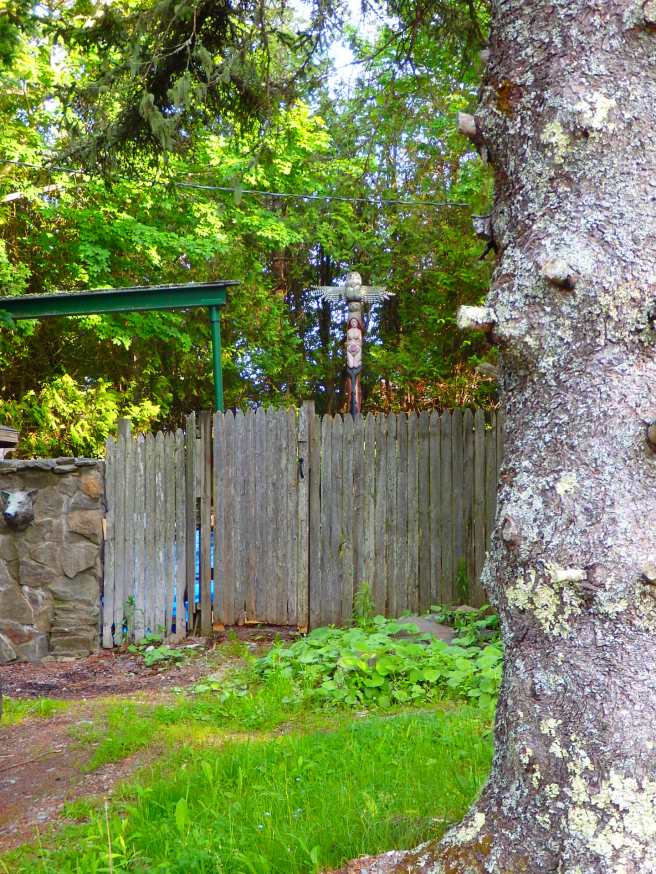
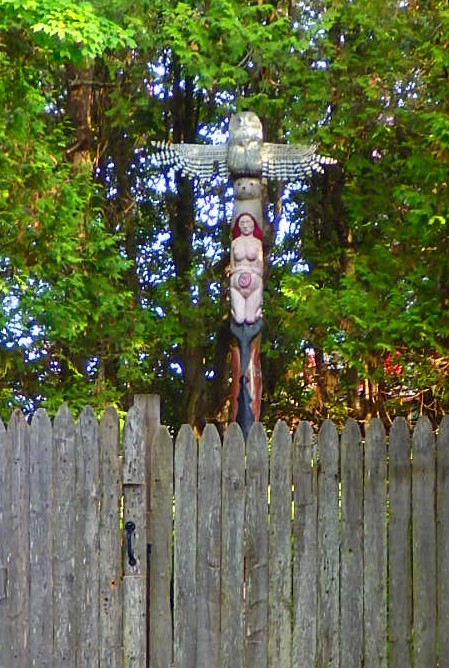
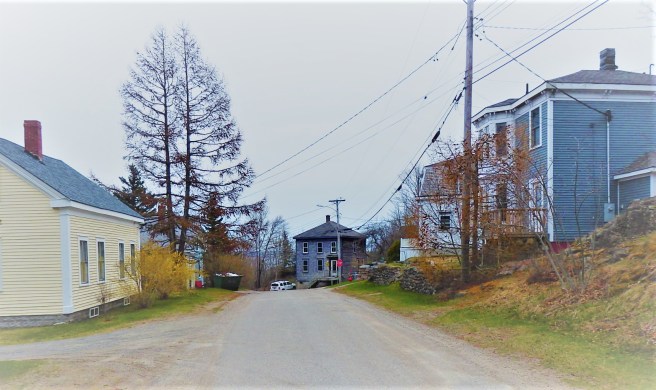
Caught my attention while strolling along an unfamiliar street.Especially once I got closer. This one is truly quirky. The foliage gives it a better background than it has this time of year.
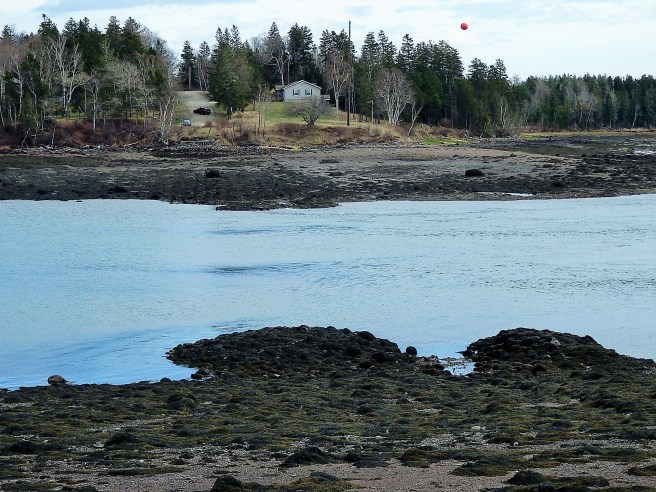
A toll-bridge used to span this. The road on the other side leads through today’s Quoddy Village.Of course, at high tide and its currents, the task was more daunting.
We’re quickly approaching the longest nights of the year, which are truly long here in Eastport. Accompanied by the most truncated days of the year, when the sun barely clears the horizon. We’re just a hair shy of the 45th Parallel, the halfway point between the equator and the North Pole. These days, it can feel even further north than the map shows.
The experience can be especially harsh here, now that the Summer People are long gone and most of the stores and galleries are shut for the season while those that remain open do so largely on limited hours. You might see a stranger or two in town around sunset, looking for a place to eat, and the best you can do is tell them to go to the IGA and get there before the 7 o’clock closing. Pizza slices or deli cuts plus a six-pack lead the list.
Even more, we know big snow, escalating ice, and profound cold are still ahead, as well as a blustery nor’easter or three.
We don’t even have a retail scene to crank up the holiday hoopla. Nor do we have anything resembling a nightlife, apart from a few cultural performances. Bless ‘em, especially after the Covid shutdowns.
Needless to say, social connections are especially important. For me, that includes singing in Quoddy Voices and worshiping with Cobscook Friends Meeting.
Also anticipated is a big stack of reading, both books and magazines, and concerts streamed from the Pine Tree State and beyond.
I’m already looking forward to the invasion of family for the holidays.