


You never know what we'll churn up in cleaning a stall

I’m waiting to name a character Sorrell. And Hezekiah is what I would have loved to have named a son, not that I would have found support on that one. Maybe as a middle name?
In a story, I try to avoid using names of people I know, or at least know well. Ditto for close family. So they don’t count here. It certainly narrows the range. On top of everything, after multiple revisions, I don’t always remember what I’ve kept in the end.
Besides, a name should be suggestive.
Now for ten or so more.
For children, though, I’ve become very fond of handing down family names. Even using a maternal surname. Guess it’s the genealogist in me at work.
We haven’t even gotten to nicknames, which can really pop a character into focus. Think of “Willy” as one possibility.
How ‘bout some suggestions from you?


Fortunately, the fisherman got a new coat this summer, a bright yellow one. Seeing the old one now comes as a shock.
Vermont may be renowned for maple syrup and skiing, but Maine lays claim to a very dry humor as well as lobsters. Maybe they’re somehow connected.
When I first moved in New Hampshire, I learned much about the region through the Humble Farmer, Robert Skogland’s weekly hour on Maine Public Radio. But his comedy act wasn’t the only one in the Pine Tree State.
Tim Sample remains the epitome, even though his time was cut unfortunately short.
Another now classic run was “Men from Maine,” a one- to two-minute comedy segment that opened with soap opera organ music and something varying along the lines of, “And now for another thrilling episode of the exciting adventures of Men from Maine. As today’s action-packed drama begins,” which aired on a morning radio show in Boston.
The episodes typically revolved around Lem and Ephus and others in backwoods Maine. While the humor was essentially redneck, it was opposed to that of the American South. Episodes ran all the way from industrial accidents handled in incompetent ways (many residents, including Lem and Ephus, worked in the local sawmill, though the canneries could be equally hazardous), to bestiality, but, as observers noted, the humor always came from the stupidity of the characters and their obliviousness.
After I’d been introduced to the men via Clackity Jane’s show on Eastport’s little FM station, I discovered how much they’re stilled treasured in these parts, maybe because they struck something true.
Laugh on, dude … and dudette.
Can You
Cancun?
Cancun
Canoe?
Can You?
The broker listed our house as being built in the 1860s, but even then, we thought it went back further. I’ve since seen maps from the mid-1830s showing a footprint for a house like ours, which seems right, confirmed in an 1855 map of town.
We know it was here before 1886, as the charred rafters affirm, reflecting the great fire that destroyed the downtown. (One historian had primed us to look for that touch.)
The 1855 map even shows this as the Estate of J. Shackford, a member of a prolific local family that originated in Dover before scattering to Portsmouth and Newburyport, Massachusetts, and then resettling up here quite successfully.
But to everyone we’ve met, it’s the Baskerville House.
I love the literary allusion, of course, to Sherlock Holmes and The Hound of the Baskervilles (and the fact it takes place largely in Devonshire, which plays into so much of my history of Dover). Hound/house are, of course, nearly homonyms. Beyond that, there’s also the fact that Baskerville was a basic serif typeface back in the letterpress days when I entered journalism. It’s an old style that largely didn’t make the leap to digital, though I see it has recently joined my Windows options. (Not so for my beloved Caslon of the same era.)
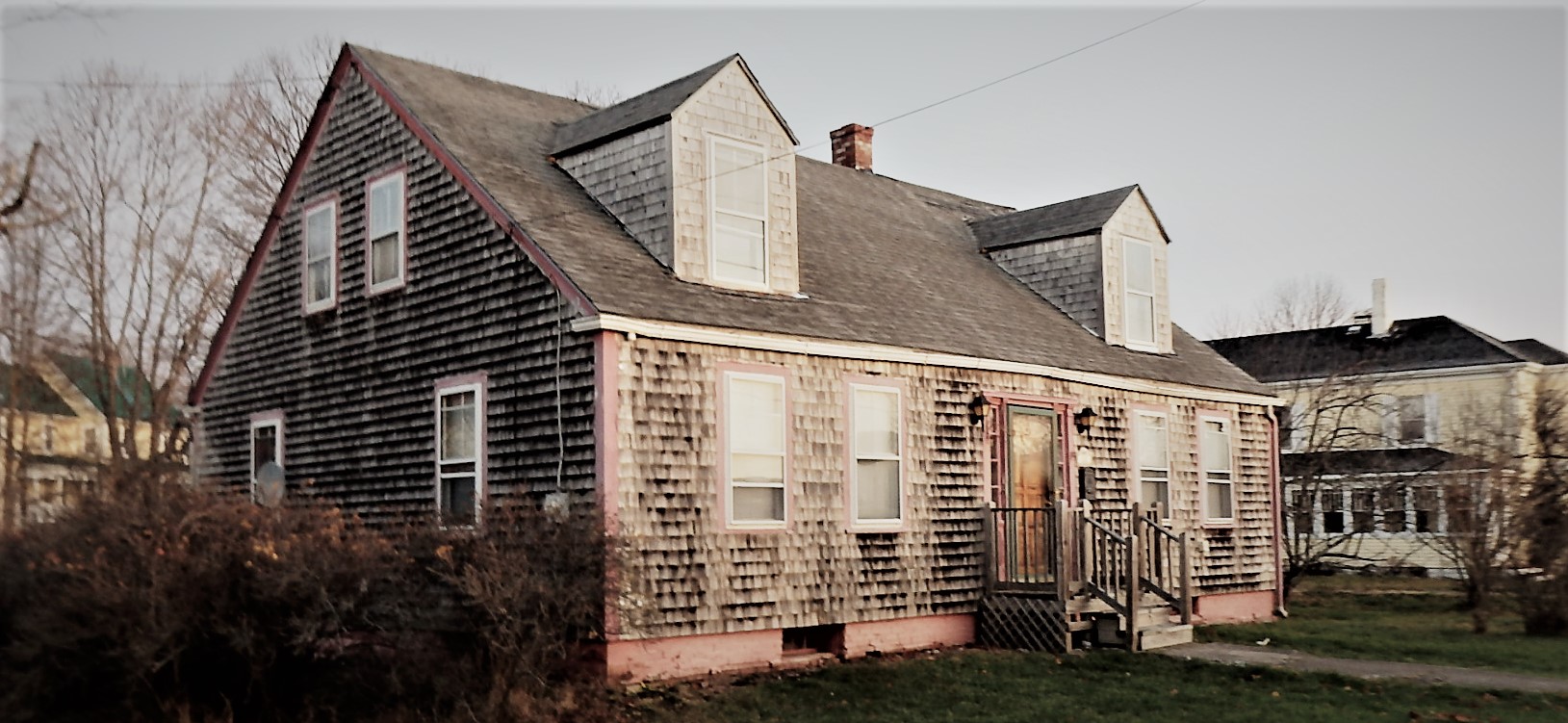
What we liked about the place, besides its location and TLC potential, was the fact it felt good inside. Close-your-eyes, even when the room’s chilly. I’ve certainly felt comfortable in extended solitude and all the writing that’s come within it.
Something that struck me after moving to New England was how often people – even highly rational professionals – calmly asked new homeowners if their place had ghosts. I’m not kidding. And Maine seemed especially prone to that.
Nobody’s asked us, though. Instead, they confirmed that ours always felt good to them, too.
The Baskerville at the heart of this story is Anna, a retired Black nurse who came to Eastport in 1999 to live with her son and daughter-in-law, also named Anna.
From what I’m told, she was stout, had red hair, and loved to sing – especially in all of the churches, where she was always welcome. And she, too, found this place hard to heat but stayed in it, after her son remarried and moved to the other end of town.
When I said no ghosts but the place feels good, others piped up that’s likely Anna’s presence or spirit. I’ve known similar imprints elsewhere, especially in old Quaker meetinghouses.
Naturally, we want to know more about her.
One story I heard was about her introduction to the town. She had a longstanding fear of deep water, and because her new residence was only a block from the ocean, the family arranged for her to arrive after dark and get used to the house first. Maybe they figured they could deal with any trauma better in the morning.
So, as I’m told, when Anna awoke and opened the blinds and saw the expanse of water, she inhaled and, as she proclaimed later, “I knew I was home.”
Yes, we know the feeling, too. And we still want to know more.
In the meantime, we’re trying to keep our renovations in line with what we hope she would have approved. There are good reasons to respect the past.
What do you know about the place where you’re living?
Singing in front of an audience is a relatively new experience for me, one arising in my retirement years, mostly through Boston Revels’ top-caliber community chorus and related events.
What I can say is that from the stage, each performance has been thrilling and transcendental, even when not necessarily perfect. Most remarkable is the oneness we sense as a company making melody and harmony.
Before the Covid restrictions and my relocating to Downeast Maine, I was commuting from New Hampshire to Boston as a baritone in the Revels Singers, first under George Emlen and then Megan Henderson. The ensemble ranged from 40 or so to maybe 80 members, depending on the season. Its classical and world folk repertoire was drawn largely from the shows the organization had produced in its more than a half century, with music in nearly 30 languages and spanning a good millennium of history. Many of the arrangements, editions, and original compositions were by our conductors or others affiliated with Revels.
~*~
These days I’m with a much smaller group, Quoddy Voices, which is also led by a fine conductor, pianist, and composer, John Newell, and I’ll proclaim that its standards and abilities are just as high.
We just concluded the second pair of programs with me as a member, and once again I must admit moments of listening to the others in amazement and then wondering how on earth I ever managed to be included. Yes, it’s humbling and challenging.
Technically, we’re a chamber choir – for the concert, 20 singers. Among other things, it means any slipups are more exposed.
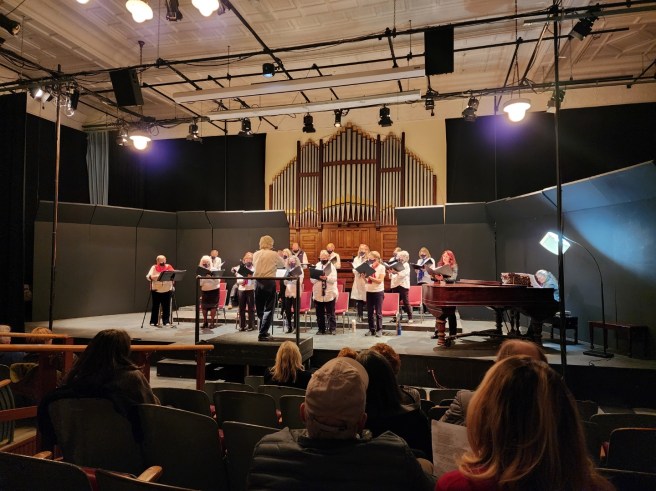
Our program, a Harvest of Song, put us ahead of Thanksgiving and the crowded holiday schedule at the arts center. That meant a shortened rehearsal schedule, but online practice scores of our parts definitely made a difference.
Compared to Revels Singers, our repertoire engages more in works other choirs are also exploring, which led us to three pieces by Florence Price, the first Black American woman to have a symphony performed by a major orchestra. She’s finally being widely discovered, nearly 70 years after her death. From our point of view, her writing is deft, with touches of jazz and flashes of difficulty. The bass line in one score movingly upheld the axiom of less is more.
From living composers we had two widely performed works by Englishman John Rutter, who is admired for pieces that fit the voice like a latex body suit; Californian Frank Ticheli’s masterpiece, “Earth Song”; a lively Calypso in 5-4 time by the now 95-year-old Harry Belafonte; and a haunting 35-year-old Dan Forrest’s setting of a Ralph Waldo Emerson poem.
From old masters we had a deeply reverential motet from Romantic-era Anton Bruckner and sections of Baroque brilliance from Henry Purcell’s 1692 “Ode to Saint Cecilia’s Day,” which foreshadows Handel and his Messiah but with sides of pagan homage, as English poets of the time were wont to do.
We concluded with Randall Thompson’s classic 1940 “Alleluia,” drenched in sadness, as the composer admitted, but becoming quite polyphonic and agitated before introducing a single second word at the end, a seven-part, two-note amen.
While all of these works are widely known in choral circles, all but the Thompson were new to me. I had heard the Thompson only in a broadcast just a year ago and earlier from an old buddy who raved about singing it with his chorus.
Our audiences, as usual, were attentive and enthusiastic.
~*~
So now some of us are scheduled to do some informal caroling before Christmas.
And then, come February, we get to see what our director has in store for us next.

latest dispatch, the first in nearly a year, tells of her decision to return to wearing a covering but Mennonite-style rather than her mother’s Quaker so what’s this about more hot wheels, eh, or clicking those heels, ah, to prefer dwelling in New England as I recall our discussion comes back, so I learned last night nothing else new comes to mind to report look forward to the next mailing, of course I’m not always a sterling example of what some embrace as Christian Love with or without the olives, yes, definitely, stay securely on your feet or knees the heartbreaking headlines demand attention regardless of the deadline every small detail adds up

