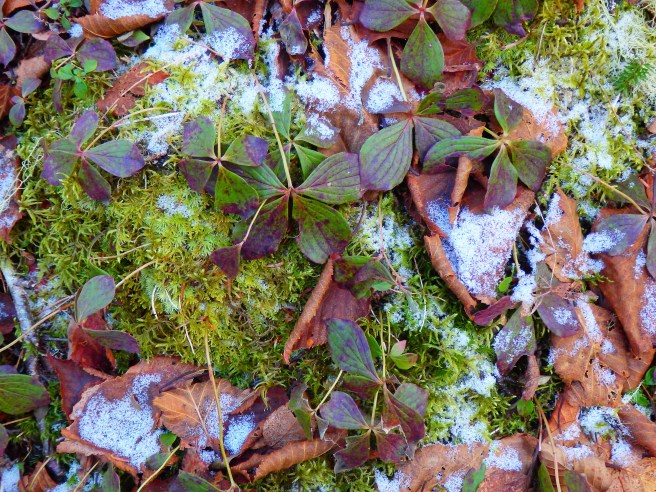
We’ve become fond of this groundcover along many of our trails, with its white blossoms in the spring and red berries well into summer. Here the foliage is fringed with red, set here against moss and a touch of snow in a stretch of what may be a peat bog.
Quoddy Head State Park, Maine
For the record, Cornus canadensis is also known as Canadian dwarf cornel, quatre-temps, even crackerberry,
Have to admit “New Brunswick” sounds more exotic than simply “Canada.” Most Americans know where Canada is, after all, but have to think twice when the province is mentioned.
The deep channel between Eastport and Campobello Island, New Brunswick, is called Friars Road, named for a rock formation dubbed the Old Friar. It stands at the foot of the bluff that’s part of the international park honoring Franklin Roosevelt’s former summer estate.
Equally exotic for this Ohio boy is living on one of the Fundy Bay islands, even if we don’t have to take a ferry to get to or from the mainland.
If I’m counting right in the satellite images, mine is one of the one hundred most easternmost houses in the continental U.S. It’s likely I’m even the most easternmost Quaker in the country.
Was this once part of a sardine cannery? Or the steamship terminal? Yes, that’s more of Campobello Island, New Brunswick, on the other shore.
Been here two years now, too, and it’s still amazing me.
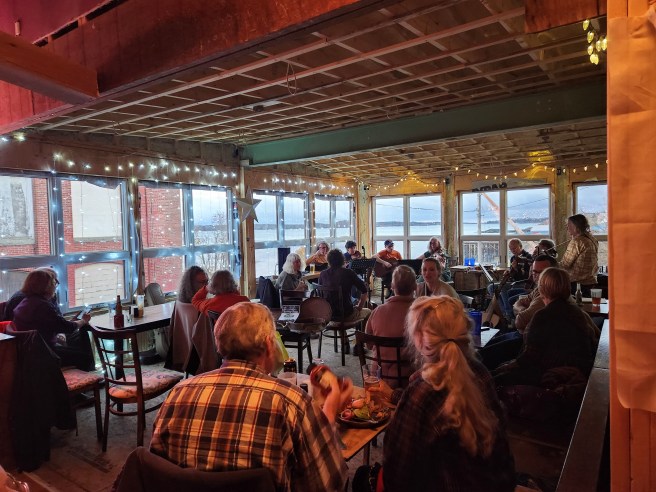
All of them regard waltzing, rather than the facing lines that give New England contradances their name.
I should mention that there’s something special about waltzes, which usually come just before the break after the first hour or so and definitely at the conclusion of the evening. In fact, one girlfriend would always grill me about my waltz partners on those nights she decided instead to stay home.
The first memory here involves a dance at the town hall in Bowdoinham, Maine, always special in my experience, especially those when the band centered on three families of musicians.
At the break, as I was conversing with a lovely potential dance partner, I noticed that a young fiddler, maybe six years old, was still on stage and teaching an even younger fiddler some music. It was enough for me to say, “Hey, it’s a waltz, let’s dance,” and we did, soon joined by others. I looked up and saw the amazement in her eyes. You know – If we play, they will dance – as an epiphany.
~*~
Years later, elsewhere, I was telling that story to a fantastic young dancer as we waltzed.
Her eyes lit up.
“So you’re the one!”
~*~
And then, at a Bob McQuillan retrospective honoring the rerelease on CD of an earlier LP, the partner I had for the waltz was named Amelia.
Coincidentally, the same as my step-grandmother, fondly recalled.
And the waltz was titled “Amelia’s Waltz,” composed by Bob for the daughter of a beloved band member.
The same one, it turned out, circling with me and ever so light on her feet.
~*~
I’m getting teary as I relate all this, but there you have it.
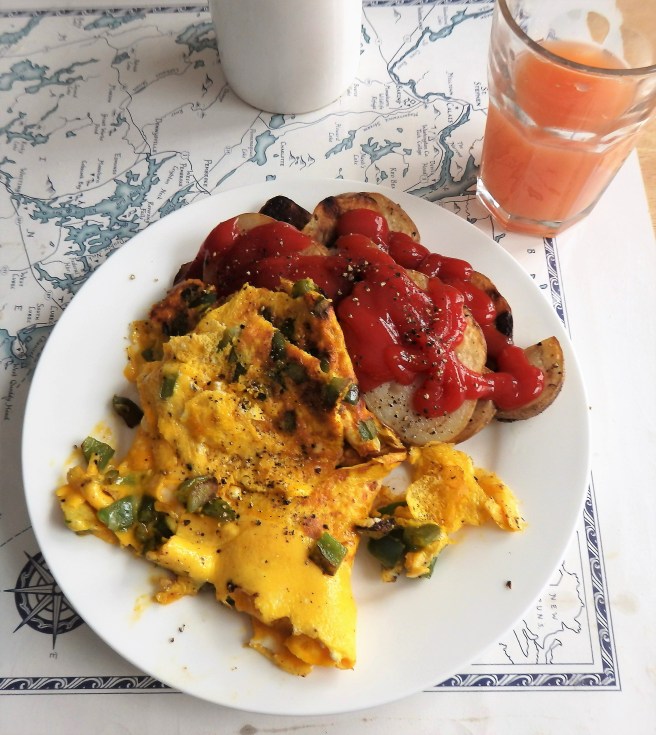
A cheese, green pepper, and mushroom omelet using eggs from our next-door neighbor’s hens is served with home fries made of potatoes I purchased in Aroostook County. Notice there’s no need for ham or bacon. I do love grapefruit juice, by the way. Brunch like this remains a favorite Saturday tradition for me.
My eating habits were one of the places my residency at the ashram changed my life (see my novel Yoga Bootcamp for a taste of the experience).
The lacto-vegetarian cuisine was one, leading to three extended periods “on the outside” when I continued it. Even when I haven’t, the amount of meat in my menus has remained much less than many Americans’. I rarely use bacon, for instance, and when I do, it’s likely to be as a garnish, say on a spinach salad. Hamburger is more likely to be in a meatball or meatloaf rather than in a bun.
Gravy, curiously, has become more heavenly than ever as an extension of the rue family.
And lamb, a recent addition, is simply glorious, especially grilled.
Grilling, I should add, is something I’ve come to treasure through my wife and the space we dubbed the Smoking Garden. There’s no substitute, as far as I can tell, and it makes for some great social gatherings.
What I gained through the ashram was a delight in vegetables and fruits, especially in season, as well as dried beans, nuts, and mushrooms.
The other lasting change was in my dining habits.
Our first food of the day came after morning meditation, community scripture reading, and perhaps physical exercise, and then it was light food – coffee and toast, maybe with yogurt or fruit, and that after we’d already been up three hours. The real meals were a late brunch or early lunch, around 11, and an evening meal around 4 or a little later.
I’ve continued a similar schedule, foodwise. Well, my caffeine intake is down, per doctor’s orders, but what I have is top-notch. Quality over quantity, right? When I was working the “vampire shift,” till midnight or so, the hours were adjusted accordingly, often with a melty cheese sandwich before bed or a martini. (Alcohol was strictly forbidden on the yoga diet.)
In retirement, I find myself often down to one major meal of the day, and holding steady.
There are many reasons for the closure of the Dover Friends meetinghouse after the First World War, as I note in my book, along with its reopening in the 1950s.
Dover Friends meetinghouse, erected in 1758, the congregation’s third in town.
In an even bigger picture, we could argue about the marginalization of religion in American society in general, and then extend our consideration to lessened civic involvement and association.
My short quip is that Friends became too respectable.
For now, I’ll leave it at that – at least here, in a blog post. Many other factors come into play.
Besides, it’s the basis of enough for an entirely new book, rather than the history at hand.
Just what makes us tick, anyway – individually and together?
~*~
Check out my new book, Quaking Dover, available in an iBook edition at the Apple Store.