Well, more like Puget Sound.
We have plenty of foggy mornings, often with cold damp air.
Turns just about everything gray, even monotone, a lot like I remember Seattle.
You never know what we'll churn up in cleaning a stall
Well, more like Puget Sound.
We have plenty of foggy mornings, often with cold damp air.
Turns just about everything gray, even monotone, a lot like I remember Seattle.
I’ve been part of a study group that’s been trying to envision a sustainable future for our small corner of the globe.
It’s been an exciting exercise, actually, looking for ways we can enhance what we have in conjunction with neighboring communities.
But it’s also terrifying, when we look more broadly.
Nine billion population, up from one billion when I was born. Can the globe really carry that load? I’m doubtful, but maybe.
Let’s start with increasing urbanization. I was blown away by the fact that 75 percent of Britain is considered urbanized today.
Add to that global warming. The regions where population is booming will be scrambling for food and water. Yes, water becomes essential. As well as ways to earn a livable income.
Now consider the automation of many jobs, something that points toward income readjustment, which is being largely ignored in public discussion.
Get political, and Republicans are in utter denial about all this, something I find deeply troubling. Engage, intelligently, will you? The future of humanity is at stake. Or are you really dinosaurs, just looking only for your next meal?
According to the projections, I’m in a good place to survive this – or at least my descendants are. Yeah, the ocean will be closer to our doorstep, even if we are higher than the downtown we adore. Still, the directions on the charts point to a lot of turbulence ahead, especially desperation and violence.
Here, in these workshops, we’ve been looking at the enhanced value of tourism, seeing our place as a pocket of natural wonder. As much as I love that projection, I doubt things will be that easy.
Will Florida actually be off the map by then, along with all of its reactionary politics? Or maybe those partisans will still be denying global warming would ever happen.
Where do you see the world in just 30 years?
Or even in just six, 2030?
You vote for one of them, you’re voting for the worst of them.
They’re sticking that much together.
Wanna talk about rotten apples?
Or of unity in essentials, either side of the aisle.
I’ve mentioned my bewilderment at the failure by the Church of England to serve its communicants in New England during most of the 1600s.
As well as the fact that Dover’s First Parish could have been the first Baptist church in America, beating Roger Williams in Providence, Rhode Island, by a year.
What perplexes me is that I find nothing in New Hampshire before almost 1800, although there was a church in Boston, a place where Friends struggled.
The fact is that the Baptist tradition originated as a liberal movement. We’ve seen threads of that continuing in Jimmy Carter and Bill Moyers.
In my research, I kept coming across fleeting references to Baptists during the years before the American Revolution, but curiously not much outside of Rhode Island to indicate ongoing activity in New England. They were not singled out like the Quakers as great dangers to social or godly order, even though they were still outlawed and ridiculed. Did they meet secretly, perhaps even at times other than Sunday morning? None were hanged in Boston, for one thing. In New Hampshire, they had only three congregations by 1770 – Newton, founded 1755; Madbury, adjacent to Dover; and Weare, which had a strong Quaker presence. Still, as I sense, theirs is a crucial history yet to be written.
Considering all the furor around minister Hanserd Knollys’ brief tenure in Dover, just before he began preaching definitively Baptist doctrines, as well as the support he had, I keep wondering about his legacy in the Piscataqua settlement. Somehow, he set off an unorthodox flame in the community, at least by Puritan standards.
Curiously, as I considered the matriarchal role in the continuing nurture of a faith tradition, the path led back to Thomas Roberts and his wife, Rebecca Hilton. This time I chanced across not their Quaker impact but rather a Baptist one.
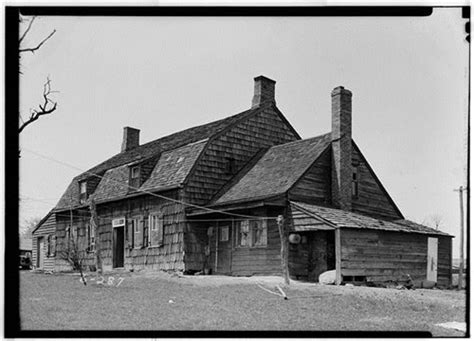
Their daughter Esther – also recorded as Hester and Easter – born around 1625 and one of the first English children in New Hampshire, married John Martin (also Martyn) around 1645 in Dover. He descends from Mayflower arrivals in Plymouth Bay. After a round of public service, they relocate to Oyster Bay on Long Island, perhaps among those who flee to avoid persecution, but in 1666 move on to New Jersey shortly after the British seized it from the Netherlands. Joined by Drake, Dunn, Gilman, Hull, and Langstaff families from New Hampshire, as well as other Baptist New Englanders, the name Piscataway soon sticks to their New Jersey community, reflecting their Piscataqua roots. Theirs was perhaps the seventh oldest Baptist congregation in America. The colony itself came under Quaker proprietorship in 1675, assuring religious liberty. Think about all that the next time you’re driving along the New Jersey Turnpike and see the signs for that exit.
That’s the last I find of Baptists in New Hampshire until a Scammon from Stratham on Great Bay – a surname that appears early among Friends – weds a Rachel Thurber of Rehoboth in southern Massachusetts in 1720. Resettling in Stratham, she struggles for 40 years, making one conversion, before moving on to Boston and being baptized into its second Baptist church.
Glory, hallelujah, and all that.
~*~
Welcome to Dover’s upcoming 400th anniversary.


It’s a common topic of conversation this time of year in New England.
How’s the foliage shaping up?
Are drought or wetness, heat or cold, or any number of other factors impacting it negatively?
Or is it going to be another banner month across the six-state region?
Vermont and New Hampshire tourism tries to capitalize the most from the colorful outburst, but they’re hardly alone in sometimes dazzling displays. New York and Pennsylvania can also be memorable.
So here we are, trying to make the most of the outdoors before winter cold sets in all too soon.
What’s it like where you are?
Are all of those “Hi, how are you doing,” Facebook messages to me really from accounts that have been hacked?
Sure, I recognize half of the people, maybe more, but do they all come up with identical messages? How improbable. Makes me wary, especially after my own account had been hacked.
Apparently, it’s very easy to set up a counterfeit you and invite all of your “friends” to check in at the new address.
Just how secure is that party line, anyhoo?
If you think one of your real friends has been hacked, tell them, so they can alert FB security. Inform them that merely changing their password won’t fix it, too.
Anyone else gone through this?
There’s just so much out there, in print and especially online, and it keeps proliferating daily, even hourly, and I don’t know about you, but I’m in the camp that finds it truly overwhelming.
Everywhere, each minute, make that second, we’re expanding outward, away, from any notion of a renaissance man, and woman, who could possibly be well informed on every facet of a civilized society.
Even in science – or maybe, especially in science – it’s become impossible to keep abreast of the flood.
Interdisciplinary collaboration has become more essential than ever, but also more elusive.
Is this leading toward disintegration?
Is this, in fact, the root of the reactionary backlash around the globe, not just the Trumpian cultists?
Yeah, the folks who rely on Fox TV biased “news” in the USA.
I look at the crises facing our children and grandchildren, and these are critical, but there are so many it’s mindboggling trying to decide where to pitch in taking a stand. Climate change, population explosion, racism, corrupt politics, the one percent and injustice, environmental protection, medical systems, education … Hey, I’m back to hippie era causes on steroids.
How are we supposed to preserve our sanity and still press toward a better future?
We still have to be informed, right? And thinking clearly?
As many fish stocks dwindle precariously, salmon farming and related aquaculture are hailed as a viable alternative.
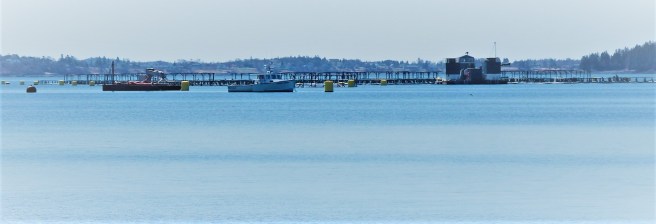
Young salmon are placed in the circular enclosures when they’re about six inches long, where they leap and splash under netting that protects them from eagles, osprey, cormorants, and gulls. In about two years, they grow to a harvestable size of about two feet and ten pounds. A specially designed vessel sucks the mature fish from their pens and its conveyor stream immediately cleans and guts them.
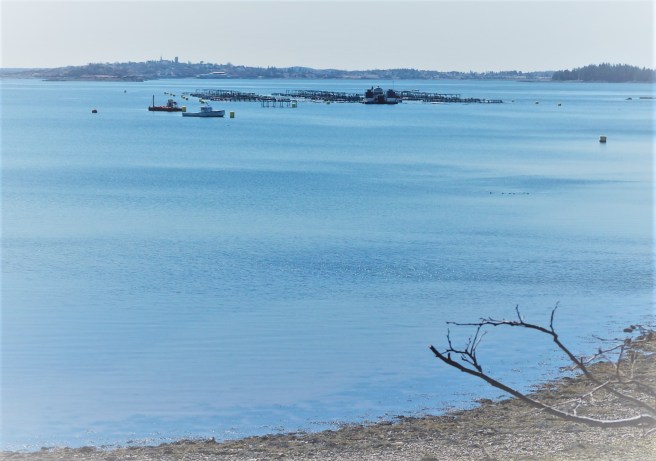
Cooke Aquaculture, based in Blacks Harbour, New Brunswick, manages 15 pens in Deep Cove and Broad Cove, operating from a former fertilizer plant on Estes Head. A feeding barge sits amid the pens, which house about 450,000 salmon. About one-third of the pens are left fallow at any time.

From our upstairs windows, we can see other salmon farms at Campobello Island across the channel.
As for recipes? I’ll often make mine as sashimi.
I was feeling a little down as Eastport turned into its annual ghost town. Cooped up, too, especially under the tedious revisions to the Dover history, even before seeing how much I still don’t know and will likely never know, even if I spent a month at the University of Massachusetts going back through the Quaker archives.
Then I realized I hadn’t been anywhere other than eastern Washington County since mid-April. Six months confined to this sliver of rocky coastline and piney interior. The largest city has only ten thousand population and has commercially suffered under the Covid border restrictions. So I decided to see something new and finally settled on Aroostook County, widely known simply as The County, and thus hit the road at 7:15 Monday morning and headed up U.S. 1 without a plan other than turning back around noon.
I can now tell you it’s four hours to Caribou and a lovely drive, some of it through long stretches of forest, others through the tidy farmlands of The County itself. Yes, tidy, unlike many of the rural residences in this state.
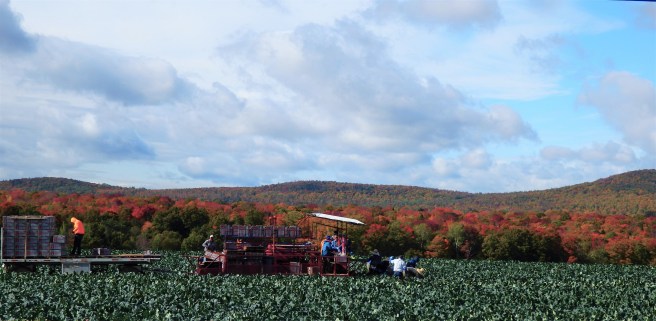
Turned out to be the perfect day. Sunny, foliage in its prime, little traffic, small roadside sheds selling new potatoes on the honor system. I really felt at home amid all the farmland wonder.
Feeling sated with the visual glory, I felt ready to head home. At Caribou, turned over to Fort Fairfield to follow U.S. 1A back to Mars Hill, and was surprised to find a yellow “share the road” sign with a horse carriage emblem. And sure enough, I found a large colony of Amish. I’ve missed them and Mennonites and Brethren since moving to New England, and this was exciting.
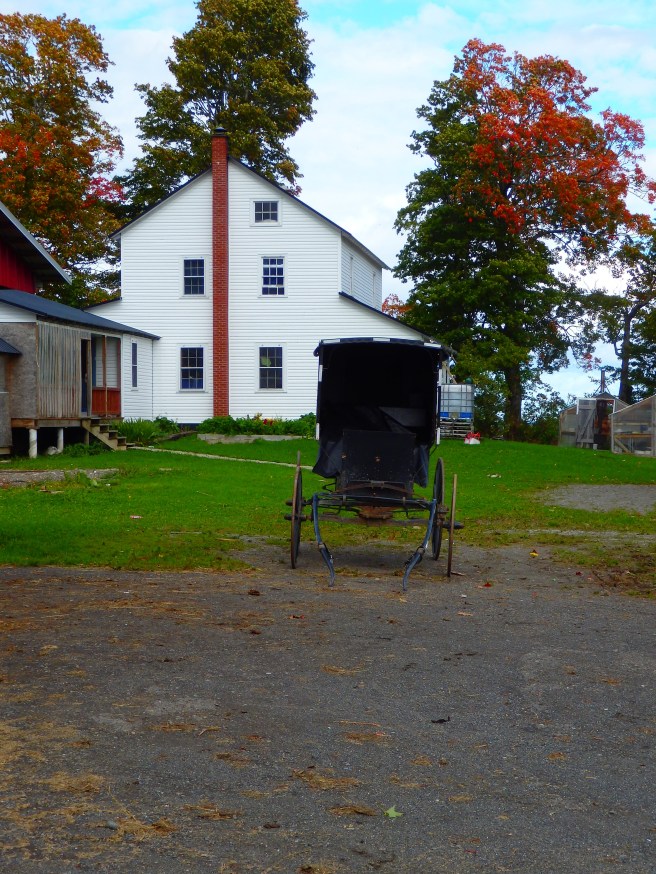
After passing one Amish farm and its bright red barn – yes, that seems to be the custom here, red next to the plain white farmhouse and laundry on the line – I noticed a small church and whipped around to take a closer look.
Never would have if a Friend hadn’t tweaked my interest by sharing something he found online.
The meetinghouse is one that escaped Silas Weeks’ research for his definitive book, too.
Afterward, I learned that one of our good friends was from Caribou, not further north as I’d thought. And then another was from Presque Isle.
So now I have a much better grasp of what folks are talking about when the say “The County.”
I should also mention I came home with 60 pounds of new potatoes from three different stands. Ten pounds for five dollars, three different varieties. Turns out they’re ones that didn’t pass the baggers’ standards, usually because of irregular shape or size, but that’s no problem for us. The skins of new potatoes are so soft and tasty – no need to peel them, even for mashed potatoes. You do need to unbag them, wash and inspect them, before storing. Otherwise, a few damaged ones can spread rot.
~*~
Next time I venture that far north, I plan to visit the entire solar system. Seriously. I caught a clue of it with a model of Saturn atop a pole beside U.S. 1 followed miles later by Neptune. Turns out all of the planets sit beside the road to Presque Isle, scaled in size and distance from the sun at the University of Maine branch campus. There really is a lot of emptiness in space.
One more thing to impress me.

