There’s a widespread assumption across America that no household should be without a turkey on Thanksgiving Day. And that’s led many charitably inclined groups and individuals to deliver free turkeys to poorer families ahead of the holiday.
What gets overlooked is the realities of the recipients themselves. Some may not welcome the challenge in front of them. Some don’t cook, period. Some don’t have a full-sized oven. Some live by themselves and have no way of dealing with all that meat. Carving the heavy roast gets tricky, even if you have a large platter and the right knife and serving fork. Not everyone even likes the taste, white meat or dark.
I’ve heard of one group home that had a dozen of the brick-solid big birds stashed away in the bottom of its chest-style freezer, no date attached. A diligent volunteer finally took charge and into the trash they went, one a week.
Speaking of volunteers. Many people step up to volunteer for the holidays, only to be told the spots are already filled and then turn testy. What do you mean?
Doing good can get tricky and lead to hurt feelings.
The real needs continue all year, especially through the depth of winter, when the food and volunteers would be most welcome.
That holiday spirit doesn’t have to be expended all at once, does it?
After discussing Maine’s unincorporated townships, I need to add that there are a lot of variants – 17, if I’m counting right. Among them are the BKP, BPP, NBKP, NBPP, and WBKP designations – translated as Bingham’s Kennebec Purchase, Bingham’s Penobscot Purchase, North of Bingham’s Kennebec Purchase, North of Bingham’s Penobscot Purchase, and West of Bingham’s Kennebec Purchase.
So just who was this Bingham guy?
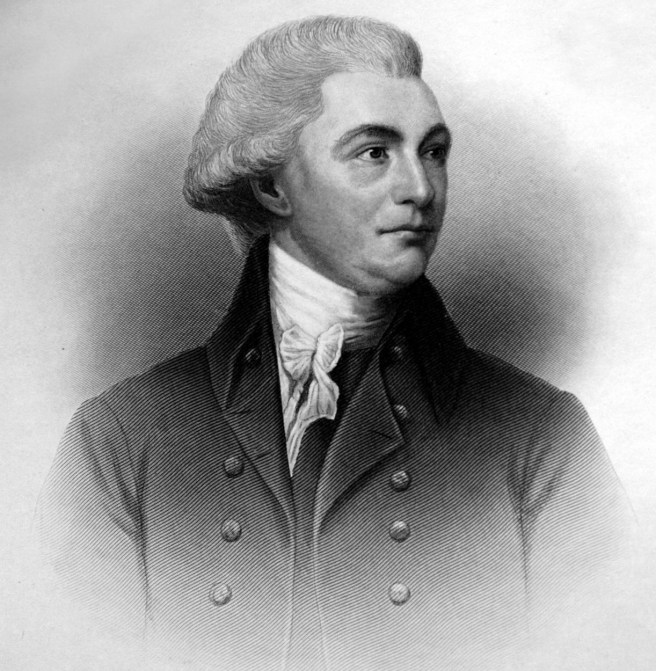
In short, he was William Bingham, already a wealthy Philadelphian when he became filthy rich via privateering during the Revolutionary War. He was also a statesman and U.S. senator who parlayed his riches into vast land purchases, as noted above but also including upstate New York, where Binghamton, where I’ve also lived, was named in his honor.
Got it?
Quite simply, Bingham owned two million acres in Maine, making him land rich but cash poor.
His agent in Maine, Revolutionary War Gen. David Cobb, was responsible for laying out most of the roads associated with the Airline Highway (now eastern State Route 9). And when Cobb retired in 1820, John Black, agent for Baring Brothers Bank in London, felt that lumber was the wealth that would provide his boss the needed profit. There were further complications as well as marriages, but you get an idea how Baring township in the Moosehorn wildlife preservation got its name.
Cobb did, however, build a great house at Gouldsborough and soon faced some harsh realities that he notated between 1795 and 1800.
First, the land and climate of eastern Maine were not and are not suitable for farming. He noted that “those who come to view the country … have as frequently returned almost blind by the bites of flies and mosquitoes. You have no conception of the hosts of these devils that infest the thick forest at this season.”
More critically, he found “the great body of the people of this country possess no regard to the rights of private property,” calling them ” vicious inhabitants who disfigured its landscape. Every inhabitant here is now a trespasser, a plunderer. They live by it, and therefore they will not cultivate the finest soil in the world. They’re not doing this is the chief cause why the reputation on the country has been damn’d. If the people who live by lumbering are indulged in cutting the forests wherever they please, they will have but little … appreciation of the soil.”
For the record, the soil itself wasn’t nearly that rich.
But continuing, in his estimation, “The greater part … follow lumbering and fishing … and they are very intemperate, very lazy and very poor. It may be said in truth … the majority of the inhabitants are drunkards.”
There are those, of course, who would question whether much has changed since.
Or, as is sometimes said of Eastport, it’s a drinking village with a fishing problem.
You might think the ideal time to work in a forest would be spring or fall, but that’s not how it’s turned out in logging in the great northern forests of New England and New York state. Instead, the time to be out harvesting trees is deep winter. Yup, below zero around here.
I first learned of this when trying to order firewood after an uncommonly warm winter in New Hampshire. Because the ground hadn’t frozen hard enough long enough, the cutters hadn’t been able to access much of the woods with their heavy equipment. The result was a marketplace shortage.
For contrast, mud season can be notorious, so much so that come spring, logging roads are closed to prevent destruction. Much of Maine, in particular, is either standing water, once the ice melts, or boggy, including soft peat bogs. And in late spring and early summer, hoards of nasty black flies swarm about – the defenders of wilderness, as some contrarians contend.
~*~
Folklorists examining the songs of Maine have noticed that many of the songs from the old lumberjack camps originated at sea. You know, as shanties and the like. At first, these scholars were puzzled, but then they realized that winter was a treacherous time to be out on the water. Many sailors instead headed for the forests, to work in the camps for the season. Somehow, though, any songs originating in the woods failed to travel the other direction.
Historically, the logs were stacked along streams, awaiting the spring melting and surging high waters that the timber could ride to ride millponds. That, in turn, could be exciting, demanding, and deadly work where mariners would continue.
From there, the sailors went back out on the ocean.
Mechanization has changed much of that, on land and sea, but not the reality of mucky soil.
We’ll see what global warming does to the industry.
For those of us who come to New England from other parts of America, the insistence that here we live in either a town or a city but nothing in between comes as a shock. There’s no saying “near” anywhere, even if the place has its own post office. Nope, either city or town, the difference being the kind of government it has.
Eastport, for instance, is a city, while neighboring Lubec, roughly the same size, is a town.
And each may have its own neighborhoods or villages, further complicating the picture. A town typically has its historic center, even when larger development came later somewhere else within the boundaries – maybe out along the railroad tracks, for instance, or the mills. Note that when you look at maps.
Maine adds a third twist to this model. Much of the state was surveyed into parcels, typically six-by-six-mile squares, that never lived up to expectations, at least in terms of habitation and development. They remain uninhabited, seasonally or year-’round, or lack sufficient population to self-govern themselves.
Here in the Pine Tree State, they’re designated as townships or even plantations, though some do have names or have reverted by necessity from self-rule to management by the state.
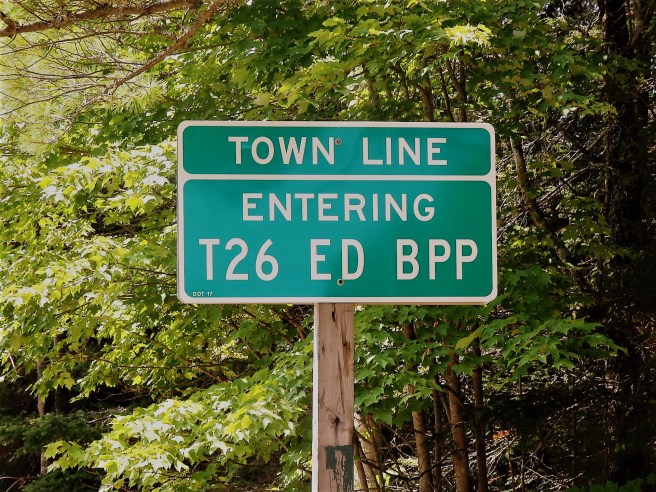
Thus, when driving along you might see a highway marker like the one announcing that you’re entering T26 ED BPP.
There are many more signs like this, equally baffling. This one translates as Township 26, Eastern District, Binghams’ Penobscot Purchase. Don’t ask me more, I’m already confused, as I’m sure you are.
There’s even another variation, PLT, for Plantation – and, no, it has nothing to do with fields of cotton or tobacco.
The Plt stands for plantation, which has nothing to do with a privately owned farm in Maine.
Significantly, more than half of the state is uninhabited. Hard to think of that, considering the urban and suburban density and congestion of so much of the rest of the Northeast.
Somehow, nobody’s counting mosquitos or moose in the equation.
What do you have to explain to others about the political setup of the place you live? Ward politics? The county sheriff? The nut jobs, right or left?
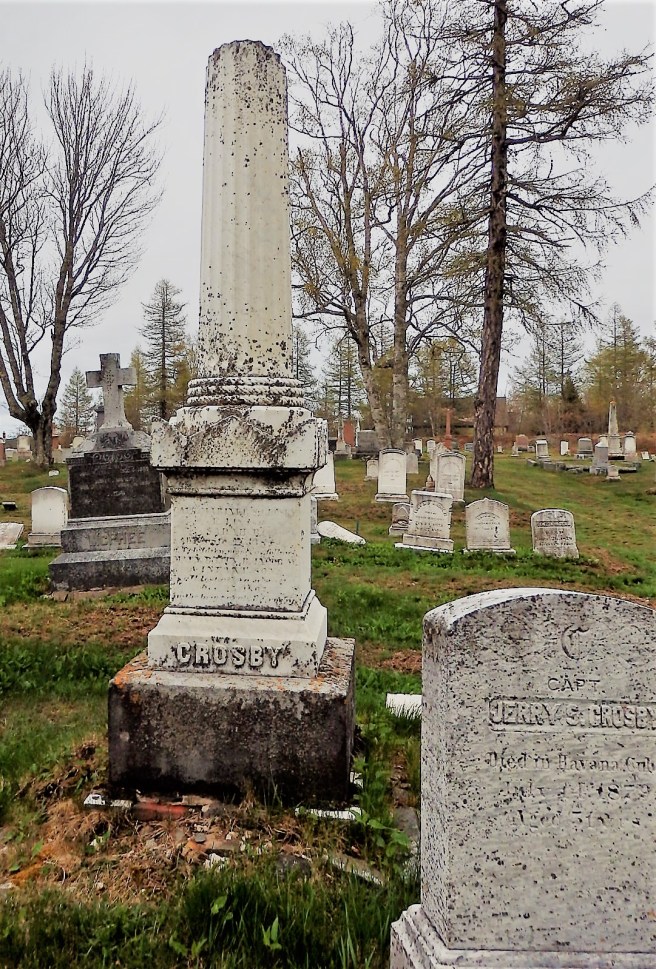
Capt. Mariner S. Crosby. Given his Christian name, it was inevitable that he would take to the sea. That’s what struck me the first time I wandered through Hillside Cemetery.
The second time I went to the graveyard, I was looking for that marker but couldn’t find it. Back home and at my computer, Find-a-Grave led me to the rest of the inscription, which is admittedly rather worn away, as well as some additional facts.
What I found was this:
“Lost at sea with his family and the Brig Sarah B. Crosby,” named for his wife. She and the four children, one of them an unnamed infant, are then listed on the white memorial – Jacob W., Mary B., and Lucy B.
The date of their demise is uncertain, “around Oct. 25, 1867” – in season for a hurricane or some other vicious storm, although a fire in a wooden ship can’t be ruled out.
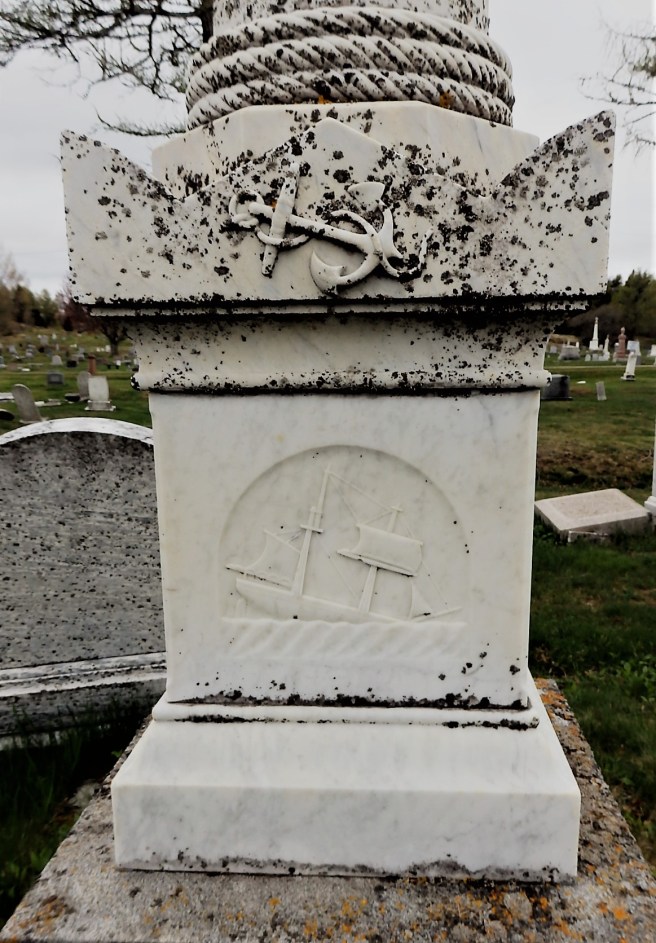
I trotted back to the cemetery for a closer look. Here it is:
The broken column symbolizes the loss of an upstanding citizen in his prime.
The Chamber of Commerce website reveals more:
“Mariner Crosby was the master of the brig ‘Maria White’ in 1852 and the schooner ‘Mary Jane’ in 1855. From 1861-1863 Mariner was the master of the barque ‘Charles Heddle,’ also built by C.S. Huston,” in Eastport. Around the corner from me, actually. “Mariner’s last command was the brig ‘Sarah B. Crosby,’ named for his wife, which was built in Pembroke. He commanded this vessel from 1863 to 1867 when the vessel was reported overdue. Mariner, his wife Sarah and four children, as well as the crew and passengers, were lost at sea without a trace.”
The pillar is a broken mast, as the three rings of rope emphasize. And there’s a carving of a brig going down, all but one of its square sails blown away.
We’re not even told where the ship was bound, much less about its cargo, passengers, or crew. And a brig did require significant manpower to manage the massive square sails.
The two-masted 316-ton “Sarah B. Crosby” was built in Pembroke by George Russell in 1863 and then based out of Portland, bound for ports such as New York and St. John, New Brunswick.
I started to investigate and found a bit more.
She knew the travails of the sea, having wrecked at treacherous Sandy Hook, New Jersey, on March 1, 1865, with the passengers and crew safely removed. And then, after being abandoned, she was reclaimed and repaired, with shipments of coal from Halifax, Nova Scotia, later in the year.
On March 19, 1867, the New York Herald carried this notice: “Brig Sarah B Crosby (of Portland), Crosby, Measina, Jan 27, with fruit to Lawrence, Giles & Co, passed Gibraltar Feb 16; has had heavy westerly gales, with snow and hail, and split sails. Mar 13, latitude 41 30, longitude 65, spoke ship Michigan, from Liverpool for London.” (Measina, a mystery unto himself, was first mate. They would have been just off England at the time this information was relayed.)
I would like to know more in general about wives and children traveling with captains. It turns out to have been common, with a significant number of the children being born at sea or spending a large part of their childhood there. Wives were partners with shares in the business, whether they went abroad or stayed ashore. They even learned navigation, but did not interfere with the cook aboard ship. There were strict lines of authority. Beyond that, what were Sarah’s views and experiences? Was she even related to the 1841 Robert Bates house a few doors up the street from me? She was only 33 or so at the end; there’s no age for Jacob, though Mary would have been around 11 and Lucy, only seven.
While Mariner grew up in Eastport, the son of a Nova Scotia immigrant, Sarah was the daughter of a hotelier in Calais, Maine, best I can tell. Her father came from Massachusetts; her mother, New Hampshire. Mariner Crosby and Sarah E. Bates were married in Eastport February 12, 1855, by the Baptist minister Nathaniel Butler, of note himself. We have no idea how they met.
Mariner came to the sea naturally. At least two of his four brothers were also sea captains. Not just sailors or first masters but skippers.
Capt. Jerry died in Havana in 1879.
And Christopher Crosby led the racing yacht “Coronet” that defeated the “Dauntless” in a famed trans-Atlantic race in 1897. He went to sea at age 17 and was skipper by the time he turned 19. Yes, born to the sea.
And that’s as much of their story as I’m able to find, all prompted by one name in stone.
Something I pretty much skip over in my history of Dover is the Puritan authorities’ close examination of the bodies of the early Quaker women missionaries for any signs revealing them to be witches, from 1656 on.
That was down in Boston, for one thing, and I’ve seen no indication of similar actions along the Piscataqua watershed in New Hampshire and Maine, the center of my new book.
But it has come back to haunt me.
Much of my argument regarding the readiness for a significant portion of the Dover population’s joining Quakers has to do with the ways they differed culturally from the Puritan majority in the Massachusetts Bay colony and Connecticut. What David Hackett Fischer terms “folkways.”
For example, in all of their fearful piety, what made the Puritans so morbidly curious about the naked female flesh, anyway? And just what, exactly, were they looking for? This gets weird, doesn’t it? I’m not sure I want specifics, as in details, much less in those parading through Salem, Massachusetts, these days in preparation for Halloween. I’ll have to admit that part leaves me feeling queasy.
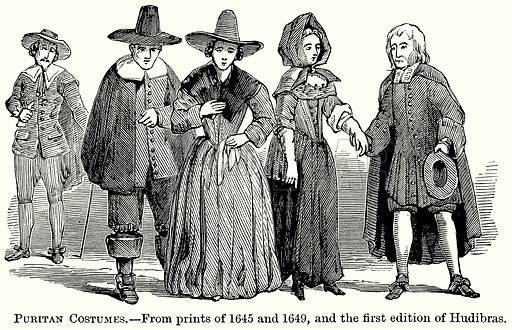
Puritan Costumes. Illustration from The Comprehensive History of England (Gresham Publishing, 1902).
Just consider the stereotypical presentation of witches in pointed hats and black capes and then recognize how much that resembles the dress of Puritan women in New England at the time. As for flying on brooms? How strange! Just how did that conflation happen, anyway? Put another way, witches didn’t dress differently than anyone else. As for the brooms? Every housewife had one.
Well, maybe that points to the male authority role in all of this, something I’m perceiving as a gender power play.
Back to the Quakers. As historian Arthur J. Worrall explains, “Two groups of Quakers arrived in 1656. The first, led by Anne Austin and Mary Fisher, came to Boston in July. The Massachusetts government promptly imprisoned them for five weeks; after checking them for signs of witchcraft, they expelled them in August. A second group of eight Quaker missionaries came to Boston two days after their expulsion,” aboard the Speedwell.
“Massachusetts imprisoned this group for eleven weeks and expelled them also, after the clergy had examined and debated with them.”
For perspective, Fischer notes that from 1647 to 1692, the Puritan colonies accounted for ninety percent of the accusations and eighty-five percent of the executions for witchcraft in English-speaking America. That is, almost ALL of them.
Moreover, “In England, every quantitative study has found that the recorded cases of witchcraft were most frequent in the eastern counties from which New England was settled.” Specifically, the Puritan heartland, in the motherland and then in the New World.
“Even white magic was regarded as a form of blasphemy. In 1637, for example, Jane Hawkins was punished for selling oil of mandrakes in Boston. Many other magicians and sorcerers were treated in the same manner.”
So just what defined a “witch,” anyway? Anyone who drew on folk remedies? Or even a midwife who knew more than she was supposed to?
Fischer goes into ways the Puritans’ Calvinist teaching and likely their earlier folkways combined to make them especially fearful.
As I observe, Salem itself was a cauldron of controversy from early on and a place where the Puritan invasion clashed with the existing population. Like Dover, the Puritans were latecomers there.
I’m still curious about the zealot ferocity of the Puritan outburst at the time of the infamous mistrials in Salem, 1692, in a perfect storm that may have fused an outbreak of hallucinogenic ergot in rye, a clash between traditional ways of examination versus newer ones, a gap in the governorship and jurisprudence, and a drive to curb the influence of the now well in place Friends by attacking their servants instead. Many, many other factors, perhaps even the weather, likely also come into play. All of the other angles I’ve heard point in the same direction.
One of the overlooked aspects in all the controversy is how the witch persecutions in Salem solidified the collapse of the rigid Puritan reign in New England. In a way, the old guard overplayed its hand and had to bear the consequences. With widespread revulsion at the executions and their abuse of the court system, a new strand of teaching and emphasis emerged in the Congregational churches. In another century-and-a-quarter, many of them would even become Unitarian, a far cry from the Puritan orthodoxy.
What makes witches so romantic for so many today?
Did the accused “witches” have their revenge in the end?
Yup, home prices went through the roof in most of the country – but not here.
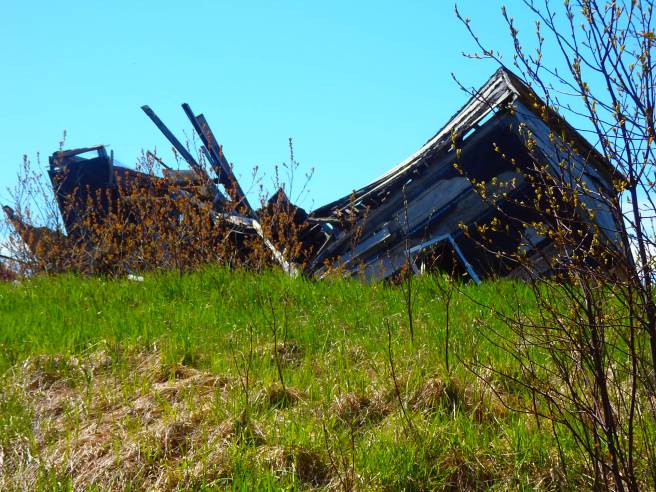
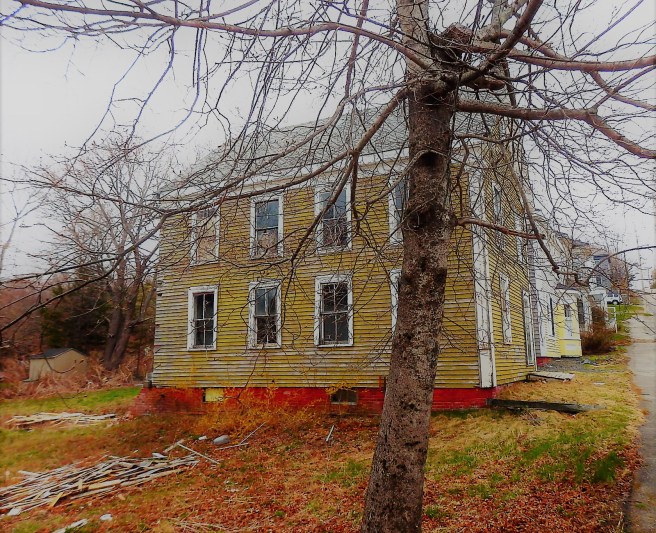
A common sight throughout Downeast Maine is abandoned housing in varying stages of decay. Seeing an old dwelling like that, your initial impulse is that somebody, somewhere, ought to save it. You know, live out in the woods, free from hassles, and all that. It’s gotta have a charming history, right? (Rusting trailers and mobile homes somehow get less sympathy, if any.)
Abandoned housing comes in varying stages of collapse.
Then reality kicks in. Most of these would cost a ton to renovate – and many are tiny. Insulation, plumbing, and wiring are only the beginning. It’s cheaper to start fresh, if you can. Jobs are scarce, often towns away, if you can find work, so unless you’re retired, that’s another strike. And if you are retired, you might check out far to the nearest doc or clinic. I have to wonder, too, why anyone would want to live that close to the highway and its noisy traffic, other than maybe getting priority plowing after a snowfall. As for the mosquitos and black flies?
Others might tell you it gets boring. No malls or big-box stores, much less neighbors or a real supermarket.
Even as a summer home, then, there are drawbacks. Wouldn’t you rather be on a lake or the ocean?
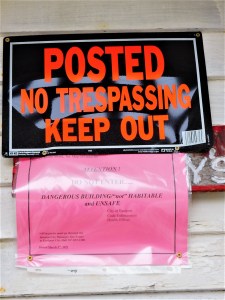
It’s not all out in the wilds, either. Eastport has three in a row here.Each with this notice attached, declaring a building dangerous, unsafe, and not habitable.