Eastport’s tap water last summer took on a greenish color and a definite off-taste. It got to the point that we started running everything we’d be drinking or using for cooking through an activated charcoal filter.
The explanation was that the supply came from a large but shallow lake a dozen miles away and that every summer the algae bloomed. The private company that provides water to the city then had to heighten its use of chemicals for treatment, resulting in the offensive character.
Water to the Sipayik reservation also came from the same source but was delivered via a different pipeline and was, by reports, much more troubling.
In its attempts to redress the issue, the company announced it would be using an alternative to treat the water, and I have to say we haven’t noticed the off-taste or discoloration this year. We haven’t yet seen a chemical analysis yet, however, or heard about the current situation on the reservation.
Still, public water quality is something most Americans take for granted.
Funny how often we overlook a problem, even when it has, as I hope, been clearing up.
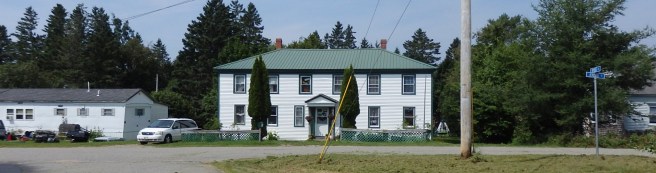
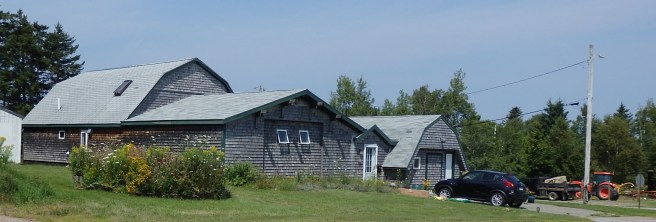
Most of Eastport’s small population resides in a semicircle around the Breakwater downtown. Quoddy Village stands apart, separated by a narrow neck around Carrying Place Cove. It also fronts Half Moon Cove, with a dead-end road to the former toll-bridge to the mainland. The place feels like an island of its own and is easily overlooked when you drive into town. The highway skirts it, and what you see is mostly former industrial, rusty, and all that.
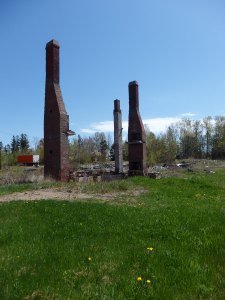
A former factory looking for new uses gives no clue to passers-by of the residential neighborhood behind it.Chimneys are all that remain of the administrative headquarters and even a school that supported a federal project in the 1930s.
Until 1935, this was farmland, but then an ambitious but ecologically disastrous public works project took off, one to dam up most of Passamaquoddy and Cobscook bays to transform their vast tidal energy into electricity. A large but confusing working model of the engineering proposal can be viewed at the historical society’s gift shop in downtown Eastport. (The room-size three-dimensional map is water in and water out, mostly. If you don’t already know the area, it’s baffling – and the presentation is aimed at today’s tourists. I still think it would make for a really interesting model railroad layout.) The short-lived boondoggle’s most lasting contribution, apparently, was the causeway connecting Eastport to the mainland by filling in a former railroad line. No more toll bridge and longer loop. Oh, yes, and it also had a noticeable negative impact on the Old Sow, the world’s second-largest whirlpool, perhaps even pushing it more into Canada.
Significantly, the project needed housing for its estimated 5,000 workers, and that led to the construction of Quoddy Village.
Even though the plug was pulled a year later on what would have been the world’s largest tidal dam – it did require Canadian cooperation, among other things – 128 single-family, two-family, and four-family houses had been constructed, along with three large dormitories with dining rooms for single workers, plus a fire station, a hospital, a heating plant, a school, a large mess hall, and a large administration building that included a theatre, library, and sub post office. In other words, a small city unto itself. Even though the homes had been designed as temporary, many of them are still occupied today. Still, for a brief time, the village was home to a thousand people.
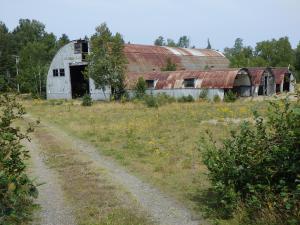
More evidence of abandoned projects, also seen from the state highway.
From 1938 to 1943 the National Youth Administration used Quoddy to train 800 city youth a year in vocational trades. It was also a Navy Sea Bee base named Camp Lee-Stephenson during World War II.
And then? It morphed into a residential neighborhood.
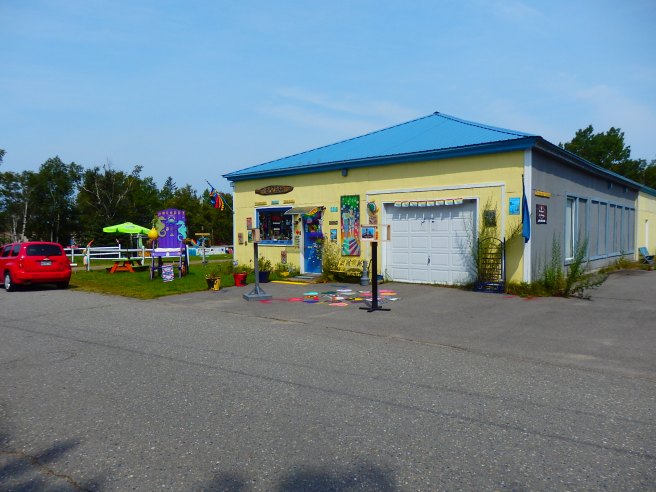
Its best-known attraction today is David Oja’s colorful and eccentric Bazaar, a gift shop that includes what’s arguably the best gourmet wine and cheese selection in Washington County. Think of it as a blast of Puerto Rico, Brooklyn, and Provincetown rolled into one. Who knows what the original function of the building was, we can be sure it was not nearly anything like this.
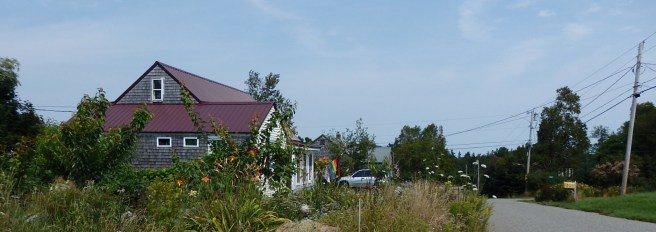
The one-of-a-kind Bazaar, seemingly out in the middle of nowhere.Today it’s mostly residential. I think of it as a small suburb.Anyone else see potential here?Yes, there’s a mix of housing, some of it from the ’30s.Much of it is also a working neighborhood. I’m all in favor of working from home, when you can.
A revival of Indigenous languages, which were long suppressed by federal policy, is gaining momentum where I live in Way Downeast Maine.
For one thing, the Passamaquoddy are now teaching it in their schools.
For another, their words are pronounced in ways that transcriptions into Latin-based letters don’t quite capture. There are simply sounds that my ears miss entirely and my tongue and lips will never manage to enunciate properly. How humbling!
“Passamaquoddy,” for instance, is pronounced more like “peskotomuhkati,” meaning “people who spear pollock,” reflecting their ocean hunting skills.
Linguistically, the Passamaquoddy language works differently than do European languages with their subject-verb-object constructions, and reflects an alternative way of comprehending the land, waters, and skies where we dwell.
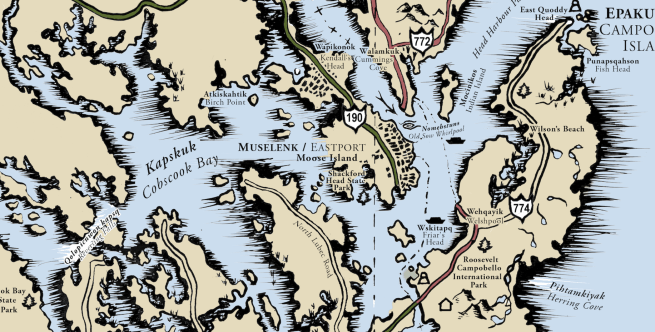
Detail of the new map, with some places denoted by dual names.
The latest edition of the Tides Institute’s Artsipelago map of communities and sites around the tidal waters of our corner of Maine and neighboring New Brunswick, Canada, now includes Passamaquoddy names in addition to the more familiar English, Anglicized, and French ones.
To my eyes, this adds another dimension to our awareness of the landscape and its legacy.
On one hand, they’re proud of having voted for the candidate and want you to know they did, but on the other hand, they want to distance themselves from any culpability for his actions.
Will somebody tell them, “You can’t have it both ways,” as a citizen?
Grow up and take responsibility for your choice, which includes the possibility of repenting in the light of reflection or otherwise being party to the vulgarity, insults, lies, and the general mess he’s left the nation and world to endure. (Reflection? We’ve never heard him admit he’s ever done anything wrong, which means he’s never even said he’s sorry for anything he’s done. Mistakes are always someone else’s fault. That would put him a bit higher than Jesus.)
There’s no denying the loser’s the king of blame, casting censure on everyone but the one-and-only he faces admiring himself alone in a mirror. I, for one, am exhausted by the gush of blame that’s been poured on what we’ve treasured and join.
So, yes, be prepared to be blamed or praised.
Voting is a serious responsibility, folks. Embracing what your candidate has done, in and out of office, ultimately reflects on your own values and character – and we’ve all had to face the ugly consequences.
Before blaming Biden for things like higher fuel prices, see instead how they stem from the Donald’s encouragement of his Russian pal, Putin. As for inflation, how about those fat checks the fed government handed out with Donald J. Trump as the signature?
Running deeper in this is the denial that the American political system is based on a multi-party dynamic, with the minority serving as a loyal opposition. There’s been nothing loyal about this GOP, not since it turned obstructionist back before Obama. Instead, it’s been trying to wreck the machinery of a just republic. That identity is anything but conservative.
If you’re proud of his true record, stand up. But face it all, not just the cherry-picked Fox version.
And don’t think you’re above blame or shame.
A good dose of humility is a virtue.
Shame on you, if you’re trying to shirk off the consequences of your vote.
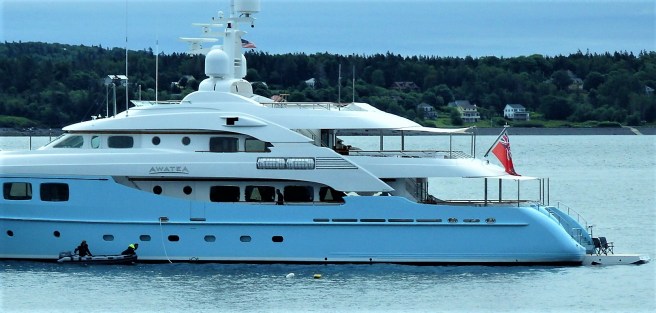
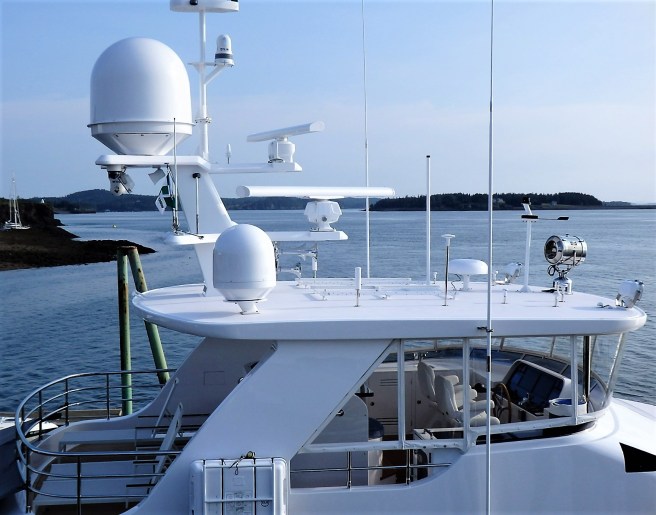
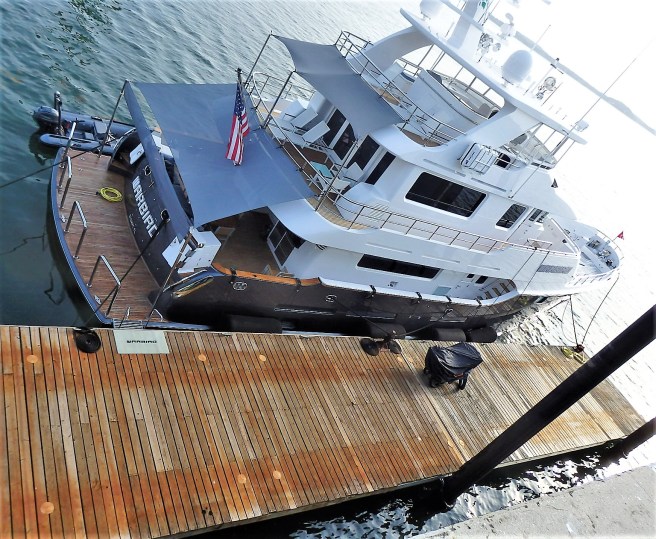
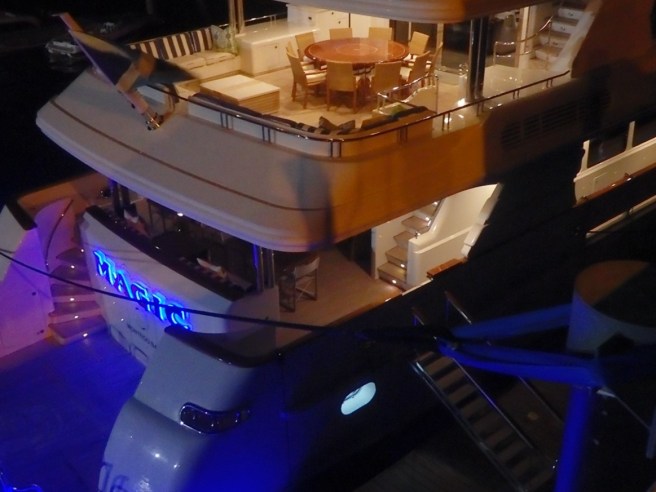
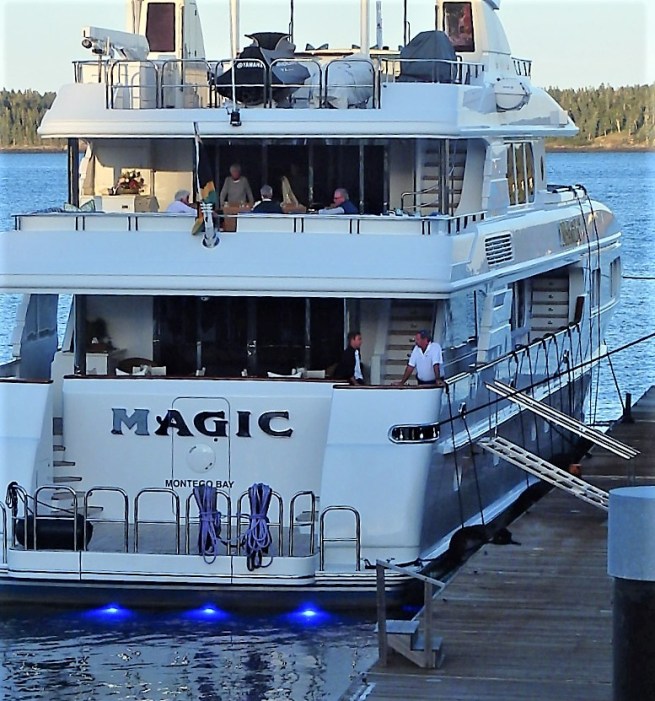
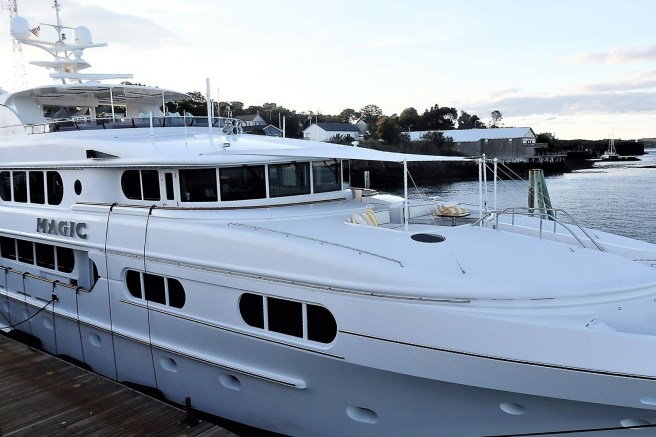
Each summer, a few superyachts make their way from the Bay of Fundy into Eastport and tie up for a night or two at the Breakwater pier downtown. They usually draw an envious gaggle, as well as pure curiosity and gossip.
I love the built-in love seat hidden by the pillar, although I wouldn’t mind one of those captain’s chairs for my workstation at home.The welcome mat was more for changing shoes to keep the interior clean. Note the bikes under the tarp, too.
Some of them even blog about their travels, referring to each other first-name only and touting the “good friends” they made in port.
Uh-huh.
Charters for $130,000 a week plus expenses and fees.It’s 130 feet long, holds ten guests in five room, takes a crew of seven, and cruises at 12 knots. The waitstaff was pretty impressive, even from a distance.Includes his and hers bathrooms in the master suite, a jacuzzi, and a gym.
Some are flagged in the USA, while others come by way of tax havens.
An evening cruise around the bay can put on the ritz.
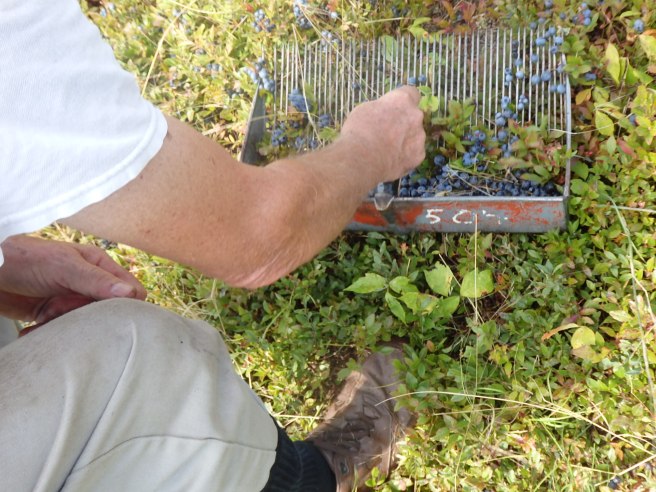
The handheld rake was invented in 1910. I can’t imagine trying to pick large quantities of blueberries without it.
What’s harvested by the ton in Washington County is not just blueberries, but wild blueberries – lowbush, laced with small pellets of complex, concentrated flavor, rather than the big, juicy, cultivated highbush kind.
What grows here, I’ll argue, is tastier and richer than the more coddled kind I had previously known and even grown.
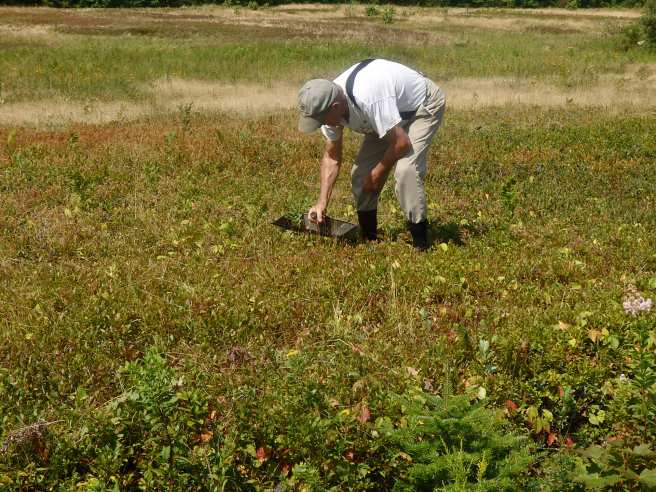
As you can see, traditional picking can be backbreaking work. But old-timers tell you it delivers better berries than the newer mechanized harvesters do.
Maine has a near monopoly in the production of the wild lowbush berries in the United States. Neighboring parts of Canada are also of note. Still, the output is only a fraction of what’s harvested from the domesticated highbush farmers in other states.
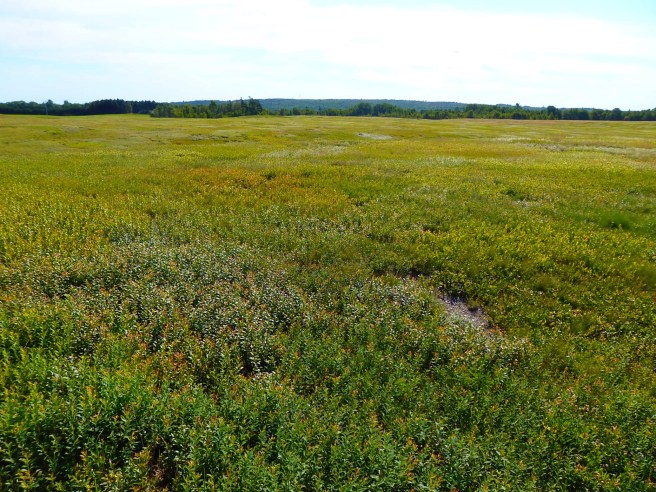
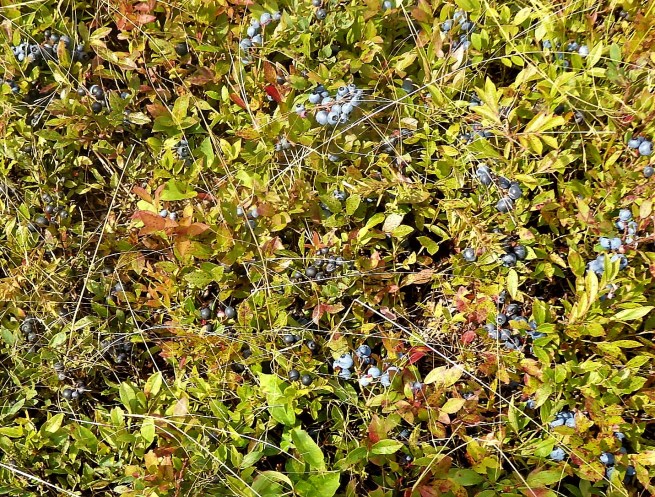
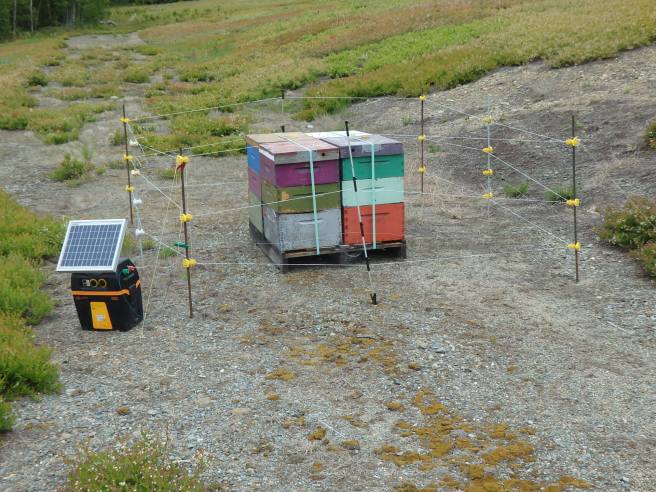
You can drive right past a blueberry barren like this and not know it’s loaded with ripe fruit.Here’s what a stop to look reveals.For a few weeks each spring, clusters of commercial honeybee hives are placed by the hundreds throughout the barrens. The electrical fencing is intended to keep bears out.
Just so you know.
What’s your favorite kind of berry? And your favorite way to eat (or drink) them?
In researching a project of any scope, you can’t ever read everything touching on the subject, and sometimes that can be a blessing in disguise.
For one thing, it may mean you have to examine points afresh and unguided rather than relying on another’s assumptions or conclusions.
And, for another, you may find reassurance or in seeing how another researcher has come to the same results you have independently or, in another vein, you may strengthen your disagreement.
That’s where I find myself on The Devil of Great Island: Witchcraft and Conflict in Early New England, Emerson W. Baker’s 2007 examination of a paranormal outbreak of flying rocks in an inn on an island in Portsmouth, New Hampshire, ten years before the infamous Salem witch trials just to the south. Now that I’ve finally read it, I can say he’s cleared up some questions I had on events upstream and provided backup for some of my deductions.
My new book, Quaking Dover, takes place one colonial town upriver from Great Island, today’s New Castle, and shares some of the same cultural and historic influences. While I examine a sharp divide in Dover between its English settlers from Devonshire and the Puritans from East Anglia, Baker identifies this in Portsmouth and much of the rest of New England as the Old Planters, of Anglican faith, being pushed aside by the newer Puritans, and their rigid Calvinism. Quite simply, the tensions were more prevalent and widespread than I’d assumed.
The target of the airborne mineral projectiles was innkeeper George Walton, along with his family and guests, evening after evening through an entire summer.
Baker labels Walton repeatedly as a Quaker, as he also does for the identity for Nicholas Shapleigh, continuing a widespread misconception. The prominent Shapleigh proved a valuable ally but, as his descendants point out, he was never a member of the Society of Friends (Quakers). While Major Shapleigh suffers persecution for maintaining some of the Friends positions, nothing in Walton’s life or character suggests he did so. Quite the contrary, there were many reasons he would have been disciplined and disowned, if he had been part of a Quaker Meeting, the closest one being at Hampton.
As Baker, a Salem State University history professor, lays out Walton’s family and neighbors, what becomes clear that just about everyone had good reason to target the contentious innkeeper. As for a devil on Great Island, I’d have to say it was Walton himself.
Baker sees the New Castle incident as a precursor to similar events that culminate in Salem, and he traces individuals who would have been familiar with the Walton stoning incidents to the outbreaks elsewhere. He further finds common elements that include contested land claims and political upheaval, which far outweigh theological issues.
Baker has since written much more about witchcraft, befitting his locale. The Devil of Great Island is a fun and fast read and a fine introduction to a definitive moment in the American experience.
As I’m arguing, there’s much more in New England’s past than you were ever taught. Or maybe even suspected.
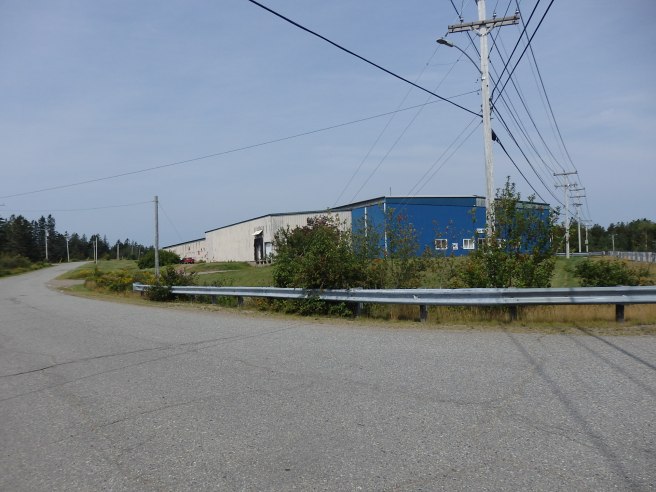
The site in south Boston where two Quaker missionaries were hanged less than a month after visiting Dover, New Hampshire, was eventually christened – get this – Dover Street.
The street was later renamed.
Another of the four who died on the gallows there had also apparently visited Dover a year or two earlier.
Who made the decision – and why? They couldn’t be that oblivious, could they?
Once the surrounding water was filled in, the street came to have a long history of immigrants and seedy characters, perhaps doomed by its bloody past, before part of the neighborhood was razed for the urban renewal that brought the Boston Herald newspaper plant and later removed the elevated subway station after the Orange Line was rerouted to the west in 1987.
Today it’s known as East Berkeley Street, hoping for a new image.
Check out my new book, Quaking Dover, available in your choice of ebook platforms at Smashwords.com.
Though Eastport was settled relatively late – that is, toward the end of the Revolutionary War – it was instilled with a Colonial flavor by prominent early residents who were resolute veterans.
A continuing spirit of Tea Party and Minutemen makes Independence Day in New England feel different than those elsewhere. It’s not just the place of the Shot Heard ‘Round the World. It’s the region where thickheaded Yankees have always doodled.
Quite simply, history is palpably alive everywhere across New England.
Boston, of course, is the epicenter, but across the six most northeasterly states, local observations uphold distinctive traditions. Think of musketeers firing a round ever so often along the town parade route, along with fifes and drums.
As an independently enterprising oceanside village, Eastport soon had a reputation as a hive of privateering – that is, legalized piracy – and not-so-legal smuggling. That independent streak gets its own attention in the city’s annual Pirate Festival a week after Labor Day.
How joyous!
Unlike much of America, the city had frontline experience of the War of 1812. Fort Sullivan atop the bluffs surrendered to the British Navy in 1814, and Eastport then remained under the royal thumb until 1818.
Two years after its reunification with the United States, Maine became liberated from Massachusetts for the first time since 1653 and began to breathe into its own unique character.
For its part, Eastport rocketed as a center of shipping, shipbuilding, fishing, and sardine canning before the big decline of the 1900s set in.
Today, the tiny city’s locals remember a vibrant past and close-knit community, one that spanned the shorelines on both the American and Canadian sides of the watery border.
Is a renaissance on the horizon? There are signs for hope.
All of these strands infuse the holiday here.
Here’s a taste of last year’s pyrotechnics fired off from the fish pier downtown.Yes, fireworks can be visually composed, leading your eyes around the sky.
The national holiday also marks the opening of New England’s short summer season. After a cold, dark, long winter, Eastport’s small year-’round populace can actually come out into the open air for long times together. The ocean and lakes are finally warming, to the extent that they do, and that attracts vacationers to join in.
After months when only a stray New Hampshire or Massachusetts auto plate is seen around here, I’ve now seen those of every state but Alabama, Hawaii, and North Dakota (not all at the same time), some seeming rather exotic.
And the Fourth includes the city’s Old Home Week, with high school reunions and the return of many summer residents.
A lot happens over a four-day span. There’s a doll carriage and wagon parade. A torchlight parade. Car shows, bike races, water games, pet show, rubber ducky race, festive all-you-can-eat blueberry pancake breakfast, free outdoor movie, contests, live music, and a street dance, all with a small-town flavor.
A traditional visit by a large U.S. Navy vessel failed to materialize, a consequence of being on Ukraine-related alert. Three different ships had expressed interest in landing at the Breakwater before the turn in world events.
While fireworks were displayed off over the harbor on the Fourth, America’s Independence Day (the beautifully designed and executed big show fired from the town’s Fish Pier was followed by a joyously rowdy encore from a diner’s smaller private pier), the companion July 1 presentation for Canada Day, in honor of our neighbors in New Brunswick, was still a victim of Covid cutbacks. Some residents, though, could view shows happening on Deer Island across the water.
Seems ever so fitting to shoot the works twice, considering Eastport’s dual connections.