Are all of those “Hi, how are you doing,” Facebook messages to me really from accounts that have been hacked?
Sure, I recognize half of the people, maybe more, but do they all come up with identical messages? How improbable. Makes me wary, especially after my own account had been hacked.
Apparently, it’s very easy to set up a counterfeit you and invite all of your “friends” to check in at the new address.
Just how secure is that party line, anyhoo?
If you think one of your real friends has been hacked, tell them, so they can alert FB security. Inform them that merely changing their password won’t fix it, too.
There’s just so much out there, in print and especially online, and it keeps proliferating daily, even hourly, and I don’t know about you, but I’m in the camp that finds it truly overwhelming.
Everywhere, each minute, make that second, we’re expanding outward, away, from any notion of a renaissance man, and woman, who could possibly be well informed on every facet of a civilized society.
Even in science – or maybe, especially in science – it’s become impossible to keep abreast of the flood.
Interdisciplinary collaboration has become more essential than ever, but also more elusive.
Is this leading toward disintegration?
Is this, in fact, the root of the reactionary backlash around the globe, not just the Trumpian cultists?
Yeah, the folks who rely on Fox TV biased “news” in the USA.
I look at the crises facing our children and grandchildren, and these are critical, but there are so many it’s mindboggling trying to decide where to pitch in taking a stand. Climate change, population explosion, racism, corrupt politics, the one percent and injustice, environmental protection, medical systems, education … Hey, I’m back to hippie era causes on steroids.
How are we supposed to preserve our sanity and still press toward a better future?
We still have to be informed, right? And thinking clearly?
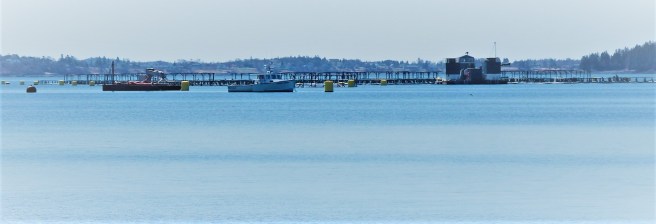
As many fish stocks dwindle precariously, salmon farming and related aquaculture are hailed as a viable alternative.
Salmon pens at Broad Cove.
Young salmon are placed in the circular enclosures when they’re about six inches long, where they leap and splash under netting that protects them from eagles, osprey, cormorants, and gulls. In about two years, they grow to a harvestable size of about two feet and ten pounds. A specially designed vessel sucks the mature fish from their pens and its conveyor stream immediately cleans and guts them.
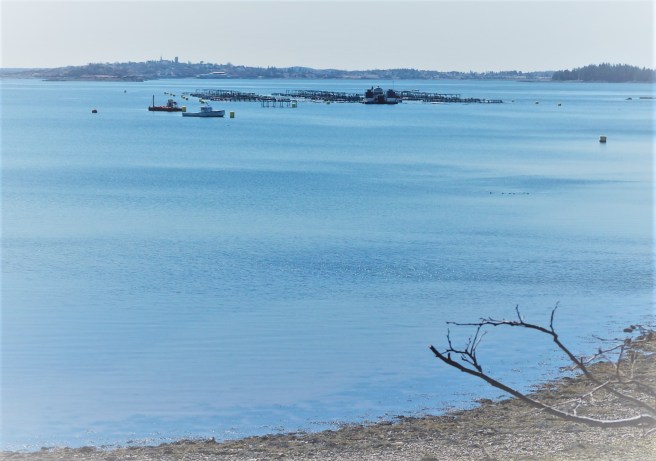
Lubec rises in the distance.
Cooke Aquaculture, based in Blacks Harbour, New Brunswick, manages 15 pens in Deep Cove and Broad Cove, operating from a former fertilizer plant on Estes Head. A feeding barge sits amid the pens, which house about 450,000 salmon. About one-third of the pens are left fallow at any time.
A pen like this can hold 25,000 fish. The netting protects the salmon from osprey, eagles, and other predators.
From our upstairs windows, we can see other salmon farms at Campobello Island across the channel.
I was feeling a little down as Eastport turned into its annual ghost town. Cooped up, too, especially under the tedious revisions to the Dover history, even before seeing how much I still don’t know and will likely never know, even if I spent a month at the University of Massachusetts going back through the Quaker archives.
Then I realized I hadn’t been anywhere other than eastern Washington County since mid-April. Six months confined to this sliver of rocky coastline and piney interior. The largest city has only ten thousand population and has commercially suffered under the Covid border restrictions. So I decided to see something new and finally settled on Aroostook County, widely known simply as The County, and thus hit the road at 7:15 Monday morning and headed up U.S. 1 without a plan other than turning back around noon.
I can now tell you it’s four hours to Caribou and a lovely drive, some of it through long stretches of forest, others through the tidy farmlands of The County itself. Yes, tidy, unlike many of the rural residences in this state.
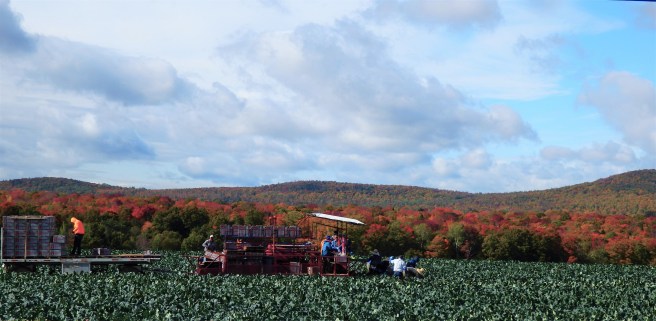
Remote Aroostook County is famed as potato farming country.
Turned out to be the perfect day. Sunny, foliage in its prime, little traffic, small roadside sheds selling new potatoes on the honor system. I really felt at home amid all the farmland wonder.
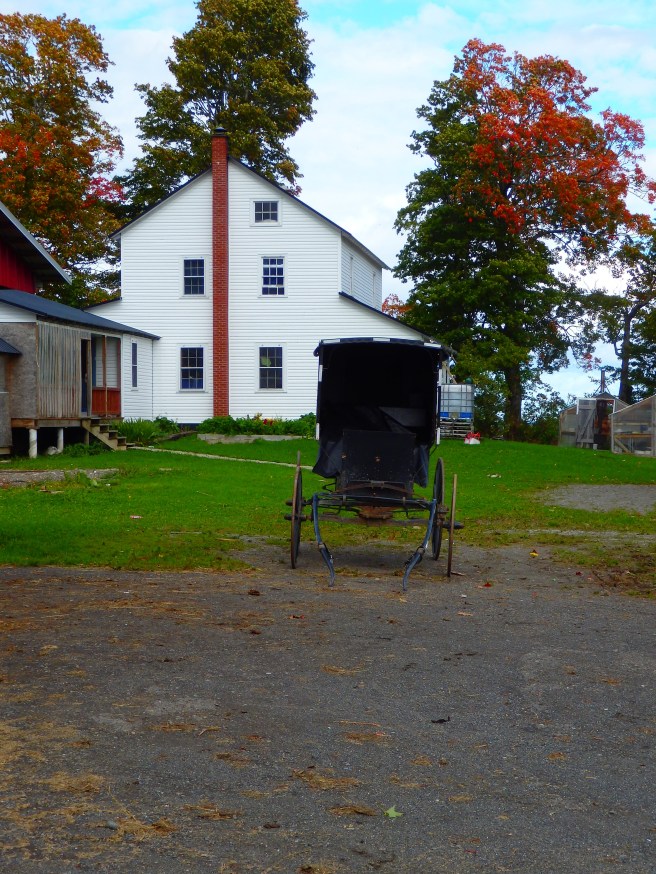
Feeling sated with the visual glory, I felt ready to head home. At Caribou, turned over to Fort Fairfield to follow U.S. 1A back to Mars Hill, and was surprised to find a yellow “share the road” sign with a horse carriage emblem. And sure enough, I found a large colony of Amish. I’ve missed them and Mennonites and Brethren since moving to New England, and this was exciting.
Amish families are finding a place here.
After passing one Amish farm and its bright red barn – yes, that seems to be the custom here, red next to the plain white farmhouse and laundry on the line – I noticed a small church and whipped around to take a closer look.
Never would have if a Friend hadn’t tweaked my interest by sharing something he found online.
The meetinghouse is one that escaped Silas Weeks’ research for his definitive book, too.
Afterward, I learned that one of our good friends was from Caribou, not further north as I’d thought. And then another was from Presque Isle.
So now I have a much better grasp of what folks are talking about when the say “The County.”
I should also mention I came home with 60 pounds of new potatoes from three different stands. Ten pounds for five dollars, three different varieties. Turns out they’re ones that didn’t pass the baggers’ standards, usually because of irregular shape or size, but that’s no problem for us. The skins of new potatoes are so soft and tasty – no need to peel them, even for mashed potatoes. You do need to unbag them, wash and inspect them, before storing. Otherwise, a few damaged ones can spread rot.
~*~
Next time I venture that far north, I plan to visit the entire solar system. Seriously. I caught a clue of it with a model of Saturn atop a pole beside U.S. 1 followed miles later by Neptune. Turns out all of the planets sit beside the road to Presque Isle, scaled in size and distance from the sun at the University of Maine branch campus. There really is a lot of emptiness in space.
Looking at Facebook, too many ads. Getting harder to file through to the posts by people I know or sites I follow.
In the past, I had largely ignored FB, returning sporadically, but after moving up here, where it’s like a telephone party line, back when people had landline phones, I’m finding more reasons to check in.
But not everyone, by a long shot, is hanging on to hear the gossip.
Too many ads. And maybe too much chatter.
The return was also prompted in the past year by an opportunity to catch up on a host of classmates I’d lost contact with in my moves across the continent.
That part’s been helpful.
But I’m also encountering too many folks who haven’t posted anything in three or more years. Likely haven’t checked in since then, either.
Geographically, Sunrise County is one of the largest in New England – the county line is an hour-and-a-half drive away from where I live, unless you’re going to Canada – but there are a lot of things we don’t have.
There are only three traffic lights, for instance – all in Calais en route to the busy international border crossing.
So I was wondering, just in case, where the closest dry cleaner is. We have two laundromats, but say, what if I wanted to send my dress shirts out to be washed and pressed, as I did back when working in an office?
Eastport’s tap water last summer took on a greenish color and a definite off-taste. It got to the point that we started running everything we’d be drinking or using for cooking through an activated charcoal filter.
The explanation was that the supply came from a large but shallow lake a dozen miles away and that every summer the algae bloomed. The private company that provides water to the city then had to heighten its use of chemicals for treatment, resulting in the offensive character.
Water to the Sipayik reservation also came from the same source but was delivered via a different pipeline and was, by reports, much more troubling.
In its attempts to redress the issue, the company announced it would be using an alternative to treat the water, and I have to say we haven’t noticed the off-taste or discoloration this year. We haven’t yet seen a chemical analysis yet, however, or heard about the current situation on the reservation.
Still, public water quality is something most Americans take for granted.
Funny how often we overlook a problem, even when it has, as I hope, been clearing up.
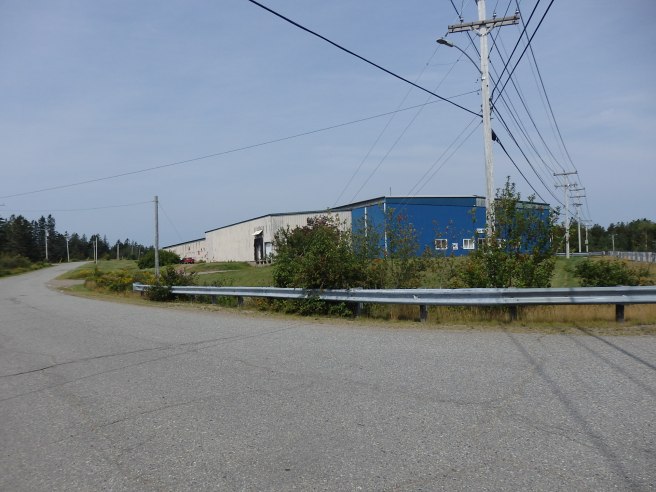
Most of Eastport’s small population resides in a semicircle around the Breakwater downtown. Quoddy Village stands apart, separated by a narrow neck around Carrying Place Cove. It also fronts Half Moon Cove, with a dead-end road to the former toll-bridge to the mainland. The place feels like an island of its own and is easily overlooked when you drive into town. The highway skirts it, and what you see is mostly former industrial, rusty, and all that.
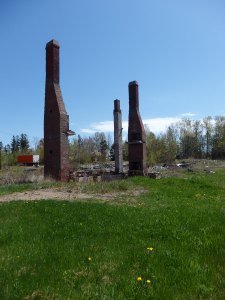
A former factory looking for new uses gives no clue to passers-by of the residential neighborhood behind it.Chimneys are all that remain of the administrative headquarters and even a school that supported a federal project in the 1930s.
Until 1935, this was farmland, but then an ambitious but ecologically disastrous public works project took off, one to dam up most of Passamaquoddy and Cobscook bays to transform their vast tidal energy into electricity. A large but confusing working model of the engineering proposal can be viewed at the historical society’s gift shop in downtown Eastport. (The room-size three-dimensional map is water in and water out, mostly. If you don’t already know the area, it’s baffling – and the presentation is aimed at today’s tourists. I still think it would make for a really interesting model railroad layout.) The short-lived boondoggle’s most lasting contribution, apparently, was the causeway connecting Eastport to the mainland by filling in a former railroad line. No more toll bridge and longer loop. Oh, yes, and it also had a noticeable negative impact on the Old Sow, the world’s second-largest whirlpool, perhaps even pushing it more into Canada.
Significantly, the project needed housing for its estimated 5,000 workers, and that led to the construction of Quoddy Village.
Even though the plug was pulled a year later on what would have been the world’s largest tidal dam – it did require Canadian cooperation, among other things – 128 single-family, two-family, and four-family houses had been constructed, along with three large dormitories with dining rooms for single workers, plus a fire station, a hospital, a heating plant, a school, a large mess hall, and a large administration building that included a theatre, library, and sub post office. In other words, a small city unto itself. Even though the homes had been designed as temporary, many of them are still occupied today. Still, for a brief time, the village was home to a thousand people.
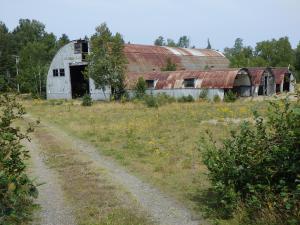
More evidence of abandoned projects, also seen from the state highway.
From 1938 to 1943 the National Youth Administration used Quoddy to train 800 city youth a year in vocational trades. It was also a Navy Sea Bee base named Camp Lee-Stephenson during World War II.
And then? It morphed into a residential neighborhood.
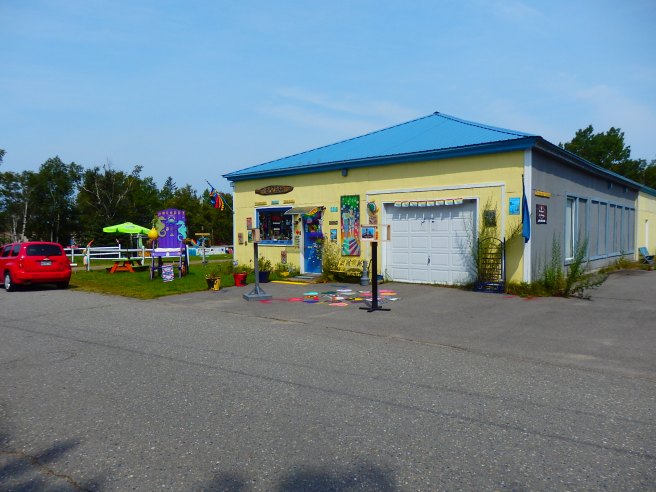
Its best-known attraction today is David Oja’s colorful and eccentric Bazaar, a gift shop that includes what’s arguably the best gourmet wine and cheese selection in Washington County. Think of it as a blast of Puerto Rico, Brooklyn, and Provincetown rolled into one. Who knows what the original function of the building was, we can be sure it was not nearly anything like this.
The one-of-a-kind Bazaar, seemingly out in the middle of nowhere.Today it’s mostly residential. I think of it as a small suburb.Anyone else see potential here?Yes, there’s a mix of housing, some of it from the ’30s.Much of it is also a working neighborhood. I’m all in favor of working from home, when you can.
A revival of Indigenous languages, which were long suppressed by federal policy, is gaining momentum where I live in Way Downeast Maine.
For one thing, the Passamaquoddy are now teaching it in their schools.
For another, their words are pronounced in ways that transcriptions into Latin-based letters don’t quite capture. There are simply sounds that my ears miss entirely and my tongue and lips will never manage to enunciate properly. How humbling!
“Passamaquoddy,” for instance, is pronounced more like “peskotomuhkati,” meaning “people who spear pollock,” reflecting their ocean hunting skills.
Linguistically, the Passamaquoddy language works differently than do European languages with their subject-verb-object constructions, and reflects an alternative way of comprehending the land, waters, and skies where we dwell.
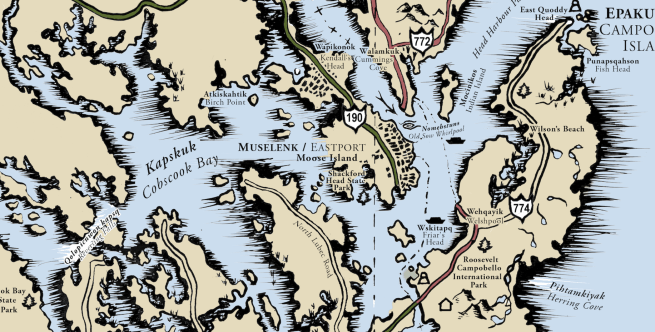
Detail of the new map, with some places denoted by dual names.
The latest edition of the Tides Institute’s Artsipelago map of communities and sites around the tidal waters of our corner of Maine and neighboring New Brunswick, Canada, now includes Passamaquoddy names in addition to the more familiar English, Anglicized, and French ones.
To my eyes, this adds another dimension to our awareness of the landscape and its legacy.
On one hand, they’re proud of having voted for the candidate and want you to know they did, but on the other hand, they want to distance themselves from any culpability for his actions.
Will somebody tell them, “You can’t have it both ways,” as a citizen?
Grow up and take responsibility for your choice, which includes the possibility of repenting in the light of reflection or otherwise being party to the vulgarity, insults, lies, and the general mess he’s left the nation and world to endure. (Reflection? We’ve never heard him admit he’s ever done anything wrong, which means he’s never even said he’s sorry for anything he’s done. Mistakes are always someone else’s fault. That would put him a bit higher than Jesus.)
There’s no denying the loser’s the king of blame, casting censure on everyone but the one-and-only he faces admiring himself alone in a mirror. I, for one, am exhausted by the gush of blame that’s been poured on what we’ve treasured and join.
So, yes, be prepared to be blamed or praised.
Voting is a serious responsibility, folks. Embracing what your candidate has done, in and out of office, ultimately reflects on your own values and character – and we’ve all had to face the ugly consequences.
Before blaming Biden for things like higher fuel prices, see instead how they stem from the Donald’s encouragement of his Russian pal, Putin. As for inflation, how about those fat checks the fed government handed out with Donald J. Trump as the signature?
Running deeper in this is the denial that the American political system is based on a multi-party dynamic, with the minority serving as a loyal opposition. There’s been nothing loyal about this GOP, not since it turned obstructionist back before Obama. Instead, it’s been trying to wreck the machinery of a just republic. That identity is anything but conservative.
If you’re proud of his true record, stand up. But face it all, not just the cherry-picked Fox version.
And don’t think you’re above blame or shame.
A good dose of humility is a virtue.
Shame on you, if you’re trying to shirk off the consequences of your vote.



 Jnana's Red Barn