From 1653 until 1820, Maine was governed by Massachusetts.
The westernmost port down there is Westport, beside Buzzard Bay. A lovely place, by the way.
And the easternmost port was Eastport, in waters subsidiary to the Bay of Fundy. As you’ve been seeing here.
But then, come 1820, the two extremes separated when Maine finally became independent as a state.
Now I guess that easternmost point down under distinction falls on Chatham, out on Cape Cod. And Maine has no Westport.
One year, while still living in New Hampshire, I was in Eastport one weekend, and Westport, the next. I saw it as some kind of weird coincidence, not knowing there really had been a rational connection.
Have you ever thought about the name of the place where you’re dwelling?
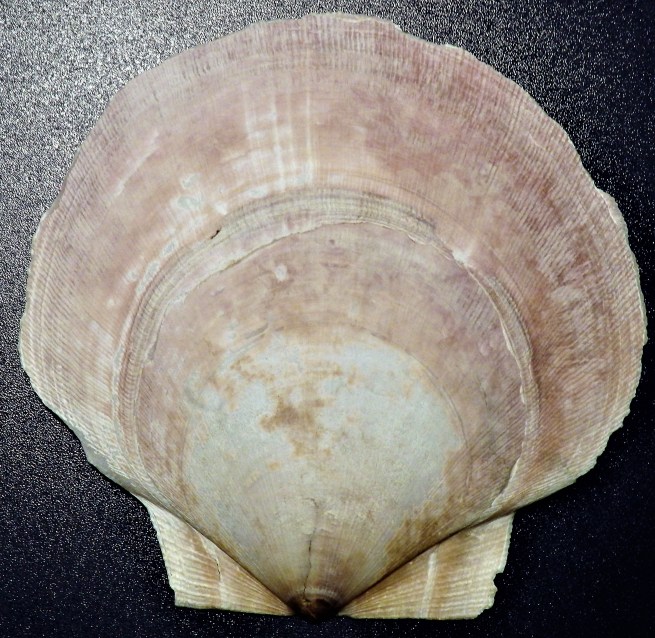
There’s not a lot of meat in one of these, but what there is will be treasured by many seafood lovers.
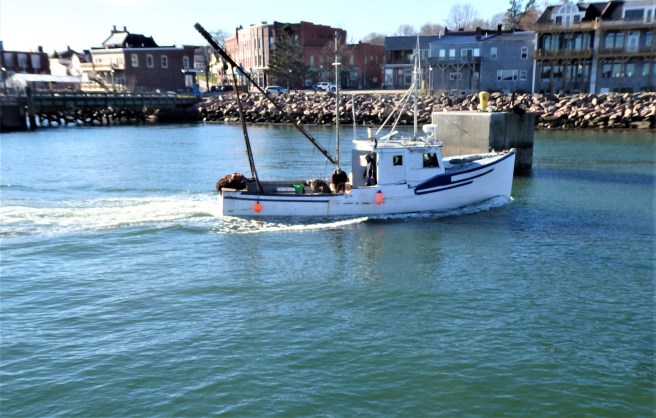
This time of year, I hear the puttering motors in the chill air before the sun’s even up as the fishing boats head out to drag the depths for scallops. No matter how low the thermometer reading or how bad the weather, the vessels venture by, or attempt to, intent on catching their daily limit of ten or 15 gallons a day in a season that runs no more than 50 or 70 days but may close earlier, depending on the sustainable harvest in each of the regulated zones.
Rigged with a boom for the heavy chain net that drags the seafloor for scallops, this vessel returns to port with its harvest.
A day not out on the water of the bays around Eastport is a day’s income that’s lost for the season. The economics of fishing are precarious enough.
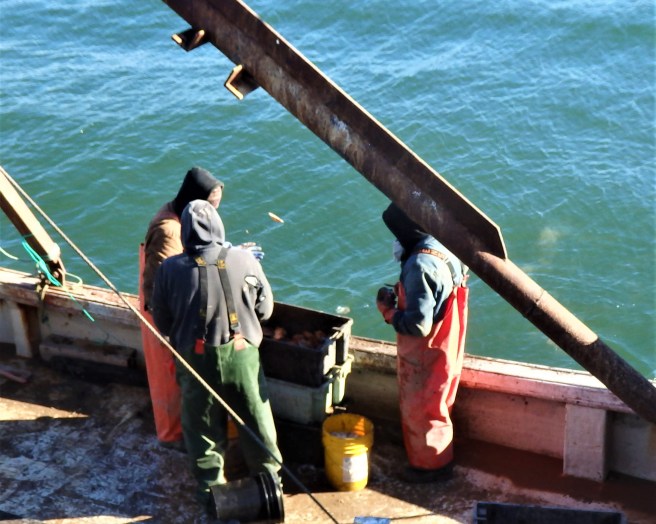
These intrepid fishermen shuck their catch onboard, tossing the shells overboard, which provides grounding for the breeding of more, and then return to port with their precious harvest, often well before noon.
A shell flies toward the water as these fishermen quickly shuck the precious bivalves onboard.
The licenses are coveted and even the size of crews is limited by state law.
Come summer, many of the boats, with their rigging reconfigured, and their crews will have turned their attention to lobster.
Other important harvests here are urchins and clams.
What workers impress you the most when they’re out in bad weather?
The cheapest ones still came to 27 cents apiece. Add postage to that, and paying bills can add up.
As for paying directly online?
As much as I’m a fan of the U.S. Postal Service and am trying to do my part to assure its survival, I am listening to my wife’s advice to switch over to online bill paying. Before I do anything drastic, though, I want to hear from others.
My latest book is nothing like the others I’ve written. It’s not one of the novels, which required me to learn entirely different approaches to a story than I’d used in the daily newspaper business. And it’s not extended essays, like my usual Quaker materials. Nor is it poetry, where most of my literary efforts have been.
At the start, my genealogy came closest, but those are more research notes for others to follow up on – and if I ever get the energy to return to those, they do need a major cleanup.
As much as I’ve loved history, from childhood on, I’m not a trained historian. The closest I came was majoring in political science.
But for the last 50 years, I’ve been a Quaker and become quite grounded in the movement’s history and theology. And that’s what prompted the new book, along with Dover’s upcoming 400th anniversary.
I do like the big picture, and that’s what evolved here. Not just Dover Friends Meeting, then, but the broader forces that shaped and impacted it. So I went digging, drawing on others who had closely examined the early records or, in some cases, drawing on published journals and other early accounts.
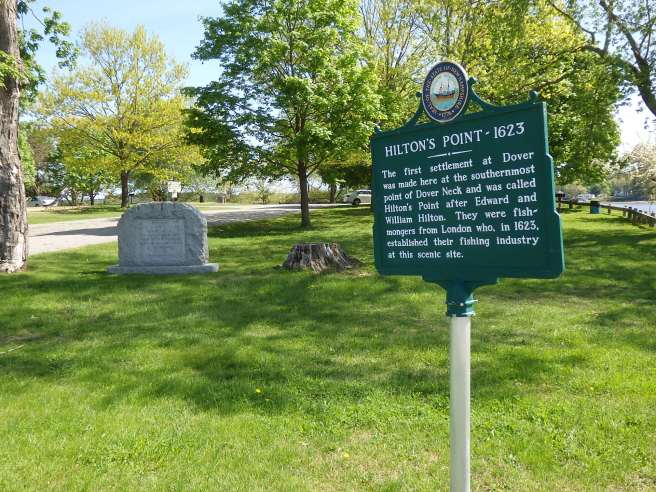
Ground Zero, as it were. Contrary to the historic marker, however, William was not yet on the scene. The honor rather goes to Edward’s apprentice, Thomas Roberts, who was a key player in the early settlement.
What I collected seemed to write itself, which was an exhilarating experience – until I showed it to a circle of Beta readers. And then it was back to the drawing board, cutting the first half of the book by two-thirds and refining the tone by inserting myself into the text. The journalist in me, trained to be invisible, did so uneasily but trusted in the generous advice of a fellow poet and writer.
Also insightful has been historian Stephen Sanfilippo’s quip about being a “footnote historian,” the professional who can spend much of his career investigating minutia that become a paper or dissertation that in turn become a footnote in a “general” historian’s book, one that looks at the broader scene.
Much of my book is a step from that, drawing more on the general historians before me, but that’s led to its own encounters. I’ve often found myself in conversation with them, wishing we could actually sit down together rather than having all these years, even centuries, between us.
The first was Annie E. Pinkham, whose A Brief History of Dover Friends Meeting, a 1935 mimeographed paper, became the springboard for this project. Her material is no doubt based on much of what she had heard passed down in her husband’s family and maybe her own, though I’ve since found that her version of the earliest days of the town reflect common misunderstandings.
I’m also grateful to some people I knew personally, a generation older, who went through the Quaker minutes themselves – Shirley Leslie and Silas Weeks and I sense a few others. Their summaries were sufficient to round out the history, though there are many points where I now see that a more thorough investigation, of a doctoral dissertation nature, might glean answers that currently elude us. (Back to the footnote historians!)
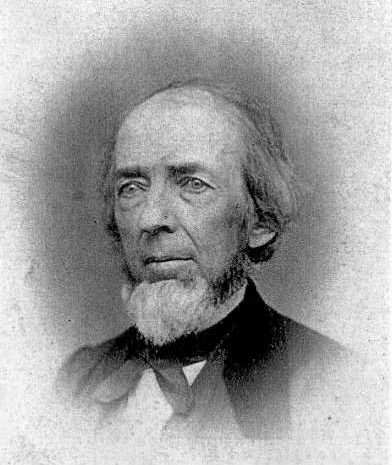
George Wadleigh
Another voice I’ve been deeply grateful to is George Wadleigh, who struggled with many of the town’s often conflicting details and missing data when assembling his own history of Dover, dated April 1882 but not published until 1913.
The volume is prefaced with “NOTICE. It was the intention of the collector of these notes to complete them to a later date, then to revise and publish them, but he did not live to do so. They are now published without the revision the collector would have made, in order that his work may not be entirely lost.”
Originally, I thought that was Wadleigh’s own insertion, but finding that he died two years after dating the preface and that the book had to wait 31 years before publication, the “collector” seems to be Wadleigh himself, with the notice being added by one of the editors.
Either way, Wadleigh apparently had access to perspectives and possibly documents unavailable to earlier historians. He also may have had long discussions of the materials and their implications with other elders. From 1831 to 1868, he was editor and publisher of the weekly Dover Enquirer newspaper.
And then there are bloggers like Mark Everett Miner, some of them working as genealogists. I’m curious to see what they make of my take.
Beyond that, I hope I’m ready for the nitpicking and correction I’ll no doubt hear if anyone actually reads what I’ve produced.
As Stephen Sanfilippo has said, repeating the advice of one of his mentors about working in history, if you think you have the answer, you’re mistaken.
Or as I learned doing genealogy, every new answer you get raises ten more questions.
Dover and Portsmouth have always been at odds, it seems. But Dover is definitely older, despite the upstart’s claims to the contrary.
Portsmouth goes back to 1630, when the Laconia Company dispatched Captain Walter Neale, an English Army officer, to locate the large “lake of the Iroquois” the investors believed existed beyond the Piscataqua, which would give them a monopoly on the beaver trade – and possibly gold. He arrived with eight or ten ex-military adventurers aboard the barque Warwick that spring or summer and set up operations at the abandoned Pannaway Manor in today’s Rye, New Hampshire.
Portsmouth grew up around its harbor downstream from Dover.
As George Wadleigh deduced in 1882, “The Thomson house erected at Little Harbor in 1623, though built of stone, could have been no such substantial structure as has been assumed for it. It is not probable that ‘it presented the general appearance of the dwelling houses of the time of James I, vast numbers of which still remain in good preservation all over the old country.’ Had it been of this character it would hardly have been reduced to the dilapidated condition in which it was found by Hubbard in 1680, less than sixty years after its erection, when only ‘the chimney and some parts of the stone wall were standing.’ It is probable that as it must have been hastily built, it only sufficed for the immediate needs of Thomson and his little party, as a shelter from the elements.”
Within a year, Neale moved two miles east along the Piscataqua River, choosing to settle on a site rife with wild berries, leading to the name Strawbery Banke. Over the course of a few years, the Warwick and Pide-Cowe conveyed 48 men and 22 women to the new settlement. Note the odds. At least there were women.
A “Great House” was erected as the center of the settlement, one that “would be larger than the house at Pannaway.” It would be built of pine, with a stone foundation and chimney. In addition, a storehouse was constructed, along with small houses for the tenants, a shelter for cows and sheep, and wells were dug. There were also a sawmill and platforms for drying fish. Humphrey Chadbourne has sometimes been credited as the carpenter, but he would have been only 16 at the time, if he were even in the New World at all. He does definitely show up a few years later, though, at Newichwannock at today’s South Berwick, Maine, just upstream.
In addition to his explorations, Neale served as administrator, or governor, of the “lower plantations” along the river, while Wiggin did the same for the “upper plantations.” They had boundary disagreements during the three years before Neale returned to England.
As Wadleigh wrote, “‘Mason Hall,’ or the Great House, as it has been styled, was … probably a more suitable location for carrying on the business of the settlement, while the station at Little Harbor was abandoned. Such as it was, it passed into the hands of Mason’s men, and was sometimes called his ‘stone house,’ though it is now conceded the term ‘Mason Hall’ was never, as has been popularly supposed, applied to it.”
As a business, though, “In a few years this company broke up [in 1634] and the servants were discharged, the whole scheme proving a failure. On a division of the property, Mason bought the shares of some of his associates and sent over a new supply of men, set up saw mills, and soon after died.”
As Wadleigh notes, “These settlements on the Piscataqua went on but slowly for several years.”
~*~
At the time, “There were but three houses or settlements in all this region, namely, at Little Harbor or Portsmouth at the ‘Bank,’ at Dover Point and at Newichwannock. … Their occupants turned their attention chiefly to trade and the fisheries, the cultivation of the grape and the discovery of mines; in the latter it is hardly necessary to say that they did not meet with much success. Very little improvement was made on the lands, and bread was either brought from England, in meal, or from Virginia in grain, and then sent to the windmill in Boston to be ground.
“That they fared hard, if they did not work hard, is evident. One of them (Ambrose Gibbons) in a letter to the proprietors in England, complains that for himself, wife and child, and four men, ‘an have but half a barrel of corn … beef and pork I have not had but one piece this three months, nor beer this four months. I nor the servants have neither money nor clothes,’ etc.”
Wadleigh added, “The dwellings of the early settlers for nearly a hundred years were hastily constructed and of the rudest character. Their houses had but one or two rooms. Very few of them had other than block windows. Their furnishing, beyond a few necessary cooking utensils, was of the most meagre description. Of the dwellings of the settlers at Plymouth, at about the same time, we collect here and there (says Palfrey) a hint as to their construction. A storm on the 4th of February 1621, ’caused much daubing of our houses to fall down’; this was the clay or other earth which filled the chinks between the logs. Winslow wrote to persons proposing to emigrate, ‘Bring paper and linseed oil for your windows.’ The earliest houses on Cape Cod were built by selecting large logs of the right dimensions for sills and plates. In these, holes were bored about six inches apart and poles were inserted as a sort of studding, intervals being allowed for doors and windows. The spaces between them were filled with stones and clay. The most thoroughly built were plastered with clay. The roofs were thatched with long grass. The chimney was built of sticks, arranged like a cob house and plastered with clay inside. The windows were supplied with oiled paper instead of glass. The floors were nothing more than the bare earth or perhaps in some cases flat stones covered with straw, for as late as 1623 the cottages of the common people in England, of whom the emigrants were chiefly composed, were no better finished.”
Nor do I find any mention of a church in Portsmouth before 1641, which suggests the town’s faithful found themselves relying on Dover’s minister and congregation. The southern province itself didn’t incorporate until 1653, when it took the name of Portsmouth, after John Mason’s home port in Hampshire, rather than continuing as Strawbery Banke.
In looking at the categories I’ve used since launching this blog a decade ago, I feel I should explain why I’ve resisted adding to them.
I simply wanted to retain some kind of focus on what I’d envisioned as a merry-go-round. Yes, the categories were the selected horses to ride.
Think of “American Affairs,” largely inspired by an academic department that Indiana University and Yale and a few others launched in the mid-‘60s to encapsulate a multicultural investigation of current affairs. I nearly embraced it as my own major, the way some Blacks turned to Swahili.
Hey, I had a girlfriend who saw that regarding her own eldest brother. Back off, please, and let’s get back to subject.
What I’ve found in practice here at the Red Barn is that my Am Affairs specific pigeonhole has increasingly probed local public states, especially in Dover, New Hampshire, and more recently, Eastport in Way Downeast Maine.
Or, as the adage goes, all politics are local. (Should that be “is”?)
The writer Tom Wolfe was someone I had thought followed this American Affairs college degree path, but I find myself mistaken, at least as far as academia goes. Still, I would list him as an inspiration here, just shorn of the heap of superlative adjectives, expletives, and adverbs.
But our localities do get lost in the national mass-media mindset, to the impoverishment of us all.
Or, as the French said, “Vive la difference!”
Actually, as I’m realizing, that also applies to my latest book, Quaking Dover.
Saw a small, weathered sign at the side of the road.
A restaurant, it turns out: Pickled Wrinkle.
While that particular location is long gone, not so over at Birch Harbor, near Acadia National Park.
“Wrinkle,” as I’ve learned, is a diminutive of “periwinkle,” which are commercially harvested around here. In the old days, pickling them was perfect for packing and shipping. And they are an invasive species, FYI.
As for today, you can look up the recipes yourself.
It turns out that Edward Hilton’s older brother, William, did indeed have a taste of what to expect in New England before settling in along the Piscataqua River.
William had emigrated to the Plymouth Bay colony aboard the Fortune, the first vessel after the Mayflower to bring settlers to the Pilgrim plantation. The small ship, carrying only 35 passengers, left England in July 1621 but didn’t arrive at Plymouth until November 10 or 11 of that year – late in the sailing season and most likely after the big feast or even too late for any leftovers.
As genealogist Mark Everett Miner notes, “On arrival they found that half the Mayflower passengers had not made it through their first winter in Plymouth and had died. The Fortune sailed back to England carrying a ‘cargo of good clapboard as full as she could stow, and two hogsheads of beaver and other skins,’ which showed the great potential for settling in America, and the hopes of selling this cargo and ensuring future settlement at Plymouth. Unfortunately, before reaching port in England, the ship was stopped by the French, who seized the cargo, and that intended profit for the small colony back in Plymouth was lost.”
So much for further thanksgiving. Sounds more like continued lamentation was in order.
The Fortune was under the command of Captain William Trevore, who had previously joined the crew of the Mayflower in its oft-told voyage to the New World after the Speedwell was deemed unfit. His exploration of Boston Harbor with Myles Standish gave name to the island New Hampshire pioneer David Thomson later inhabited. In the 1630s, as master of the William, Trevore made repeated trips bringing Puritan settlers into Massachusetts.
In a letter sent to their cousin Anthony Hilton in South Shields, England, William Hilton described the conditions of the Pilgrim settlement, where William was now living and laboring while his wife and children remained in England. They would come in 1623 aboard the ships Anne and the smaller, supply-loaded Little James.
As he wrote in a cheery mode:
“Loving Cousin,
“At our arrival at New Plymouth, in New England, we found all our friends and planters in good health, though they were left sick and weak, with very small means; the Indians round about us peaceable and friendly; the country very pleasant and temperate, yielding naturally, of itself, great store of fruits, as vines of divers sorts, in great abundance. There is likewise walnuts, chestnuts, small nuts and plums, with much variety of flowers, roots and herbs, no less pleasant than wholesome and profitable. No place hath more gooseberries and strawberries nor better. Timber of all sorts you have in England doth cover the land, that affords beasts of divers sorts, and great flocks of turkeys, quails, pigeons and partridges; many great lakes abounding with fish, fowl, beavers, and otters. The sea affords us great plenty of all excellent sorts of sea-fish, as the rivers and isles doth variety of wild fowl of most useful sorts. Mines we find, to our thinking; but neither the goodness nor quality we know. Better grain cannot be than the Indian corn, if we will plant it upon as good ground as a man need desire. We are all freeholders; the rent-day doth not trouble us; and all those good blessings we have, of which and what we list in their seasons for taking. Our company are, for the most part, very religious, honest people; the word of God sincerely taught us ever Sabbath; so that I know not an thing a contented mind can here want. I desire your friendly care to send my wife and children to me, where I wish all the friends I have in England; and so I rest
“Your loving kinsman,
“William Hilton”
The “cousin,” incidentally, may have been an alias for Captain Smith, who soon after published the letter in his own book promoting New England settlement.
~*~
William Hilton next appears in 1623, when Governor William Bradford dissolved the communal operation of the Plymouth colony’s holdings and parceled out land to the settlers to build on and farm themselves. Hilton received one acre as a passenger on the Fortune and his wife and two children received three acres as passengers on the Anne.
Given a farm of four acres, Hilton was unlikely to pull up roots so soon to try the unknown Piscataqua venture or, for that matter, to be part of Thomson’s Pannaway Plantation. Confirmation of his remaining at new Plymouth rather than Piscataqua comes the next year, when the infant John Hilton was baptized by the Reverend John Lyford, who was not a member of the Pilgrims’ congregation. That action stirred up a controversy between Lyford and the Plymouth authorities that quickly escalated to the point that Lyford and John Oldham were expelled.
According to Miner, Hilton and his family left new Plymouth soon thereafter, possibly to join his brother Edward on the banks of the Piscataqua. William’s land in Plymouth, I assume, reverted to the colony. Real estate ownership, as we’ve noted, had different meanings back then.
Regarding the Lyford controversy, Miner explains the child “could not be baptized at Plymouth unless the parents joined the Pilgrim church, which they were not disposed to do, being staunch Anglicans. They appealed to Rev. John Lyford and arranged a private baptism according to the rites of the Church of England. … This issue … was behind the family’s migration first to the Piscataqua River and later to join his brother Edward to help found Dover, New Hampshire.”
Miner does acknowledge an alternative destination: “On the other hand, Noyes, Libby and Davis state that Hilton ‘left Plymouth and joined Thomson at Little Harbor with the purpose of starting salt works,’ and apparently did this in partnership with Gilbert Winslow,” a brother of two fellow Fortune passengers. “This would provide William Hilton and his family with a home prior to the arrival of Edward Hilton, assuming the latter did not come so early as 1625.”
There’s also the possibility that William may have had previous wives before the one, maybe named Mary, who followed him to new Plymouth. Miner quotes a source “suggesting that if one of his wives should prove to have been a Winslow, it would explain his letter writing with Edward Winslow, his association with John Winslow, his removal to Piscataqua [Fort Pannaway] with Gilbert Winslow and the marriage of two of John Winslow’s sons to his relations.”
Either way, William Hilton and his family would not have been living on the Piscataqua as early as 1623. And curiously, there’s no indication of his trade directly involving fish but rather salt manufacture.
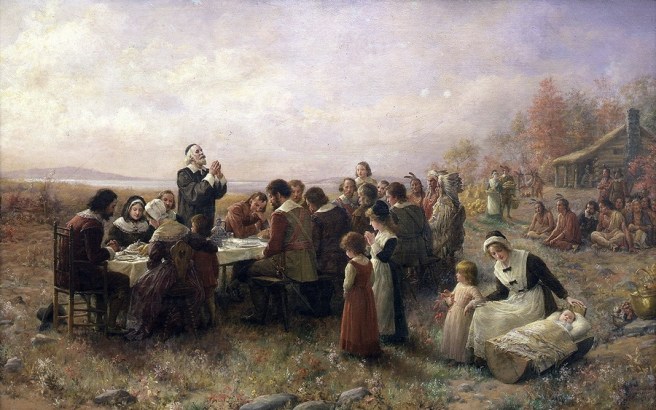
William Hilton arrived at Plymouth but probably was a tad too late for the big dinner. Don’t bother looking for him in the group shot. Also note that the settlement looked nothing like this. It was fortified, for one thing, and had a completely different style of house.
The Lyford incident illuminates another side of the New England migrations. Not everyone came for a noble cause, religious or entrepreneurial. Some were running away from reprehensible acts.
After the Hilton child’s baptism, leaders of the colony discovered that Lyford had been writing letters to England disparaging the Separatists at new Plymouth. As the Lyford entry on Wikipedia explains, some of the letters were seized before they were sent and opened. When Governor Bradford confronted Lyford about their contents. Lyford apologized but later wrote another similar letter that was also intercepted. After the second incident, Lyford was sentenced to banishment.
Before his expulsion, Lyford’s wife, Sarah, came forward with further charges. Lyford had fathered a child out of wedlock with another woman before his marriage, and after his marriage, he was constantly engaging in sexual relationships with his housemaids.
Bradford recorded Sarah Lyford’s explanation of how her husband “had wronged her, as first he had a bastard by another before they were married, and she having some inkling of some ill cariage that way, when he was a suitor to her, she tould him what she heard, and deneyd him; but she not certainly knowing the thing, other wise then by some darke and secrete muterings, he not only stifly denied it, but to satisfie her tooke a solemne oath ther was no shuch matter. Upon which she gave consente, and married with him; but afterwards it was found true, and the bastard brought home to them. She then charged him with his oath, but he prayed pardon, and said he should els not have had her. And yet afterwards she could keep no maids but he would be medling with them, and some time she hath taken him in the maner, as they lay at their beds feete, with shuch other circumstances as I am ashamed to relate.”
Once more, he was on the run, eventually landing in Virginia. Sarah apparently remained behind, where as a widow, she married Edmund Hobart, a constable, court official, and minister, in 1634.
~*~
So much for some juicy scandal surrounding all the piety.
Happy Thanksgiving, anyway.
It’s all part of my new book, Quaking Dover, available in a Nook edition at Barnes & Noble.
For someone raised like me far from the ocean, trying to pin down places along the coastline can be confounding.
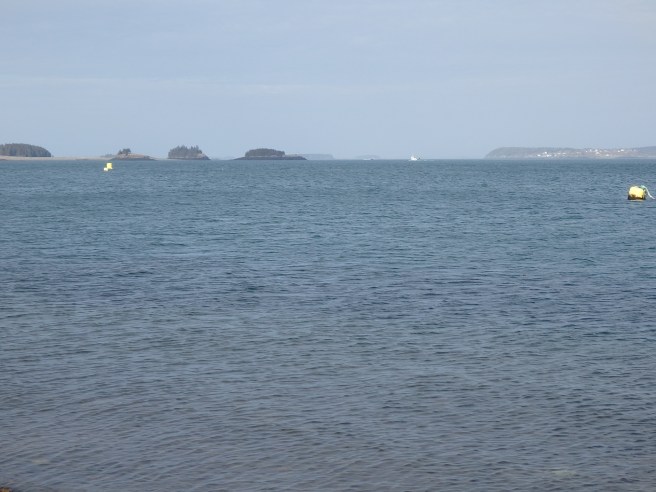
Eastport, for instance, lies within famed Fundy Bay yet also has Cobscook Bay lapping its west banks and Passamaquoddy Bay on its east.
What gives?
Well, let’s say the bays are like Matreshka Dolls, one fitting inside another one that fits within yet another one and so on.
Cobscook Bay, for instance, includes the smaller East, South, Sipp, Dennys, and Whiting bays.
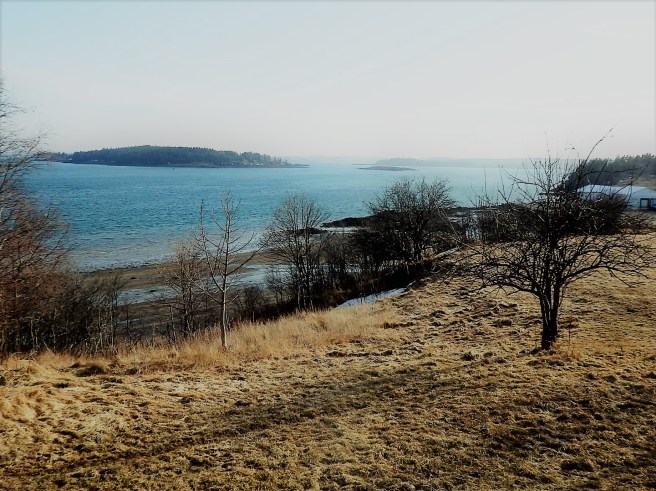
Looking into Cobscook Bay to the west of Eastport.Or to the east, toward the Bay of Fundy.
I guess it’s like a New Yorker saying she’s from Flatbush, meaning a part of Brooklyn within New York City, which does – contrary to the knowledge of many Manhattanites – sprawl far beyond their little island.
So Eastport can justly claim to be the City in the Bay. Or several.
There’s a widespread assumption across America that no household should be without a turkey on Thanksgiving Day. And that’s led many charitably inclined groups and individuals to deliver free turkeys to poorer families ahead of the holiday.
What gets overlooked is the realities of the recipients themselves. Some may not welcome the challenge in front of them. Some don’t cook, period. Some don’t have a full-sized oven. Some live by themselves and have no way of dealing with all that meat. Carving the heavy roast gets tricky, even if you have a large platter and the right knife and serving fork. Not everyone even likes the taste, white meat or dark.
I’ve heard of one group home that had a dozen of the brick-solid big birds stashed away in the bottom of its chest-style freezer, no date attached. A diligent volunteer finally took charge and into the trash they went, one a week.
Speaking of volunteers. Many people step up to volunteer for the holidays, only to be told the spots are already filled and then turn testy. What do you mean?
Doing good can get tricky and lead to hurt feelings.
The real needs continue all year, especially through the depth of winter, when the food and volunteers would be most welcome.
That holiday spirit doesn’t have to be expended all at once, does it?
 Jnana's Red Barn