Not to be left in the dark

Is it just me but are power outages becoming more common, more widespread, more severe?

That would fit the forecast of climatic instability, otherwise known as global warming, which is no longer undeniable.

Remember the scoffers who first decried the prophets as ridiculous, denied the causes, spent millions to ensure their profits, and ultimately said there’s nothing we can do about it, contrary to what those insightful prophets had warned?

I’m looking for a better option than paying for a propane-powered generator that further lines the pockets of a source of the problem. Got it?

Those guys should be paying us.

End of this jeremiad, for now.

The four original towns of New Hampshire differed from the start

For most of the first century, Dover dominated both New Hampshire and neighboring Maine.

It was the core of population, for one thing, as well as the oldest continuing settlement.

It also had significant water power, unlike Strawbery Banke, the future Portsmouth.

But Portsmouth, in turn, was closer to the Atlantic and had a viable harbor, leading it to become a center for adventure capitalists and merchants plying the ocean for trade at the same time Dover’s fishing focus diminished, in part a consequence of the sawdust in the water from the lumber trade.

Hampton (1636) and Exeter (1638) were both founded by men seeking religious freedom from Massachusetts. How’s that for a turn of affairs as well as a challenge to the argument that the latter was established in a quest for religious liberty while New Hampshire folks were interested only in lucrative gain?

Hampton long remained the most agricultural of the lot. Exeter did have water power for mills both there and in today’s Newmarket, yet it soon aligned with some powerful Puritan families. As did a elite portion of Hampton.

There were even the poor collected off the streets of London and shipped to New England, who may have then drifted northward.

Maine, meanwhile, began to coalesce around York, one town over from Dover.

Today, each of them remains somehow unique, within a New England identity.

Hampton, for instance, has a suburban sprawl feel with colonial touches. Exeter, with its prestigious Phillips Exeter Academy, could easily be one of the old towns abutting Boston but yet isn’t. The novelist John Irving calls it Gravesend. Continuing on, Portsmouth is a magnet for wealthy residents and resembles wealthy port towns all along the New England coast. George Washington, after all, did both sleep and worship there. It definitely has a superiority complex. And Dover, once a major textile mills and railroad center, is taking off as a family-friendly town with a viable, pedestrian-welcoming, downtown. It has, to me, the most practical yet visionary community spirit.

The differences are a subject well worth investigating. In the meantime, I’m keeping my focus on everything touching Dover.

It is, after all, the center of my new book and the city’s 400th anniversary as the oldest of all.

Dover’s prominence in the early province is typically overlooked

Not only is Dover the oldest permanent settlement in New Hampshire, it’s also the largest city in the Seacoast region today, with more than 30,000 residents. The region, however, adds to way more.

An hour northeast of Boston and with proximity to both Atlantic Ocean rugged shoreline and beaches as well as New Hampshire’s White Mountains, Dover has also become the fastest-growing city in the Granite State.

The town originally encompassed what’s now Durham (home of the University of New Hampshire), Barrington, Lee, Madbury, Rollinsford, Somersworth, and parts of Newington and Rochester. It also interacted heavily with the earliest settlements of Maine across the Piscataqua River, back when fishing was a leading business, followed by logging and sawmilling.

Still, there has also been a longstanding rivalry with Portsmouth just downstream, ever since its enterprising merchants rose to the fore. You know, uppity. Well, they do have the Music Hall.

Dover, I’ll insist, has been more modest. I’ll refrain from adding more for now.

For perspective, the region today has more than a half-million residents.

I like to think the center of gravity is shifting back to Dover. We’ll see. In the meantime, there’s that big 400th anniversary to celebrate.

Please stand by, as they used to say on radio.

Starting with a wedding certificate

Join me online from the Whittier Birthplace Museum in Haverhill, Massachusetts, on Thursday, January 26, at 7 pm.

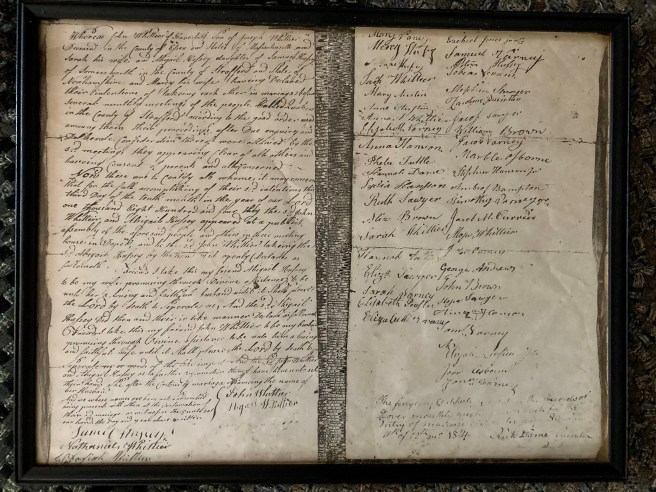
My presentation in their virtual lecture series via Zoom will explore the celebrated abolitionist and poet’s many connections to Dover, starting with an examination of his parents’ certificate of marriage in the Quaker meetinghouse in 1804. His mother grew up in the Dover Quaker community, and his Whittier uncle, Obadiah, was already living in town at the time of the wedding. In fact, Whittier Falls and Whittier Street weren’t named for the poet but his uncle and cousins.

There’s a lot packed into this historic document. Join me to find out.

Once we’ve gleaned insights into seemingly quaint Quaker practices of the time, we’ll turn to the signatures of the witnesses – that is, all of the Friends in attendance – and learn about some of them, too, as well as a few who weren’t present but were still members of the Meeting living in a town to the west and definitely of interest.

And then it’s your turn to ask questions or make comments.

The event does require preregistration and a suggested donation of $10 per household. Go to whittierbirthplace(dot)org and click on Events to learn more.

Here’s hoping you can make it. Putting this together has been a blast.

For tiny Dover, why all the hoopla?

As improbable as it would seem now, Dover was a throbbing center of dissidents and misfits in its early years, at least from the perspective of the Puritan authorities to the south in Boston.

Nor would I have expected a settlement inland from the ocean to be the one that took root, rather than the companion complex facing the ocean, but the Dutch trading post at Albany, New York, was even further up a river and survived.

There are good reasons that Dover became the center of action north of Salem, Massachusetts, and of Boston further south, not that you were taught any of that in your history classes.

I have to admit, it’s taken a while for the fact to sink in. Dover was the heart of the New Hampshire province, not that we see that today. Still, the roots remain.

My book, Quaking Dover, looks at the history from a minority viewpoint that leaves most of the last 200 years pretty wide open. Yes, there’s so much more to examine and include in the full picture leading to the rebirth of the community in recent years.

But what I’ve found is still pretty remarkable.

To think, it was such a humble and audacious start 400 years ago and counting.

It’s gonna be a big year!


Why there’s no Eastport, Massachusetts

From 1653 until 1820, Maine was governed by Massachusetts.

The westernmost port down there is Westport, beside Buzzard Bay. A lovely place, by the way.

And the easternmost port was Eastport, in waters subsidiary to the Bay of Fundy. As you’ve been seeing here.

But then, come 1820, the two extremes separated when Maine finally became independent as a state.

Now I guess that easternmost point down under distinction falls on Chatham, out on Cape Cod. And Maine has no Westport.

One year, while still living in New Hampshire, I was in Eastport one weekend, and Westport, the next. I saw it as some kind of weird coincidence, not knowing there really had been a rational connection.

Have you ever thought about the name of the place where you’re dwelling?

Scalloping in the dead of winter

There’s not a lot of meat in one of these, but what there is will be treasured by many seafood lovers.

This time of year, I hear the puttering motors in the chill air before the sun’s even up as the fishing boats head out to drag the depths for scallops. No matter how low the thermometer reading or how bad the weather, the vessels venture by, or attempt to, intent on catching their daily limit of ten or 15 gallons a day in a season that runs no more than 50 or 70 days but may close earlier, depending on the sustainable harvest in each of the regulated zones.

Rigged with a boom for the heavy chain net that drags the seafloor for scallops, this vessel returns to port with its harvest.

A day not out on the water of the bays around Eastport is a day’s income that’s lost for the season. The economics of fishing are precarious enough.

These intrepid fishermen shuck their catch onboard, tossing the shells overboard, which provides grounding for the breeding of more, and then return to port with their precious harvest, often well before noon.

A shell flies toward the water as these fishermen quickly shuck the precious bivalves onboard.

The licenses are coveted and even the size of crews is limited by state law.

Come summer, many of the boats, with their rigging reconfigured, and their crews will have turned their attention to lobster.

Other important harvests here are urchins and clams.

What workers impress you the most when they’re out in bad weather?


Pricing out my new checks

The cheapest ones still came to 27 cents apiece. Add postage to that, and paying bills can add up.

As for paying directly online?

As much as I’m a fan of the U.S. Postal Service and am trying to do my part to assure its survival, I am listening to my wife’s advice to switch over to online bill paying. Before I do anything drastic, though, I want to hear from others.

What’s your experience been?

When working from others becomes a conversation

My latest book is nothing like the others I’ve written. It’s not one of the novels, which required me to learn entirely different approaches to a story than I’d used in the daily newspaper business. And it’s not extended essays, like my usual Quaker materials. Nor is it poetry, where most of my literary efforts have been.

At the start, my genealogy came closest, but those are more research notes for others to follow up on – and if I ever get the energy to return to those, they do need a major cleanup.

As much as I’ve loved history, from childhood on, I’m not a trained historian. The closest I came was majoring in political science.

But for the last 50 years, I’ve been a Quaker and become quite grounded in the movement’s history and theology. And that’s what prompted the new book, along with Dover’s upcoming 400th anniversary.

I do like the big picture, and that’s what evolved here. Not just Dover Friends Meeting, then, but the broader forces that shaped and impacted it. So I went digging, drawing on others who had closely examined the early records or, in some cases, drawing on published journals and other early accounts.

Ground Zero, as it were. Contrary to the historic marker, however, William was not yet on the scene. The honor rather goes to Edward’s apprentice, Thomas Roberts, who was a key player in the early settlement.

What I collected seemed to write itself, which was an exhilarating experience – until I showed it to a circle of Beta readers. And then it was back to the drawing board, cutting the first half of the book by two-thirds and refining the tone by inserting myself into the text. The journalist in me, trained to be invisible, did so uneasily but trusted in the generous advice of a fellow poet and writer.

Also insightful has been historian Stephen Sanfilippo’s quip about being a “footnote historian,” the professional who can spend much of his career investigating minutia that become a paper or dissertation that in turn become a footnote in a “general” historian’s book, one that looks at the broader scene.

Much of my book is a step from that, drawing more on the general historians before me, but that’s led to its own encounters. I’ve often found myself in conversation with them, wishing we could actually sit down together rather than having all these years, even centuries, between us.

The first was Annie E. Pinkham, whose A Brief History of Dover Friends Meeting, a 1935 mimeographed paper, became the springboard for this project. Her material is no doubt based on much of what she had heard passed down in her husband’s family and maybe her own, though I’ve since found that her version of the earliest days of the town reflect common misunderstandings.

I’m also grateful to some people I knew personally, a generation older, who went through the Quaker minutes themselves – Shirley Leslie and Silas Weeks and I sense a few others. Their summaries were sufficient to round out the history, though there are many points where I now see that a more thorough investigation, of a doctoral dissertation nature, might glean answers that currently elude us. (Back to the footnote historians!)

George Wadleigh

Another voice I’ve been deeply grateful to is George Wadleigh, who struggled with many of the town’s often conflicting details and missing data when assembling his own history of Dover, dated April 1882 but not published until 1913.

The volume is prefaced with “NOTICE. It was the intention of the collector of these notes to complete them to a later date, then to revise and publish them, but he did not live to do so. They are now published without the revision the collector would have made, in order that his work may not be entirely lost.”

Originally, I thought that was Wadleigh’s own insertion, but finding that he died two years after dating the preface and that the book had to wait 31 years before publication, the “collector” seems to be Wadleigh himself, with the notice being added by one of the editors.

Either way, Wadleigh apparently had access to perspectives and possibly documents unavailable to earlier historians. He also may have had long discussions of the materials and their implications with other elders. From 1831 to 1868, he was editor and publisher of the weekly Dover Enquirer newspaper.

And then there are bloggers like Mark Everett Miner, some of them working as genealogists. I’m curious to see what they make of my take.

Beyond that, I hope I’m ready for the nitpicking and correction I’ll no doubt hear if anyone actually reads what I’ve produced.

As Stephen Sanfilippo has said, repeating the advice of one of his mentors about working in history, if you think you have the answer, you’re mistaken.

Or as I learned doing genealogy, every new answer you get raises ten more questions.

The work is never done.

Welcome to the dialogue.

~*~

Welcome to Dover’s upcoming 400th anniversary.