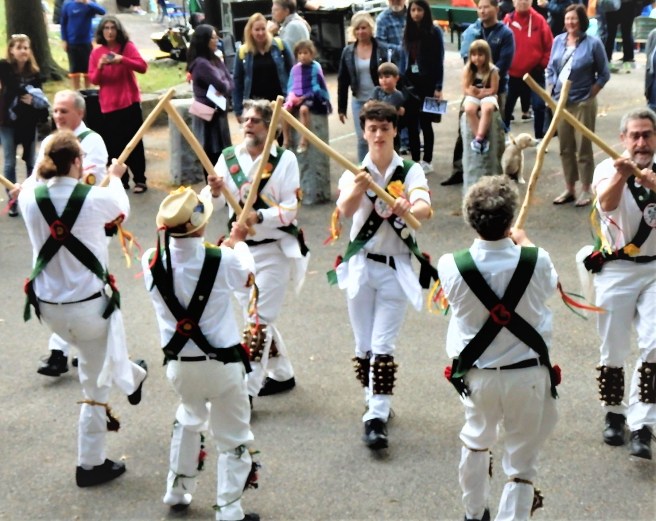
Morris men in a ring at the autumn equinox
You never know what we'll churn up in cleaning a stall
When I first started to reflect on his, I was inclined to cite the obvious big forces – the superrich, their military-industrial-financial complex, and a host of similar drains on the common good. I’ll let Bernie Sanders carry that side of the argument for now.
Instead, I’m thinking of some of the themes that play out in my novels Daffodil Uprising and Pit-a-Pat High Jinks.
What would you add to the list?
It’s not just Cassia in What’s Left who wants to know about her father’s fascination with Tibetan Buddhism. It plays a big role in his movements in Pit-a-Pat-High Jinks and Subway Visions, too.
My newest novel takes place in a Yoga Bootcamp. It’s run by an unorthodox American swami who’s also known as Elvis or Big Pumpkin, for good reasons. His followers think he’s divine, and they’re out to spread the word as yoga itself is first becoming popular across the nation.
Each of them has moved to his farm to intensify their practice. What they find has as much to do with cleaning toilets or weeding the garden as does standing on their heads in exercise class. Even a single day can embrace eternity as well as a cosmic sense of humor.
Mysticism? It’s largely quite down-to-earth, as you’ll see.
The novel is being published and released today at Smashwords.com. And that certainly has me levitating.
Be among the first to read it!

Cost-cutters have long found ways to shrink the product to meet rising costs or boost the profit. As was said years ago, “It’s getting hard to find a nickel candy bar for a quarter anymore.” I hate to think what it costs now, much less in a vending machine.
Newspaper pages are no exception. The first jolt to tradition came back in the mid 1970s when there was a newsprint shortage. The Canadian suppliers, for whatever reason – a labor strike? – just didn’t have enough to meet demand. One solution was to narrow the width of the page.
In recent years, as the Internet has disrupted the business model of the news industry, the pace of cost-cutting has quickened.
The ones around here are now 11 inches wide, versus 15½ when I started in the business or one paper where I worked where the page was nearly 18 inches wide.
In other words, today’s broadsheet is as wide as a tabloid was back then, only longer. It’s lost two columns of news on each page – or a quarter of its surface. It’s so skinny I wince.
We never had enough room to print everything we wanted as it was.
In my novel What’s Left, Cassia’s father balances his career between work as a professional photographer and as an American authority on Tibetan Buddhism.
This description seemed a tad overcooked for the final serving:
In the end, Baba creates a dozen-and-a-half commercials before returning to his seat between a pair of six-foot-long brass trumpets and a twelve-hour holy recitation.
~*~
No matter how much I like the image of long trumpets and chanting, the average reader is going to require too much explanation to get it. Oh, my. Maybe it’s a danger of my being a poet, too.
I have no idea about your father, but I can assure you mine was nothing like that. Mine worked as an accountant for a division of a global corporation. He wore suits and ties, and I never, ever got to see the floor where he worked.
Let’s just say Cassia’s Baba had a lot more freedom and flexibility than most.
Could you imagine having a father like hers Or maybe a famous TV actor? How would your life be different?
Thanks to Cassia’s father in my novel What’s Left, she’s familiar with Buddhist teaching and practice.
Here are ten basics.
Gee, I didn’t even get to koans, those mind-boggling puzzles presented to Zen aspirants.
“The workaholic is the happiest person around. It’s the people around him who are miserable.”
How curious the pronoun is masculine.
The Port City is hemmed in by water on three sides, and it’s running out of room to grow.
While the waterfront and beaches are part of the city’s tourism and residential appeal, the demand on downtown real estate has been going up steeply. Literally.
Not all that long ago, Portsmouth was a sleepy little New Hampshire city with a hippie edge and a lot of historic Colonial houses. Unfortunately, the city fathers had jumped on the urban renewal boom in the early ’60s, nearly demolishing one old neighborhood that was instead miraculously transformed into the Strawbery Banke living history museum. Visit it, if you can.
The side opposite the downtown wasn’t so lucky. Much of it, an Italian neighborhood of large Victorian houses with impressive interiors, was razed to make room for a small mall that never took off. It instead became a forbidding asphalt graveyard for private parking surrounding some kind of small bunker.
At least that vacuous mistake and eyesore is finally gone.
I’m not so sure about the replacement, though.
In what seems like one fell swoop, a monolithic set of five-story buildings has popped up to form a forbidding wall along the north side of the downtown.


It has none of the variety and charm of Congress and State streets that run parallel to it just a few blocks away. It’s largely not pedestrian friendly, preferring instead to maximize every square inch of rentable space, and despite its visual unity has a cookie-cutter quality that bears no kinship to the rest of the district other than brick. Where are the quirky touches that abound so close at hand in the earlier eras?
There is one exception.

Downtown Dover, ten miles to the north, is undergoing growth of its own and seems to be avoiding this kind of monolithic development, even while going to five stories. Whether we can avoid something similar on the riverfront project on the other side of the Cocheco is another question.
In both cities, these are once-in-a-lifetime opportunities for defining the larger community. What does this say about Portsmouth?

