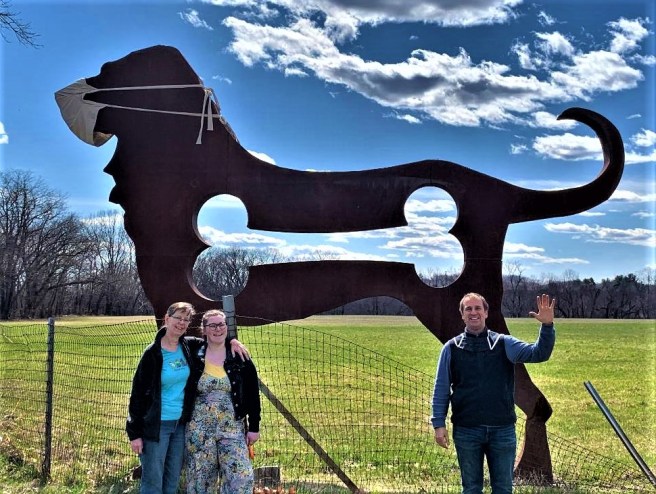
Just a friendly reminder

The creators of the homemade mask (at left) pose with the creator of the sculpture (right) at this landmark along Interstate 495 north of Boston.

This whimsical public sculpture in Haverhill, Massachusetts, has always brightened our trips down I-495. I don’t know why the dog-bone cutout works so well, but it does, perhaps suggesting that Rusty (or whatever its name) has happily ingested a big treat. The playful open shape even allows opportunities for seasonal additions like a row of pumpkins every October.

So I get this attachment from a favorite funnyman in my life, acknowledging that he’s not the only comedian in the family. His wife and daughter, above, have been sewing Covid masks like crazy and, as dog lovers, they got an impulse to do more.

Look at it as inspiration, either to make your own masks or to make sure you wear one in public.

Ciao and bow-wow!


As the random blahs kick in

So this general shutdown or shelter-in-place or self-isolation, call it want you want, is dragging on and will likely do so. Any novelty’s worn off. I miss my old routine and acquaintances. Can I assume I’m speaking for everyone?

My wife and I are lucky to live in a big enough old house so that we’re not always tripping over each other except in the kitchen. (Not that you care.) We have a big yard, too, which this time of year is beginning to demand gardening attention, getting me outside in the dirt and, well, mud. We also have access to a lovely carriage trail we can follow through a nearby woods to the top of a hill, giving us some decent exercise almost daily.

But I’ve definitely reached the state of blah, even when it’s not one of those dull wet deeply gray days. No, as I draft this, it’s partly sunny outside my window.

So here I am, up in one end of the third-floor attic, while my wife’s “working from home” with an online meeting on the first floor. I hate to walk through that. You know, the little square showing her face in the upper right-hand corner? Anyone else know the feeling? I’d move her to another room, but she’s comfortable in that particular spot. We try to adjust.

I can’t imagine being cooped up in a tiny apartment, much less with kids, though I’m sure that’s the case for many. Even a mobile unit in a trailer park would be way too confining.

What’s shut down goes beyond much of what most of us are seeing. Look, it even includes playgrounds! The one around the corner saved my sanity with the younger one more times than I can count. Let me sympathize with every parent during this duration.

But let’s try to be aware of the wider impact.

Continue reading “As the random blahs kick in”

Who sez nothin’ ever happens in a small town?

As the sophisticated outsider at the outset of Nearly Canaan, Jaya’s already at odds with the small-town outlook of Prairie Depot.

For some, she’s a breath of fresh air. For others, she’s a threat. Is it enough to ignite combustion?

Her presence bursts into romance, certainly.

But in freeing her suitor from the inhibitions of his strict upbringing, does she create a monster?

~*~

What’s your take on inhibitions? Especially where you live?


Looking into the past

Apponegansett Friends meetinghouse in South Dartmouth, Massachusetts

Sometimes when I stop at old Quaker meetinghouses, I’ll try to take a photo of the interior through the windows. Reflections make it tricky, in this case casting an image of me and my camera back at  us. What remains is the rustic interior of the 1790 Apponegansett Friends meetinghouse in South Dartmouth, Massachusetts, viewed from the former women’s side of the house, with a set of cedar dividing shutters lifted out of sight in the middle. The gallery for ministers and elders is at the left, and seating for the general membership is at the right. Does it get any simpler than this?

Ten ways ‘What’s Left’ and ‘Nearly Canaan’ differ

I’m relieved to find these two novels have big differences.

Here are ten.

~*~

  1. Children and family. Cassia starts telling her tale from age 11, and she’s surrounded by her two brothers and a clutch of close cousins. No kids of note in Jaya’s tale.
  2. Greeks. Central to Cassia’s identity. None pop up in Nearly Canaan.
  3. Gypsies. Are they really a strand in Cassia’s background? Not a factor in Jaya’s.
  4. Ghosts. Cassia’s dealing with her family history, after all. Jaya isn’t.
  5. The cat. A key figure in Nearly Canaan. None by name with Cassia.
  6. Sexuality. More explicit in some scenes of Nearly Canaan.
  7. Infidelity. For Cassia, it’s an issue in her parents’ generation. In Jaya’s circle, it’s a more immediate threat.
  8. Wilderness. The desert is a major influence when Jaya and Joshua move west. Hardly noticeable for Cassia, even when she’s living in Las Vegas. In addition, much of Nearly Canaan veers off into the forests and mountains to their west.
  9. The volcano. A turning point in Nearly Canaan. No geologic activity in What’s Left, apart from the mountain that triggers Cassia’s lifelong obsession.
  10. Photography. Her father’s archives become the key to Cassia’s discoveries. None to examine with Jaya.

~*~

Any of these strike your fancy?

A tidbit from a digital committee meeting

Or should that be a committee’s digital meeting?

As we were considering the possibility of extending an online workshop to our Quaker fellowship, to replace an in-person one we had cancelled, some of us sighed and admitted feeling Zoom’ed out.

That’s the phrase they used.  Zoom’ed out. Bet it’s quickly popping up around you, too. The way Google went from a way of looking (as in googly eyes) to an online search engine (capitalized) to a verb reflecting generic online usage, as in “googling,” even when you do it on Bing or DuckDuckGo.

Zoom isn’t the only platform being used for virtual meetings. Go To Meeting is also popular, and Skype is still there for one-on-ones, among others. Feel free to mention alternatives.

So, now that we’ve recently added “coronavirus” and “Covid-19” as new words in our common vocabulary, we’re about to add one more.

Any of you feeling Zoom’ed out yet?

Why fundamentalist Christians prefer the King James translation

It’s less intelligible to the modern ear.

OK, that’s the flip retort, but it’s true. The King James Version of the Bible sounds truly remote and incomprehensible to most Americans, and I suspect that’s part of the appeal, the way Latin used to be for Roman Catholics.

I’ve tried to teach our teens in Meeting how to use the “thee” and “thou” that are so much a part of traditional Quaker expression, but find the kids are completely baffled. The 17th century language is the core of the KJV, too. Take note.

But as those fluent with Hebrew remark, the KJV is also full of mistranslations, some of them deeply ingrained in our English language and thinking.

We can blame one of the characters in my upcoming book The Secret Side of Jaya for that translation problem, since the KJV (more officially known as the Authorized Version) drew heavily from his English renderings. That’s something that could lead to an arcane debate we’ll not get into today.

As for me, I’d prefer cracking the nut open, using as many different translations as possible, making the events all the more astonishing.

You’re welcome to check out what I’ve been examining in my reading of the Bible straight through at my blog As Light Is Sown.

But first, in recognition of today’s celebration, Happy Easter.

Where are the Greek-American stories?

As I’ve become aware of the extensive presence of Greek-Americans in my own town and across much of New England, I’m surprised how little fiction has been written of their experience and distinctive culture.

They’re not the only ones to be largely unseen in American literature, especially as it has reflected the melting pot ideal of the wider society. Still, there are reasons distinctive identities remain, as we might see in the stories of blacks, Southerners, Irish-Americans, and Native Americans who were among those who gained a significant voice in the last half of the 20th century. Wandering through the library stacks, I’ve also been surprised to find so much by Asian-American novelists and African expatriates.

And most notably, perhaps because of their strong rabbinic tradition and support of erudition, American Jews have long been prolific writers and storytellers, producing many of the leading novelists of the 20th century.

In puzzling contrast, Greek-Americans, with perhaps as much as half the population of American Jews, have been largely invisible.

The Greek perspective is most likely to be expressed in the old country, especially in the works of Crete native Nikos Kazantakis, although I’m also intrigued by the Dubai-born Karl El-Koura, now living  in Canada.

Here’s what I’ve found by Americans:

Natalie Bakopoulos’ The Green Shore is about life under the Greek junta.

Celebrated Dean Bakopoulos (My Amerian Unhappiness) looks entirely at mainstream consumer life.

Prolific D.C.-focused crime novelist George Pelecanos touches on Greek connections (Shame the Devil, for instance) without revealing anything unique to the culture – his characters could as easily be Irish or Italian.

Susannah Hardy’s Greek to Me Mysteries perhaps come closer.

The stellar exception is Michigan native Jeffrey Eugenides, whose father was of Greek descent and his mother, English and Irish.

His 2002 Middlesex is a masterpiece of not only the Greek experience before and after arriving in the New World but also of the frequently overlooked Midwest itself. His other two novels, The Virgin Suicides (1993) and The Marriage Plot (2011) also contain telling insights into the Hellenic influence.

The one other writer I know of who tackles the identity head-on  is Anna Pappadapoulos and her marvelous 2015 Samaritans. The novel has both a Greek-American mother and an opening in Indiana, something it holds in common with my own What’s Left before veering off in a much more precarious life journey.

Well, yes, there is also The Movie (you know the one I mean). It is sweet and informative, but barely touches the surface and has some saccharine scenes that make those in the know blanch.

Do you know of any other Greek-American novelists or books to add to the list? Are there other ethnic or religious cultures who need better representation?