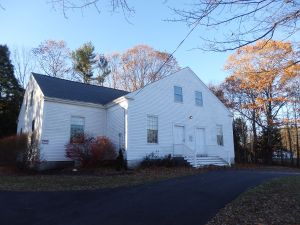
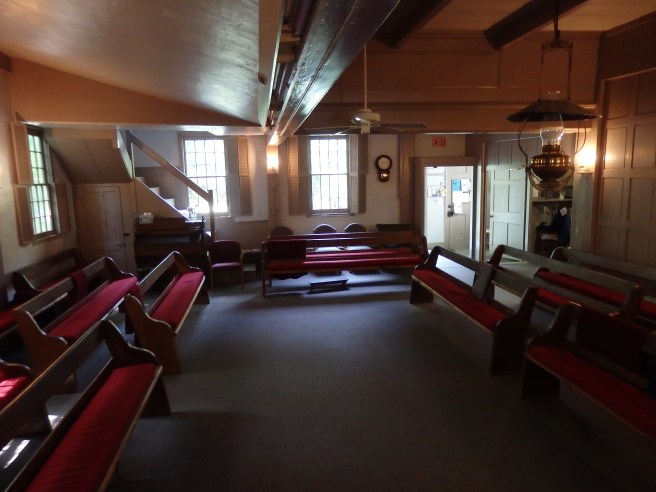
In January 1774, a large protest meeting against England called by the town of Dover was held in the Quaker meetinghouse. A resolution upholding the demand for the right of representation in government was unanimously passed.
We’re left wondering why the Friends meetinghouse rather than the Congregational one funded by the town, or whether the town fathers even asked permission.
But a year later, Quaker Nathaniel Meader and others made a public declaration, “We do not choose to sign allegiance to the colonies,” in part as a matter of not swearing oaths but more likely a reflection of their desire to avoid warfare.
~*~
Like the earlier decades of hostilities with the French and their Native allies, this was a special trial of faith for Quakers, who were committed to nonviolence and peacemaking. The historic peace testimony given to King Charles II in 1660 declared warfare to be contrary to the spirit and teaching of Christ as well as the practice of the apostles. Friends recognized clearly that violence begets more violence and arises from sin.
“Our principle is, and our Practice have always been, to seek peace and ensue it and to follow after righteousness and the knowledge of God, seeking the good and welfare and doing that which tends to the peace of all,” the testimony states. “We know that wars and fightings proceed from the lusts of men, out of which lusts the Lord hath redeemed us, and so out of the occasion of war. The occasion of which war, and war itself (wherein envious men, who are lovers of themselves more than lovers of God, lust, kill, and desire to have men’s lives or estates) ariseth from the lust. All bloody principles and practices, we, as to our own particulars, do utterly deny, with all outward wars and strife and fightings with outward weapons, for any end or under any pretense whatsoever. And this is our testimony to the whole world.”
The document also rejects conditions for allowing arms:
“That the spirit of Christ, by which we are guided, is not changeable, so as once to command us from a thing as evil and again to move unto it; and we do certainly know, and so testify to the world, that the spirit of Christ, which leads us into all Truth, will never move us to fight and war against any man with outward weapons, neither for the kingdom of Christ, nor for the kingdoms of this world.”
Friends were instead set upon living out the Peaceable Kingdom described in the prophecies of Isaiah. “For which cause we shall freely give up our bodies a sacrifice, rather than disobey the Lord. For we know, as the Lord hath kept us innocent, so he will plead our cause, when there is none in the earth to plead it. So we, in obedience to his truth, do not love our lives unto the death [that is, a life of sin, but rather] that we may do his will, and wrong no man in our generation, but seek the good and peace of all men. And he that hath commanded us that we shall not swear at all, hath also commanded us that we shall not kill, so that we can neither kill men, nor swear for or against them.”
A Dover Meeting minute of 3rd mo 23rd 1776 speaks of three who went to war: “After deliberate consideration thereof it is the judgement of the meeting that the above named friends should not stand as members of our said meeting until they return with unfeigned repentance for the above misconduct.”
Even so, the first reading in town of the Declaration of Independence was made at the Quaker meetinghouse.
The Peace Testimony wasn’t the only reason for Friends to be troubled by the Revolutionary War. There was no basis to assume that a new government would respect their hard-earned religious liberty. Quakers also had strong ties to their British coreligionists.
Some, like Nathaniel Greene of Rhode Island, did take up arms or otherwise support political independence. British unjust seizure of his brother’s shipping fleet pushed Nathaniel into action. As a general, he is renowned as a brilliant strategist, though his most famous campaign was one largely of retreat that ultimately exhausted the enemy.
Dover Friends sadly agreed that those who joined the fighting could no longer be counted as members, at least until they expressed repentance. The decision came at a steep price.
The Quaker archives at the University of Massachusetts contain three collections of Denials, or disownments, at Dover. The first covers general offenses, 1761 to 1801. The second, marriages, 1721 to 1800. The third, military service, 1775 to 1778.
I’m sure all three are heavy reading.
In Berwick alone, at least 18 young men with Quaker surnames enlisted, according to a tally by the local historical society. Assembling similar tallies in the other communities covered by Dover Meeting would be a challenge.
In the end, the Constitution of the new nation would include a Bill of Rights based largely on Quaker William Penn’s 1701 Charter of Liberties for Pennsylvania. To commemorate the jubilee anniversary of that charter, a large bell was commissioned to be cast and initially known as the Great Quaker Bell, now renowned as the Liberty Bell for its inscription from Leviticus 25:10.
Look it up. It’s a revolutionary economic and social concept.
~*~
Check out my new book, Quaking Dover, available in your choice of ebook platforms at Smashwords.com.
Welcome to Dover’s upcoming 400th anniversary.