Through much of its history, the Society of Friends was rooted in families, in contrast to today’s more individualistic lacework.
I use the earlier term, Society of Friends, rather than the more modern version, Religious Society of Friends, because Quaker practice emphasized all facets of one’s life, not just a spiritual component. We can argue about whether Friends worship is mystical or meditative as well as about our understandings of the nature of the Divine, but the faith has led us over our history to closely examine our political, business, educational, community, and family interactions. Often, as we’ve seen, from an intensely practical point of view.
It has been said that there are no Quakers apart from a Meeting, meaning that we need each other to hold ourselves to the path and practice. Families, too, need other families who share a similar vision.
When Friends had large nuclear families, three households could easily fill a small meetinghouse, especially when grandparents and unmarried siblings were included. As Quaker families intermarried over the generations, it became common for children to address everyone in Meeting, except their own parents, grandparents, or siblings, as aunt, uncle, or cousin. We can see how that would easily apply in Dover.
What I hadn’t expected when I began examining the genealogies of Dover’s early Friends was to discover just how intermarried their families had already become in the four decades between the arrival of the Quaker missionaries and the beginning of the Meeting’s surviving minutes. Some families were close even before that, suggesting religious conversions, “convincements,” often came within extended relations or among neighbors more than one by one, individually.
In other cases, some lines of a Dover family were Quaker while others hewed to the Congregational church. Even after a surname line left the Society of Friends, some individuals might later rejoin, and sometimes it is hard to determine precisely when or how. In addition, children of households listed in Dover Friends records might seem to disappear from further consideration when, in reality, their location was one finally set off within a newly recognized Monthly Meeting. In effect, their Meeting moved while they stayed put on the same land. A diligent researcher will need to go to those minutes to continue, if possible.
Compounding this, in terms of this particular history, is the fact that for some of Dover’s Meeting’s families, few or maybe none of the households lived within the current city limits. The Eliot, Maine, role – still officially in the town of Kittery – stands out, as do the Berwicks, in Maine, and Oyster River, now Durham, New Hampshire.
As long as a family was Quaker, we can make some general assumptions about its values and lifestyle.
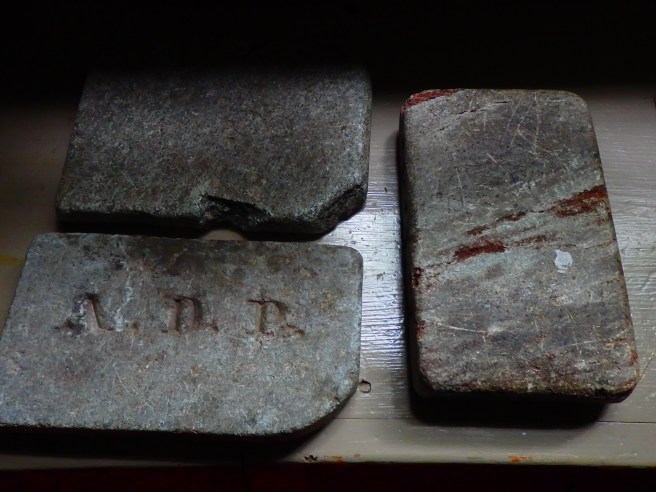
Through much of the history, neither the Congregational nor Quaker meetinghouses had heat in the winter. Instead, members heated soapstone cut like these and carried it in containers from home. I have no idea why they were given to the Meeting, other than a reminder of how tough those characters were.
In some ways, they were like Amish today, with distinctive dress and turns of speech, though choosing to “live behind a protective hedge” rather than separate more totally from the wider world. We’ve seen that Dover Friends were not afraid of speaking out in public and pressing for political redress, unlike the Amish.
Among the values were simplicity, plainness, integrity (honesty, no oathtaking), pacifism and nonviolence, equality of sexes and races. In addition to an avoidance of oathtaking, gambling and gaming, military service, Friends eschewed vain entertainments, including fiction, theater, dance, music, visual art. Science, mathematics, and poetry, however, were valued. There were no headstones until the 1850s. Nor did Friends take other Friends to court – differences were to be settled within Monthly or Quarterly Meeting. Quaker inheritance guidelines sought equal distribution for all the children rather than the bulk of an estate going to the eldest son – over time, raising the overall wealth of a family.
Anger, which commonly leads to violence, was curbed or suppressed – at a hidden price of burying all of one’s emotions.
Yes, the restrictions could be severe, but they also led to some remarkable accomplishments.
As I’ve reviewed Dover Quaker surnames, I find some moved out of the immediate area altogether. Others stayed, but moved completely out of the Society of Friends – still, their accomplishments were part of the larger society.
Even in a small community like Dover Friends Meeting, trying to keep the 41 or so surnames straight over several generations becomes difficult, but is a tight-knitted fabric of individuals and kinships. Sometimes, when I’m sitting in the silence of the meetinghouse, I feel that they’re also sitting with me. It’s a comforting, even strengthening, experience.
~*~
Check out my new book, Quaking Dover, available in an iBook edition at the Apple Store.
so where are the agents at the end of this uphill trial if you meet the test only to pack away crates of hallowed vials and jugs to haul northward for further aging the first time? that truly is such a big butt for such a tiny face
Maybe I just didn‘t notice, but I don’t recall noting so many quirky sides in the other places I’ve lived. Maybe they’ll pop out when I review my old journals.
Still, there are things in Eastport I hadn’t anticipated. For instance …
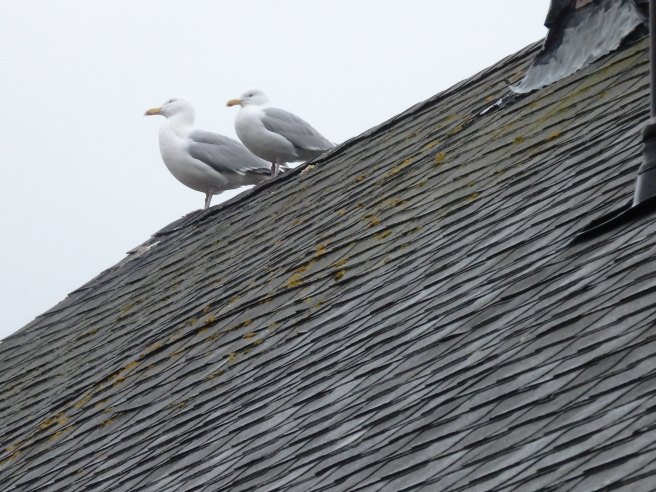
As far as birds go, it’s basically gulls and crows. Just listen. Even with bald eagles right overhead.
In summer, it’s ten degrees cooler than the mainland seven miles away. In fact, I wore my shorts only three times last year – and two of them were when I was running around inland. Well, as far as that goes, I should mention how much I now perceive the fact I’m living on an island.
Watching the fog roll in from the Bay of Fundy, either up from the channel by Lubec or down between Campobello and the islands just north of it. As well as watching spectacular sunsets from the other side of town, in contrast to the amazing dawns I face from my house.
No nightlife. Apart from events at the arts center, the place pretty much settles in after dusk. And then rises early.
No commercial net fishing. The haul is largely lobster, scallops, clams, and urchins – a delicacy in Japan. But we were also once the sardine capital of the world, which left a bigger impact than I ever imagined.
The importance of smuggling in the port’s past, as well as shipbuilding.
The impact of Dover on its early settlement. Many of the early settlers came from the Piscataqua watershed, and even those who claimed Portsmouth or Newburyport, Massachusetts, could trace their lines back to Dover.
Horn Run Brewing and Bocephus. Two new businesses, each one run by an enterprising and delightful couple.
Diver Ed. A long-time tourist attraction in Bar Harbor, with all of its Acadia National Park crowd, he pulled up anchor and brought his Starfish Enterprise to our Breakwater instead. As a natural ham, he knows how to entertain an audience, even otherwise reticent teens, while teaching them the wonders in our waters.
The number and variety of wild apples. That helps explain the appearance of so many deer on the island. I’d call them wild, but (another surprise) have seen neighbors feeding them by hand.
While most of Eastport’s sardines were packed in cottonseed oil, some brands boasted of mustard, too, or of even smoking them first.
Even those that weren’t still might be smothered in a mustard sauce.
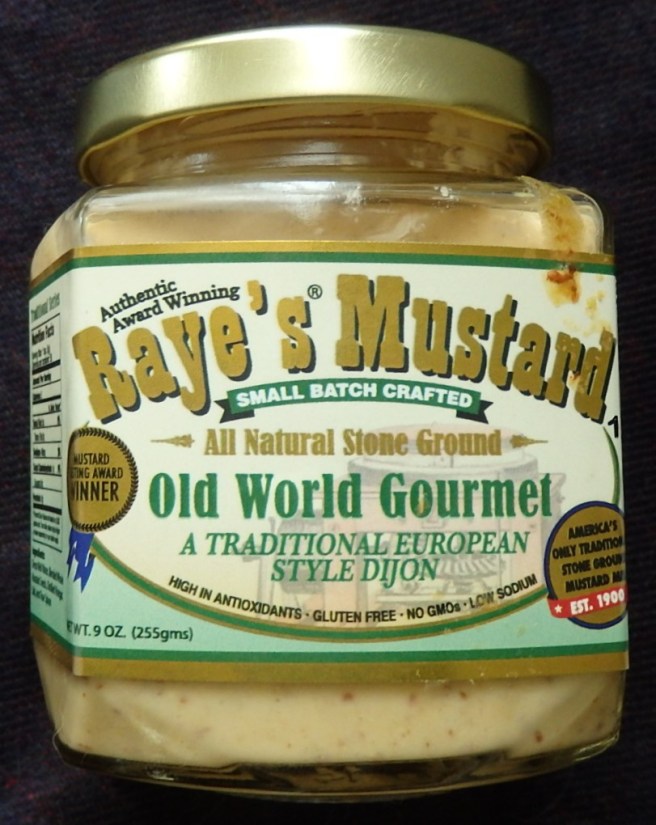
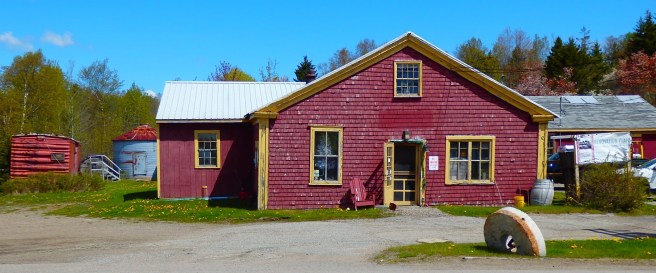
In 1900, J. Wesley Raye, the 20-year-old son of an Eastport sea captain, founded his mustard business in the family smokehouse in 1900 and moved it to its current site in 1903 to meet demand from the canneries.
Not just Eastport’s, either. Much of the family’s mustard, as the Raye’s website touts, was shipped by both rail and steamship, two means of transport long gone from the city. But, as they boast, their mill remains the last one in America to make mustard the old way. Theirs is made in small batches from mustard seed they’ve ground slowly on millstones made in France.
One of its many styles today.
If you don’t recognize the name, you might know the taste. It’s rebranded by some high-end labels.
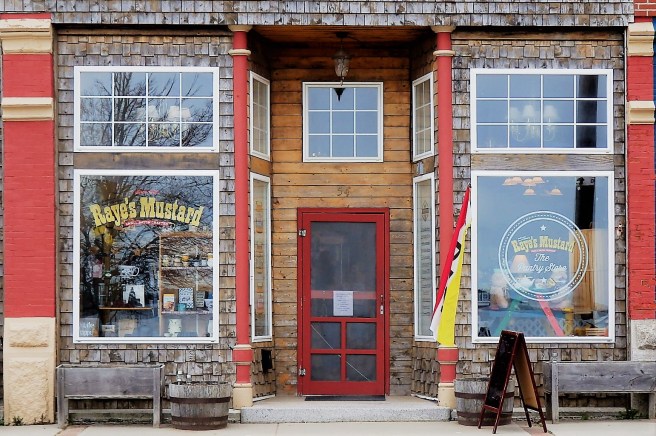
The old mill is still in operation. Note the railroad boxcar at left.Yes, there’s more.Their downtown retail store is a bright spot on Water Street, selling much more than mustard alone.
the home trip was shorter than any desire worth pursuit followed by a week strip-mined between Wheeling and Zanesville where the alphabet winds down and begins again in Ashland or Barnesville, maybe in another language still here I’m settling down as a monk in my scriptorium or as a bootlegger distilling silos of citations and trophies or as a bachelor milking his own antiquity to that point where you no longer know if you’re any good or not, you’re just pushing what you have to your best abilities . not everyone comes back