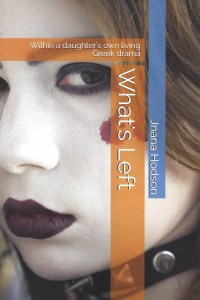
My novel What’s Left began percolating as I considered the dimensions of the hippie movement and realized it had never really died but continued disguised in many streams of action. Yes, I’d published my Hippie Trails series but so much still felt unfinished.
And, as a consequence of Cassia in the new novel, I went back and transformed the others into Freakin’ Free Spirits.
Looking at the world today, what pressing issues do you consider unfinished?
~*~
My novel is available at the Apple Store, Barnes & Noble’s Nook, Scribd, Smashwords, Sony’s Kobo, and other fine ebook distributors and at Amazon in both Kindle and paperback.
My subways novel started out to be my big hippie tome, building on a metaphor of hitchhiking, which was ubiquitous for us, but the extended concept ultimately got to be too unwieldy for one book. The supportive details were stripped away for what’s become Daffodil Uprising and Pit-a-Pat High Jinks, leaving the metropolis altogether.
Spurred on by Richard Brautigan’s “Trout Fishing in America” with a dash of William Burroughs, the initial drafts played surrealistically in a tension between the wide-open roads of the countryside and the underground realms of the biggest cities.
Then, four or five years after taking up the project, I was pawing through a used books bin in the desert of Washington state and came across a 1915 engineering volume, “Building Subways in New York,” which included “Elevated Railway Steelworks.” I still have it. How on earth had it ever landed out there amid the sagebrush?
I had already lived in Upstate New York four hours from Manhattan, and nearly all of my friends, housemates, and lovers were from The City. That was followed by my residency in a yoga ashram two hours away in the Poconos, so yes, I had learned to ride the trains. (Nowadays, it’s mostly Boston’s a little over an hour south of me.)
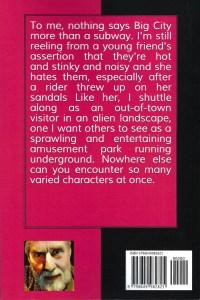
… and the back cover.
The original “Subway Hitchhikers” had a structure that ran like trains passing in opposite directions, which readers could find confusing rather than energizing. It also had a lacy air that reminded me of Robert Rauschenberg’s pop art “combines.” Gone, too, in the revisions is the protagonist’s hippie handle, substituting a more conventional nickname that better links this story to the others.
In the revised version, Subway Visions, there’s more focus on characters, plus new sections on Kenzie’s encounters of Tibetan Buddhism in a tenement near Greenwich Village as well as a graffiti artist known as T-Rex.
What’s evolved has a much straighter narrative and more arresting development, now linked to Kenzie’s ongoing life in the hills to the north. And elements of fantasy and heightened playfulness now augment the earlier surrealism.
I suspect I still have some classic coin tokens in my possession, somewhere.
Why does the restaurant business sustain so many immigrant families? Just look at all our ethnic options in dining today, even in small cities. Not just Greek-American, like the one in my novel What’s Left.
What’s your favorite food stop? Is it run by a single family? Does it have an ethnic identity?
Having Cassia cast a Buddhist chant as a spell in my novel What’s Left, is a bit of an inside joke. She may be trying to intimidate her middle school classmates, but what she utters, Su To Ka Yo Me Bha Wa, translates as “Grant me complete satisfaction” or “Grant me complete satisfaction within me.” Not that they have a clue.
Besides, I feel a shade of Harry Potter here, without an ominous wand. These words can simply feel magical.
By the way, Cassia’s chant is one letter off from Su Po Ka Yo Me Wa, “Grow within me” or “Increase the positive within me,” which also fits.
Just in case you’re wondering.
~*~
Think of some word or phrases you repeat often.
Do you have your own “mantra,” a word or phrase to raise your spirits?
(My favorite 9-year-old introduced me to “Yay!” So yours doesn’t have to be the least bit exotic.)
~*~
Cassia’s aunt Pia came from a family that owned places like this. Not far from Lowell, Massachusetts, where she grew up, for that matter.
In my novel What’s Left the family-owned restaurant is a local institution, one set at the edge of campus even before her grandparents and their siblings took over and made it distinctly their own. Everybody in town seems to know them.
Have you ever been recognized because of something your parents or grandparents did?
~*~
My novel’s available at the Apple Store, Barnes & Noble’s Nook, Scribd, Smashwords, Sony’s Kobo, and other fine ebook distributors and at Amazon in both Kindle and paperback.
There was no Nita for me during college or immediately after. Had she existed, my route would have been much less conflicted. Somehow, though, I managed to figure out enough on my own, often through seemingly chance introductions, to survive in an alien milieu.
After college I landed in a place where I knew nobody except a few people from my previous summer as a newspaper copy desk intern. I was a Midwesterner trying to comprehend the East Coast, a hippie working in a low-paid newsroom. Single and lonely.
The locale I create in Pit-a-Pat High Jinks is situated vaguely somewhere north of New York City. It could be in the Berkshires of Massachusetts or in southern Vermont or places like Oneonta or Cortland, New York, perhaps even Utica.
The paperback cover …
I paint it as smaller than Binghamton, the strange place where I was living and working. The Tri-Cities, as it was referred to locally, was flailing to recover from collapsing industry, especially its shoe-manufacturing ruins, as well as a deteriorating but expensive housing supply. The new state university attracted socially awkward straight-A geeks and nerds. My first year I resided in a neighborhood that was Italian by day and Black, as in ghetto, by night. And then there was the summer and autumn on the farm we shared up in the hills. My work schedule was crazy like Kenzie’s, except for the three-day weekend once a month, which I really wish had been in place – I took that from a newspaper where I worked a dozen years later.
Strangely, I also soon came to love the region. There’s something distinctive about Upstate New York, with its hills and forests and lakes, and almost all of my friends were from The City, meaning the Big Apple aka Gotham. Few of them confined their definition to Manhattan, I should note. Through them I got to know Brooklyn, the Queens, Staten Island, Long Island, and northern suburbs as much as the sliver between the Hudson and East rivers.
I initially addressed this fertile period in my life as two parallel novels – one where the hippie boy largely fails to connect with free love; the other, X rated, where his fantasies come to fruition. Either way, the plots arrived at the same finale. Later, in light of Cassia’s perspectives in What’s Left as well as a few of the early reviews, I returned to these two versions and blended them into a much more cohesive, and I hope more engaging tale, “Pit-a-Pat High Jinks.” Well, that is one of the advantages of ebook editions – you can always update them.
There’s still so much that baffles me about the time and place. How one housemate would come home with a different lover each night, all of them gorgeous to my famished gaze. What was his trick, other than that twinkle in his eye?
In the revised rendering, Kenzie encounters a sequence of hippie chicks, goddesses, lovers, each of them leading him to fresh understandings. Still, I’m left wondering how each of these interludes would sound from the woman’s point of view. I suspect Kenzie wouldn’t fare so well.
Also, for me, it was yoga rather than Buddhism as a new spiritual practice, but that’s told in Yoga Bootcamp.
More lingering are the questions of what’s happened to so many I’ve met in the broader Bohemian spectrum. I can’t even remember many of their names, but I have learned that some went on to become OBGYN physicians, United Way executives, federal attorneys, United Nations officials, photocopier technicians. Hardly what you’d expect of hippies, right?
Well, I’ve tried to record and reflect on what happened, seen mostly on the run. Can you experience something – live it – and still step back enough to record it? In my novels, that’s what the photographer tries to do, similar in its own way to my own struggle. And now you can see how much that role’s changed, too, in the shift from film and darkrooms to the digital ease of today.
Her aunt Nita in my novel What’s Left, has an interesting insight on showing up for work before all the others. It doesn’t fit every job, but it did hers. And then I cut this from the final version of the book:
If you’re the first one in and the last one out, you can disappear in the middle of the day and your coworkers and bosses are none the wiser. They just assume you’re out on assignment.
~*~
Not all jobs require you to punch-in or punch-out on some kind of clock. I’ve never had to work one of those, fortunately, although I’ve often had to fill out weekly time cards before being paid.
What I did find, though, was that even when I was putting in a lot of unpaid overtime (the joys of being low-tier management!), I could still feel the judgmental eyes behind my back.
Are you ever considered a slacker on your job? How does it feel? How do you respond?
~*~
In the family, Cassia would have had food like this. Greek olives! Best of all, packed in olive oil!