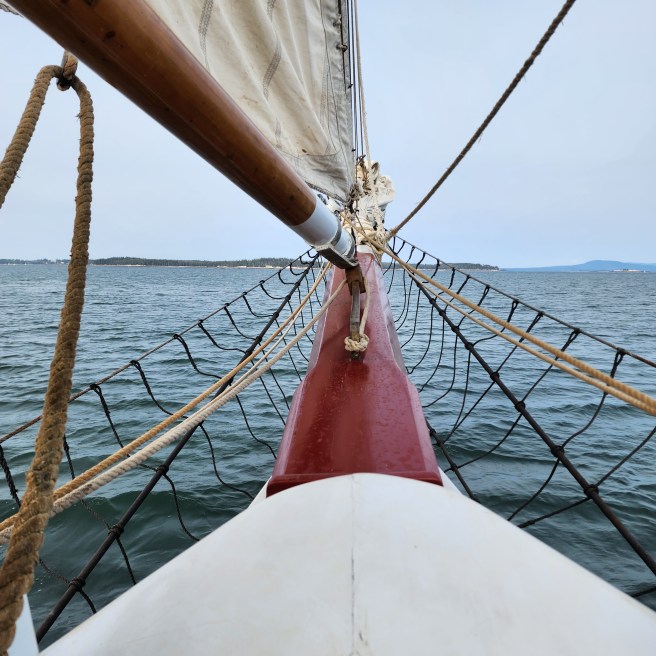
From the bow seat

Finally warm enough to take my cap off
and we’re getting some wind

yes, it’s all atmosphere

haze-infused grays with tinges of green forests
and bluish mountains
pulley block rasping behind me

the advantages of a cloudy day
without sunscreen
for a bald guy
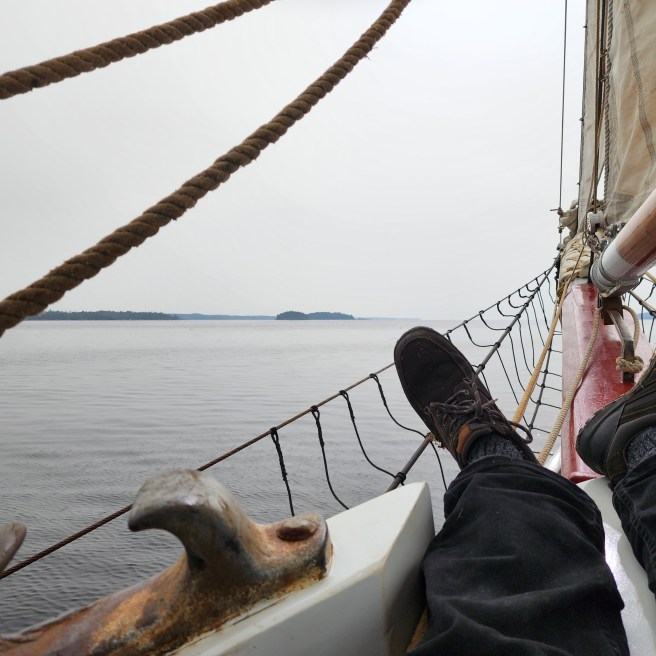
sitting motionless
apart from a slight roll
in a nearly dead wind

how calming

am still surprised the tiny yawl can push this big boat

a porpoise here, a porpoise there
a bald eagle flies past

the chains to even the tension
on the bowsprit with jibs

A few things to do in Dayton

The Gem City of Ohio has taken some hard hits since I left for other points as an adult. Even then, many folks said there was nothing to do or see, but that’s not what I find in return visits. Here are some things I’ll recommend.

  1. Carillon Park: This charming 65-acre historical park, originating with support from the National Cash Register company and designed by the famed Olmstead brothers, is somewhat like Henry Ford’s Dearborn Village but much smaller and less crowded. Settled in the shadow of a limestone carillon tower donated by engineer and industrialist Edward Deeds and his wife, the campus of small, often historic buildings at the foot of a wooded hillside showcases the region’s industrial innovations and contributions to world progress. One pavilion displays an early Wright Brothers’ airplane, while other buildings feature the automotive self-starter (launching the Delco division of General Motors) and indoor refrigeration (leading to Frigidaire), among the many contributions inventor Charles F. Kettering that advanced the lives of Americans and the rest of the world. John Henry Patterson’s development of the cash register changed retailing from cigar-box accounting while pioneering modern marketing and creating demand where none had existed. The displays have grown and become more diverse, and there’s even brewpub and festivals now. Still, it used to be free admission.
  2. Air Force Museum: My, this trove at the edge of Wright-Patterson Air Force Base has come a long way from the old hangars it occupied inside the base when I was a teen. You can get lost in what’s billed as the world’s oldest and largest military aviation museum. Some of the Wright Brothers’ earliest work in human flight took place in this locale. Free admission.
  3. Cox Arboretum: New to me is this botanical delight on the former estate of newspaper publisher, governor, and U.S. Democratic presidential nominee James M. Cox. The floral displays and gardens at this 174-acre park can be stunning, the trails are gentle, and there’s even a butterfly house. Thank goodness it was spared from development.
  4. Dayton Art Institute: Some astute collecting over the years has resulted in a wide-ranging collection of masterpieces from both the Old World and the Americas. While others were bidding up prices on third-rate pieces by famed signatures, Dayton was acquiring first-rate works by lesser-known hands or rare pieces from Inca and Aztec traditions, among others. Now it even has extensive Asian galleries.    
  5. Paul Lawrence Dunbar home: The Black American poet is finally getting due attention. His neighborhood on the West Side, which he roamed with friends Orville and Wilbur Wright, is now restored and open to the public.
  6. America’s Packard Museum: New to me is the world’s largest public collection of Packard automobiles and memorabilia – more than 50 classic cars, thousands of parts, and a research library in a 60,000 square-foot facility that was built in 1917 as an art deco Packard dealership, the Citizens Motorcar Company.
  7. Miamisburg Mound and Fort Ancient: Many of my favorite memories involved hiking in the neighboring landscape. These two sites – one in neighboring Miamisburg, the other further south along the Little Miami River, give a clue to the wonders of the ancient peoples who constructed intricate earthworks we’re only beginning to comprehend – think Stonehenge, for an English parallel, only vaster. Miamisburg’s, for instance, rises 65 feet, has a circumference of 800 feet, and contains 54,000 cubic yards of earth, all built by hand.
  8. Clifton Gorge, John Bryan State Park, and Glen Helen: Upstream on the scenic Little Miami River, these three sites connect into one for the ambitious stroller. The gorge, or limestone canyon, was largely unknown when I explored it but is now more available to the public. The river then meanders through the state park and its trails. Glen Helen, in Yellow Springs, was part of Antioch College.
  9. Englewood dam: The largest of the five passive flood-control dams erected in the Great Miami River watershed after floodwaters in 1913 devasted the valley, Englewood’s is 4,716 feet long and 110.5 feet high, part of an innovative civic district and remarkable engineering feat that became a model for the federal Tennessee Valley Authority during the Great Depression. Here, as well as at the Taylorsville, Huffman, Germantown, and Lockington dams, the retarding basins on the upstream side and the wooded hillsides now form the Five Rivers Metroparks system. And downstream has never been inundated since.     
  10. Aullwood Audubon Center and Farm: Adjacent to Englewood dam is one more relief from the suburban sprawl that has overtaken much of Greater Dayton. This 200-acre sanctuary includes a nature center and educational farm, along with eight miles of walking trails.

Fine carpentry, too

Jesus was a carpenter, after all, surrounded by fishermen and their boats. Maybe he built a few to float, too.

the curve of the deck – sheer
ours noticeably higher at the bow
than even the stern

while the crown with its sides
for water runoff

a dutchman
a piece of wood
cut in
to replace a rotten section

ditto in our home

The Angelique, too

if not a schooner
a ketch

Technically, a ketch rather than a schooner.
the Angelique a beautiful ketch

at anchor nearby
rust-colored sails
quite distinctive

yes, ketch that

everyone else went ashore in the yawl
to the boat school etc.

Brooklin

just me and the crew left aboard

someone in a white sweatshirt

jumping rope on the dock
the sound of the slapping rope
across the water
caught my attention

finally wearing my new hoodie
with its kangaroo pocket

learned that phrase yesterday

Joe bought the E.B. White democracy book while ashore
after hearing us discuss the author
(the son became a famed boat builder)

boat school temp tattoos stamped
on other passengers, crew

we’re leaving the Angelique at anchor

Fire on board

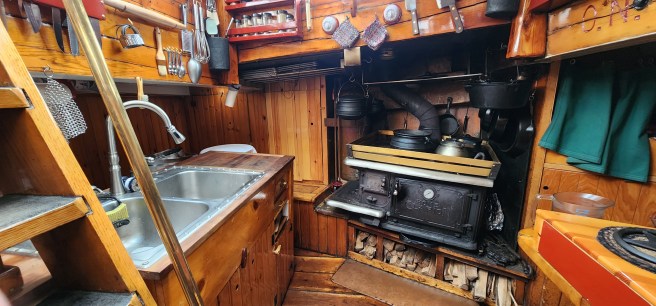
Wooden sailing vessels traditionally had only one fire onboard, the cook’s stove. I can’t imagine how cold sailors, much less passengers, were through most of the year.

Windjammers hew to that tradition.

a wooden sailing vessel
with a wood-fired cook stove
and kerosine lanterns

two iceboxes

Smoke from the cookstove goes
into a T-shaped chimney vent

don’t get too close

“Smokestack,” not “chimney”
maybe “noble Charlie”

A sense of Lake Meddybemps

Sunrise County is laced with big lakes. In fact, 21 percent of it 3,258 square miles is water, including streams of all sizes, bogs and flowages, and ponds.

The largest lake, Meddybemps, covers more than 27 square miles within four towns, reaches a maximum depth of 58 feet, is dotted with islands, and is famed for its smallmouth bass fishing.

Light on winter ice provides a unique clarity in perceiving the lake’s profile, seen in part here from State Route 214.

Hoisting the sail

perfect weather, sunny, 60s
a knot = 1.1 mph

a little more up
meaning into the wind

luffing, meaning chuffing in the sheets

no sea legs yet
wobbly

even on calm seas

bit queasy
edge of mal de mer?

slow lull

slow sun

will I feel a late-season burn?

“all on the bowline, we sing that melody
like all good sailors do when they’re faraway at sea”
a song our Dylan doesn’t know
in his impressive repertoire
a generational gap

116th Street Blues, starts out with Captain Ahab
then more nautical lines

find your own style

it’s an active experience
just relax