Lobster boats prep for a fast racing season start

Informal racing out on the open waters was already a longstanding tradition when the Maine Lobster Boat Racing Association formed and launched its first races in 1964.

Fishing is a dangerous occupation, one luring a gnarly but dedicated gang into its ranks. It’s said they have salt water in their veins, or as I’ve heard them say of themselves, they’re either crazy or dumb – or both.

It should be no surprise, then, that here in Maine, lobstermen come together on summer weekends to race their boats. They have a pick of at least one every weekend.

Yup, race. Lobster boats don’t exactly look sleek or graceful – they’re built to work in all kinds of weather and take a beating. But they also have powerful engines. I had no idea just how powerful.

Besides, guys being guys, lobstermen have long boasted about their beloved boats – many are named after sweethearts and children, after all. Comparing theirs against their peers’ meant putting their words to the test.

All of that has led to a circuit of races starting in Boothbay and ending in Portland, with ten or so other sites along the way.

With that in mind, here are ten more bits to consider.

  1. Each race is different. Some draw more than 100 boats. The lengths of the races vary by location. Some routes are less than one mile, while others stretch over a few miles. Some courses are straight, while others are loops.
  2. Depending on the location, the winning speeds vary. The fastest boats typically reach 50 to 60 miles an hour, though a record 68.3 mph was recorded in 2022.
  3. The emphasis is on regular lobstermen, not professional racers, and additional events may be scheduled after the summer’s taken off. While prizes are awarded at the end of the season, the racers participate mostly for the thrill and its bragging rights.
  4. Typically, the races are divided into categories by boat type. For example, there may be separate runs for workboats under 24 feet length, gas-powered workboats of more than 24 feet, and diesel-powered workboats of more than 24 feet. There’s even a Class O category for non-working boats, any length, any horsepower – shall we guess these are out-and-out racers?
  5. In 2022, the entries ranged from 30-horsepower outboards to a 1,400-horsepower, 44-foot-long vessel named Bounty Hunter IV.
  6. For the races, they’re stripped of their gear and any other extraneous weight, or so I’m told.
  7. As for boat names? Maria’s Nightmare II and Wild Wild West give you an idea.
  8. While many spectators watch from the shoreline, others head out on the water to get close to the action. Some ferries and boats offer race day trips.
  9. The Moosabec Reach annual races are the closest event to me – and the only one in Washington County. The one-mile course runs between Jonesport and Beals Island, ending just before the bridge that connects Jonesport to the island. The race used to include going under the bridge, but that stopped after lobstermen crashed while trying to navigate under the bridge and around other boats.
  10. Since the Maine lobster boat races are in the summertime, it’s best to bring sunscreen. For distant viewing, binoculars are recommended. Other handy items to pack include refreshments and a sweatshirt in case there’s a cool ocean breeze.

What to pack for the trip

brought latest Paris Review and Harper’s
as reading along with Vincent Katz pages
maybe stimulation

didn’t read anything, really, apart from some entries
in the free guide to lighthouses I had picked up
nearly a decade earlier


So here’s the official advice before setting forth:

We are very relaxed and informal on board, so bring comfortable outdoor clothes. If possible, use a duffel or collapsible bag to pack your gear. Hard suitcases are sometimes difficult to store in the cabins.

The weather may be cool or warm, so include pants, shorts, long and short sleeve shirts, a sweater or sweatshirt and a jacket. When the wind picks up, things cool off, so think layers when you pack.

Don’t forget your bathing suit, either for sunbathing or a quick plunge in the ocean.

Soft soled shoes are best, and an extra pair may come in handy. Sandals also work well on board or on the beaches we visit.

If you have a rain slicker, bring it along just in case. We do have extra rain gear on board if you can’t bring your own.

Also, if you can, check the weather for Camden, Maine online before you pack. It may give you an idea of the specific weather for your trip. But remember that it is always slightly cooler out on the water.

We provide towels, linens, blankets, pillows, and all the food and non-alcoholic drinks. We have an icebox on board for passengers to use if they would like to bring along their own beer, wine, etc.

Bring a camera with extra batteries, sunglasses, lots of sunscreen, a good book, binoculars, a journal, and your musical talents/instruments (if they are transportable!). If you want to sleep on deck under the stars, bring along a sleeping bag. Some folks bring charts or GPS’s to keep up with our route.

Once we leave the dock, we operate on 12 volt DC power. There are USB outlets for charging phones – please bring your own USB cord. We do have limited 110 volt AC power (like in your house) that can be used for medical machines and for occasional charging of batteries. Please let us know when you book if you will be needing 110 volt AC power to operate a medical machine.

A few more things to put Maine in perspective for you

Geographically, Maine is the biggest state in New England – almost as large as the other five combined. That still ranks it 39th in size in the USA.

We’re also famed for some very dry humorists and fresh-from-the-sea lobsters the way Vermont’s stuck with maple syrup and a red leaves identity.

Beyond that, here are some other things that are unique to the place.

  1. It’s the only state that borders just one other state. But it’s also the only one that borders three Canadian provinces.
  2. Half of the state is essentially unpopulated – mostly forests, wetlands, black flies, and mosquitoes.
  3. Its craggy coastline is longer than California’s, but shorter than Florida’s and Louisiana’s and, of course, Alaska. While the state and its tidal waters are famed for lighthouses, Michigan – with four of the freshwater Great Lakes ringing its shores – has the most.
  4. The bulk of the population lives within twenty miles of the Atlantic and its tides. Less well known are the interior towns between the ocean and the mountains. Much of that belt’s suffering, economically.
  5. Some of the state’s biggest urban centers are divided into two cities by rivers: Portland/South Portland, Lewiston/Auburn, Bangor/Brewer, Biddeford/Saco, Brunswick/Topsham. Calias/Saint Stephen is complicated by the U.S.-Canada border. Augusta and Waterville are the prime exceptions.
  6. Demographically, Mainers are the oldest folks in the country. The median age is 45.1 years. About 21.2 percent of the residents are 65 and above while only 18.5 percent is under 18.
  7. Despite all the white steeples you see in the photos, Maine is among the four least churched states. Typically, it’s hovering at the bottom, with New Hampshire, Massachusetts, and Vermont as rivals. Some of the variation occurs when looking at religious affiliation versus measures of religiosity.
  8. Famed outdoor outfitter L.L. Bean in Freeport can be seen as the epitome of the Pine Tree State. But quirky discount chains Mardens and Remy have their own loyal following, as adventurous visitors discover.
  9. Maine is the leading lobster-producing state in the nation, employing more than 5,600 hundred lobstermen (male and female). The tightly regulated catch contributes more than a billion dollars to the state’s economy.
  10. The state is also famed for its wild, lowbush blueberries. More than 70 percent of them are harvested in Washington County, where I live. Ranked by dollar value in the state’s agricultural output, the berries traditionally come in second, a bit above $100 million a year, but way below the $247 billion potato crop, mostly in Aroostook County to our north or the $137 million milk output statewide. But medical cannabis sales, at $266 million in 2020, surpassed them, and that’s without recreational marijuana figures, $72 million in 2021. They’re expected to go even higher this year.

My first nights out on the water

sleeping with the ocean
a mere foot from my head

the ship at port / anchored creaks, lines grinding / groaning
I hear the neighbors either side
Intimately

have you read
a common topic so uncommon
elsewhere

“I’m dying to be a better reader”

like digging a hole
I like going to bed
or lying on a beach

back below, in my berth
I hear steady breathing a few feet away
only a thin wall separating our heads

her boyfriend’s in crab school

yep, they giggle
unlike the couple with Southern accents
from Florida

the knitting picked up again

I’m going to sleep
[I’m falling asleep]
and so is most of the rest

finally

how many times will I be up
in the middle of the night
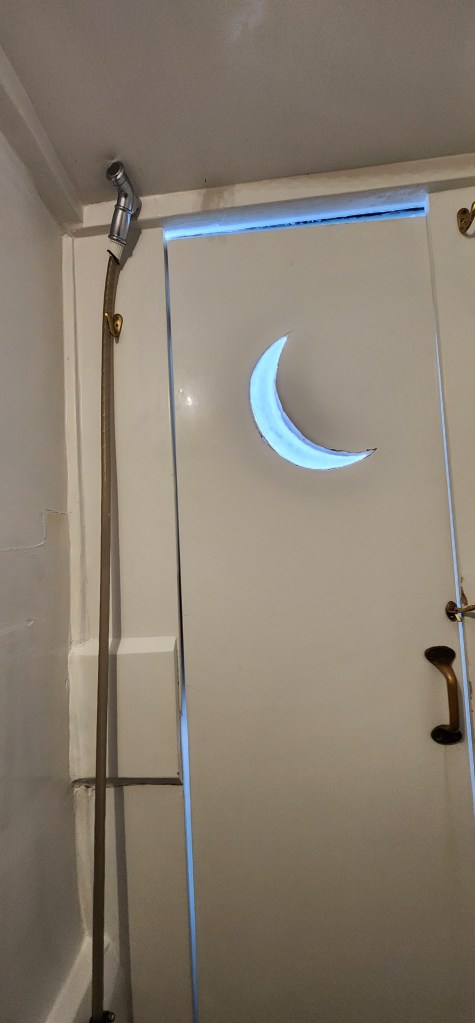
the head’s up on deck

I’m glad it’s not raining
or heavily foggy

though we’re sleeping at sea
it’s calmer than a water bed

creaking and thumps
more likely my neighbors
than the interplay of planks and sea

yes, somebody’s bones

now, for that damned mosquito
or some scratching overhead

who just dropped what
on the deck above me?

a shutting door
with a latch
and shuffling

who’s securing the gear
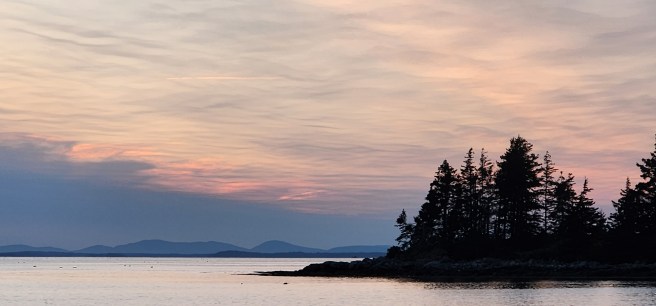
in the dusk?

what a still, calm spot she’s chosen
for the night

3:30 am, a nearly full moon
scattering sound of steady traffic
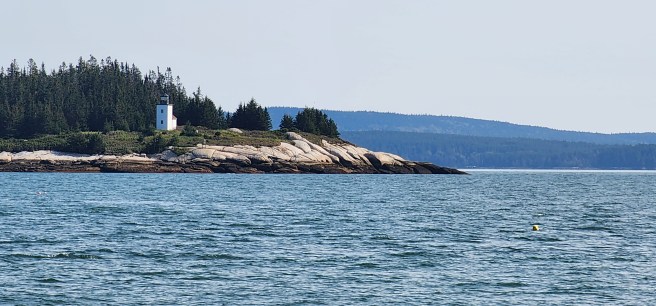
the other side of Isle au Haut
(the south)
may simply be the water motion

there’s definitely surf other side,
slight breeze, 1 mph?
to the west

can barely see Polaris
light cloud cover

only one plane overhead
on the European flight way

and the flash of a fishing boat
light array
in the gap of Deer Isle

what’s all the noise around me tonight
besides a stray cough
or zipper

are we really that restless

I have no idea what the Patriots
or Sox
did over the weekend
though they’ve been spiraling downward

light snoring in my ear last night

I had the most erotic dream
of someone who in reality was almost well

This could become obsessive.

Full sail!

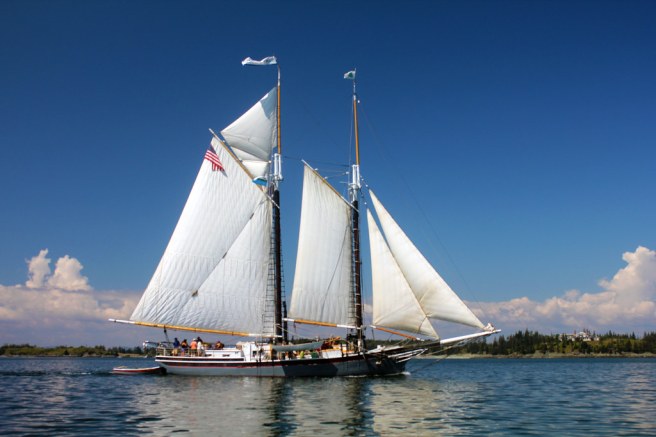
The evolution of the surviving coasting schooners from freight to a summer vacation platform where people could get a taste of what had previously been available only aboard the yachts of the rich is largely credited to Captain Frank Swift and his efforts from 1936 to create what he saw as a kind of dude ranch escape on the waters of Penobscot Bay.

In time, other owners joined in.

Notably, in 1973 Captain John Foss purchased the Louis R. French and removed her from the freight trade. He spent three years restoring the vessel to her original sailing condition and outfitting her hold for passengers. Oh, my, did he!

In 1986, he sold the schooner to his brother-in-law, who sailed and captained the French out of Rockland and then Camden until she was purchased from by Captain Garth Wells in 2003, who in turn sold to Captain Becky Wright and Nathan Sigouin. Maybe “passed her on” would be a more apt description.

Meanwhile, the already legendary Foss turned his attention to renovating the American Eagle, which he purchased in 1984. It’s now one of the few schooners that undertake longer voyages to places like Grand Manan Island near me or down to Gloucester on Cape Ann, Massachusetts, in addition to venturing offshore looking for whales.

At first, those names meant little to me. Now, however, I understand why they’re often uttered in reverential tones.

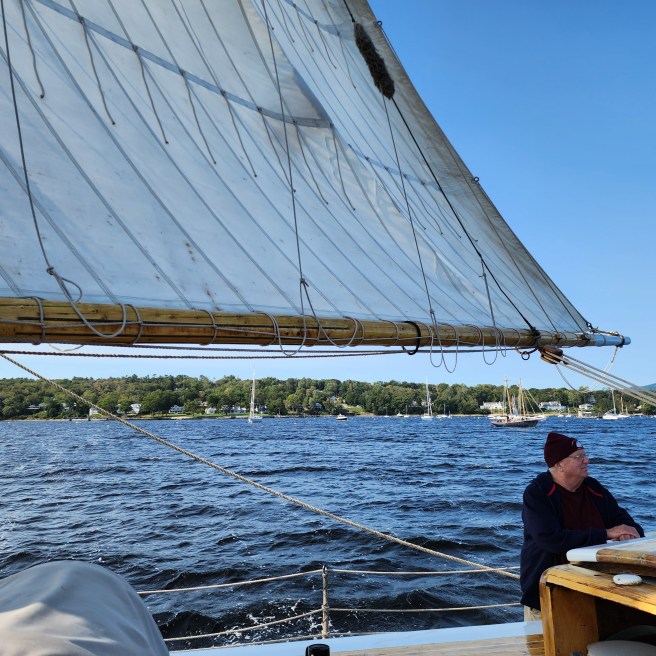
first, flapping fabric as wind kicks in
then a surge at my seat and flooring
like riding a stallion
muscular under the saddle

They weren’t always considered romantic

The 1990 application to include the restored and repurposed Louis R. French in the National Register of Historic Places includes much more than a detailed physical description of the schooner and her history.

The National Park Service document, Louis R. French (Schooner), available online  portrays the two-masted coasting schooner as the most common American vessel type, with tens of thousands of them functioning as the “freight trucks” of their time, carrying coal, bricks, iron ore, grain, oysters, lumber, and even ice between ports.

Yet, at the time of the application, only five of them were surviving in the United States.

In addition, the French was the oldest surviving sailing vessel built in Maine, the center for wooden shipbuilding in the United States after the Civil War.

As the application noted, until the outbreak of World War II, the coasting schooners were so common that nobody paid much attention to them. Designed to run fairly close to shore, the coaster lacked the fishing schooner’s ability to ride out a gale offshore on the fishing grounds. Nor did the coaster approach the scale of the great four-, five-, or six-masted coal schooners that transported coal from southern to northern ports.

Deepwater sailors, who occasionally took a large schooner across the Atlantic, scorned the useful and ubiquitous little coasters, sometimes accusing their skippers of “setting their course by the bark of a dog.”

The application quoted maritime historian Howard I. Chapelle, who observed “the straight fore-and-aft-rigged schooner is decidedly a coastwise vessel, and attempts to use such craft for long voyages have invariably been disappointing and disillusioning, if not disastrous to the adventurers.”

The schooner supplanted the square-riggers in the coasting trade for practical reasons:

Fewer sailors were required to handle the vessel, and a schooner could be worked into and out of harbors and rivers more easily than any square-rigged craft. Her trips could also, as a rule, be made in quicker time, as she could sail closer into the wind, and it was hardly necessary for her to sail from Maine to New York by way of the Bermudas, as some square-rigged vessels have done during baffling winds.

Put another way, they were the errand boys, the short-haul freight droghers, and the passenger buses for many a year, and their contribution to coastal community life, especially in New England, was substantial.

“Without them, the country could hardly have been settled,” as the report quotes one source.

These days, there’s nothing Plain Jane about them, though. Not in my boat – err, book.