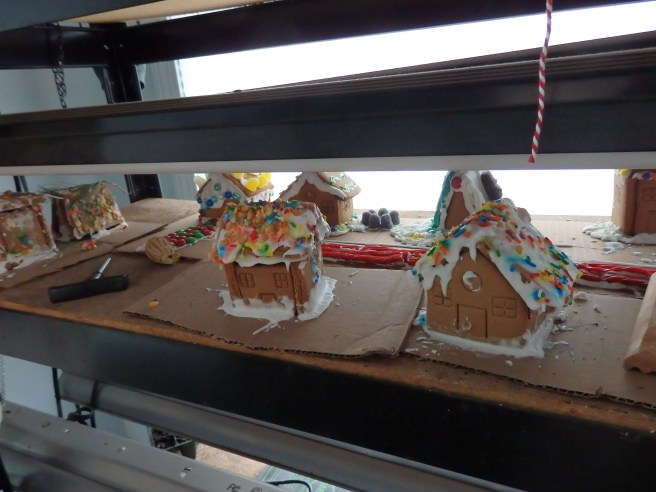
You never know what we'll churn up in cleaning a stall
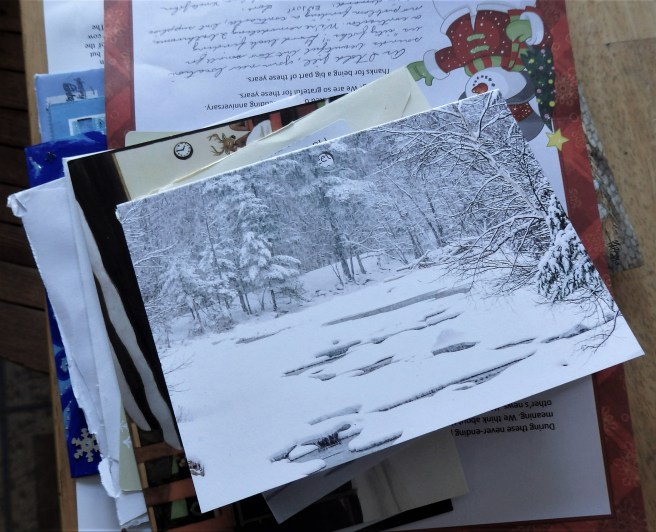
Those (real, postal carrier delivered) cards and letters are a fading tradition, but some of us cling on. Hearing on paper from old friends and some special family members each year is quite different, and warmer, than anything we’d receive online.
Even if it is from the governor or our U.S. senator. In a small state, we’ve usually met them face-to-face.
All of them regard waltzing, rather than the facing lines that give New England contradances their name.
I should mention that there’s something special about waltzes, which usually come just before the break after the first hour or so and definitely at the conclusion of the evening. In fact, one girlfriend would always grill me about my waltz partners on those nights she decided instead to stay home.
The first memory here involves a dance at the town hall in Bowdoinham, Maine, always special in my experience, especially those when the band centered on three families of musicians.
At the break, as I was conversing with a lovely potential dance partner, I noticed that a young fiddler, maybe six years old, was still on stage and teaching an even younger fiddler some music. It was enough for me to say, “Hey, it’s a waltz, let’s dance,” and we did, soon joined by others. I looked up and saw the amazement in her eyes. You know – If we play, they will dance – as an epiphany.
~*~
Years later, elsewhere, I was telling that story to a fantastic young dancer as we waltzed.
Her eyes lit up.
“So you’re the one!”
~*~
And then, at a Bob McQuillan retrospective honoring the rerelease on CD of an earlier LP, the partner I had for the waltz was named Amelia.
Coincidentally, the same as my step-grandmother, fondly recalled.
And the waltz was titled “Amelia’s Waltz,” composed by Bob for the daughter of a beloved band member.
The same one, it turned out, circling with me and ever so light on her feet.
~*~
I’m getting teary as I relate all this, but there you have it.
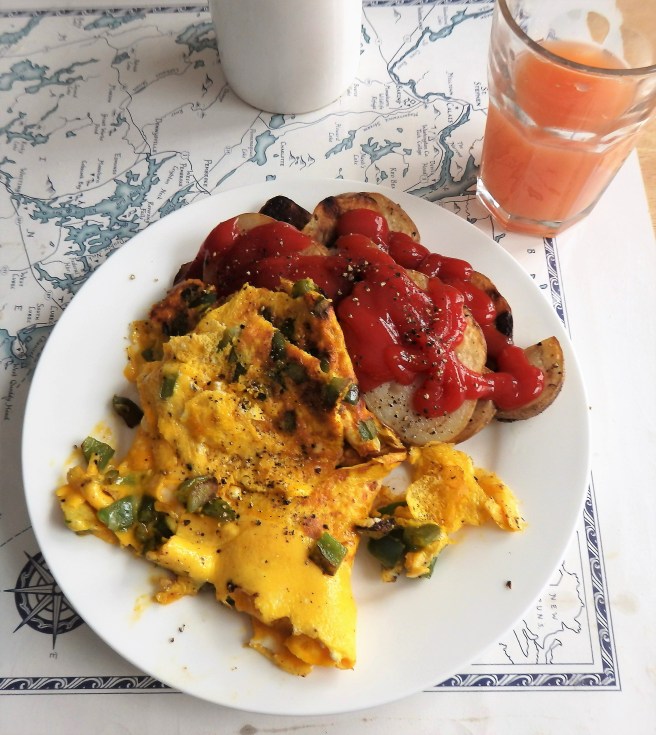
My eating habits were one of the places my residency at the ashram changed my life (see my novel Yoga Bootcamp for a taste of the experience).
The lacto-vegetarian cuisine was one, leading to three extended periods “on the outside” when I continued it. Even when I haven’t, the amount of meat in my menus has remained much less than many Americans’. I rarely use bacon, for instance, and when I do, it’s likely to be as a garnish, say on a spinach salad. Hamburger is more likely to be in a meatball or meatloaf rather than in a bun.
Gravy, curiously, has become more heavenly than ever as an extension of the rue family.
And lamb, a recent addition, is simply glorious, especially grilled.
Grilling, I should add, is something I’ve come to treasure through my wife and the space we dubbed the Smoking Garden. There’s no substitute, as far as I can tell, and it makes for some great social gatherings.
What I gained through the ashram was a delight in vegetables and fruits, especially in season, as well as dried beans, nuts, and mushrooms.
The other lasting change was in my dining habits.
Our first food of the day came after morning meditation, community scripture reading, and perhaps physical exercise, and then it was light food – coffee and toast, maybe with yogurt or fruit, and that after we’d already been up three hours. The real meals were a late brunch or early lunch, around 11, and an evening meal around 4 or a little later.
I’ve continued a similar schedule, foodwise. Well, my caffeine intake is down, per doctor’s orders, but what I have is top-notch. Quality over quantity, right? When I was working the “vampire shift,” till midnight or so, the hours were adjusted accordingly, often with a melty cheese sandwich before bed or a martini. (Alcohol was strictly forbidden on the yoga diet.)
In retirement, I find myself often down to one major meal of the day, and holding steady.
What are some of your food traditions?
Now they’re pretty routine.
Any idea why?
This has the makings of a fine Saturday afternoon tradition through gloomy winter around here. Not that it won’t work on a sparkling day, either.
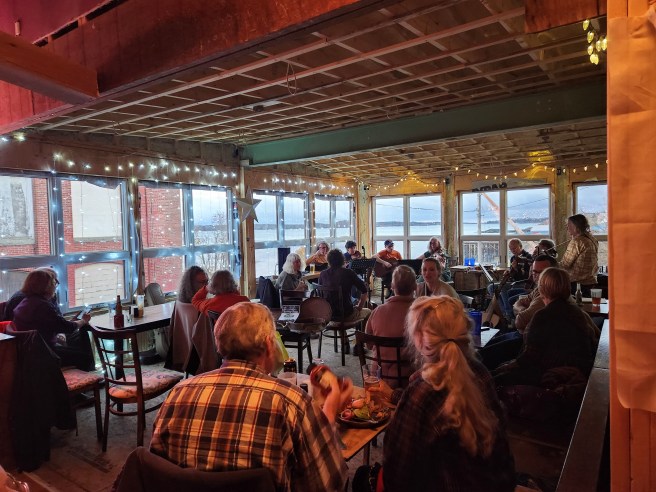
The local contradance band has another monthly performance at the Old Sow grill coming up, and the previous one, as you can see, was a hoot.
It attracted a handful of sit-in musicians in addition to an appreciative audience that packed the house.
Plus, monthly dances at the arts center are set to resume at the end of January after a long Covid hiatus.
Singing in front of an audience is a relatively new experience for me, one arising in my retirement years, mostly through Boston Revels’ top-caliber community chorus and related events.
What I can say is that from the stage, each performance has been thrilling and transcendental, even when not necessarily perfect. Most remarkable is the oneness we sense as a company making melody and harmony.
Before the Covid restrictions and my relocating to Downeast Maine, I was commuting from New Hampshire to Boston as a baritone in the Revels Singers, first under George Emlen and then Megan Henderson. The ensemble ranged from 40 or so to maybe 80 members, depending on the season. Its classical and world folk repertoire was drawn largely from the shows the organization had produced in its more than a half century, with music in nearly 30 languages and spanning a good millennium of history. Many of the arrangements, editions, and original compositions were by our conductors or others affiliated with Revels.
~*~
These days I’m with a much smaller group, Quoddy Voices, which is also led by a fine conductor, pianist, and composer, John Newell, and I’ll proclaim that its standards and abilities are just as high.
We just concluded the second pair of programs with me as a member, and once again I must admit moments of listening to the others in amazement and then wondering how on earth I ever managed to be included. Yes, it’s humbling and challenging.
Technically, we’re a chamber choir – for the concert, 20 singers. Among other things, it means any slipups are more exposed.
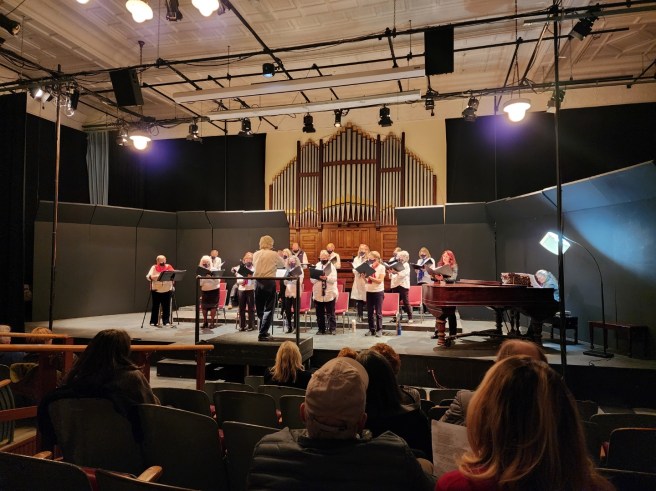
Our program, a Harvest of Song, put us ahead of Thanksgiving and the crowded holiday schedule at the arts center. That meant a shortened rehearsal schedule, but online practice scores of our parts definitely made a difference.
Compared to Revels Singers, our repertoire engages more in works other choirs are also exploring, which led us to three pieces by Florence Price, the first Black American woman to have a symphony performed by a major orchestra. She’s finally being widely discovered, nearly 70 years after her death. From our point of view, her writing is deft, with touches of jazz and flashes of difficulty. The bass line in one score movingly upheld the axiom of less is more.
From living composers we had two widely performed works by Englishman John Rutter, who is admired for pieces that fit the voice like a latex body suit; Californian Frank Ticheli’s masterpiece, “Earth Song”; a lively Calypso in 5-4 time by the now 95-year-old Harry Belafonte; and a haunting 35-year-old Dan Forrest’s setting of a Ralph Waldo Emerson poem.
From old masters we had a deeply reverential motet from Romantic-era Anton Bruckner and sections of Baroque brilliance from Henry Purcell’s 1692 “Ode to Saint Cecilia’s Day,” which foreshadows Handel and his Messiah but with sides of pagan homage, as English poets of the time were wont to do.
We concluded with Randall Thompson’s classic 1940 “Alleluia,” drenched in sadness, as the composer admitted, but becoming quite polyphonic and agitated before introducing a single second word at the end, a seven-part, two-note amen.
While all of these works are widely known in choral circles, all but the Thompson were new to me. I had heard the Thompson only in a broadcast just a year ago and earlier from an old buddy who raved about singing it with his chorus.
Our audiences, as usual, were attentive and enthusiastic.
~*~
So now some of us are scheduled to do some informal caroling before Christmas.
And then, come February, we get to see what our director has in store for us next.
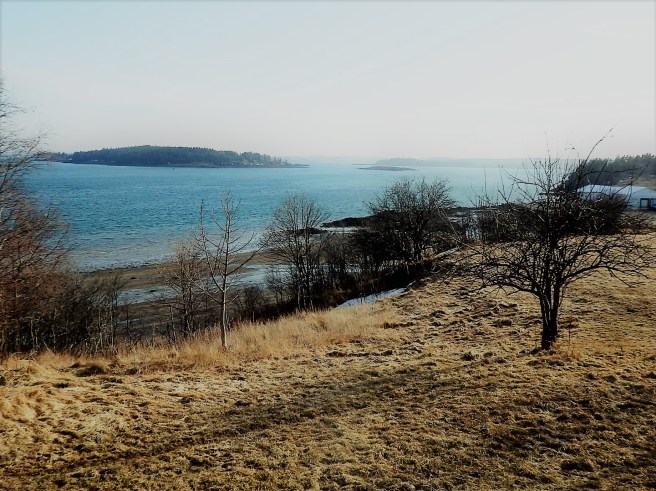
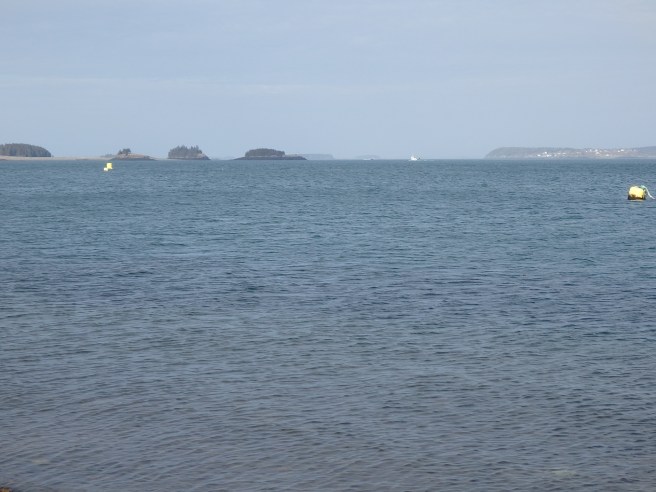
For someone raised like me far from the ocean, trying to pin down places along the coastline can be confounding.
Eastport, for instance, lies within famed Fundy Bay yet also has Cobscook Bay lapping its west banks and Passamaquoddy Bay on its east.
What gives?
Well, let’s say the bays are like Matreshka Dolls, one fitting inside another one that fits within yet another one and so on.
Cobscook Bay, for instance, includes the smaller East, South, Sipp, Dennys, and Whiting bays.
I guess it’s like a New Yorker saying she’s from Flatbush, meaning a part of Brooklyn within New York City, which does – contrary to the knowledge of many Manhattanites – sprawl far beyond their little island.
So Eastport can justly claim to be the City in the Bay. Or several.
You might think the ideal time to work in a forest would be spring or fall, but that’s not how it’s turned out in logging in the great northern forests of New England and New York state. Instead, the time to be out harvesting trees is deep winter. Yup, below zero around here.
I first learned of this when trying to order firewood after an uncommonly warm winter in New Hampshire. Because the ground hadn’t frozen hard enough long enough, the cutters hadn’t been able to access much of the woods with their heavy equipment. The result was a marketplace shortage.
For contrast, mud season can be notorious, so much so that come spring, logging roads are closed to prevent destruction. Much of Maine, in particular, is either standing water, once the ice melts, or boggy, including soft peat bogs. And in late spring and early summer, hoards of nasty black flies swarm about – the defenders of wilderness, as some contrarians contend.
~*~
Folklorists examining the songs of Maine have noticed that many of the songs from the old lumberjack camps originated at sea. You know, as shanties and the like. At first, these scholars were puzzled, but then they realized that winter was a treacherous time to be out on the water. Many sailors instead headed for the forests, to work in the camps for the season. Somehow, though, any songs originating in the woods failed to travel the other direction.
Historically, the logs were stacked along streams, awaiting the spring melting and surging high waters that the timber could ride to ride millponds. That, in turn, could be exciting, demanding, and deadly work where mariners would continue.
From there, the sailors went back out on the ocean.
Mechanization has changed much of that, on land and sea, but not the reality of mucky soil.
We’ll see what global warming does to the industry.
Though Eastport was settled relatively late – that is, toward the end of the Revolutionary War – it was instilled with a Colonial flavor by prominent early residents who were resolute veterans.
A continuing spirit of Tea Party and Minutemen makes Independence Day in New England feel different than those elsewhere. It’s not just the place of the Shot Heard ‘Round the World. It’s the region where thickheaded Yankees have always doodled.
Quite simply, history is palpably alive everywhere across New England.
Boston, of course, is the epicenter, but across the six most northeasterly states, local observations uphold distinctive traditions. Think of musketeers firing a round ever so often along the town parade route, along with fifes and drums.
As an independently enterprising oceanside village, Eastport soon had a reputation as a hive of privateering – that is, legalized piracy – and not-so-legal smuggling. That independent streak gets its own attention in the city’s annual Pirate Festival a week after Labor Day.

Unlike much of America, the city had frontline experience of the War of 1812. Fort Sullivan atop the bluffs surrendered to the British Navy in 1814, and Eastport then remained under the royal thumb until 1818.
Two years after its reunification with the United States, Maine became liberated from Massachusetts for the first time since 1653 and began to breathe into its own unique character.
For its part, Eastport rocketed as a center of shipping, shipbuilding, fishing, and sardine canning before the big decline of the 1900s set in.
Today, the tiny city’s locals remember a vibrant past and close-knit community, one that spanned the shorelines on both the American and Canadian sides of the watery border.
Is a renaissance on the horizon? There are signs for hope.
All of these strands infuse the holiday here.


The national holiday also marks the opening of New England’s short summer season. After a cold, dark, long winter, Eastport’s small year-’round populace can actually come out into the open air for long times together. The ocean and lakes are finally warming, to the extent that they do, and that attracts vacationers to join in.
After months when only a stray New Hampshire or Massachusetts auto plate is seen around here, I’ve now seen those of every state but Alabama, Hawaii, and North Dakota (not all at the same time), some seeming rather exotic.
And the Fourth includes the city’s Old Home Week, with high school reunions and the return of many summer residents.
A lot happens over a four-day span. There’s a doll carriage and wagon parade. A torchlight parade. Car shows, bike races, water games, pet show, rubber ducky race, festive all-you-can-eat blueberry pancake breakfast, free outdoor movie, contests, live music, and a street dance, all with a small-town flavor.
A traditional visit by a large U.S. Navy vessel failed to materialize, a consequence of being on Ukraine-related alert. Three different ships had expressed interest in landing at the Breakwater before the turn in world events.
While fireworks were displayed off over the harbor on the Fourth, America’s Independence Day (the beautifully designed and executed big show fired from the town’s Fish Pier was followed by a joyously rowdy encore from a diner’s smaller private pier), the companion July 1 presentation for Canada Day, in honor of our neighbors in New Brunswick, was still a victim of Covid cutbacks. Some residents, though, could view shows happening on Deer Island across the water.
Seems ever so fitting to shoot the works twice, considering Eastport’s dual connections.
it really does feel like a party’s come to town.
How do you celebrate the Fourth?
 Jnana's Red Barn