Yay! I’m now up on YouTube, too

My first-ever Zoom presentation is now available for streaming, thanks to the Whittier Birthplace Museum. The presentation on January 26, “Starting with a marriage certificate: Why Whittier was no stranger to Dover,” focused on the famed poet and abolitionist’s many connections to, well, my new book Quaking Dover.

For the full YouTube event, do take a look here.

John Greenleaf Whittier is hardly the central theme in the book, but for me, developing the topic for this show, along with the accompanying PowerPoint slideshow, another personal first, was fun.

If you’re a regular here at the Barn, you know I do lag behind on the tech front. One step at a time, right?

I didn’t expect an unusually itchy nose and scratchy throat resulting from our dry indoor air. So much for my up-in-the-corner-of-the-screen stage presence.

On top of that, with the PowerPoint up in front in me, I couldn’t see who was attending. Oh, well, I had my hands full anyway.

Earlier, behind the scenes, there was concern about a possible power outage on my end as unusually warm temperatures dropped below freezing amid heavy rain. We did have a contingency plan, just in case.

I’m so glad we didn’t need it.

I never expected so much Donizetti

I’ve posted previously on the outstanding and often original finals’ week programming on Harvard’s student-run FM radio station. Each December and May, the regular schedule shifts to a few weeks of special blocks of classical, jazz, rock, folk, world, and many other strands of music I hadn’t even heard of for something the station has trademarked as Orgy, as in “Donizetti Orgy,” which I’ll explain. For accuracy, we should note that final exams really cover closer to two weeks or a tad more.

One year, for instance, they played everything Bob Dylan had recorded. A few years later, a much shorter sequence introduced many of us to Florence Price, a significant Black American woman composer who has since been receiving a posthumous flowering. The decisions are often based on anniversaries, as happened a few years ago when we got to hear everything Beethoven had ever written, in chronological order. Musically speaking, of course. I have no idea about his letters. A year ago, Schubert got the same treatment, meaning a lot of art songs in German, especially. That one nearly became an Orgy of its own for the baritone Dietrich Fischer-Dieskau, whose son once told classmates what his dad did for a living was make records. Let’s just say that many of these Orgies are highly eclectic.

I did raise my eyebrows in the last round when well over a hundred hours of airtime were devoted to the 225th anniversary of the birth of Domenico Gaetano Maria Donizetti, known largely for a dozen or so marvelously florid operas. Turns out he created nearly 70 operas plus symphonies, string quartets, concertos, piano scores, songs, and so on, which were presented, again chronologically, in big blocks over two weeks. Where do the programmers dig up all of the recordings? Is this really some Harvard grad student’s thesis project?

Donizetti (1797-1848) is renowned, along with Rossini and Bellini, for a specialized style of opera called bel canto, “beautiful singing,” which has had a major revival in the past half-century. Today its embellishments, soaring lines, and vocal athletics have become widely embraced, but back when I was first listening, it was all revolutionary. And, among the three, Donizetti was far and away the most prolific.

What made the series significant to me was the way it revealed an evolution over his 29-year career from formulaic provincial stage comedies to what we recognize as Romantic opera. It filled in a gap in operatic history for me, getting from us classical Mozart to gripping dramatic Verdi and beyond. Composing at fever pitch, Donizetti often churned out four new operas a year, many of them in one-act pieces plus others that recycled earlier material before he reached a more sustainable stride. Think of a rock band or pop artist turning out an album, which is only an hour or so compared to a three-hour opera. Or a movie composer, for that matter, who has to create a similar amount of music. Nobody does four a year, right?

In the broadcasts, Donizetti’s early works sounded serviceable but not memorable. They were built on strings of solo arias, choruses, and recitative, which I streamed while working on my own life. That would mean one character in the spotlight, exit stage, and then another. Laundry, cooking, vacuuming, or washing dishes anyone? You know, everyday stuff, with music in the background. Midway into the series and his career, though, the dramatic level rose immensely and caught me in my tracks, especially with the appearance of ensembles of simultaneous conflicting emotions and motivations. Yes, there were hints of things ahead, like the flash connecting one faintly familiar tenor aria with what would emerge later, with nine high C pings inserted as “Ah! Mes mis,” and eventually launch Luciano Pavarotti into international household fame in 1972. (We did hear him in that role around 6 am the final day, when “La Fille du Regiment” aired from a recording of London’s Covent Garden production with Joan Sutherland and Richard Bonynge costarring.)

Quite simply, those were the flashes when I recognized we had crossed over into everything today’s operagoer anticipates, even with Mozart, Gluck, and Handel remaining glorious within their earlier realms.

Many of the Orgies really are once-in-a-lifetime events. With Donizetti, for example, it’s unlikely that I’ll ever again hear most of what was introduced. Simply tracking down rare pieces would be an overwhelming challenge.

Let’s see what May brings. Those kids at WHRB really do deliver.

The world’s most glorious sauerkraut

For most of my life, I never would have thought sauerkraut could rise any higher than maybe a gag-inducing edible in an obligatory sort of way. You know, like liver. Something in some households you might be required to eat on New Year’s Eve to assure a good 12 months ahead. Think of lutefisk (lye fish) in Nordic cultures as a parallel.

Well, my best friend’s parents, of good German Lutheran stock, made their own, but they also composted for their garden, and back in the ‘50s, that seemed pretty weird.

I am convinced that there are certain dishes that will never become acquired tastes to some or even many tongues. (Feel free to make nominations here.)

That said, imagine my surprise in recent decades in discovering the joys of fine Chinese cuisine, along with the shock of learning that the filling on those snappy eggrolls and spring rolls was essentially sauerkraut, just by another name.

Maybe that set up the moment of revelation.

Morse’s in Waldoboro.

First came some nibbles after an old Mainer made his annual pilgrimage, returning with 20 or 30 pounds or so.

The taste was sweet and tangy, even refreshing. I do like pickles, but these are in a class all their own. I mean, they’re glorious. OK, I had come to prefer coleslaw with a vinegar dressing more than the conventional creamy one, so maybe that had prepared me. (Not that I turn down either.)

That’s set up our own trips in the family, including one with me in the depths of a very snowy February. The road out of the village to the store seemed to take forever, I was sure we had taken a wrong turn somewhere, but then the small store appeared, and it offered more crocks of pickled traditions than just kraut. It also had a small but very tasty German restaurant, which appears to have fallen victim to Covid restrictions. All in all, a delight.

Upshot is, it’s a dish I’ve come to anticipate each winter from our own ten-pound or so purchase.

Morse’s is, in itself, a fascinating story of a family business that’s undergone some transformations but maintains a small niche in an increasingly monolithic food industry. I have no idea if you can find it anywhere near where you live, but then maybe that might inspire another entrepreneur to rise to the challenge. Bigger is not always better.

A half gallon of fresh scallops

Or about 4½ pounds, purchased from a dragger docked at the Breakwater pier, where the crew of three was busy shucking the morsels from their shells. After dining on these two days straight last Christmas, we agreed we have a new holiday tradition. Unlike ones you would purchase at a market, these have no water added, and that means you can get a lovely sear when sauteing them in a bit of olive oil and butter. Do I need to add they taste heavenly?

Once again, we’ll catch up

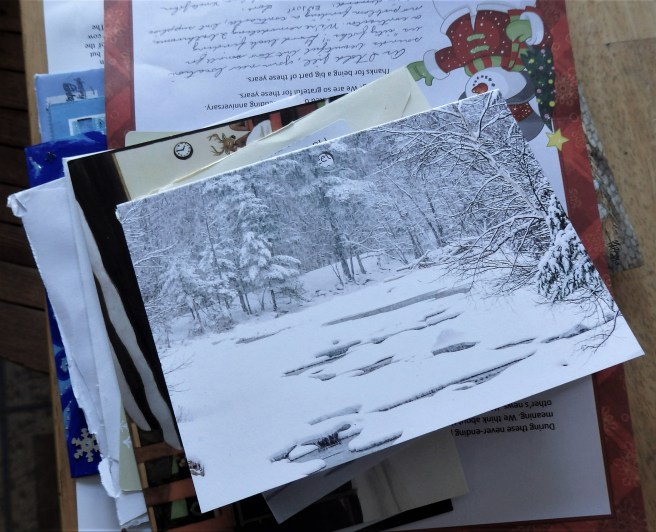
Those (real, postal carrier delivered) cards and letters are a fading tradition, but some of us cling on. Hearing on paper from old friends and some special family members each year is quite different, and warmer, than anything we’d receive online.

Even if it is from the governor or our U.S. senator. In a small state, we’ve usually met them face-to-face.

Three contradance highlights

All of them regard waltzing, rather than the facing lines that give New England contradances their name.

I should mention that there’s something special about waltzes, which usually come just before the break after the first hour or so and definitely at the conclusion of the evening. In fact, one girlfriend would always grill me about my waltz partners on those nights she decided instead to stay home.

The first memory here involves a dance at the town hall in Bowdoinham, Maine, always special in my experience, especially those when the band centered on three families of musicians.

At the break, as I was conversing with a lovely potential dance partner, I noticed that a young fiddler, maybe six years old, was still on stage and teaching an even younger fiddler some music. It was enough for me to say, “Hey, it’s a waltz, let’s dance,” and we did, soon joined by others. I looked up and saw the amazement in her eyes. You know – If we play, they will dance – as an epiphany.

~*~

Years later, elsewhere, I was telling that story to a fantastic young dancer as we waltzed.

Her eyes lit up.

“So you’re the one!”

~*~

And then, at a Bob McQuillan retrospective honoring the rerelease on CD of an earlier LP, the partner I had for the waltz was named Amelia.

Coincidentally, the same as my step-grandmother, fondly recalled.

And the waltz was titled “Amelia’s Waltz,” composed by Bob for the daughter of a beloved band member.

The same one, it turned out, circling with me and ever so light on her feet.

~*~

I’m getting teary as I relate all this, but there you have it.

When and what do you eat?

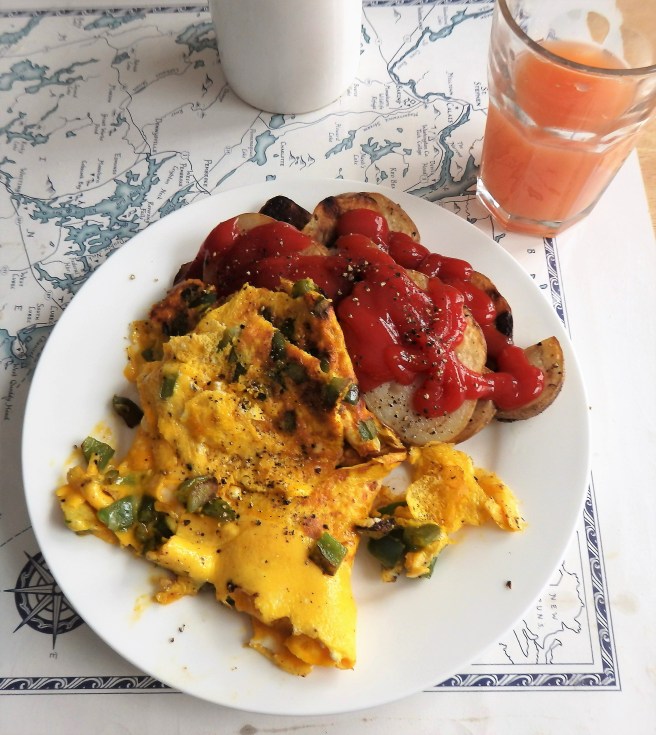
A cheese, green pepper, and mushroom omelet using eggs from our next-door neighbor’s hens is served with home fries made of potatoes I purchased in Aroostook County. Notice there’s no need for ham or bacon. I do love grapefruit juice, by the way. Brunch like this remains a favorite Saturday tradition for me.

My eating habits were one of the places my residency at the ashram changed my life (see my novel Yoga Bootcamp for a taste of the experience).

The lacto-vegetarian cuisine was one, leading to three extended periods “on the outside” when I continued it. Even when I haven’t, the amount of meat in my menus has remained much less than many Americans’. I rarely use bacon, for instance, and when I do, it’s likely to be as a garnish, say on a spinach salad. Hamburger is more likely to be in a meatball or meatloaf rather than in a bun.

Gravy, curiously, has become more heavenly than ever as an extension of the rue family.

And lamb, a recent addition, is simply glorious, especially grilled.

Grilling, I should add, is something I’ve come to treasure through my wife and the space we dubbed the Smoking Garden. There’s no substitute, as far as I can tell, and it makes for some great social gatherings.

What I gained through the ashram was a delight in vegetables and fruits, especially in season, as well as dried beans, nuts, and mushrooms.

The other lasting change was in my dining habits.

Our first food of the day came after morning meditation, community scripture reading, and perhaps physical exercise, and then it was light food – coffee and toast, maybe with yogurt or fruit, and that after we’d already been up three hours. The real meals were a late brunch or early lunch, around 11, and an evening meal around 4 or a little later.

I’ve continued a similar schedule, foodwise. Well, my caffeine intake is down, per doctor’s orders, but what I have is top-notch. Quality over quantity, right? When I was working the “vampire shift,” till midnight or so, the hours were adjusted accordingly, often with a melty cheese sandwich before bed or a martini. (Alcohol was strictly forbidden on the yoga diet.)

In retirement, I find myself often down to one major meal of the day, and holding steady.

What are some of your food traditions?

Not a bad way to spend a dark Saturday afternoon

This has the makings of a fine Saturday afternoon tradition through gloomy winter around here. Not that it won’t work on a sparkling day, either.

Moose Island Contradance Band. Photo by Rachel A. Williams.

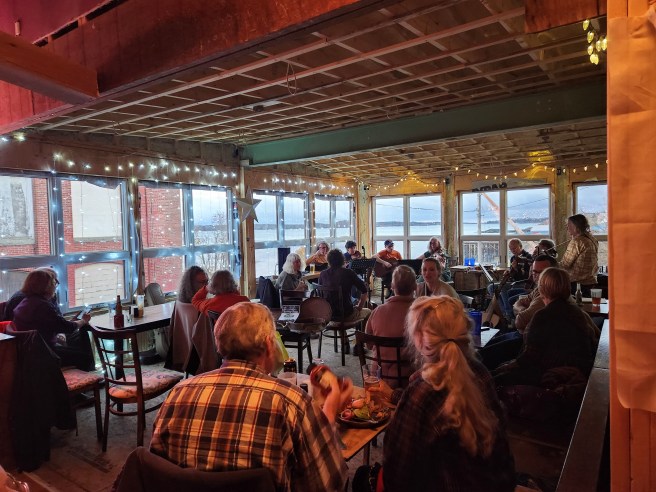
The local contradance band has another monthly performance at the Old Sow grill coming up, and the previous one, as you can see, was a hoot.

It attracted a handful of sit-in musicians in addition to an appreciative audience that packed the house.

Plus, monthly dances at the arts center are set to resume at the end of January after a long Covid hiatus.