Forget what you think you know about pirates

The popular image, shiver me timbers, comes straight out of Disney.

To set the record straight:

  1. They didn’t punish people by making them walk a plank blindfolded. Instead, the victims were killed immediately or keelhauled – tied to a rope and dragged behind the ship.
  2. They didn’t say “Ahoy!” or “Matey!” I’m not so sure about “Argh!”
  3. Female pirates had to disguise themselves as men to protect themselves. But, by some accounts, there were many of them.
  4. Forget the buried treasure. And their loot was often something other than gold or jewelry.
  5. In fact, maps and some books were more treasured as booty than gold.
  6. Captains were elected and could be removed. Who would have thunk?
  7. The eyepatch wasn’t to hide a missing eye but rather to allow for rapid visual adjustment between above deck and below. Anyone want to try that for verification?
  8. Conditions aboard a pirate ship were often more civilized than those on merchant vessels, where lousy rations and low pay were often common.
  9. The skull-and-crossbones Jolly Roger wasn’t the only terrifying pirate flag, by far. How about Black Bart’s one having himself holding an hourglass with the Devil? Or Captain Low’s blood-red skeleton standing at the ready?
  10. Pirates still flourish today, especially in the Indian Ocean and parts of the Pacific.

Well, Eastport’s annual pirate weekend festival’s coming up. We’re bracing for the invasion.

I’m feelin’ some schooner excitement

Somewhere in my youth I fell under the spell of windjammers – vessels under full sail in the wild ocean. Those were as far away from my native Ohio as were the white-capped mountains that also caught my fancy.

Over the years, though, even as I came to know first the Pacific Northwest and later, coastal New England, I never considered actually going on an overnight windjammer cruise. Dismissed it as too expensive on our limited income. For contrast, I should note that I’ve never had any interest in an ocean-liner cruise. Zip.

But in late May, a dear friend from Vermont stopped by for a few days on his way to his annual windjammer trip on Penobscot Bay and that, well, reignited those dreams.

My wife looked at our budget and encouraged me to join him on his early autumn return. For the record, she’s declining to go too, remembering a bad seasick whale watch excursion when we were first together. No way would she venture forth for so many hours or days.

Upshot is at the end of next month buddy and I will spend the better part of a week under sail on a historic schooner exploring some famed Maine waters, especially the lighthouses along the way.

I have to admit, a windjammer should be my kind of excitement. And because my buddy grew up sailing, I’ll certainly be privy to a deep source of inside information. At least maybe I’ll have more of the terms right when I report on our adventure.

In addition, many of the classic sailing ships were built only a block or two from our house, back in the heyday of masts and canvas sails. The remaining keel of one schooner is exposed at low tide only a block or two from my house.

I’ve started counting the days till we set sail.

Will they even be called sportswriters anymore?  

I’m still reeling from the decision at the New York Times to disband its sports department.

Admittedly, for much of my career, a newspaper’s sports staff was a mystery, set aside in a different room or even more elaborately from the rest of the reporters and editors. Sports seemed to demand a disproportional amount of newsprint, too, compared to, say, world news or even politics.

Only later, working at the fringe of Greater Boston with its intense team fanaticism, did I come to see things differently.

For one thing, the Boston Globe had some great sports coverage and I soon admired some of the writers. For another, I could see how the Red Sox, Patriots, Celtics, and Bruins held the region together at a gut level as an extended community. Many of our obituaries, for instance, included the line, “She was an avid Sox fan” or the like. Devoted? Sometimes “rabid” would have been more accurate, but “avid” was the term of choice.

As a journalist, I envied the excellence at the top papers that resulted from deep planning and commitment as well as top talent. I could see that a few papers stood head and shoulders above the rest on that front – the Globe, Washington Post, Chicago Tribune, Los Angeles Times, and, of course, the New York Times. Gee, they even had expense accounts and travel.

~*~

Thus, the idea of shuttering a first-class operation seems extremely drastic.

Yet, the Times does differ from most other dailies. It is, for one thing, a national newspaper far more than a New York paper. High school sports are trivial in its scope, as are many college games. The city itself has not just one or two professional teams – or even four, like Boston – but two in baseball alone and two in football plus two in basketball, does anyone even care about hockey or soccer or tennis or golf or whatever else in that crush? There’s only so much space in a paper, after all.

Much of the coverage will be drawn from the Times’ subsidiary website, The Athlete, which already has a national focus and staffing. There is reason for concern, though, that those positions do not have union representation, unlike the Times.

The decision likely reflects a recognition of major shifts in sports coverage across the city and the county as well. Internet access means that scores and other statistics can be instantly browsed from anywhere, rather than having to wait for the paper to arrive.

Cable has expanded game availability to fans, even those living far from the teams.

And then what’s there left to say after ‘round-the-clock sports talk radio and all the call-in chatter?

The Times’ arts coverage has already undergone a similar evolution, with less coverage of events and more emphasis on trends and influences. That seems to be what we can expect on the athletic front next.

In the newsroom, we were always perplexed that a section that generated so much readership – presumably male – failed to garner much advertising support. Department stores and supermarkets didn’t want to appear there, nor did auto dealers and parts stores. As for restaurants or movie theaters or politicians? Remember, advertising, rather than subscribers or newsstand sales, paid the bulk of the bills.

Deadlines, too, often hinged on the final score of the day, at least for the morning papers. Back in the day when we still had afternoon papers, you could get a more leisurely account there before the next game. Either way, those deadlines have moved up for other reasons. No waiting around breathlessly.

~*~

How this will play out on local papers remains to be seen. All I know is that staffing and space and advertising are all way down there, too.

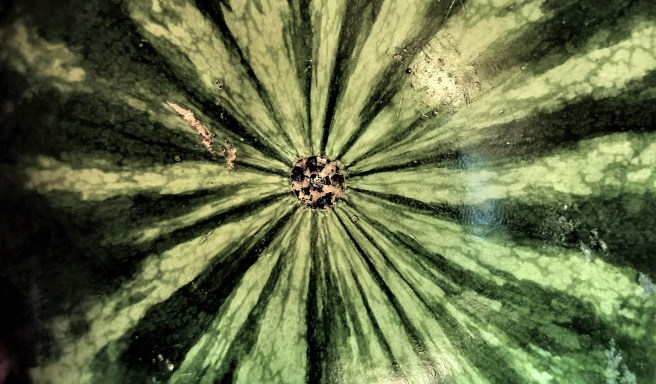
Does anything celebrate summer more than a watermelon?

And here I was about to investigate all kinds of melons, starting with cantaloupe.

That said, just consider:

  1. A watermelon is one of the few foods to be classified as both a fruit and a vegetable. Wish I could count it twice on my daily dietary requirements but guess that would be cheating.
  2. It’s a relative of both pumpkins and cucumbers.
  3. It’s far and away the most popular melon in America.
  4. There are more than 1,200 varieties, but the seedless hybrids are the only ones you’ll likely find nowadays at the market, at least in the USA.
  5. Those seedless versions aren’t genetically modified. Technically, they’re simply sterile with white seeds that are perfectly safe to eat.
  6. Watermelons originate in Africa and have been cultivated in Egypt for 5,000 years. That’s why they really do need a long stretch of summer.
  7. Based on weight, watermelon is the most consumed fruit in America.
  8. It’s 92 percent water yet rich in vitamins and contains only six percent sugar. By the way, there’s no bad fat or cholesterol.
  9. Its flesh isn’t always red – orange, green, yellow, or white are other options.
  10. In Japan they’re grown in glass boxes to maintain the unnatural cubed shape.


Adding to the memories

Sailors who visited Eastport for the Fourth of July voiced their amazement at the pilot who guided their U.S. Navy destroyer vessel at the Breakwater pier in some very dense fog.

They could hear the conversational voices of humans on the pier and shoreline but couldn’t see a thing. We could hear them but not see them, too.

And then they were landed, gently and safely.

They told us he was a magician, and from my angle of observation, it was true. Even the commanding officer was most amazed, in what became a memorable experience.

Oh, those clean starched white dress uniforms

The 350 U.S. Navy sailors who descended on Eastport for our extended Independence Day festivities were the first to uphold the longstanding tradition since before the Covid pandemic.

They were a welcome contingent in our small community, often appearing in their pristinely ironed white uniforms, which do look impressive even though, as I was told, they can be a challenge to keep clean. You have to lean way over while eating, for instance, to keep from spilling anything on yours. Not that we noticed any dirt when they marched as a big bloc in the grand parade Tuesday afternoon. At least the sailors and officers who fielded teams in the very messy cod relay contest the previous day were more practical in their dress.

What they got was a six-day taste of small-town America having summer fun.

As the police chief reported, “the Fourth of July was relatively quiet, aside from a couple of fights involving sailors … which were handled by the crew from the Navy ship.”

Finally, a decent seafood selection Way Downeast

Even though we live a block from the ocean, we’ve been perplexed by the selection of local seafood available in the region’s markets. Or more accurately, it’s lack.

The bigger supermarkets have been a disappointment, and the smaller ones, quite limited.

The best overall selection we’ve found, especially for local catch, is Earle’s SUV that shows up on U.S. 1 down in Machias on selected days. That’s an hour away.

For crab, clams, and scallops, it’s Betty’s seasonal shack in Pembroke, about 20 minutes from home.

Other than that, it’s meant going directly to the fishermen, if you know where they are.

Finally, we’re feeling upbeat. The reopening of Quoddy Lobster’s dining operation, just a block from us, includes a fresh seafood counter.

New owner Look Lobster, a fifth-generation family company in Jonesport, has already invested heavily in the Eastport site by rebuilding the pier for straight-from-the-boat deliveries. Last summer it became my go-to place for fresh retail lobster, especially for anything over a pound and a half.

Now that the end-of-the-street site is serving traditional lobster plates for the first time since Covid, it won’t be long before the outdoor picnic tables by the sea are soon packed with devoted fans. The place, a very popular destination both among tourists and locals, was much missed.

Hold on to that fish!

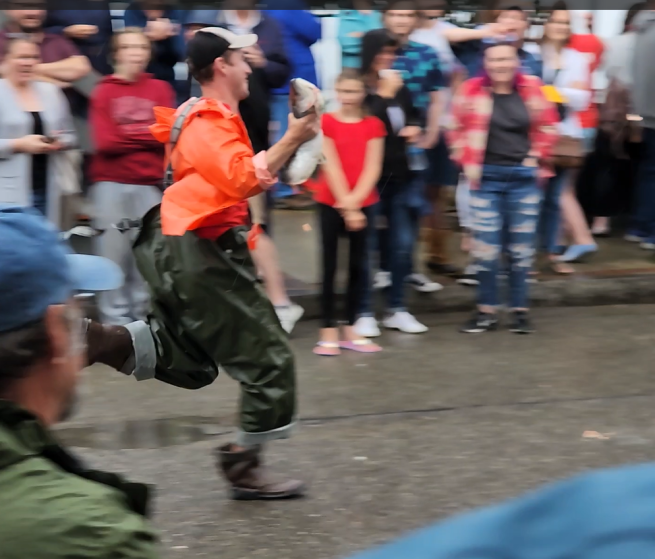
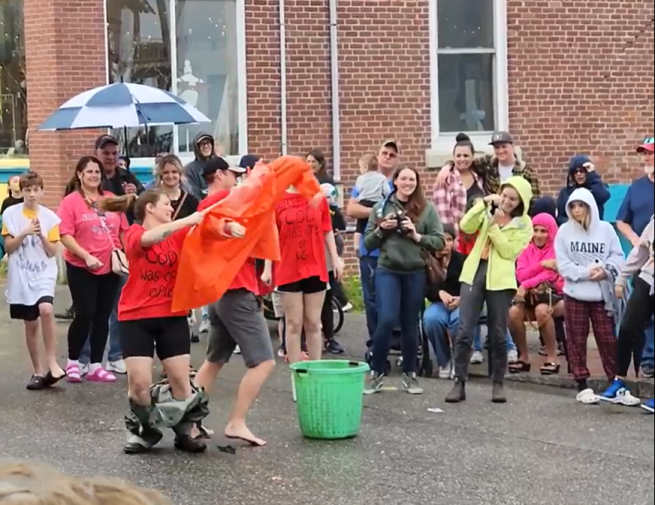
An annual cod relay race – using raw salmon instead – is one of the more hilarious traditions at Eastport’s extended Fourth of July festivities.

Running down the street with a fish is only part of the excitement.

Relaying the gear – boots and the slicker, along with the fish – to the next runner is the heart of the contest. Here, two of the younger runners have it almost down to a science.

All-ages teams are paired off during the day until there’s a first-place winner.

This is the big day for pyrotechnic displays

Unabashedly, I am a snob when it comes to putting big fireworks together in an aesthetic whole, rather than something that resembles an action movie big car smashup.

A smart design team can use the entire sky as a canvas of evolving colors, combined with the timing of a sharp comedian.

That said, here’s some perspective.

  1. A show like Boston’s on the Charles River Esplanade fires off 5,000 pounds of explosives in its half-hour glory. That performance requires a computerized launch system for five barges floating on the water.
  2. Macy’s, the nation’s biggest, goes for an average 1,600 shells a minute – more than three times as many as a typical town display uses for the entire night. That show has more than 40,000 shells fired from six barges in the Hudson River.
  3. China produces 85 percent of the world’s fireworks.
  4. Many of the styles are named for flowers such as peony, chrysanthemum, or dahlia. Others, after trees, as in willow and palm tree.
  5. Prices vary wildly, especially when you’re looking for some serious color intensity and blending rather than honky-tonk garish.
  6. Shells are sold by tube diameter, commonly six-, eight-, and ten-inches, with each additional inch typically adding another 100 feet of elevation to the shot. Are some of those bursts really a thousand feet overhead?
  7. An aerial shell contains six parts. Or more, depending on what bells and whistles are added on.
  8. Larger shells cost average around $336 apiece and may require an 840-foot display radius.
  9. Even a small-town show will run between $7,500 to $15,000 to produce, just for the fireworks. Add to that set-up and clean-up labor, sanitation, musicians, and public safety expenses. The average municipal show costs $25,000. In contrast, a wedding show is tabbed for $1,500 to $3,000. But don’t hold me to those figures. Other estimates I’ve seen simply soar.
  10. Injuries send about 10,000 Americans to the emergency room every year, two-thirds of them males, and many of the injuries are to children. That’s in addition to 7.9 fatalities. As another safety consideration, more fires are reported on July 4 than any other day of the year – some 19,000.