Somehow, lobsters have become identified with Maine the way maple syrup has stuck to Vermont, even though both are found abundantly in neighboring states and provinces. I won’t even get into moose in this discussion.
Here are some talking points.
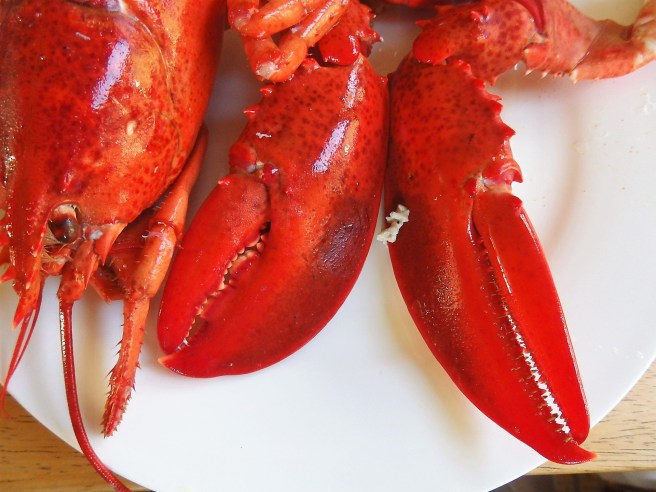
Unlike other varieties, ours are distinguished by having large claws. One claw, the crusher, is larger than the pincher.
They have clear blood.
They smell with their eight legs but have poor vision. Their four antennae help them locate food. They can also swim backward.
They chew with their stomachs, which are located right behind their eyes. They lack teeth but have a “gastric mill” that reduces their prey.
They live on the ocean floor and never stop growing, which they accomplish by molting. Some are known to be more than a hundred years old. In fact, they show no signs of aging and almost universally die of external factors.
It was once a poor-man’s dish, typically fed to servants. Impoverished families sent their children to school with lobster in their lunch buckets and an envy of the richer kids’ roast beef or chicken.
Lobster comprises 75 percent of Maine’s commercial fishery value. In 2016, a banner year, the state’s 6,000 lobster-fishers landed more than 130 million pounds worth more than $533 million.
A traditional lobster pot or trap has two sections – a “parlor,” where they enter, and the “kitchen” behind it. But for much of the region’s history, they were more likely to be harvested by hand along the shore and tide pools, where they washed up after storms.
Most lobsters are caught in the summer months, before the shellfish trot off to deeper waters where they’re harder to harvest. In Eastport, many of the lobster boats do double-duty each winter, rigged to drag the bay bottoms for scallops. A few even go after urchins.
Maine commercial lobstering is tightly regulated – more than in neighboring Canada – and licensing involves a long waiting list. You’d better apply well before your twenty-third birthday if you’re interested. Even if your dad still has his boat.
People with their cameras – or more often than not, their cell phones – are everywhere, taking pictures. Everywhere you turn, you find them visually captivated.
Across the country, pumpkin flavoring seems to infuse about everything on the menu come October, and something similar happens every summer in Maine with blueberries. The tourists and summer people, especially, seem to eat it right up. (Err, couldn’t help myself there.) So it’s not just lobster they come to devour.
Here are some facts about Maine’s in relation to the rest of the nation and world, mostly.
The local brewpub calls its obligatory blueberry ale Skul Clothes. The name puzzled me until I was told that’s how kids traditionally earned the money for their school clothes each year, at least before mechanized machines took over most of the patches. “It’s hard work, down on your hands and knees,” as one recent high school graduate told me. “But the pay’s good.” After that, I could tell the locals who walked in for the first time, looked at the offerings on the chalkboard, and broke out in a grin. They’d all done it.
Ours are lowbush, wild, unlike the highbush varieties cultivated elsewhere. We lead the world in lowbush production, though it’s a drop in the bucket compared to the highbush harvests of British Columbia, Oregon, or Washington state. While Atlantic Canada produces half of the world’s wild blueberry tally, that covers more than a single province – Nova Scotia is the leader there.
Lowbush berries are smaller but more flavorful, in our humble opinion.
They’re also preferred in making blueberry wine.
Blueberries are one of the few commercially-available fruits native to North America. The First Nations, some of whom called them star-berries for their blossoms and the tiny ring at their base, have been eating them for at least 13,000 years
They top the list as an antioxidant and are rich in Vitamin C and even manganese.
Wild blueberry patches are burned every two years.
Wild blueberries freeze in just four minutes.
Some research indicates they counter memory loss in aging. I’ll have to remember that. They’re also good for the heart, cancer-risk reduction, and lowering blood pressure.
I like mine fresh, with yogurt or cream. Pancakes, muffins, jams and jellies come next.
I’ve mentioned the impact of my rogue Boy Scout troop on my life via hiking. Camping was related. We used homemade square tarpaulins – three rows of muslin our mothers sewed together that we then dyed and waterproofed.
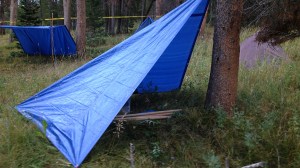
Here’s the general idea for pitching a trail tent.
We called them “trail tents,” though “tarp tents” seems to be more universal. They could be set up in any number of ways – a two-sided triangle with the front open was most common, using a second one as the ground cloth – or in good weather we could even roll our sleeping bags into one and stretch out in the open.
We took pride in our primitive camping abilities.
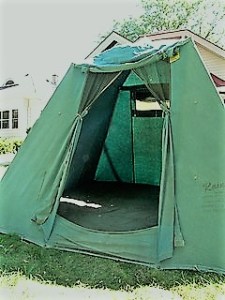
Our vintage umbrella tent was like this, with the poles inserted along the ridges inside.
My family, on the other hand, had a clumsy and often smelly “umbrella tent,” so named for the way you had to set it up from the inside and then remove the aluminum center post – well, they’re now called “cabin tents,” and apparently more flexible.
I inherited the tent and used it for many of my escapes in the Pacific Northwest, my complaints aside. It got a lot of miles over the years.
The result in either case was some memorable opportunities to get closer to nature. Among them:
Family summer vacations at Indiana state parks, especially Spring Mill with its limestone caves; Natural Bridge in eastern Kentucky with its old railroad tunnel at the base of a mountain with a stone arch at the top; Mammoth Cave in Kentucky; and Lincoln’s Old Salem in Illinois.
There was also a Florida trip we shared with a Chattanooga family Mom and Dad were fond of from his Army-Air Force days. At age 12, it was my first exposure to the ocean and a Southern belle a year or two older than me. Our trip back included a night 17 miles back from the highway in Okefenokee Swamp in Georgia, where we were surrounded by masses of mosquitoes, more than a few three-legged deer (the result of encounters with ‘gators), and raccoons that could open the doors to the porches of the camp headquarters and then raid the top-slider Coke coolers. Let’s say simply we heard a lot of eerie sounds in the darkness and escaped with our lives once the sun rose through the Spanish moss.
My first time in a trail tent was shared with another neophyte. We proudly set up our tent, tying the front line to an Osage orange tree – I remember the strange color when we split firewood. Alas, a storm blew in during the middle of the night and pulled up some of our stakes. I rolled enough of the ground cloth around my sleeping bag to get through the night. Not so, Jackson. He nearly froze and his bag the next day must have weighed a hundred pounds. After that experience, I always checked the wind direction before deciding where to raise the tent.
Another Scout outing, remembered vaguely, was in May or June in a farmer’s woodlot. It simply felt magical, nothing like a designated campground.
Our troop joined one or two others in the summer at a site in Lake Vesuvius State Park near Ironton, Ohio. This time we used wall tents, but it was still primitive. The park had the remains of an early stone blast furnace, and we spent a day in rowboats exploring the lake. One fall, we returned to plant trees in a strip mine. I’ve hated that form of mining ever since.
Out-of-state hiking trips also included overnights, usually two. I especially remember those of the Lincoln trails and others around Lexington, Kentucky. And there was the near-perfect night in Indiana when we rolled out under the stars only to be interrupted at midnight and having to hustle our gear under a nearby picnic pavilion when a harsh storm blew in. And then the rangers showed up and scolded our scoutmasters. But the next morning, and for much of our drive home, we saw tornado damage.
Roan High Knob, at the end of our week on the Appalachian Trail, turned into a festive array of unconventional trail-tent setups. It was like a camel caravan had moved in. At least until the big thunderstorm and repeated deluges.
Later, as an adult, there was a week circumnavigating the Olympic Peninsula, an event I celebrate in a longpoem.
Also in Washington state, a week I spent in the North Cascades – where poet Gary Snyder, especially, wrote extensively as a forest fire lookout. Silver Star Mountain was especially memorable and worth a return with my then-wife.
Another week in the North Cascades included time at the base of Mount Shuksan and Mount Baker. Washing my dishes in the small river, I recognized gold flecks in my bowl – not enough to pan, if I could, but the valley had been the scene of a big gold rush once upon a time. I also noticed that the river level kept rising through the day, a result of melting snow and glacier ice upstream, up above me.
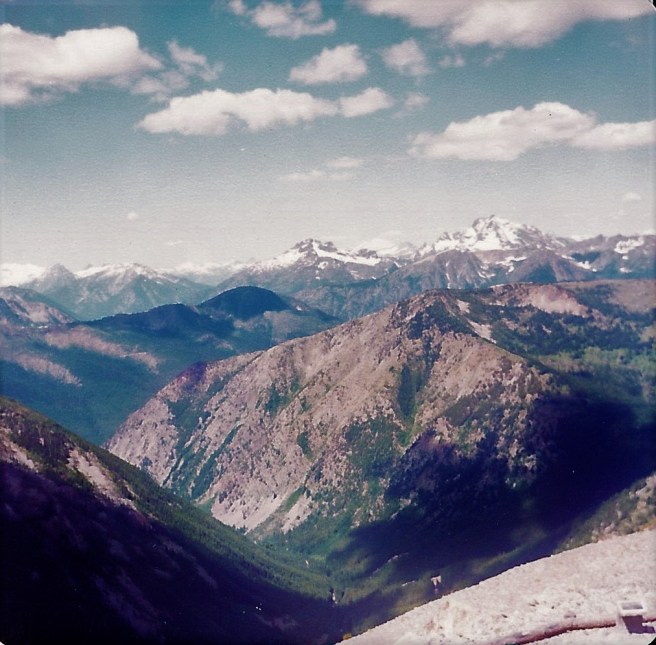
Imagine opening your tent flap and seeing this. I did, in the North Cascades.
Curiously, I haven’t camped since 1980, though there was a week I spent in a spartan, bare-bone cabin near Lake Sabago, Maine, in October ’99. That’s when I learned to canoe … and to steer clear of the middle of the water when it’s just me all alone.