A few memorable camping adventures in my life

I’ve mentioned the impact of my rogue Boy Scout troop on my life via hiking. Camping was related. We used homemade square tarpaulins – three rows of muslin our mothers sewed together that we then dyed and waterproofed.
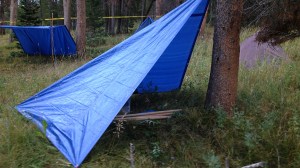
Here’s the general idea for pitching a trail tent.

We called them “trail tents,” though “tarp tents” seems to be more universal. They could be set up in any number of ways – a two-sided triangle with the front open was most common, using a second one as the ground cloth – or in good weather we could even roll our sleeping bags into one and stretch out in the open.

We took pride in our primitive camping abilities.
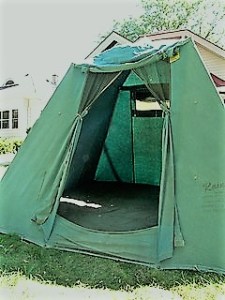
Our vintage umbrella tent was like this, with the poles inserted along the ridges inside.

My family, on the other hand, had a clumsy and often smelly “umbrella tent,” so named for the way you had to set it up from the inside and then remove the aluminum center post – well, they’re now called “cabin tents,” and apparently more flexible.

I inherited the tent and used it for many of my escapes in the Pacific Northwest, my complaints aside. It got a lot of miles over the years.

The result in either case was some memorable opportunities to get closer to nature. Among them:
  1. Family summer vacations at Indiana state parks, especially Spring Mill with its limestone caves; Natural Bridge in eastern Kentucky with its old railroad tunnel at the base of a mountain with a stone arch at the top; Mammoth Cave in Kentucky; and Lincoln’s Old Salem in Illinois.
  2. There was also a Florida trip we shared with a Chattanooga family Mom and Dad were fond of from his Army-Air Force days. At age 12, it was my first exposure to the ocean and a Southern belle a year or two older than me. Our trip back included a night 17 miles back from the highway in Okefenokee Swamp in Georgia, where we were surrounded by masses of mosquitoes, more than a few three-legged deer (the result of encounters with ‘gators), and raccoons that could open the doors to the porches of the camp headquarters and then raid the top-slider Coke coolers. Let’s say simply we heard a lot of eerie sounds in the darkness and escaped with our lives once the sun rose through the Spanish moss.
  3. My first time in a trail tent was shared with another neophyte. We proudly set up our tent, tying the front line to an Osage orange tree – I remember the strange color when we split firewood. Alas, a storm blew in during the middle of the night and pulled up some of our stakes. I rolled enough of the ground cloth around my sleeping bag to get through the night. Not so, Jackson. He nearly froze and his bag the next day must have weighed a hundred pounds. After that experience, I always checked the wind direction before deciding where to raise the tent.
  4. Another Scout outing, remembered vaguely, was in May or June in a farmer’s woodlot. It simply felt magical, nothing like a designated campground.
  5. Our troop joined one or two others in the summer at a site in Lake Vesuvius State Park near Ironton, Ohio. This time we used wall tents, but it was still primitive. The park had the remains of an early stone blast furnace, and we spent a day in rowboats exploring the lake. One fall, we returned to plant trees in a strip mine. I’ve hated that form of mining ever since.
  6. Out-of-state hiking trips also included overnights, usually two. I especially remember those of the Lincoln trails and others around Lexington, Kentucky. And there was the near-perfect night in Indiana when we rolled out under the stars only to be interrupted at midnight and having to hustle our gear under a nearby picnic pavilion when a harsh storm blew in. And then the rangers showed up and scolded our scoutmasters. But the next morning, and for much of our drive home, we saw tornado damage.
  7. Roan High Knob, at the end of our week on the Appalachian Trail, turned into a festive array of unconventional trail-tent setups. It was like a camel caravan had moved in. At least until the big thunderstorm and repeated deluges.
  8. Later, as an adult, there was a week circumnavigating the Olympic Peninsula, an event I celebrate in a longpoem.
  9. Also in Washington state, a week I spent in the North Cascades – where poet Gary Snyder, especially, wrote extensively as a forest fire lookout. Silver Star Mountain was especially memorable and worth a return with my then-wife.
  10. Another week in the North Cascades included time at the base of Mount Shuksan and Mount Baker. Washing my dishes in the small river, I recognized gold flecks in my bowl – not enough to pan, if I could, but the valley had been the scene of a big gold rush once upon a time. I also noticed that the river level kept rising through the day, a result of melting snow and glacier ice upstream, up above me.
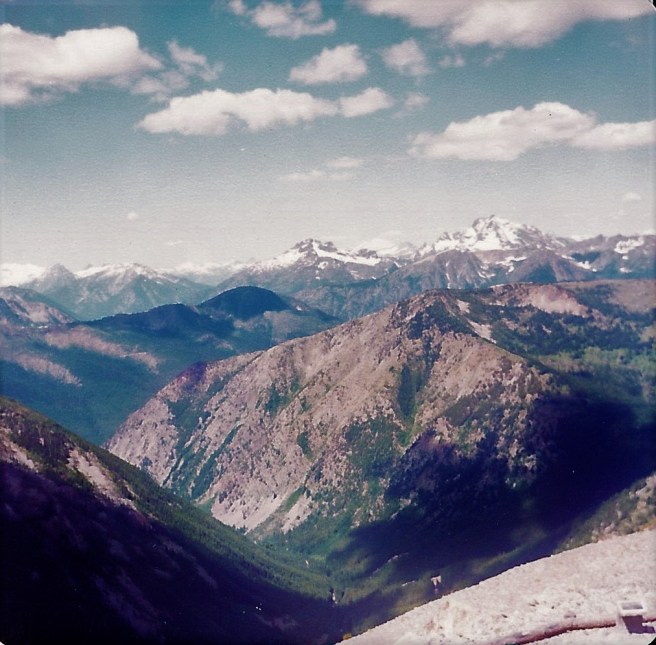
Imagine opening your tent flap and seeing this. I did, in the North Cascades.

Curiously, I haven’t camped since 1980, though there was a week I spent in a spartan, bare-bone cabin near Lake Sabago, Maine, in October ’99. That’s when I learned to canoe … and to steer clear of the middle of the water when it’s just me all alone.

Kinisi 113

Once upon a time I thought I would have children with the woman of my dreams who would grow old with me.

Once upon a time I would have had a Rolls Royce or at least a Mercedes.

Once upon a time I would have lived in a city where I could ride subways
and subscribe to the opera.

Once upon a time I would have never believed in dragons.

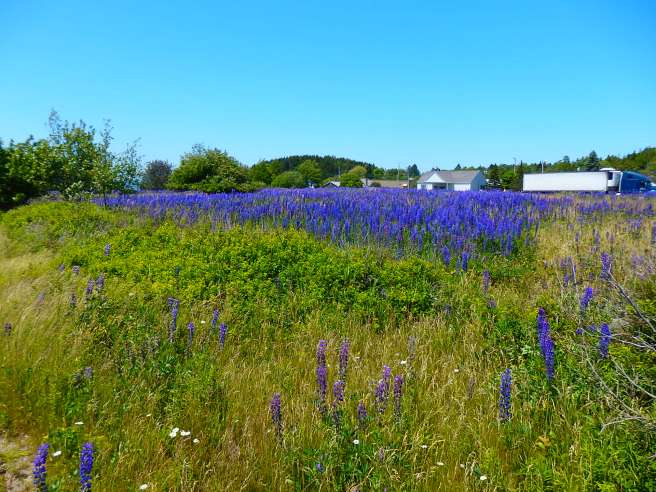
Lupine island

Officially, Eastport sits on Moose Island, though I have yet to see one here.

This time of year, though, it’s covered with flowering lupine, gloriously so. You’d never imagine the kind of winter we’d had.
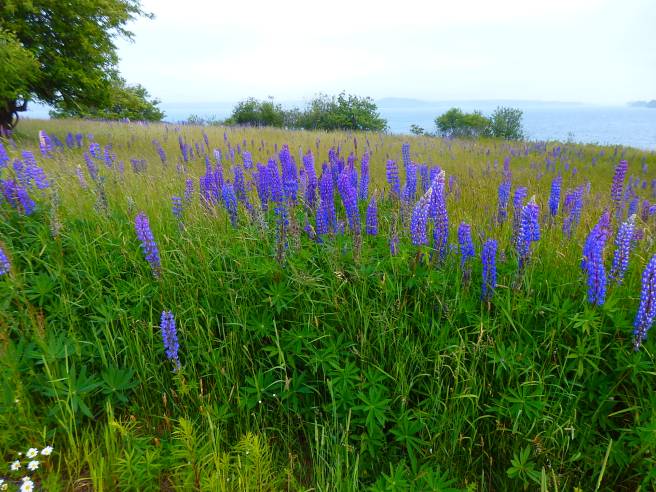

With the sea in the distance.


Against our house, with Dame’s Rocket.


Behind the IGA.

Don’t overlook Baltimore

There are reasons it’s also known as Charm City. Or, as they say of neighboring D.C., it has Northern charm combined with Southern inefficiency. By the way, don’t blame me for that perspective.

USS Constellation, built in 1855, graces the Inner Harbor. (Photo via Wikimedia)
  1. Baseball great Babe Ruth was born here (1895) and poet Edgar Allan Poe died a drunk on its streets (1849).
  2. Speaking of baseball, the Camden Yard ballpark spurred the return of smaller professional arenas to central cities across the continent. Now, if the Birds could only fly higher than the Yankees or Red Sox in their division. They really are doomed in that association.
  3. Speaking of birds, the Baltimore Oriole got its name because its colors resembled those of the coat of arms of Maryland founder Lord Calvert. I have no idea about their religion, but he was an advocate of religious liberty.
  4. The port was second only to Ellis Island in the number of immigrant arrivals in the 19th century. And while the city sits below the Mason-Dixon line and has a Southern outlook, it also has a strong German presence and Northern connection strengthened by the Baltimore & Ohio train tracks.
  5. With his profits from those rails, Quaker Johns Hopkins founded the nation’s first research university in 1876. Today it and its related hospital and institutions are the state’s largest employer.
  6. The metro area is also home to McCormick spices. You can smell it in the humid spring air.
  7. The National Aquarium crowns the redevelopment of the Inner Harbor as a popular destination. The waterfront is also graced by the tall-masted USS Constellation of Civil War glory.
  8. American Methodism was founded in 1784 at the site of today’s Lovely Lane church. And a 1789 conference at Old Otterbein Church led to the formation of the United Brethren denomination of German-Americans (it merged in 1968 with the Methodists, giving them the “United” in today’s name). Also in 1789, the nation’s first Roman Catholic archdiocese was founded in the city; its cathedral was finished in 1821. It even produced a saint, I believe.
  9. A flag waving over Fort McHenry during the War of 1812 inspired Francis Scott Key to write the lyrics to the National Anthem, the one that was much in the air yesterday, but the music’s from a much older British drinking song. How ironic, especially since it challenges even the most professional singers.
  10. The city doesn’t show up in my fiction, despite my living in the inner city’s Bolton Hill and suburban Owings Mills for three years. Even if the place is so hot and humid you have to turn on your air conditioner on the same day you turn off your furnace. Or, as they say of neighboring Worshington, it’s built over a swamp you know.

When our small city turns into a four-day party

Though Eastport was settled relatively late – that is, toward the end of the Revolutionary War – it was instilled with a Colonial flavor by prominent early residents who were resolute veterans.

A continuing spirit of Tea Party and Minutemen makes Independence Day in New England feel different than those elsewhere. It’s not just the place of the Shot Heard ‘Round the World. It’s the region where thickheaded Yankees have always doodled.

Quite simply, history is palpably alive everywhere across New England.

Boston, of course, is the epicenter, but across the six most northeasterly states, local observations uphold distinctive traditions. Think of musketeers firing a round ever so often along the town parade route, along with fifes and drums.

As an independently enterprising oceanside village, Eastport soon had a reputation as a hive of privateering – that is, legalized piracy – and not-so-legal smuggling. That independent streak gets its own attention in the city’s annual Pirate Festival a week after Labor Day.
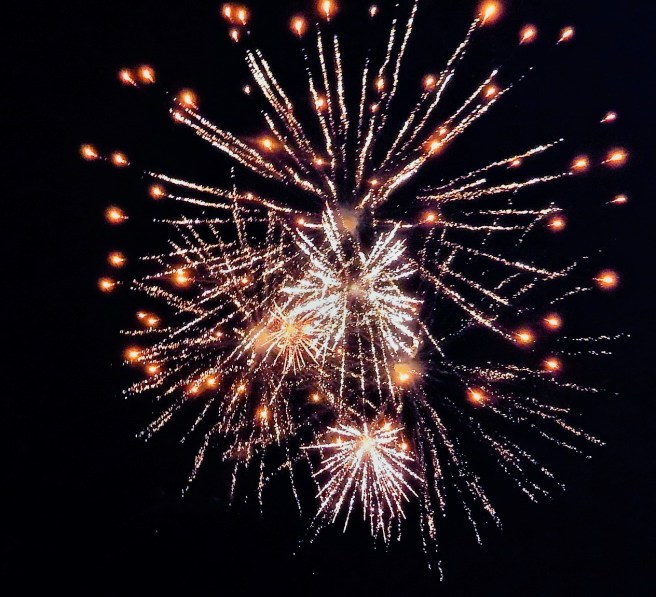
How joyous!

Unlike much of America, the city had frontline experience of the War of 1812. Fort Sullivan atop the bluffs surrendered to the British Navy in 1814, and Eastport then remained under the royal thumb until 1818.

Two years after its reunification with the United States, Maine became liberated from Massachusetts for the first time since 1653 and began to breathe into its own unique character.

For its part, Eastport rocketed as a center of shipping, shipbuilding, fishing, and sardine canning before the big decline of the 1900s set in.

Today, the tiny city’s locals remember a vibrant past and close-knit community, one that spanned the shorelines on both the American and Canadian sides of the watery border.

Is a renaissance on the horizon? There are signs for hope.

All of these strands infuse the holiday here.
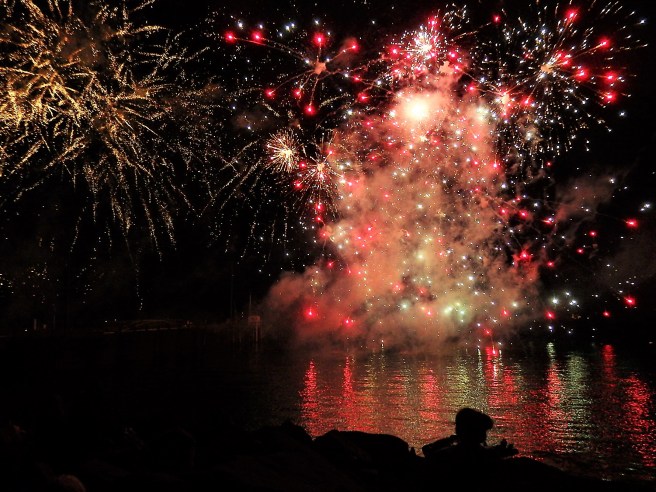
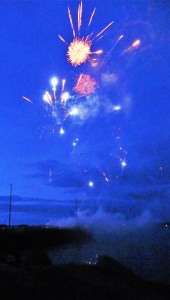
Here’s a taste of last year’s pyrotechnics fired off from the fish pier downtown.
Yes, fireworks can be visually composed, leading your eyes around the sky.

The national holiday also marks the opening of New England’s short summer season. After a cold, dark, long winter, Eastport’s small year-’round populace can actually come out into the open air for long times together. The ocean and lakes are finally warming, to the extent that they do, and that attracts vacationers to join in.

After months when only a stray New Hampshire or Massachusetts auto plate is seen around here, I’ve now seen those of every state but Alabama, Hawaii, and North Dakota (not all at the same time), some seeming rather exotic.

And the Fourth includes the city’s Old Home Week, with high school reunions and the return of many summer residents.

A lot happens over a four-day span. There’s a doll carriage and wagon parade. A torchlight parade. Car shows, bike races, water games, pet show, rubber ducky race, festive all-you-can-eat blueberry pancake breakfast, free outdoor movie, contests, live music, and a street dance, all with a small-town flavor.

A traditional visit by a large U.S. Navy vessel failed to materialize, a consequence of being on Ukraine-related alert. Three different ships had expressed interest in landing at the Breakwater before the turn in world events.

While fireworks were displayed off over the harbor on the Fourth, America’s Independence Day (the beautifully designed and executed big show fired from the town’s Fish Pier was followed by a joyously rowdy encore from a diner’s smaller private pier), the companion July 1 presentation for Canada Day, in honor of our neighbors in New Brunswick, was still a victim of Covid cutbacks. Some residents, though, could view shows happening on Deer Island across the water.

Seems ever so fitting to shoot the works twice, considering Eastport’s dual connections.

it really does feel like a party’s come to town.

How do you celebrate the Fourth?

It may be a stool but it’s not for sitting

When I’m working at the laptop on my real desktop, having the stool to my right comes in pretty handy. It’s the right height for papers I need at the moment or even something to sip. Not that I planned this shot, which accidentally exposes a bit more of how I really live. The lower milk crate, by the way, serves as a cell phone recharging station while keeping the bunnies away from the sensitive wires plugged in behind it.

Top zoos in North America

Yeah, yeah, I know the concerns about holding animals in captivity. But where else are kids going to learn about exotic fellow creatures? TV? They can’t smell them there. The circus? Few of us even live on farms anymore, and those dogs I see walked up and down the street are hardly exemplary of the animal kingdom. Frankly, they’re more spoiled than most children.

But I digress. Out of view, the best zoos are also places of serious research and attempts to keep gene pools alive.

Here are some of the best in North America:

  1. San Diego. It pioneered the open-air, cageless exhibits, for one thing, and is in a beautiful park, for another. So I’ve heard.
  2. St. Louis. More than 600 species on 90 acres, and you can get around via a mini-railroad.
  3. Omaha. Some of us remember it from a television series.
  4. Cincinnati. Includes a botanical garden, and for years it was also home to the summer opera, the nation’s second-oldest. Now that was an interesting mix.
  5. Bronx. It was the first with a zoo animal hospital and full-time veterinarian staff.
  6. Toronto. Features seven distinct zoogeographic regions – animals and relevant plants and climate displayed together.
  7. Smithsonian, Washington, D.C. One of the most diverse, and admission is free.
  8. Los Angeles. Founded in 1966, it’s one of the newer zoos in America and has zoomed in status.
  9. Columbus. Includes a notable aquarium, a manatee rescue and rehabilitation program, and Polar Frontier.
  10. Philadelphia. Also noted for its success with hard-to-breed-in-captivity species.

Honorable mentions to Miami, Fort Worth, Seattle, Brookfield and Lincoln Park in Chicago, Disney’s Animal Kingdom in Florida, Houston, and Denver.