Accused of something. What?
Eyewitnesses.
Dayton, with a bridge and subway.
Subway?
You never know what we'll churn up in cleaning a stall
Accused of something. What?
Eyewitnesses.
Dayton, with a bridge and subway.
Subway?
ANGEL
ANGER
ANGLE
I’ve posted previously on the outstanding and often original finals’ week programming on Harvard’s student-run FM radio station. Each December and May, the regular schedule shifts to a few weeks of special blocks of classical, jazz, rock, folk, world, and many other strands of music I hadn’t even heard of for something the station has trademarked as Orgy, as in “Donizetti Orgy,” which I’ll explain. For accuracy, we should note that final exams really cover closer to two weeks or a tad more.
One year, for instance, they played everything Bob Dylan had recorded. A few years later, a much shorter sequence introduced many of us to Florence Price, a significant Black American woman composer who has since been receiving a posthumous flowering. The decisions are often based on anniversaries, as happened a few years ago when we got to hear everything Beethoven had ever written, in chronological order. Musically speaking, of course. I have no idea about his letters. A year ago, Schubert got the same treatment, meaning a lot of art songs in German, especially. That one nearly became an Orgy of its own for the baritone Dietrich Fischer-Dieskau, whose son once told classmates what his dad did for a living was make records. Let’s just say that many of these Orgies are highly eclectic.
I did raise my eyebrows in the last round when well over a hundred hours of airtime were devoted to the 225th anniversary of the birth of Domenico Gaetano Maria Donizetti, known largely for a dozen or so marvelously florid operas. Turns out he created nearly 70 operas plus symphonies, string quartets, concertos, piano scores, songs, and so on, which were presented, again chronologically, in big blocks over two weeks. Where do the programmers dig up all of the recordings? Is this really some Harvard grad student’s thesis project?
Donizetti (1797-1848) is renowned, along with Rossini and Bellini, for a specialized style of opera called bel canto, “beautiful singing,” which has had a major revival in the past half-century. Today its embellishments, soaring lines, and vocal athletics have become widely embraced, but back when I was first listening, it was all revolutionary. And, among the three, Donizetti was far and away the most prolific.
What made the series significant to me was the way it revealed an evolution over his 29-year career from formulaic provincial stage comedies to what we recognize as Romantic opera. It filled in a gap in operatic history for me, getting from us classical Mozart to gripping dramatic Verdi and beyond. Composing at fever pitch, Donizetti often churned out four new operas a year, many of them in one-act pieces plus others that recycled earlier material before he reached a more sustainable stride. Think of a rock band or pop artist turning out an album, which is only an hour or so compared to a three-hour opera. Or a movie composer, for that matter, who has to create a similar amount of music. Nobody does four a year, right?
In the broadcasts, Donizetti’s early works sounded serviceable but not memorable. They were built on strings of solo arias, choruses, and recitative, which I streamed while working on my own life. That would mean one character in the spotlight, exit stage, and then another. Laundry, cooking, vacuuming, or washing dishes anyone? You know, everyday stuff, with music in the background. Midway into the series and his career, though, the dramatic level rose immensely and caught me in my tracks, especially with the appearance of ensembles of simultaneous conflicting emotions and motivations. Yes, there were hints of things ahead, like the flash connecting one faintly familiar tenor aria with what would emerge later, with nine high C pings inserted as “Ah! Mes mis,” and eventually launch Luciano Pavarotti into international household fame in 1972. (We did hear him in that role around 6 am the final day, when “La Fille du Regiment” aired from a recording of London’s Covent Garden production with Joan Sutherland and Richard Bonynge costarring.)
Quite simply, those were the flashes when I recognized we had crossed over into everything today’s operagoer anticipates, even with Mozart, Gluck, and Handel remaining glorious within their earlier realms.
Many of the Orgies really are once-in-a-lifetime events. With Donizetti, for example, it’s unlikely that I’ll ever again hear most of what was introduced. Simply tracking down rare pieces would be an overwhelming challenge.
Let’s see what May brings. Those kids at WHRB really do deliver.
With my elder daughter’s growing allergies to rabbits’ prolific fur, which flies everywhere, Salty and Pepper had to move on. The Lagomorph duo did provide companionship through two deep winters, as well as constant amusement. In late summer, they received a new home with a then 13-year-old and her 11-year-old brother. From what I seen from a distance since, they couldn’t have been luckier. Those are two happy kids.
Still, it’s surprising how many times I start to do something that might involve them – say bend over to pick dandelion greens while out on a walk or gather carrot ends or parsley stems to feed them while I prepping dinner or move an electrical cord or papers out of their reach – only to realize, emptily, their lusty absence.
Here are a few shots as reminders.


The popular (and how) “king of horror” has long deserved kudos for getting so many people to read, period, especially in today’s mass-media and marketing saturation. (I refuse to say “culture.”) Plus, there’s evidence he’s a much “better” writer than his top-selling novels reflect, given his appearances as a poet under pseudonyms and a few rogue novels. He’s quite conscious of structure and a bigger picture, for one thing.
Add to that poet Donald Hall’s observation that New England has a gothic nature, which King has played in spades, and King’s own comments about today’s publishing scene in his duels with the critics, often with advice I wished I’d been able to apply to my own work, but mine remains what it is.
All I’m saying is don’t underestimate him.
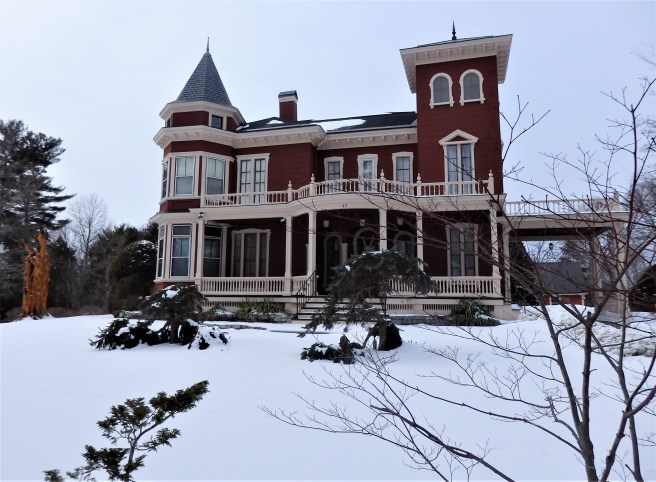
The King home in Bangor is a popular tourist attraction. A tree trunk outside has been transformed into a wild sculpture.
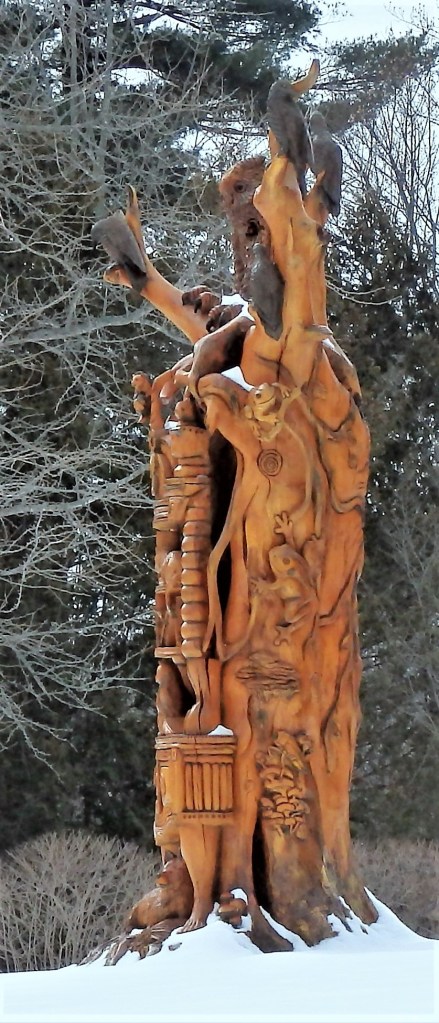
In the Archaeology of Imagination

Love their fresh rye bread, if I can get down there in time on the weekend.
It makes great toast and croutons, in addition to marvelous sandwiches.
Oh, yes, it does take far more time than I anticipated, even when I had a backlog of poetry and correspondence for republication. And I do miss the Fresh Pressed selections in the Reader feed. But not so the self-congratulatory “awards” nominations that made the rounds.
the double meaning
once you were here

