RENOVATING A PERENNIAL BED

Gardeners in New England – especially in its northern realms of Maine, New Hampshire, and Vermont – soon discover the month of May can be a frantic stretch. (Or, for those of us with short memories, the word should be rediscover. I keep hoping for something more orderly than what feels dropped upon us each year.) For much of April, even apart from the threat of killer-frost nights or piles of lingering snow, the ground can be too cold or too wet for planting, and that’s if rain’s not falling. With our clay-based soil, I’ve learned not to turn it when wet, lest it form brick-like clumps. For that matter, in a typical year our large compost bin can still be frozen at heart, posing another obstacle to preparing the garden beds themselves.

When it comes to these projects, I often find myself in a bind. We simply don’t have enough room to “park” something while waiting for something else to open up or be moved to another spot. Compost is a case in point, though hardly the only one.

So when May hits, we’re rushing to get as much in the ground as soon as possible to maximize a relatively short growing season and, frankly, to try to beat the weeds to a solid start.

And that’s where we are at the moment.

I feel pretty good about a lot of the pace. Two of our raised beds have received new wooden frames, the compost bin’s been emptied and refilled with a new round of leaves and garbage, black plastic and a soaker hose are in place on what will be this year’s nightshade bed (tomatoes and peppers), the pea frames are up as are the seedlings below them, the bean tripods are in place … and we’re dining on what I think’s the best asparagus ever.

Let me add that my wife’s scheduling here means a few other outdoor projects I thought I’d be addressing are put off for a few weeks, and that’s frustrating. I hope they don’t get pushed back for months, because, well, that would affect other projects in the pipeline – and that touches on yet another issue she raised today. What if we just moved to a condo with a deck and a small garden bed about the size of our dining room table?

I could see that if we did square-foot gardening as intensely as we once envisioned, we might raise enough to keep us smiling at dinner. But my beloved asparagus bed’s larger than that. Ahem.

~*~

So we finished our first round of morning coffee and headed outside for the day’s task, the fourth of the raised beds in what we call the Kitchen Garden, the one on the far side of the driveway. The one we’re tackling is a perennial bed of bee balm (which attracts hummingbirds as well as bees), sorrel (which makes for an excellent sauce on fish), and chives, all of which we’d hoped to salvage. Unfortunately, a bout of lemon balm’s gone invasive, along with grass, plus our ubiquitous ground ivy, dandelions, vetch, and several familiar weeds I have yet to identify.

In short, this has meant uprooting most of the bed, attempting to save what we could, including some hyacinth bulbs, and admitting we’d have to start from scratch with much of the rest, including new bee balm.

So here we are, ripping out, grubbing, turning, cursing, adding compost, wondering how this got away from us, anticipating, what?

I have to admit I’m not the gardener, the one who plans the arrangement using page after page of grid paper or reads up on the options or orders the seeds or starts the flats indoors under the grow lights I set up or waters them daily while envisioning the results or anticipates the way they’ll wind up in tasty dishes or fill the freezer for dinners next winter. (I admire the one who does all this, in more ways than one. After all, I married her.) At the moment, though, I’m more concerned with what goes into the wheelbarrow, shovel by shovel or handful by handful, and where it goes from there.

And then, there will be one more thing checked off my to-do list … while adding to hers.

MOODY RIVER WINDING AWAY

What may appear to be a lazy river meandering amid its wooded isles deserves consideration and room to run wild.

Passions arise and freeze over. The flow dwindles to rock. Rats run along the shoreline of factory brick at the dam. A few miles on, either direction, the dairy herds gather.

All of it reflecting my soul when I lived there.

Susquehanna 1~*~

For your own copy, click here.

REGARDING THE EXISTENCE OF SPIRITUAL REALITY

A materialistic outlook misses so much. As does an emphasis on concrete reality or causality.

How would you explain love, for starters? Much less admit passion? Why does music move us the way it does? And pain, be assured, is more than a neuro-chemical calculation. Why does social injustice to others spur our own anger? How could those who own all the creaturely comforts ever feel lonely?

The materialistic reaction to these, I suspect, prompts what we call addiction. Though it’s not always to alcohol, tobacco, illicit drugs, food, or even sex.

For liberation, a spiritual dimension will open. Or else.

TRIPLE PLAY

Any writer tackling a large work such as a novel or screenplay will need to consider the matter of structure. The easiest way out, of course, is to follow a conventional model.

In fiction that might mean 60,000 words, more or less, spread out over 20 to 24 chapters, typically in a straight chronological order, past tense. For the film, something that would come in a little under two hours. To that you’d add pacing, points of conflict, resolution, number of main characters, and so on.

Sometimes, though, you find that’s not the best way to organize your material.

For example, in its revisions, Promise emerged with three sections, each set in a different locale – Prairie Depot, the Ozarks, and finally the Katonkah Valley. Each one, as it turns out, can be viewed as a novella held together by the central couple, Erik and Jaya.

I didn’t intend it this way. The original version had five sections, for one thing, which I came to feel were simply too unwieldy. The cuts provided what I feel gives a better balance.

Let me also admit to a fondness for shorter novels. Novels, mind you, not simply novellas, no matter how much I enjoy them, as well. Maybe it’s a reflection of my typically crowded schedule.

Still, both short stories and novellas stand as kinds of orphans in today’s literary scene. They should be more popular than they are. An occasional solution, one I’ve enjoyed reading, runs a central character through a set of short stories to culminate in a volume of novel length. It’s a tricky strategy, though, and hard to pull off.

Maybe that’s one more reason I feel a special satisfaction with Promise.

Hope you do, too.

Promise~*~

For your own copy, click here.

THE INVISIBLE FACTOR

In the buildup of national elections, once again a major influence remains the elephant in the room. I’m referring to the legacy – make that plural, legacies – of the hippie outburst, especially in contrast to those on the Vietnam war side of the divide.

The wounds and tensions haven’t gone away. Just look at the continuing proliferation of POW-MIA black flags across the landscape, on one side.

For the other, the lines are much more hazy yet festering. As I’ve been arguing, hippies came – and still come – in all varieties and degrees, and likely nobody ever fit what’s become the media stereotype. With the end of the military draft, the movement lost a crucial motivating force and focusing definition.

Complicating the situation was the distancing many youths on the antiwar side felt when it came to politics. With its support of the military at the time, liberal politics were tainted with outdated Cold War ideologies like those of the conservative side. For hippies, radical was the label of honor. And the Democratic Party base of the left was splintered as its youthful potential allies had nowhere to turn or direct their forces in the political arena.

The horror meant going from a hawkish LBJ administration to one of Richard Nixon.

Fast-forward now to the present American landscape. Gone are the grandparents and parents of many of the now senior baby boomers – the core of the hippie movement versus the older generations. Yet political candidates still tiptoe around many of the reality issues, beginning with marijuana and other illicit substances, as if they’re too hot to touch. Let’s get real. Want to talk about litmus tests?

As we look at candidates, ask where each stands on a scale of continuing issues from the hippie stream. I find it enlightening.

  • Peace and social justice activism.
  • Sexual equality … including abortion rights.
  • Racial equality.
  • Environmental and ecological issues, including the outdoors.
  • Educational alternatives and opportunities.
  • Sustainable economics and fair trade.
  • Spirituality and radical religion.
  • Fitness along the lines of yoga, bicycling, kayaking, hiking.
  • Organic and natural foods.
  • Marijuana reform.
  • Arts and crafts.
  • Community as common wealth, including health care.
  • Labor as a matter of respect and a livable income.

Well, we have Bernie running straight true to the cause. Hillary, more cautiously so. But on the right? Let me suggest being wary of anyone in the pro-war camp who hasn’t served. Period. As for other life experiences?

~*~

All of this returns me to my Hippie Trails series of novels. I’d love for you to come along. Just click here.


DAYTON’S LEADING REPUBLICAN PLUMBER

Decades ago, after hearing mention that my family had Quaker roots in North Carolina, I began the genealogical detective work that now fills my Orphan George Chronicles. Although I’d independently come to the Society of Friends and become a formal member, I was surprised to hear that my family had been Quaker and that there were Quakers in North Carolina – my, have my eyes been opened!

In the genealogical work, I chose to begin with my great-grandparents – people I’d never met in the flesh.

But when my father died, the focus shifted. I realized only one person remained who might be able to fill me in on questions of his childhood and parents, and that was his “baby sister.” That would mean getting to know her – and her parents – without all of the filters that had always been applied by my mother, who had issues of her own. (Oh, for these family dynamics!)

It became a rich and fascinating project, given all the more incentive when we met my aunt and her husband, a retired university dean, at the airport. It was a first-time encounter for them and my brood, yet he swept up my younger one in his arms and proclaimed, “It’s so good to have another Democrat in the Hodson family!” The party activist suddenly had a favorite uncle. Make it great-uncle-by-marriage if you will, he got the crown.

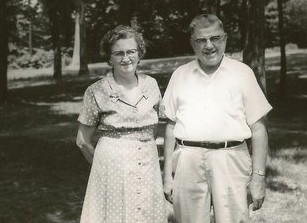
At that point, my aunt remarked that Grandpa’s slogan, painted on all of his trucks and on the calendars he mailed out each year, was “Dayton’s Leading Republican Plumber.” She promised to send a photo of the vans all lined up on the street. “You didn’t know that? It was even on his stationery and bills.” This was something I’d never known, although he did sign one of his last notes to me as “formerly Dayton’s leading Republican plumber,” a comment that long puzzled me. Through much of the spring and summer I wound up following up on her reactions and insights to her childhood and adolescence, which to my surprise (the word of the day) paralleled my own, especially in regards to their now-Methodist church, the denomination I grew up in. At last, I could finally look directly at my grandparents through all the memories and scattered bits of data I could assemble, as well as all the material I already had, doing genealogy. It was like being given a key, at last.

Grandma and Grandpa at family reunion & Aunt Irma Hodson
Grandma and Grandpa at family reunion

My aunt suggested I correspond with a surviving first-cousin Dad’s age, who wound up also contributing memories, and the result was a remarkable project, not quite memoir but more a realization of finally knowing my grandparents, pro and con, for the first time – years after their deaths – as well as questioning many of our ingrained expectations: just what are grandparents supposed to be, do, or look like, for instance. Unexpectedly, I reconnected to more feelings/memories from their house on McOwen Street than to the house I grew up in on Oakdale Avenue. Some of the stories that turned up, like my dad’s desire to be a sports writer or a big chicken dinner Grandpa arranged to help pay medical bills for one of Mom’s best friends, are priceless. From an intellectual perspective, the project also illuminates the difficulty of knowing – it often meant triangulating something in the middle of three often contradictory sets of perceptions. More importantly, to some extent, I’ve finally been able to reconnect with more than a few fragments of my childhood.

From my end, there’s little I’d say was happy in all of that childhood. But there are things I can finally claim and appreciate, and even rework or rewire. Much of my adult life, as I’ve found in Dad’s genealogy (Mom’s is entirely different, and far more gothic than she ever would have admitted) has been a matter of reclaiming many of the values and practices Grandma and Grandpa rejected in their move to the up-and-coming industrial city. I never knew that my Hodson ancestors were Quaker or that Grandma’s were Dunker (Church of the Brethren), very close to Amish and oh-so Pennsylvania Dutch. But they rejected all that, with some values somehow surviving, however invisibly.

Some discoveries still amaze me. The fact that Grandpa accomplished all he did with nothing more than a grade-school education, for one thing.

Or that his two best friends in adulthood were both a decade older than himself, and both died within a year – one of ALS, the other in a car collision. Since he was the youngest of three sons, I wonder about the dynamics.

There’s much, much more I’ve uncovered along the way. As you can guess, it’s a long story. Today would have been his birthday.

TURNING THE PAGE FOR ANOTHER ANNUAL RITUAL

Now that the Christmas season’s over, we’re getting out the seed catalogs. Gardeners know what this means. Traditionally, they start coming in the mail about now, although some seed companies have tried to jump the gun, just like the Christmas decorations and music that now proliferate around Halloween rather than Thanksgiving. No, don’t rush us. This is to be taken thoughtfully, leisurely. Now, in the depth of winter — especially when it’s bitterly cold and snowy in places like the one where we live — our imaginations fly off to springtime and high summer. We evaluate the new varieties we ordered last year to decide whether we’ll get more (if we used up all of last year’s packet) or we’ll try something different.

Some of the catalogs are simply gorgeous. Others, including our favorite, are black-and-white and photo-free. The descriptions are fun to read and have led us to delightful harvests.

One thing I know: we’ll be ordering a certain chard we tried last year. The one that doesn’t taste like beets. No, it’s much more like spinach and so much more reliable where we live. Just don’t ask me to reveal its name. We want to make sure the supplier doesn’t run out. It’s something that happens, you know. As I recall, last year it was a kind of early pea. And before that?

It’s all part of the ritual, I suppose. Along with the intricate maps of our garden my wife draws to determine just how to fit it all in.

ROUND AND ROUND AGAIN

So there on page 41 of Jeffrey Eugenides’ third novel, The Marriage Plot, I find he’s cribbed one of my fundamental arguments, the one about how the older you get, the faster time goes. Or, as he puts it, seems to go. And he didn’t even give me a footnote. Alas. (Where, oh where, by the way, has the year gone?)

At first I was going to say nothing new really happened this time around, but that’s not quite accurate. A stranger in one store did approach me to ask, “Has anyone told you how you look just like the drummer in Fleetwood Mac?” Could it be my ponytail? The one that would finally tie in the back?

And then, thanks to one inspired Christmas present last year (and wondrously repeated a few days ago), I’m swimming a half-mile daily in the city’s indoor pool. I wouldn’t say I enjoy it – laps are strenuous, after all – but the effort’s somehow refreshing and invigorating. Maybe it will also give my pun-prone physician a smile at my next physical. Could it be the giver’s in cahoots with him?

We did enjoy some all-too-short getaways through the year. Camden, Maine, in deep winter, instilled in me a fondness for tulips, thanks to a devotee’s store; Cape Cod in early summer included a panorama from the lantern room atop a lighthouse; Vermont in late summer, before the foliage turned, felt perfect.

Quaker activities have me hopping around New England, and with the Revels Singers, I performed in five concerts this fall, on top of weekly rehearsals. Add to that the release of four of my (experimental) novels and a brace of collected poetry as ebooks, which comes as a relief, and several public readings.

In addition, the Red Barn frequently draws readers from five continents, even if we’re still waiting for Antarctica. I even made my YouTube debut as the subject of an hour-long interview, as you may recall. As for the weeds in the garden or the snow in the driveway, well, can we get philosophical?

The one thing that’s been going all too slow is renovating the bathroom, which finally began before the bathtub could fall through the ceiling to the dining room. We’ll spare you the details. Could it be because everyone’s being paid by the hour? Or just the realities of trying to cope with a century-plus house? (The latter, mostly.)

So here we are, with the new year bringing us another presidential primary, the payoff on our mortgage by midyear, and my 50th high school reunion. If we survived a Social Security payment snafu at the beginning of last year, well, here we go again. Wishing you and yours all the best.