Understanding that we don’t see light itself but rather what light illuminates opens a fresh way of envisioning the divine Spirit of life.
As I examine the writings of the early Quaker movement (Society of Friends), I find a remarkable wisdom emerging within their application of the metaphor of Light and through that, an alternative Christianity itself.
One of the most remarkable periods in world history came in mid-1600s Britain, an outbreak that included the execution of the monarch by commoners (rather than a rival for the throne) amid a host of social, economic, and political upheaval. For an overview of the ferment, you can read Christopher Hill’s The World Turned Upside Down or Antonia Fraser’s Cromwell, Our Chief Among Men.
My primary interest, of course, focuses on the rise of the Quaker movement out of the waves of conflict – with the rise of a two-party political system and a loyal opposition as a byproduct of a pacifist faith. I also see parallels with much of the counterculture experience I’ve known from the hippie era on, where some have remained faithful but many others have flaked away.
The waves of English radicals can be fascinating, from the New Model Army and Levelers, Diggers, and True Levelers on through the Muggletonians, Fifth Monarchists, and others, but for Quakers, the Ranters presented a special cross to bear.
Like Quakers, the Ranters espoused personal experience of ecstatic faith, and the two movements were often confused with each other by the wider public. Unlike the discipline and discipleship among Quakers, though, Ranters had no qualms about sexual promiscuity or any other limitations (it was all God’s will, in their eyes, no matter any hurt to others), at least until persecution hit and they readily recanted. Not so the Quakers, who insisted on eternal Truth. God doesn’t change.
So here we are. What are our deepest values? Where do we stand firm, and where do we yield and bend? What is principle and what is opportunistic? How far out is our vision, and how much a matter of short-term maneuvers?
When I first took up the practice of meditation, my goal was to get high – a natural, chemical-free experience, but a kind of escape all the same.
Moving to the ashram took that a step further. The goal became to transcend this mundane experience, entering into hours of unconscious ecstasy and returning to daily life with a heavenly vision.
Over the years, though, the practice has shifted. Yes, I still value those moments of natural high and clarity and oneness with the universe, but my bigger aim these days is to get grounded. To sit and move in that which is eternal, or my true nature. To be open to the divine around me. To be authentically loving and kind and …
The practice itself still means sitting with others in silence. That hasn’t changed!
Peterson Toscano, an extraordinary “Quirky Queer Quaker Performance Artist and Scholar” with bizarre and wonderful stories to share, is coming to my corner of New Hampshire next weekend — and it’s good reason to be excited.
I’ve heard him present the Bible half-hours at Friends General Conference and New England Yearly Meeting and can say he’s both insightful and original in his exploration of Scripture. It’s a matter of encountering a passage for the first time, no matter how often you’ve read it or heard it or think you have. I’ve also seen him delivering his comedy routines to teenagers, not the easiest of audiences, and he’s had them hanging on every word.
His topics will likely range from climate change (from a social justice point of view) and environmental awareness to human rights and gender outlaws in the Bible to coping with privilege or our most tragic losses – and back again. He’s both outrageously funny and a delightfully original thinker. Who would want more?
He’ll appear in the Dover Friends Meetinghouse Saturday at 4 p.m. with his “Everything Is Connected (a collection of stories – many weird, most true)” as a late-afternoon event that’s free to all. We’re hoping this fits in between busy rounds earlier in the day and those of the evening to come – giving folks a shot of humor and hope along the way.
Other performances are at 6:30 p.m. Saturday in Portsmouth, and Sunday at noon in Rochester and in the evening in Concord.
If you can attend any of them, great! Obviously, I’m a big fan. But why not amuse yourself and sample him in his own voice? For starters, let me suggest:
In Quaker practice, elders are what other denominations call bishops, except that in ours and other Anabaptists (Amish, Mennonite, Brethren), they’re found within the congregation, rather than over it. And elders can be young folks, if they’re so gifted.
For a free copy of my poetry chapbook, Elders Hold, click here.
Living in New England, I’ve become enamored with lighthouses. My fascination has nothing to do with the quaint impression many tourists carry but rather an awareness of the ways these now antiquated emblems of peril define our landscape. Along the water, if you can identify the light, you know where you are. Believe me, there are places that would otherwise be difficult.
The night ocean, as I’ve also discovered, can be anything but romantic. It’s a different world from the one visitors encounter during the day. Cold, windy, wet, threatening, even on many summer nights. Yes, on a balmy evening, especially with moonlight, it can be magical. More often, a night ocean can be downright spooky.
Along the dark coastline, the flash of light can help you place yourself in the scene. You triangulate your position using the lights. Each lighthouse beacon has an identifiable pattern – one flash every five seconds. Or ten. Or two flashes. Their colors may be unique in that place, too – blue, green, or red, instead of clear.
The most powerful beams reach out 20 miles or more over the water. Think about that – the light doesn’t scatter but holds together using a technology that predates the laser. How much we take for granted!
And to think, in the old days the illumination came from whale oil or similar fuels.
These days it can be a 110-volt bulb the size of your thumb.
The mechanism that shapes the beams is itself a remarkable piece of technology – the Fresnel lens. Developed by the French physicist Augustin-Jean Fresnel in 1823, it’s a large sculptured glass cone, where each overlapping leaf joins to focus the ray into one. The larger ones are the size of a child, with the light from inside. Remarkably, these are much thinner than a conventional lens for the job would be – thus allowing more light to pass through and the lens to be mounted in a rotating base. (One we’ve visited floated in a 500-pound pool of mercury.)
A section of a 4th order Fresnel lens is featured on the cover of my booklet.
Just as incredible can be the tales of the lighthouse keepers and their families – lonely work, often tedious, cold, staying awake through the night, put at risk by the storms. Nothing nostalgic there, being faithful.
As I look at the light and its tower, my mind leaps to the universal application of light as a metaphor of religion and spiritual experience. It’s especially prominent in the writings of Quakers (Society of Friends), where it frames an understanding of an alternative Christianity – one earlier generations never dared voice completely. Still, the Light led them in fresh directions – and can still do the same for us today as it reaches far, including into the human heart and mind.
Decades ago, after hearing mention that my family had Quaker roots in North Carolina, I began the genealogical detective work that now fills my Orphan George Chronicles. Although I’d independently come to the Society of Friends and become a formal member, I was surprised to hear that my family had been Quaker and that there were Quakers in North Carolina – my, have my eyes been opened!
In the genealogical work, I chose to begin with my great-grandparents – people I’d never met in the flesh.
But when my father died, the focus shifted. I realized only one person remained who might be able to fill me in on questions of his childhood and parents, and that was his “baby sister.” That would mean getting to know her – and her parents – without all of the filters that had always been applied by my mother, who had issues of her own. (Oh, for these family dynamics!)
It became a rich and fascinating project, given all the more incentive when we met my aunt and her husband, a retired university dean, at the airport. It was a first-time encounter for them and my brood, yet he swept up my younger one in his arms and proclaimed, “It’s so good to have another Democrat in the Hodson family!” The party activist suddenly had a favorite uncle. Make it great-uncle-by-marriage if you will, he got the crown.
At that point, my aunt remarked that Grandpa’s slogan, painted on all of his trucks and on the calendars he mailed out each year, was “Dayton’s Leading Republican Plumber.” She promised to send a photo of the vans all lined up on the street. “You didn’t know that? It was even on his stationery and bills.” This was something I’d never known, although he did sign one of his last notes to me as “formerly Dayton’s leading Republican plumber,” a comment that long puzzled me. Through much of the spring and summer I wound up following up on her reactions and insights to her childhood and adolescence, which to my surprise (the word of the day) paralleled my own, especially in regards to their now-Methodist church, the denomination I grew up in. At last, I could finally look directly at my grandparents through all the memories and scattered bits of data I could assemble, as well as all the material I already had, doing genealogy. It was like being given a key, at last.
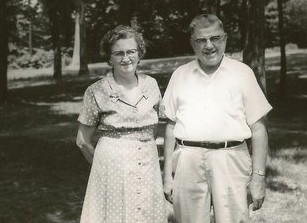
Grandma and Grandpa at family reunion
My aunt suggested I correspond with a surviving first-cousin Dad’s age, who wound up also contributing memories, and the result was a remarkable project, not quite memoir but more a realization of finally knowing my grandparents, pro and con, for the first time – years after their deaths – as well as questioning many of our ingrained expectations: just what are grandparents supposed to be, do, or look like, for instance. Unexpectedly, I reconnected to more feelings/memories from their house on McOwen Street than to the house I grew up in on Oakdale Avenue. Some of the stories that turned up, like my dad’s desire to be a sports writer or a big chicken dinner Grandpa arranged to help pay medical bills for one of Mom’s best friends, are priceless. From an intellectual perspective, the project also illuminates the difficulty of knowing – it often meant triangulating something in the middle of three often contradictory sets of perceptions. More importantly, to some extent, I’ve finally been able to reconnect with more than a few fragments of my childhood.
From my end, there’s little I’d say was happy in all of that childhood. But there are things I can finally claim and appreciate, and even rework or rewire. Much of my adult life, as I’ve found in Dad’s genealogy (Mom’s is entirely different, and far more gothic than she ever would have admitted) has been a matter of reclaiming many of the values and practices Grandma and Grandpa rejected in their move to the up-and-coming industrial city. I never knew that my Hodson ancestors were Quaker or that Grandma’s were Dunker (Church of the Brethren), very close to Amish and oh-so Pennsylvania Dutch. But they rejected all that, with some values somehow surviving, however invisibly.
Some discoveries still amaze me. The fact that Grandpa accomplished all he did with nothing more than a grade-school education, for one thing.
Or that his two best friends in adulthood were both a decade older than himself, and both died within a year – one of ALS, the other in a car collision. Since he was the youngest of three sons, I wonder about the dynamics.
There’s much, much more I’ve uncovered along the way. As you can guess, it’s a long story. Today would have been his birthday.
Within a religious tradition – I’m tempted to say any religious tradition – there are wise, seasoned guides. The ones who know from their own faithful practice what temptations and struggles the aspirant will face and how to overcome them.
Known in the various traditions as guru, swami, roshi, rinpoche, abbot, mother superior, bishop, or simply elder, among others, the best of these are adept at listening and then asking the right question.
In doing so, they hold the individual and the spiritual teachings together. As I know from my ongoing Quaker practice and earlier training.
One of the astonishing by-products of the Quaker movement was the two-party system.
Before the Quaker leadership presented its historic Peace Testimony to King Charles II in 1661, a political faction was supported by arms – or an army of its own. It’s something we’re still seeing in conflicts around the globe.
Quakers, however, proclaimed:
We utterly deny all outward wars and strife and fightings with outward weapons, for any end or under any pretence whatsoever. And this is our testimony to the whole world. The spirit of Christ, by which we are guided, is not changeable, so as once to command us from a thing as evil and again to move into it, and we do certainly know, and so testify to the world, that the spirit of Christ, which leads us into all Truth, will never move us to fight any war against any man with outward weapons, neither for the kingdom of Christ, nor for the kingdoms of this world.
Quite simply, without removing themselves from political and social revolution, Friends avowed to do so on the basis of argument and example, rather than brute force and violence. They would suffer another two decades of fierce persecution before seeing their vision upheld.
What they created was the possibility of a loyal opposition – one that would press for change and speak out for the oppressed, the way the prophets did in the history of the Hebrew Bible – while still respecting the office of existing authority. To work, moreover, it had to be a two-way street, as the Bible stories also demonstrate.
What seems to have happened in recent decades in the larger American political scene is the loss of that mutual respect, despite differences. Any loyalty to the larger good is lost in the process.
We need to get back to that two-party foundation. Or Woodpecker will keep pounding.
In college, I went through a soul-searching crisis that questioned whether we could justify subsidizing symphony orchestras or opera companies or art museums and the like in light of the economic inequities in our nation and world. And then I noticed how much of an entertainment industry flowed through the ghetto and Third World, too. That is, everybody has art (even those old Quakers, in a few restricted forms) — it’s not necessarily about money but a need for expression. And all of the emotions and aspirations that go with it. As well as the big bucks, for the big jobs.
In my trials after college, I eventually found myself moving among Friends and then, in time, a few who had grown up under the old restrictions that banned fiction, theater, and even music. Harsh as the old discipline was (and I could have never lived under it), there was also a valid criticism – especially of the superfluous nature of so much of the artistic effort and the egotism so rampant in its ranks.
Maybe the early Friends saw, too, how much the arts were a function of the royal court and its fashions. Or a gilded church. Even the way arts were used to veil the upper crust from the populace and its labors. It turns outs the original Quakers were also picking up on a dialectic from the earliest days of the Christian church, one that contended acting arose in counterfeiting thoughts and actions, many of them of an evil nature.
Within the memory of Quakers, at least, the fine arts have come a long way from the 1650s, pro and con.
Still, proscribing many of the arts did focus Friends on other matters, including abolition and nonviolence. It channeled creative energy into mathematics and science, architecture and industry, poetry and journalism (“We Friends only read true things,” as one Quaker purportedly said, regarding a neighbor’s stack of novels). Go ahead, tally the other fields.
On the other hand, how much of our own focus is deflected by our apparent indulgence? Or how much of it is enriched and deepened?
So how do we make peace with that seemingly artless side of our legacy? Let me suggest we begin with a consideration of “only true things” in our practice. Back to the deeper expression, the part that reflects Truth that goes beyond quantifiable facts. We might even begin with questions of quality or justice or compassion. And then, as they say, the plot thickens.