A regrettable turning point in counterculture evolution

In reading others’ fiction about the late ’60s and early ’70s, my awareness of the span of hippie identity has only intensified. Each one seems to focus on a different identity. As I’ve long argued, hippies came in all varieties and styles, and still do. But these also show how little overlap there often was.

So much so that I no longer find the label useful. Period. It fails to convey the extent to which we differed within the rainbow.

As one friend insists, “I was never a hippie. I was a freak!”

To the straight world, of course, there was no difference.

For many, political activism was a central component, though not for all. And I’m thinking the evolution of that activism needs more exploration. It’s where we really failed the most.

For starters, too many saw protests as the route to pursue, rather than undertaking the hard work of holding office or attending meetings.

For another, we failed to clearly articulate our vision, other than tending to be left, as in what we called radical, rather than liberal, which seemed to support the Vietnam quagmire. We were reactionary, actually, at least against the military-industrial-financial-racist complex. The ’68 Democratic national convention in Chicago didn’t help anything, either.

Looking back, it seems that too much of our political expression was being domineered by the egotistical theatrics of Abbie Hoffman and Jerry Rubin and the like. (Correct me if I’m wrong.)

Woodstock seemed to shift everything. Yes, we had the Jackson State and Kent State shootings the following spring, along with the shutdown of college campuses and some big marches. But who were our avatars?

Or, put another way, why is the experience remembered more by the music than by the speeches?

~*~

Back to Woodstock.

Seems Hoffman wanted to be part of it, naturally, and demanded – get this – $10,000, 200 free tickets, tables for distributing literature, and the right to leaflet the audience. The event’s organizer, Michael Lang, initially refused but later relented.

But that wasn’t enough. High on acid, Hoffman took to the stage and started ranting. Never mind that it was in the wee hours of Sunday morning. After 20 minutes or so, he knocked over Peter Townshend’s microphone as The Who was coming onstage, and a miffed Townshend responded by whacking Hoffman with his guitar and shouting obscenities about getting “off of my fucking stage.”

That part’s well known.

The message, intentional or not, was that politics were not to interrupt the sanctity of art.

I sense the rift only grew after that.

The protest music I remember was by folksingers-songwriters, not rockers.

Well, maybe John Lennon proved the exception.

Help me, please.

Waking up to political reality

While the upcoming national election campaigns appear to be hold, or at least on simmer, a political firestorm is nevertheless brewing.

For starters, many of us are not pleased that the choice for chief executive is coming down to two white males in their 70s, but the differences between them are vast. As in HUGE. (I’ll save that rant for later, if necessary.)

We weren’t happy that the other remaining alternative was also a white male in his 70s, but the scarier part was the rabid stance of some of his followers that if he’s not on the ballot, they won’t bother voting. They say they’ll vote only for the Revolution, and some even say that it will rise from the ruins of what’s falling around us. I wish they’d see it’s not that simple or natural. When Rome fell, it was gone.

Another revolution has been taking root in the past four years, one that’s not yet completed but definitely threatening everything the Founding Fathers established. Not all revolutions end on a positive note, after all. Look at history and you’ll see how many have ended in dictatorships and/or social destruction.

~*~

So our political quandary is not all about Covid-19, either, or at least not directly, though the epidemic has been exposing some longstanding stress points in society.

Health care is one, though it still has a long way to go to work efficiently and equitably. Covid-19 is exposing many of its weaknesses and heroic strengths.

Education and student loan debt is another frontier, going back to the shortcomings of No Child Left Behind and a comprehensive understanding of just what education means, especially when we’re dealing with children born with a laptop or smartphone in their fingers. Those kids face the world in a whole new way. What on earth can play even mean for them? And a public school system designed to train them to work in factories that have long since left the USA is another obstacle. Is anybody talking about this in the public arena?

And then there’s the broader economy, beginning with the disconnect between investors and labor. More crucially, the disturbing awakening some conservative analysts are seeing between the gains of digital advances and the devastating losses of lowest level labor. This is going to be HUGE when the bills start amassing.

This shouldn’t be an arcane discussion.

Still, let’s look at the more pressing aspect. The biggest depression in a century? Combined with the makeshift payout, with one with the Donald’s signature on the checks.

Who’s paying for all this? Yes, we had to go back to get his unauthorized fricking egotistical name of the bills we’re paying.

Look, we’re lending free money to big banks, which in turn charge HUGE usury rates on their credit cards. WTF? No wonder we’re getting next to zero on our return on any savings. Real conservatives used to advocate personal savings. Far from that any more. The faux/Fox pseudo-conservatives are on that public-treasury gravy train. Besides, many if not all HUGE corporations aren’t paying federal taxes. Ditto for many of the super-rich who benefited from the so-called trickle-down tax reforms starting in the Ronald Reagan posturing.

Let us all eat cake, then. Does anyone else remember where that led? (Whack! Whack! Whack!)

By the way, whatever happened to antitrust actions? I ponder that every time I get my online server bill, which inches by dollars up every month. Not that this corporations has any real competition. This household is about to bolt to the only other alternative and swallow the quality difference.

‘Revolution or else’ from the fringe and other political lunacy

Maybe it’s all those years I’ve lived in places where I’ve been represented at the state and federal levels by some truly embarrassing public officials.

The ones I dutifully voted against, as a point of moral witness.

Note that I still voted, even when it often felt like a losing cause.

You can imagine my elation on those rare occasions when my candidate actually won office.

The U.S. representative who proved most satisfying was Kweisi Mfume, who was elected from my district in Baltimore shortly before I headed to New England. He was about as unlike me as you could imagine, apart from his voting record, and then he and I were in delicious harmony.

What I’m getting at is about my exasperation with those who insist they won’t vote unless it’s for somebody they agree with 100 percent.

At the moment, that means those in the Bernie camp who can’t accept anything less, except maybe Elizabeth Warren. Some of these are people I love dearly and respect, apart from their belief that it’s time for the entire system to crash and burn so it can magically resurrect in what they call “revolution or else.”

I hate to tell them this, but crash and burn rarely if ever leads to something better. There’s no Phoenix or Firebird. Look at Rome after the Visgoths and Huns. It was never again the same without the full Roman Empire, not that I’m a big backer of Caesar in any form. My sentiments are more in line with the Jewish resistance, not that it matters.

And, no, I definitely don’t believe in unicorns.

I know how hard it is to start an enterprise from scratch or even to turn an existing one in a new direction.

I heard a similar crash-and-burn argument from some who voted for Trump the last time around. Yes, they hated the way things were at that point, but they weren’t differentiating between crucial differences. One wanted something other than an entry-level job. I doubt she has even that now.

Me? I knew I’d much rather have someone in office whose positions meet me half of the time than one opposed to mine 90 percent of the time … or more. Take environmental protections or the independence of the Internet as current two examples.

I also knew I want someone who’s a problem solver, working with verifiable facts, than a problem maker, spouting off lies and superstitious gossip.

And I want someone who’s not in the pocket of the lustfully super-rich and their lobbyists. You know, money-sex-power, those who have it want more of it all … now.

I remember all too well Ralph Nader’s role in giving us the eight years of W that were so detrimental to progressive legislation in this country and its judicial benches, and also how Nader refused to acknowledge his part in undermining those positions. I’m also among those who chide Bernie for undercutting Hillary Clinton’s campaign as well, especially as we look at the devastation that’s followed. Look, I voted for him in the primary and have come to regret it.

The reality is that like dating and courtship, we’ll never find someone who can fit into everything we desire. As I’ve learned, a clone of myself is a very imperfect match. A successful working relationship is something quite different. A candidate who fully matches my stands would never, ever, get elected, not even if I lived in a lefty outpost like Cambridge, Massachusetts, or Berkeley.

Yes, I’m all for a revolution, but that’s within existing realities and resources, the way the call of ’76 turned out to be.

Anyone else have a soundtrack of “Hamilton” to play now?

Greetings from the bunker

Unlike many journalists, who lust after the scoop – to be hailed as the first to the punch in revealing the newest surprise in a hot ongoing drama, especially – I preferred to wait for the dust to settle a bit so we could discern the bigger picture. Yes, I was still competitive, but too often all the latest clamor struck me as confusion. What’s REALLY going on here, rather than who’s speaking the loudest or all that, is what I wanted to hear.

(Actually, with the presence of ’round-the-clock cable news and Internet connections, it’s gotten much worse. Just look at how the current resident of the White House stirs up something fresh before the outrage of his last errant lunacy can even sink in.)

The Covid-19 situation is turning into something similar. Who can keep up with the story? There are so many elements, not just the latest numbers or locations.

We’re definitely facing some ominous long-term impacts here, and we’re not getting much clarity yet.

A big exception has been voices like the Atlantic, as well as the New York Times and Washington Post.

~*~

For me, many of the biggest issues emerge around the question:

Who’s going to pay for this?

Wall Street still hasn’t factored in the debt load, unless maybe as inflation. Make that HUGE debt load and HUGE inflation, unless the wealthiest five percent of the population come to the rescue, whether they want to or not. We can look at their gains via tax cuts as longterm loans to be repaid royally now.

As a few of the clairvoyants have noted, many of the problems now emerging have been long simmering and coronavirus is merely bringing them to the fore.

Student debt loan would be one, especially if bankruptcies become widespread.

The future of retailing would be another. And the entire medical system.

The lack of antitrust action in the face of cable operators, Amazon, Walmart, and the like would be yet another.

We get glimmers here and there, but little in the way of big pictures, which are ominous.

As one voice emphasized, we do have socialization in America, but not for the people. We’ve privatized profits while socializing risks for big corporations. That’s not real capitalism. Just watch as they line up for a bailout at the public trough. Keep an eye especially on the ones laying off people and closing plants while taking the aid for themselves and their overpaid top executives. How about tying any aid to an exchange of stock placed in public trust funds, for starters?

By the way, is anyone else aghast at the Donald’s insistence on putting his signature on those relief checks, as if he’s paying out of his own pocket? Such bombast!

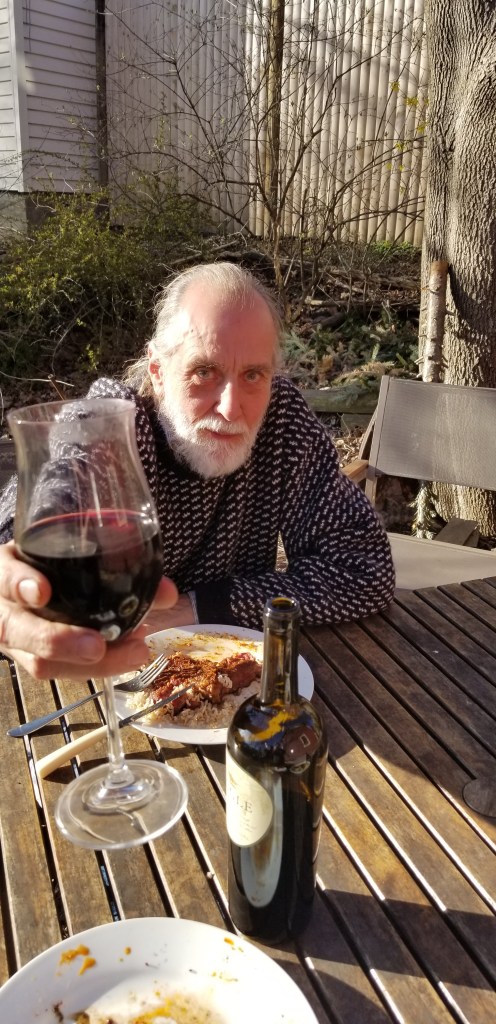
Well, we can’t go out to dine, but we can get an early start on grilling in the Smoking Garden beside the barn. Cheers!

~*~

One canary-in-the-mine-shaft question of mine asks:

How will performing arts organizations survive this shutdown?

For me, they’re essential components to society. The artists have trained all their lives for what are often marginal wages, and the supportive structures are not easily created. Rebuilding audiences will not be easy, especially in the face of damaged incomes in general. Yet they’re crucial to the fabric of civilized community.

Unlike sports, the arts don’t have huge advertising revenues. They reflect a number of similar services that make our communities better places to live, no matter how modest their seeming place in the overall scene. We need to make note of them, too, and redress the suffering.

~*~

Is anyone else watching the impact as Covid-19 spreads from the big cities into the suburbs and rural areas – that is, from urban (which also translates as black and immigrant and blue) into red-district Trump country? The virus is no longer a safe distance from “them,” or what was originally dismissed as a liberal hoax to tarnish their cult leader, and instead clearly appearing as a cruel reality. We’re back to the already fragile state of health care in rural America, for starters.

~*~

The fact is, at the rate Covid-19 cases were initially multiplying, we could have had 40 million infected people by Easter, had we not gone into quarantine. As I almost quipped back then:

How would the nation’s funeral industry cope with an extra 450,000 corpses?

Does Covid-19 spell the death of local newspapers, too?

Jack Shafer of Politico magazine recently aired his argument against including newspapers in stimulus aid for companies hurt by what he calls the coronavirus apocalypse. As his title says, “Don’t waste stimulus money on newspapers. You wouldn’t put a dead man on a ventilator, would you?”

It’s a harsh assessment, coming not from a right-wing fanatic but someone who values the experience of reading the news on paper. He knows all too well the precarious state of the news industry even before the Covid-19 devastation, and I hate to admit I have to agree with him.

If you want to see my take on some of the deep systemic financial problems, just turn to my novel Hometown News, available as an ebook.

For a little perspective, you have to realize you can’t even purchase blank newsprint for the cost of your local paper, and that’s without anything on it or delivery to your doorstep or favorite store or the box on the corner.

Shafer is not talking about the handful of national papers that are thriving, thanks to a surge of online subscribers during the Trump nightmare. He’s talking about the local papers across the country, many of them now owned by hedge funds and similar short-view gaming investors. The kind of enterprise that has gone from family ownership with roots in the community to a global conglomerate that sees money in liquidation, as in who-are-you-all-anyway and why-do-you-matter when it comes to the locals.

Well, with oil companies lining up for relief aid, newspapers definitely should be higher on the list. But I digress.

In some ways, the papers are a canary in the mine shaft, or a dinosaur looking into the eyes of an approaching train, if you care to mix metaphors. Remember what happened to the railroads, after all, when the Interstates were built … with public money. Again, I digress.

The biggest question for me is what happens to local communities if and/or when the local papers expire.

First, of course, is that the public loses an essential watchdog on grassroots level politics. Believe me, local officials act differently when they know they’re under scrutiny. It will cost you dearly when they’re not.

Covering their meetings and the impact takes time, knowledge, ability, and courage. If you’re simply blogging in your spare time, you can be bullied or miss the follow-up phone calls. ‘Nuff said there. We’re facing a threat to ground-level democracy, OK? How many of us can really afford a lawyer?

Second, though, is the loss of local identity. I think most newspapers have fallen down here, failing to raise distinct columnists you just have to read first thing in the morning, but that’s not the only problem. How important is your neighborhood and the general area to you, anyway? Do you even know your neighbors?

A third problem involves the local economy. For one thing, there’s been a huge shift in local retailing, from mom-and-pop stores to the big-box intruders at the mall or Miracle Mile and then online, as in Amazon. The mom-and-pops are the lifeblood of newspaper revenue. Those glossy inserts pay next to diddly. And when’s the last time you saw anything from that monster Amazon or even Craig’s list, which is killing the classifieds?

The obvious shift would be from on-paper publication altogether to online presence only, but no newspapers have figured out how to manage this. It requires subscriber-paid content. Web users are way too used to getting everything for free.

By the way, I hope television and radio are not included in the assistance packages. Yes, they, too, are suffering loss of ad revenue and audience. Rotsaluck. Their news coverage, meanwhile,  often rips off a lot of newspaper stories and then act as if they actually had reporters there. Who will take up the slack? Again, rotsaluck.

Which leads me to one more thought. Sports radio. That once hot-in-the-ratings screaming format that pushed broadcasting from music to talk and then to professional, mostly, athletics – with regional loyalties and identity. What’s happening there, now that nobody’s playing?

Where are you getting your community news?

Religion and the global backlash

Have you ever heard someone blame religion for all the armed conflicts in the world? It’s an easy accusation to make, at least until you look deeper to see the financial, ethnic, even racial motivations underlying the violent and oppressive actions throughout history.

Karl Marx may have called religion the opiate of the people, but he also saw economic inequalities as the real oppressor. Labor inequities were only the tip of that iceberg. For once, you can call me a Marxist, at least on that count.

As a member of a historic Peace Church denomination (a grouping that also includes Mennonites, Brethren, and Amish), I can view the wider Christian stream from a critical perspective that acknowledges the many ways faith communities get co-opted by what is often called the World in earlier pronouncements or Empire in corners of our own – even seduced by the vast range of secular idols. What emerges is corrupted and even false religion, not even of a godly scope.

That perspective can provide for a long examination, one far too broad for a mere blog post.

Nevertheless, in the face of the rising stream of intolerant and often violent social and political backlash across America and Europe, especially, I sense that the anger and hatred are fueled by a post-Christian mindset, one that is ultimately materialistic, divisive, and nihilistic.

In contrast, what I’ve often found in radical faith across traditions is an alternative of hope, humility, justice, and love. Repeatedly, progressive social, political, and economic reformers have had religious roots and support. It’s not an even history, and one that is too often countered by reactionary forces, but I wonder how else the world might turn back the growing darkness without people drawn together in deep spiritual faith and discipline.

The continuing marginalization of religion – especially radical religion, like that I espouse – is one more means of inhibiting any challenge to the few who are reaping the vast benefits of the ongoing social breakdown for their own personal gain.

Where do you find refuge, renewal, and opportunities for social progress?


As the random blahs kick in

So this general shutdown or shelter-in-place or self-isolation, call it want you want, is dragging on and will likely do so. Any novelty’s worn off. I miss my old routine and acquaintances. Can I assume I’m speaking for everyone?

My wife and I are lucky to live in a big enough old house so that we’re not always tripping over each other except in the kitchen. (Not that you care.) We have a big yard, too, which this time of year is beginning to demand gardening attention, getting me outside in the dirt and, well, mud. We also have access to a lovely carriage trail we can follow through a nearby woods to the top of a hill, giving us some decent exercise almost daily.

But I’ve definitely reached the state of blah, even when it’s not one of those dull wet deeply gray days. No, as I draft this, it’s partly sunny outside my window.

So here I am, up in one end of the third-floor attic, while my wife’s “working from home” with an online meeting on the first floor. I hate to walk through that. You know, the little square showing her face in the upper right-hand corner? Anyone else know the feeling? I’d move her to another room, but she’s comfortable in that particular spot. We try to adjust.

I can’t imagine being cooped up in a tiny apartment, much less with kids, though I’m sure that’s the case for many. Even a mobile unit in a trailer park would be way too confining.

What’s shut down goes beyond much of what most of us are seeing. Look, it even includes playgrounds! The one around the corner saved my sanity with the younger one more times than I can count. Let me sympathize with every parent during this duration.

But let’s try to be aware of the wider impact.

Continue reading “As the random blahs kick in”

Now for the real estate hit

A few months back, I was reading an analysis by one business columnist who argued that in the upcoming recession, which at the time looked about a year away, real estate prices would be little impacted.

Hah! Despite his numbers and the curves on his charts, I thought he was badly mistaken. I felt – and still do – that he was leaving an important factor out of his calculations. So much of what I saw in the 1990 real estate collapse was a consequence of households where one of the two working adults had been laid off. With housing prices as high as they were, one income was dedicated solely for the mortgage payment while the other was left to cover the remaining living expenses. Nonexistent savings weren’t going to be part of that calculus.

An old rule-of-thumb was that the purchase price of the home should be no more than 2½ times the annual household income Looking around here, I’ve been puzzled that anyone can afford a home at all, especially considering the declining wages we’ve been seeing across the board or the difficulty of younger workers trying to land full-time jobs with benefits.

Quite simply, we couldn’t afford to buy our own house if we were in the market again. And many of the people we talk to admit the same thing, nodding their heads in sad agreement.

As for single-adult households? The odds are even worse.

Flash to the present, with its record layoffs already. History sometimes does repeat itself.

~*~

In the past week, two stories have pushed the developing Covid-19 situation along these lines.

One noted that real estate transactions have essentially gone dormant. Nobody’s out looking to buy and move up, forget an open house, and sellers are reluctant to have strangers traipsing through their dwelling and touching their stuff. We’re all more or less hunkered down.

And now we’re hearing dire warnings that the mortgage industry is on the verge of collapse or meltdown as homeowners (and presumably many businesses as well) are already falling behind in their payments.

Let’s see how the stock market reacts when it wakes up to these turns.

There’s a lot more to the economy than Wall Street, for sure.

~*~

By the way, the U.S. is now the epicenter of the pandemic, and the numbers are just beginning to soar. Nate Silver, the statistics guru at FiveThirtyEight, reports that the cases and fatalities are rising faster in the Trump-leaning red states than in the blue states, where more of the testing has occurred. Within a month, he says, the per capital rate of new coronavirus cases in Trump country should outstrip those in the rest of the nation.

Let’s see what that does to public discourse and opinion.

About those numbers we’re all watching

Part of the fixation in watching the Covid-19 spread in the U.S. is in the suspense of discovering how accurately the experts’ projections hold up, especially in contrast to the deceptive and wishful thinking emanating from the White House and its cronies.

With the disease now in all 50 states and up more than 600 percent in the last week alone – or from 30 cases at the beginning of the month to 68,440 as of Thursday – the question becomes just how high and how fast those exponential numbers soar. You know, do our social isolation actions tamp down the rise or do continuing exposures fuel more spikes in the spread? To think, at the current rate we would have 2½ million cases in two weeks or 90 million by a month from now. Here in New Hampshire, the eventual infection rate is pegged at 50 percent.

You’re already familiar with the hospital overload potential. With 95,000 intensive care beds in the United States, most of them in regular use for heart attack and accident victims and the like, and a population of 330 million, there’s not a lot of margin to deal with.

For perspective, think what a serious cold does to you. I mean, sometimes it really zaps your thinking. Think of your workplace if even a quarter of your colleagues were out sick. Now extend that to every service you rely on. Uh-huh. Oh, yes, and what about those lingering bugs we seem to get, the ones that never quite go away like forever. By the way, a fever of 103 to 105 degrees is nothing I want to ever endure again. How about you?

And then, if our efforts really do deflate the dreadful scenarios we’re seeing, will a large portion of the public cynically dismiss the warnings as liberal hype? The disregard for the warnings has been disturbing enough, especially the part about infecting others even if you aren’t exhibiting symptoms.

The bigger health matter is not about the number of cases but rather the 20 percent of those that become life-threatening serious. Not just the deaths, either, but the potential for long-term harm. Permanent heart damage, for instance. We’re just now learning.

People under age 65 have been assuming it’s no big deal, but a figure out of France should be a wake-up call. Half of those in intensive care there were recently reported to be under 30. As for here? Welcome back from spring break. One more figure to keep an eye on.

~*~

You know many of the other questions and uncertain answers we’re following as we watch the numbers.

  • Will the number of cases actually fall off in warmer weather?
  • Will the coronavirus mutate and come back hard in autumn?
  • Will it become like the common cold, something that returns year after year?
  • How much immunity will we have?
  • How soon will a vaccine be available and what will the side-effects be? Will the anti-vaccers refuse it or welcome it?
  • And then there are all the stories coming out of the “shelter-in-place” experience.

~*~

In my circle, we’re still sputtering over the audacity of some of those who claim to be “pro-life” but now claim that the deaths of up to two million presumably older Americans is a small price to pay to “save” the economy. Remember, theirs is already a pro-military (not exactly a “pro-life” mission) camp that was all-too-ready to spout misleading anti-Obama advertising warning that “death squads” would rule important health-care decisions (totally ignoring the reality that insurance companies were already doing that) when it came to medical coverage. Now we see the true colors of these callous offiials. It’s been all about profits, not people, all along. Babies didn’t cost them anything. Honestly, they should be tagged anti-abortion. Pro-life is far more inclusive, embracing health care, housing, and education support.

~*~

What’s surprising you the most in the Covid-19 developments? For that matter, what worries you the most?

Is this it?

The Covid-19 devastation, already spread around the globe, is poised to inflict even greater damage when it ravages Third World countries, or so we’re reading. The impact is much more than grim death tolls. We’re hearing predictions of the greatest economic depression in a century.

In the United States, the virus is what finally exposed Donald Trump’s house of cards to full view. Not just his own illusions but his party’s, too. You know, the failure to plan. Failure to take responsibility. Endless stream of lies and fabrications. His scorn for fact, truth, scientific reality. Ridiculing and blaming others. Inability to steer a course. And so on. Feel free to add to the list.

For the past three years, I’ve restrained from commenting much on the outrage after outrage being inflicted on our democratic society. With his hooligans and their fellow cultists being so impervious to facts, I sensed anything that might break through their shells had to come from the right. The polarization of the country predates Trump, anyhoo, just look at the Congress dead set on obstructing President Obama from doing the will of the people, regardless of the ultimate impact.

From my viewpoint, what’s seemed obvious is that only something catastrophic might break through their state of denial and bombast. I kept wondering what that would be. What would it take to allow civil conversation again, one based on fact and not bullying and bombast?

In my years in the news business, I saw how difficult predicting public reaction could be. Big issues are commonly greeted with a yawn, while some seemingly trivial account unexpectedly gets everyone stirred up.

So here we are, with a medical crisis Trump arrogantly derided as a “hoax” and then claimed to have “under control” now exploding exponentially before our eyes. As it begins to hit closer to home, even his supporters can no longer poobah the epidemic as “liberal hype” to “discredit” their fuhrer. Not unless they can explain Italy and Spain’s suffering as part of a conspiracy.

Not unless they can explain why GOP senators were informing their super-rich backers of intelligence findings about the brewing virus storm and quickly selling off millions in stock while telling their voter constituents to stay calm. (Isn’t that insider-trading?)

Not unless they can explain why the markets and employers and local and state officials of both parties have independently taken the drastic actions they have, contrary to White House proclamations.

He still doesn’t have a clue, does he? This is the man who offers big aid to China after turning down any help for the most seriously impacted states in America. (Sorry, you’re on your own, guys.) What!

One of the reasons he’s clueless is that none of his incoming staffers who attended a big meeting with outgoing Obama officials eight days before the inauguration took the ebola lessons seriously. At least one future cabinet secretary dozed off during the briefings and their worst-case scenarios. Another reason is that Trump promptly eliminated the emergency preparedness coordinating office Obama had created for cases like this. What Trump touted as streamlining proves to be reckless disregard for reality and an exercise of personal spite. There was no planning, period.

Fellow Republican Susan Collins, a senator from Maine, even prevented epidemic response planning from being budgeted back in 2008. There’s a pattern.

Here we are, after being stuck with Trump’s obsession to spend billions building a useless border wall but do nothing on pandemic prep. Like that wall will stop anything.

I long ago saw that incompetent managers and executives feel threatened by competent people working below them – the very ones who could make their bosses look effective, if given the chance. Do I need to say more?

Smart management is taught to be proactive, not reactive, but that’s not what we’re seeing here.

The illness itself is only the face of the storm as we get glimpses of even bigger economic, political, and social ills that have been long festering.

Oh, yes, high turnover is another sign of mismanagement. Two-thirds of Trump’s team at that epidemic meeting three years ago are no longer part of the administration. Who’s in charge, paying attention to details?

Wall Street may have been soaring, and a “correction” had been long anticipated though not expected to kick in till after the November election, but for many of the country’s working class, full-time jobs – especially those with benefits – have been scarce. Minimum wage rarely covers basic living costs, and health insurance premiums often eat up a third of that income while imposing high deductibles few would ever be able to pay without going homeless or, if hospitalized long, losing their jobs. Many of those minimum wage jobs, by the way, require “reliable transportation” from employees, as if the pay actually covers as much as a clunker to get to worksites far from public transportation. Steps to improve their situation has not been presented from the current administration, even while cutting taxes for the rich and corporations continues.

Well, some of that finally has been acknowledged in the proposed coronavirus aid package, at least for this specific illness. Maybe it’s a start. Those low-pay, part-time jobs are a huge part of the workforce, and if they break down, even for two weeks, watch out.

That’s the real economy.

I could say more, much more, but let’s leave it at that for now. From all indications, this drama’s just starting.

There’s no disputing that bodies are piling up, even in the USA.