Farewell, Dover … in a way

It’s not like I won’t be back. My next book is a unique history of the town’s Quakers, for one thing, and I’ll be promoting it. And I’ll still be connecting with Dover Friends, especially through New England Yearly Meeting. Yes, Downeast Maine is still part of New England, thank God.

Will I miss people? Definitely. Some great neighbors, the Greek Orthodox circle, the lifeguards and fellow swimmers at the city’s indoor pool would be high on that list. My fellow musicians, on the other hand, were down in Boston, and I haven’t seen them since before Covid. Our beloved conductor even stepped down in the face of its digital demands. The local writing circle, meanwhile, adds some valued faces to the list, though I can’t say we were close or even much on the same page. But that’s where I did learn about Smashwords, where all my novels quickly appeared.

Which brings up another point. This new move would be much harder if we were leaving extended family behind or, more crucially, that rare friend who connects intimately on a range of shared interests – those things that fit one’s life mission or identity. For me, that would be a nexus of Quaker spirituality, off-beat literature, classical music, natural wonder and wilderness, back-to-the-earth awareness, even folk dancing. Things like gardening and foody smarts would be more on my wife’s side of the equation.

What, you think there are tons of people who match my varied interests? Surely, you jest.

Death has already taken a toll there, as has spiraling illness, their moving away to a distance, or even insurmountable conflict. But in my new setting, I am meeting some fascinating eccentrics. More later, I’m sure.

I do wish we had more words to describe friendships, though I’m afraid any subtlety would quickly be eroded. The fact is there are few of those soul-mate connections, especially among males of our civilized species. Women seem to be naturally inclined toward that one-special-friend connection, the kind of person you have to phone (or text) every day. Or every-other hour. Not so guys, to our own detriment. Mea culpa.

Let’s also note that Covid precautions have also already detached us. We’re rarely in physical contact, no matter how much Zoom and other platforms allow me to catch up with buddies even when I’m way up Downeast Maine. And, from everything I’m seeing, that’s likely to continue into the foreseeable future.

~*~

My wife and I have both been surprised how quickly I’ve switched into my new center. Once my workstation and files were set up in our new address, that’s where my heart was. Dover is undergoing what I expect to be an amazing rebirth, but I won’t be part of it, and I’m aware of that.

Quite simply, it’s become a great place for me to visit, but no longer home. All of my goods have ether been moved to the new address or are in the storage unit we’ve rented.

In other words, the dream has stepped on.

~*~

As I look back on my years in Dover, I realize I see I hadn’t spent as much time in neighboring Portsmouth as I’d expected or at the University of New Hampshire just a town away. Even once I’d retired from the newsroom, I was largely hunkered down in writing, revising, and publishing. So much for the writer’s life!

I can say I feel comfortable in leaving Friends Meeting in good hands and wish the best for the new owners of our old house, barn, and precious gardens.

I can say Dover’s been the best years of my life. So far. You will be seeing more from that through the coming year, here at the barn.

What would you miss most if you uprooted?
 

Letting go and moving on

It’s official. We’re selling our home of the past 21 years, including the red barn and my asparagus and fern beds.

It all happened much faster than I had anticipated. In truth, I didn’t expect our dream of relocating to a remote fishing village at the other end of Maine to go into action for another two years. Even when we made our pitch for the house we landed, I didn’t allow myself to get my hopes up – they’d been dashed too many times the previous time we were looking before we anchored in Dover.

But here we are, with any luck beating the crowd on that rising housing market. The trend of moving out from the big-city suburbs into smaller, more viable, pedestrian-friendly towns hasn’t yet reached fever levels in Sunrise County. It is, after all, an eight-hour drive from Boston.

And no, I’m not changing the name of this blog – the barn will live on in my memory and as a metaphor. Guess we’ll just have to get a garden shed, paint it red, and call it our new barn.

~*~

Still, the uprooting and transplanting have stirred up a lot within me.

I’m recalling one neighbor’s comment back in Manchester. “I don’t think anybody can afford to live in New Hampshire for under,” and he named a figure that would have gone up a lot under the inflation in the years since. At the time, I looked at him and replied, “But I do.”

He was shocked and maybe a tad embarrassed.

I still don’t know how most people are affording the prices of homes in much of New England or other hot spots, but they’re also being pressed by outrageous rental costs.

~*~

Reflecting on previous moves, I admit most of them were daring leaps to new jobs and dots on the map where I knew no one. This doesn’t feel so draconian. I’ve visited, after all, and have acquaintances, mostly through Quaker circles.

So now I flip between memories of places I was fond of and of others, well, there were some mean towns and economic struggles. Satellite photos reveal that a handful of the units I occupied have been demolished in the intervening years. Let’s just say that luxury rentals were beyond my means, but a few others had their funky charms or at least memories.

The Dover property was only the second I’d owned. The other was a marvelous 1920s bungalow in a Rust Belt town. (See my novel Hometown News for that one.) When that house was emptied, I sat down and wept in the aftermath of a divorce and the confusing developments with my fiancée.

This time, I’ve found myself anxious to move on. Both of us are finally admitting the shortfalls of our home of the past two decades – not just the short treads on the staircase but also the arrangement of the rooms and the fact it just wasn’t designed for our needs. We adapted to the space, and now that there were just two of us, the faults became inescapable.

On top of that, I keep seeing more repairs that are needed – some of them big ones the second time around. I’ve run out of energy. The responsibility – and expense – are simply too much.

But I’m also remembering guests who’ve stayed with us as well as our dinners and parties, not that we ever had as many as we would have liked.

~*~

One thing I have to acknowledge is the emotional weight of things I feel a responsibility for maintaining. As I shed more of them, I’m feel freer and more capable of opening to new experiences. The flip side is the question of just how much and what I might need to sustain that.

So here we go.

Yes, the balconies

The old Foster’s Daily Democrat newspaper plant had been added to willy-nilly over the years, and there was no way of hiding that in the building’s transformation to multi-use tenancy. As we’ve seen in previous posts, much of its rear side facing Henry Law Park was essentially a windowless concrete block wall. Not anymore. The corner apartments were quickly rented.

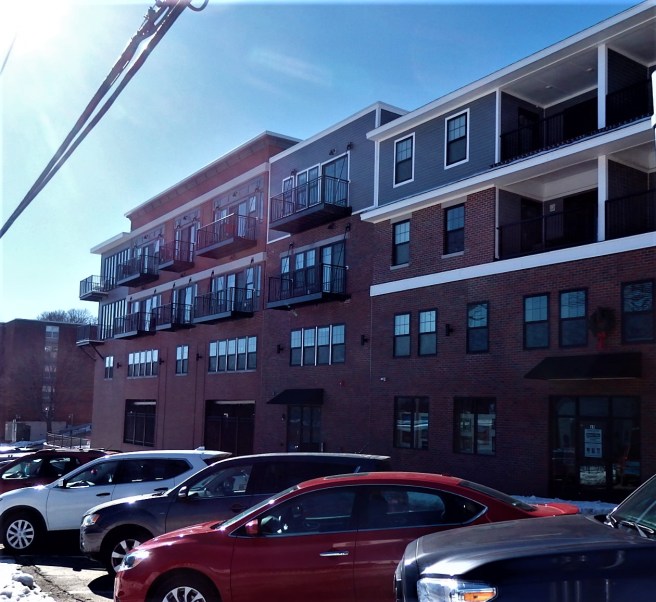
I particularly like the use of balconies that overlook a state-of-the-art playground and a green park along a bend of the Cocheco River where tall ships once turned around. In contrast, the recessed balconies ofter privacy while overlooking an outdoor amphitheater where summer concerts are held and the entrance to the children’s museum.
As I was saying about the corner apartments? How about their commanding balconies?
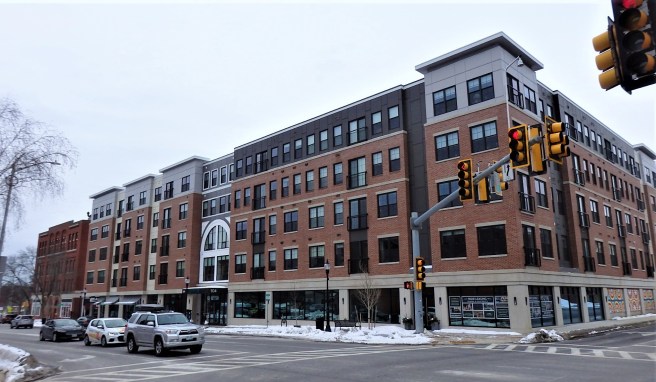
The redesign sought to maintain downtown Dover’s historic brick storefront appearance – narrow buildings with upstairs housing set side by side.


Like it’s been there all along


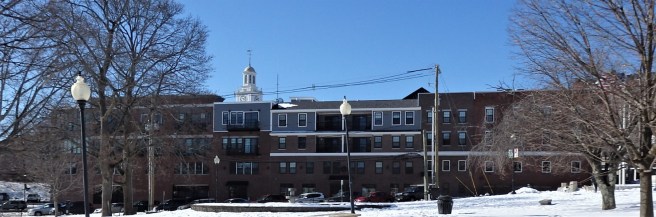
Despite its full-block size, the new Orpheum multi-use development in downtown Dover plays off the dimensions of the old Masonic building, far left. The redesign sought to maintain downtown Dover’s historic brick storefront appearance – narrow buildings with upstairs housing set side by side.
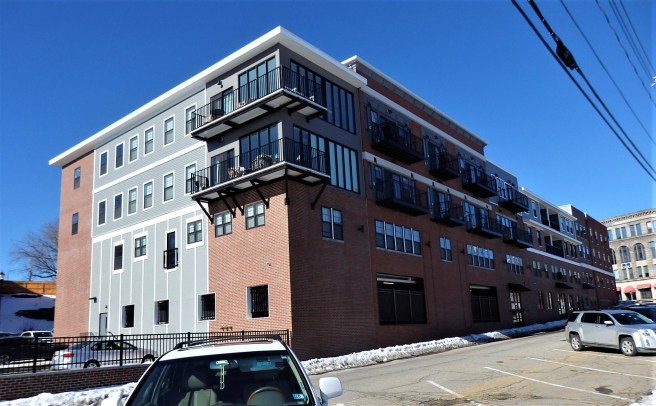
How about a brief taste of a big-city side street?
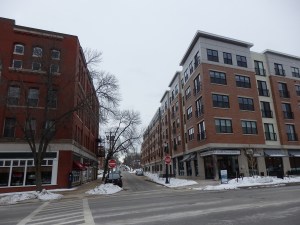
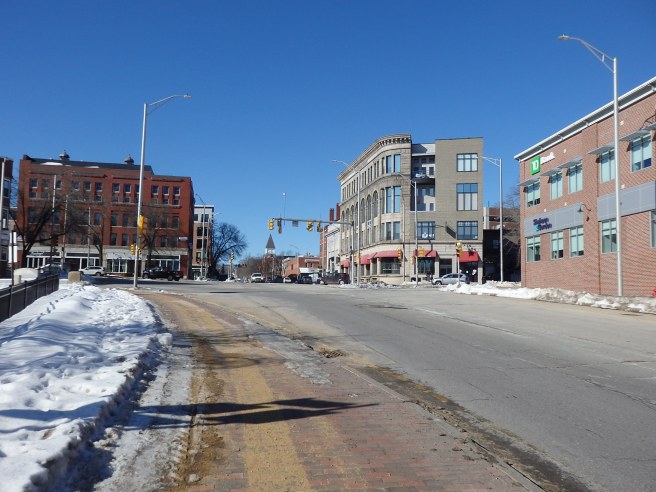
While adding population density to downtown Dover, the Orpheum remains tucked in when viewed from Washington Street just below Lower Square. The small-town landmarks remain the old Masonic building, left, and former Strafford Bank, right, in their interplay of brick and stone.


Cocheco or Cochecho?

That is, one h or two? Even before we get to COCHECAW / COCHECOW amid a host of other Colonial spellings.

A 1771 map of New England has no Dover (settled in 1623) but Rochester and Durham, later offshoots, as well as the KOCHECKA RIVER.

Also, that map shows Cape Neddick, Maine, as Bald Point, and Winnipesauke Lake, the the north, as Winipissionket Pond.

There’s so much to untangle in such evidence.

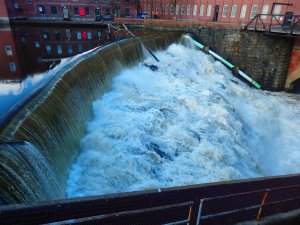
The widely used one-h spelling, by the way, is traced to a clerk’s error in 1827 in the founding of the Cocheco Manufacturing Company, building on the cotton mills started in 1812 at the waterfalls downtown.


It’s surprising to see how much early morning commuter traffic there is here

As a line in one of my poems goes, New Hampshire is for the most part a daytime state. The thought arose in downtown Portsmouth around six o’clock on a Tuesday or Wednesday evening around  this time of the year nearly three decades ago, and it still holds.

For added perspective, let me add that Portsmouth was – and until Covid – continued to be the place with the most nightlife in the Granite State, yet the center felt deserted that evening, save for a few furtive figures dashing from doorways and down the sidewalks.

Well, tourist season had long passed and the weather was definitely frigid. I imagined that everybody was already huddled inside somewhere.

Lately, I’ve been thinking there’s a good reason for that daytime state observation. The bulk of the populace in the state has a long daily commute to and from the workplace.

~*~

When I lived in Manchester, my apartment was only a few miles from the office. I had backways to zip from home to work and back.

In moving to Dover, things changed. My hour-long daily commute over Manchester involved part of the afternoon rush hour, which blessedly was headed mostly in the opposite direction. For the late-night return, the roads were nearly empty.

Working the vampire shift or weekends definitely gives you a different view of a certain subculture of society. You can shop or run other errands when so many others are locked away on their jobs.

One thing I learned to avoid in my free time was trying to head south, meaning toward Boston, any earlier than 9 a.m., when the bottleneck at the Great Bay bridge would finally clear out. (After years of construction, that problem’s finally been alleviated. Hooray!)

Other than that, I haven’t thought much about rush hours, but recently, given repeated opportunities to dash across the state in the morning on behalf of my elder daughter’s business, I’ve been retracing my former daily commute plus a little more, just at a much different hour.

Hoping to avoid the morning rush hour, I’ve set forth as early as 5:30 but been surprised by the amount of traffic already on the road, significantly more than I’ve been seeing at 8 or 9 in the evening. By 6:30 a.m., the headlights streaming out of seemingly rural locales (what we call towns or others might consider townships) is quite steady – in one direction. Many of them, I’m guessing, are headed toward jobs in Massachusetts, ones that might start at 8 or 9.

As I ponder the flow, I’m wondering how much heavier it was before Covid and all of the work-at-home shift that’s followed. Did the drivers I’m seeing previously have to leave that much earlier to accommodate the heavier traffic volume?

Still, if you’re among those who have to rise at 4 or 5 to commute four to six hours a day, that leaves little time for evening activities. It strikes me as a high price to pay, but then so is the cost of housing in the Bay State, where most of the good-paying jobs are.